# Perplexity AI Raises $1B for Answer Engine Expansion: What It Means for Global Content Creators
**Published:** 2026-04-06 | **Reading time:** 7 min
## Introduction
Creators are no longer limited by language. Today’s topic, Perplexity AI Raises $1B for Answer Engine Expansion, shows how AI is helping people localize content faster, reach more viewers, and build a stronger global presence without rebuilding their entire production workflow.
## Why It Matters
This is not just a feature update. It matters because creators, educators, and businesses all want the same thing: more reach with less friction. When AI can help turn one video into many language versions, the value of each piece of content grows.
## Key Benefits
### 1. Global audience expansion
You can make the same idea accessible to more people around the world.
### 2. Faster production
AI reduces the time and cost of preparing multilingual versions.
### 3. Better content reuse
Strong videos and explainers can now live longer and travel farther.
## Real-World Use Cases
– YouTube creators localizing evergreen videos
– educators dubbing tutorials for new markets
– SaaS founders expanding product explainers internationally
– marketers adapting campaigns across regions
## How to Use It Well
The best results come when creators combine AI tools with a clear workflow:
1. write a strong script
2. record or generate the base video
3. dub or localize into target languages
4. review the output for tone and accuracy
5. publish and measure audience response
## Final Take
Perplexity AI Raises $1B for Answer Engine Expansion is a practical reminder that AI is becoming a creator tool, not just a headline. The people who use it well will be able to scale faster and speak to more of the world.
—
*Want more creator-focused AI guides? Subscribe for weekly practical tutorials and updates.*
This section was refreshed on 2026-08-19 to reflect current risk, business impact, and operational guidance. Organizations should treat this topic as part of a recurring governance cycle: inventory the affected systems, validate ownership, measure exposure, and document the control evidence that proves the issue is managed.
For business leaders, the practical priority is not only understanding the technology but also knowing which teams own remediation, how progress is reported, and what customer, compliance, or availability risks remain if action is delayed.
Current Research Signals
Recent external coverage shows continued market attention around this topic:
It matters because AI adoption, cloud dependency, and changing security expectations have made this area a board-level operational issue rather than a purely technical detail.
What should businesses check first?
Start by identifying the affected systems, owners, business processes, access paths, and monitoring gaps. Then prioritize fixes by exposure and operational impact.
How often should this be reviewed?
Review the controls at least quarterly, and immediately after major vendor updates, incidents, architecture changes, or regulatory requirements.
What is the biggest mistake teams make?
The biggest mistake is treating the topic as a one-time configuration project instead of an ongoing governance, testing, and measurement process.
What is the practical next step?
Create a short action plan with owners, deadlines, evidence requirements, and a review cadence. Track progress until the risk is reduced or accepted.
This section was refreshed on 2026-09-02 to reflect current risk, business impact, and operational guidance. Organizations should treat this topic as part of a recurring governance cycle: inventory the affected systems, validate ownership, measure exposure, and document the control evidence that proves the issue is managed.
For business leaders, the practical priority is not only understanding the technology but also knowing which teams own remediation, how progress is reported, and what customer, compliance, or availability risks remain if action is delayed.
Current Research Signals
Recent external coverage shows continued market attention around this topic:
This section was refreshed on 2026-09-09 to reflect current risk, business impact, and operational guidance. Organizations should treat this topic as part of a recurring governance cycle: inventory the affected systems, validate ownership, measure exposure, and document the control evidence that proves the issue is managed.
For business leaders, the practical priority is not only understanding the technology but also knowing which teams own remediation, how progress is reported, and what customer, compliance, or availability risks remain if action is delayed.
Current Research Signals
Recent external coverage shows continued market attention around this topic:
This section was refreshed on 2026-09-16 to reflect current risk, business impact, and operational guidance. Organizations should treat this topic as part of a recurring governance cycle: inventory the affected systems, validate ownership, measure exposure, and document the control evidence that proves the issue is managed.
For business leaders, the practical priority is not only understanding the technology but also knowing which teams own remediation, how progress is reported, and what customer, compliance, or availability risks remain if action is delayed.
Current Research Signals
Recent external coverage shows continued market attention around this topic:
The old claim that DeepSeek V4 would run on Huawei chips mixed a model release with a hardware deployment prediction. Those are no longer the same question. DeepSeek’s official API documentation now lists DeepSeek V4 model names, so the model family itself is not merely a rumor. However, that API listing does not identify the processors behind the hosted service. The current official materials reviewed for this update do not establish a general, production-ready DeepSeek V4 deployment on Huawei Ascend hardware.
The useful conclusion is narrower: DeepSeek V4 is available through DeepSeek’s service, Huawei has an Ascend software stack for model inference, and earlier DeepSeek releases have documented Ascend paths. None of that automatically proves that a particular V4 checkpoint, precision, server configuration, or workload works on a particular Huawei system. This guide explains what is verified, what remains unverified, and how to test a deployment claim without filling gaps with guesses.
Verified precedent: DeepSeek’s official DeepSeek V3 repository says the BF16 version of V3 was adapted to Huawei Ascend NPUs through MindIE.
Not established by those facts: they do not prove that every DeepSeek V4 variant or weight package can be deployed on every Ascend product, nor do they prove production performance, training support, capacity, cost, or availability.
That distinction matters because “runs on Huawei chips” sounds binary while deployment is a chain of dependencies. A model may load but fail on a required operator. It may return a valid answer but miss latency targets. A hosted endpoint may use undisclosed infrastructure. A vendor demonstration may use code or weights that customers cannot obtain. Treat compatibility as a testable statement with a defined scope, not as a slogan.
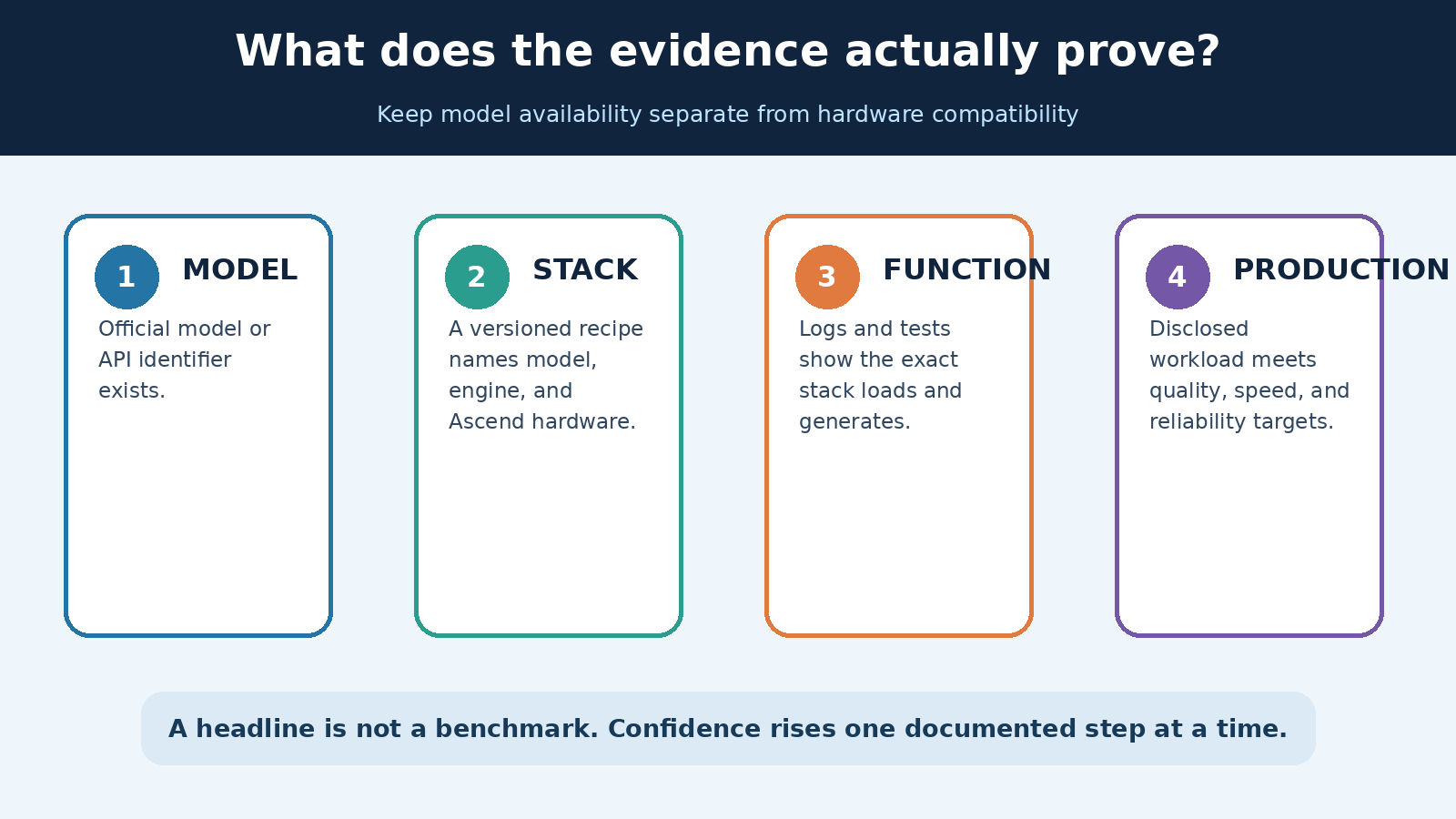
Compatibility confidence rises from model availability to a versioned stack, functional evidence, and production evidence.
Start with the exact DeepSeek model you can identify
A model name in an API request is not necessarily a downloadable checkpoint name. An API alias can be updated behind the same identifier, while a local deployment needs an exact artifact, architecture, tokenizer, configuration, license, and revision. Record whether the claim concerns DeepSeek’s hosted API, open weights, a partner distribution, or an internal build. If the claimant cannot say which one, there is not yet enough information to reproduce the result.
For the hosted service, the DeepSeek API page is the primary reference. It verifies which public service identifiers DeepSeek accepts and provides request examples. It does not reveal the service’s accelerator vendor. An API response can confirm that an endpoint works, but it cannot prove the endpoint ran on Ascend. Hardware attribution requires a separate statement or evidence from the operator of that infrastructure.
For open releases, use the model owner’s repository and model card. The official DeepSeek V3 repository is a useful example because it describes architecture, weights, precision options, and supported inference routes. It explicitly mentions MindIE adaptation for V3 in BF16. That is meaningful evidence for V3, but it should not be silently carried forward to V4. Changes in attention, routing, quantization, kernels, or serving behavior can turn a working V3 path into an incomplete V4 path.
DeepSeek’s official V3.2 experimental repository illustrates another reason to check the exact release. Its documentation distinguishes model architecture, inference code, and accelerator-specific containers. A nearby version can have different implementation requirements. Compatibility belongs to a versioned combination, not to the brand name alone.
What the Huawei software layer actually proves
Huawei’s Ascend platform is more than a chip. CANN supplies the heterogeneous computing software foundation, while MindIE focuses on model inference and serving. A deployment also depends on firmware, drivers, operating system support, framework integration, collective communication, kernels, memory management, and service configuration. The presence of MindIE support is a necessary signal for some deployment paths, but a product page alone is not a compatibility certificate for an unnamed V4 build.
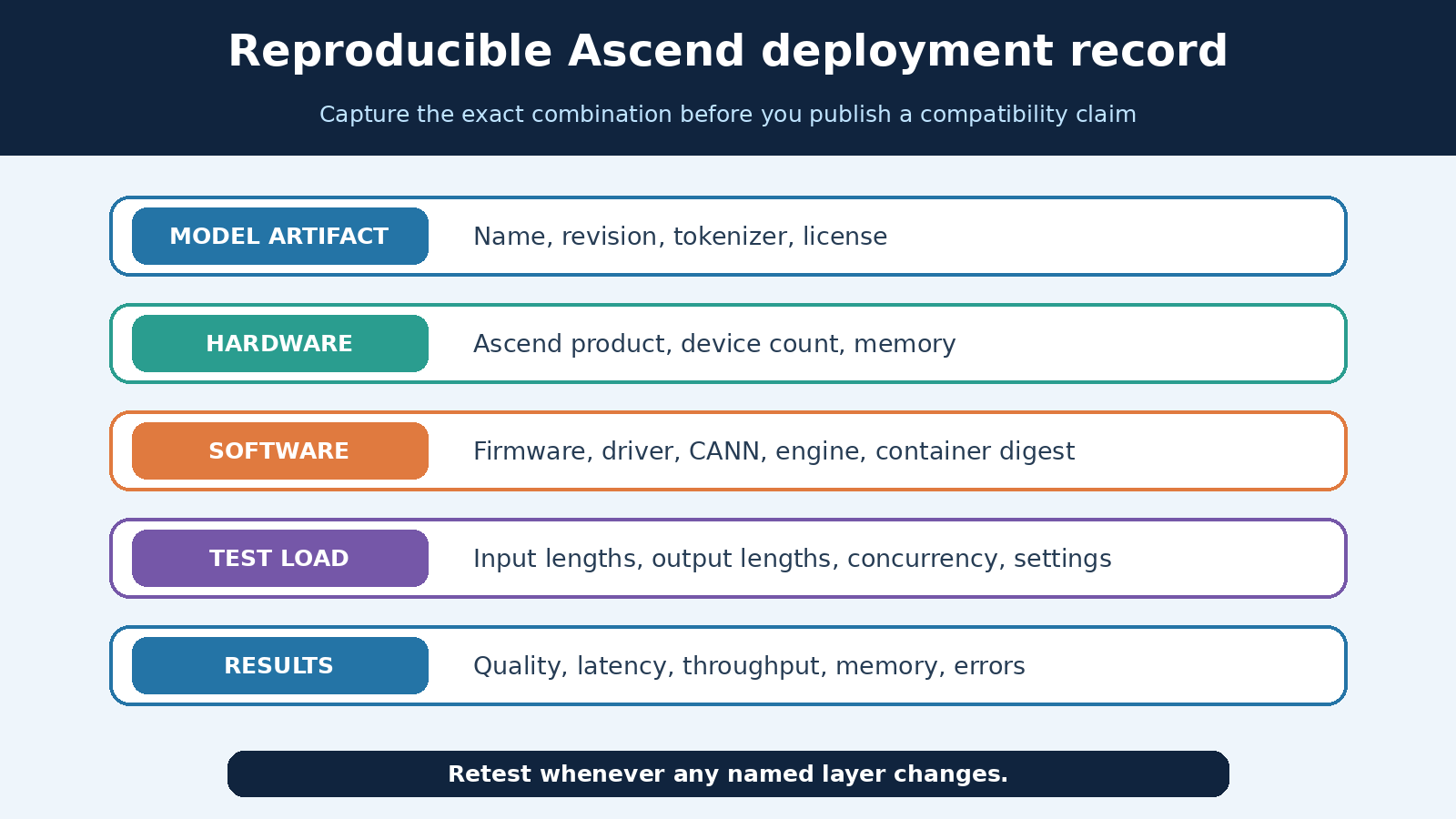
Ask for the complete environment matrix: Ascend product, number of devices, memory per device, firmware, driver, CANN version, MindIE or another engine version, container digest, model artifact revision, precision, quantization method, parallelism settings, and maximum tested sequence length. These are not decorative details. They define what “works” means and allow another team to recreate the setup.
Also separate inference from training. The fact that a model can generate tokens on an NPU says nothing by itself about pretraining or fine-tuning support. Training introduces optimizer state, gradient communication, checkpointing, numerical stability, and a very different memory profile. If the evidence shows inference, describe it as inference. If it shows a limited fine-tuning method, do not upgrade that into a claim about full training.
Four levels of evidence for a compatibility claim
A practical review gets easier when evidence is sorted by strength.
Availability evidence: a model owner lists an API model, publishes weights, or identifies a release. This proves that the named model exists in that channel.
Compatibility evidence: a versioned support matrix, official deployment recipe, or maintained implementation names the model artifact and hardware. This supports a specific path, not every path.
Functional evidence: logs, health checks, deterministic prompts, and output validation show that the exact stack loads and serves correctly.
Production evidence: a disclosed benchmark and operational trial show useful throughput, latency, reliability, and output quality under a representative workload.
A press headline usually provides only the first level, sometimes less. A deployment decision needs all four. The honest answer can therefore be “the model is verified, the platform exists, but this exact pairing still needs a reproducible recipe and workload test.” That answer is more useful than either dismissing the possibility or declaring victory early.
How to validate DeepSeek V4 on an Ascend system
Begin with a written claim. For example: “This exact model artifact can serve text generation on this Ascend cluster, using this software image and precision, at this sequence length.” Add measurable acceptance criteria. Without that sentence, teams can run different tests and still believe they evaluated the same thing.
Next, collect the primary documentation. Check DeepSeek for the model or API identifier and any downloadable artifact. Check Huawei’s compatibility information, release notes, and deployment documentation for the exact engine version. If an integration partner supplies the recipe, record that it is partner evidence rather than a statement from DeepSeek or Huawei. Save page dates, version numbers, image digests, and repository commits because rolling documentation can change.
Then conduct a minimal load test in an isolated environment. Confirm that model files are intact, the tokenizer matches, all devices are visible, the engine recognizes the architecture, and startup completes without silently falling back to another backend. Capture configuration and logs. A single attractive response is weak evidence because many serving layers can route requests elsewhere. Network isolation or endpoint tracing can help establish where inference occurred.
After the model loads, test correctness before speed. Use a fixed prompt suite that covers short and long inputs, structured output, multilingual text if relevant, tool-call formatting if supported, refusal behavior, and edge cases important to the application. Compare outputs or task scores with a trusted reference under settings that are as similar as possible. Precision changes and custom kernels can affect quality even when generation appears normal.
Only then measure performance. Report time to first token, inter-token latency, end-to-end latency, throughput, concurrency, peak device memory, host memory, error rate, and restart behavior. State prompt length, generated length, batch policy, warmup, sampling settings, request distribution, and measurement window. An isolated short-prompt result should not be presented as a production capacity forecast.
Record every layer of the deployment and retest when any named layer changes.
Design a benchmark that answers your real question
Suppose you ask whether an Ascend deployment is “fast enough.” That question has no answer until fast enough is connected to a service. An interactive assistant may prioritize first-token latency. A document pipeline may prioritize tokens per hour. A coding service may need long context and stable structured output. An internal batch job may tolerate latency but require predictable completion and low failure rates.
Use production-shaped input distributions instead of one convenient sequence length. Include concurrency ramps, cold starts, long-running requests, cancellation, overload, and recovery after a worker or network fault. Keep the prompt set and scoring method fixed when comparing hardware or software versions. Publish unsuccessful runs as well as successful ones, because operator failures and memory limits define the usable envelope.
Do not invent a price comparison from hardware labels. A defensible cost model needs quoted acquisition or service terms, utilization, power, cooling, networking, support, staffing, spare capacity, and the measured throughput of the tested configuration. If those inputs are unavailable, report technical measurements and leave the cost conclusion open. Readers interested in the broader local deployment tradeoffs can also use this guide to local LLM tools and models.
Red flags in DeepSeek hardware reports
The report says “DeepSeek V4” but gives no API alias, checkpoint, revision, or artifact source.
“Huawei chips” is used without an Ascend product, device count, memory, or software versions.
A V3 or distilled-model deployment is offered as proof for V4.
A hosted API call is treated as proof of the server’s hardware.
A successful startup is treated as proof of output quality and sustained performance.
Peak tokens per second appears without prompt lengths, concurrency, warmup, precision, or error rate.
Inference support is described as training support.
A vendor slide is cited while the deployment recipe, logs, and benchmark method remain unavailable.
None of these red flags proves that a claim is false. They show that the claim is underspecified. Ask for the missing evidence and adjust confidence to match what can be inspected. This approach also works for other forward-looking infrastructure stories, including claims about a new accelerator architecture. For an example of separating a published roadmap from deployment reality, see this guide to NVIDIA’s Rubin architecture and timeline.
A decision record for engineering teams
End the evaluation with a one-page decision record. Name the model artifact, hardware, software image, owner, test date, workload, quality checks, performance results, unresolved risks, and the evidence links. Give the result one of four labels: documented only, loads successfully, validated for the test workload, or approved for production. This prevents a narrow lab success from turning into a company-wide compatibility claim through repetition.
Set a retest trigger for any change to weights, tokenizer, serving engine, CANN, driver, firmware, precision, quantization, parallelism, or hardware. Model and accelerator stacks move quickly, and an old result can become misleading even when every sentence was accurate on the day it was written. Versioned evidence is the cure.
FAQ
Is DeepSeek V4 officially available?
Yes, DeepSeek’s official API documentation currently lists V4 service model identifiers. That verifies availability through the documented DeepSeek API channel. It does not, by itself, identify downloadable weights or the hardware used to operate the hosted service.
Does DeepSeek officially confirm that V4 runs on Huawei Ascend?
The official sources reviewed for this update do not provide enough information to make a general claim that DeepSeek V4 runs in production on Huawei Ascend. DeepSeek does document a MindIE path for the BF16 version of V3, which is evidence for that specific earlier model and configuration, not automatic proof for V4.
What would prove a DeepSeek V4 Ascend deployment?
A strong proof package would identify the exact model artifact, Ascend hardware, firmware, driver, CANN and serving-engine versions, precision, configuration, and container digest. It would include startup and device logs, functional tests, quality checks, and a reproducible benchmark under a disclosed workload. Production approval also requires reliability and operational testing.
Can V3 compatibility be used to predict V4 compatibility?
It is useful precedent, but not proof. A later model may change operators, attention behavior, routing, memory needs, precision support, or serving code. V3 compatibility makes a V4 port plausible, yet the exact V4 release still needs a versioned implementation and direct validation.
Bottom line
DeepSeek V4’s API availability is verifiable. Huawei’s Ascend inference software is verifiable. DeepSeek V3’s documented MindIE adaptation is verifiable. A broad statement that DeepSeek V4 runs on Huawei chips is not established merely by combining those facts. Keep the model claim and hardware claim separate, define the exact stack, and move from documentation to functional, quality, performance, and operational evidence. That is how a promising compatibility story becomes an engineering result you can trust.
Claims that Claude can hack autonomously deserve careful attention, but the headline alone tells you almost nothing about the actual risk. A model that solves a puzzle in a controlled cyber range is not automatically capable of compromising a defended organization. A coding assistant that finds a suspicious function is not the same as an agent that chooses a target, obtains access, persists, and achieves an objective without help. The useful question is not simply whether Claude can hack. It is what a specific model did, inside which boundary, with which tools, permissions, safeguards, human decisions, and evidence.
This guide explains how to interpret evidence about Claude autonomous hacking and AI security threats without turning the discussion into an intrusion manual. It focuses on evaluation, authorization, defensive use, and controls. Model behavior, product safeguards, and policy can change, so check current Anthropic documentation rather than carrying an old result forward as if it described every Claude model or deployment.
What autonomous hacking actually means
Autonomy is not a switch. At one end, a person asks a model to explain code and manually decides what to do. A tool enabled assistant can inspect an approved repository, run an authorized scanner, and summarize results. A more capable agent can choose among tools, adapt its plan after errors, and continue across many steps. Even then, the operator may still select the target, prepare credentials, approve commands, provide hints, reset the environment, or decide when success has occurred.
Those distinctions matter because each adds human contribution. When a report uses the word autonomous, look for a plain account of the initial prompt, available tools, network access, time budget, retry policy, human interventions, stop conditions, and success test. Also ask whether the environment contained intentionally vulnerable systems, weak defenses, synthetic data, or services already known to the evaluator. A strong result can still be important, but its meaning must stay attached to its test conditions.
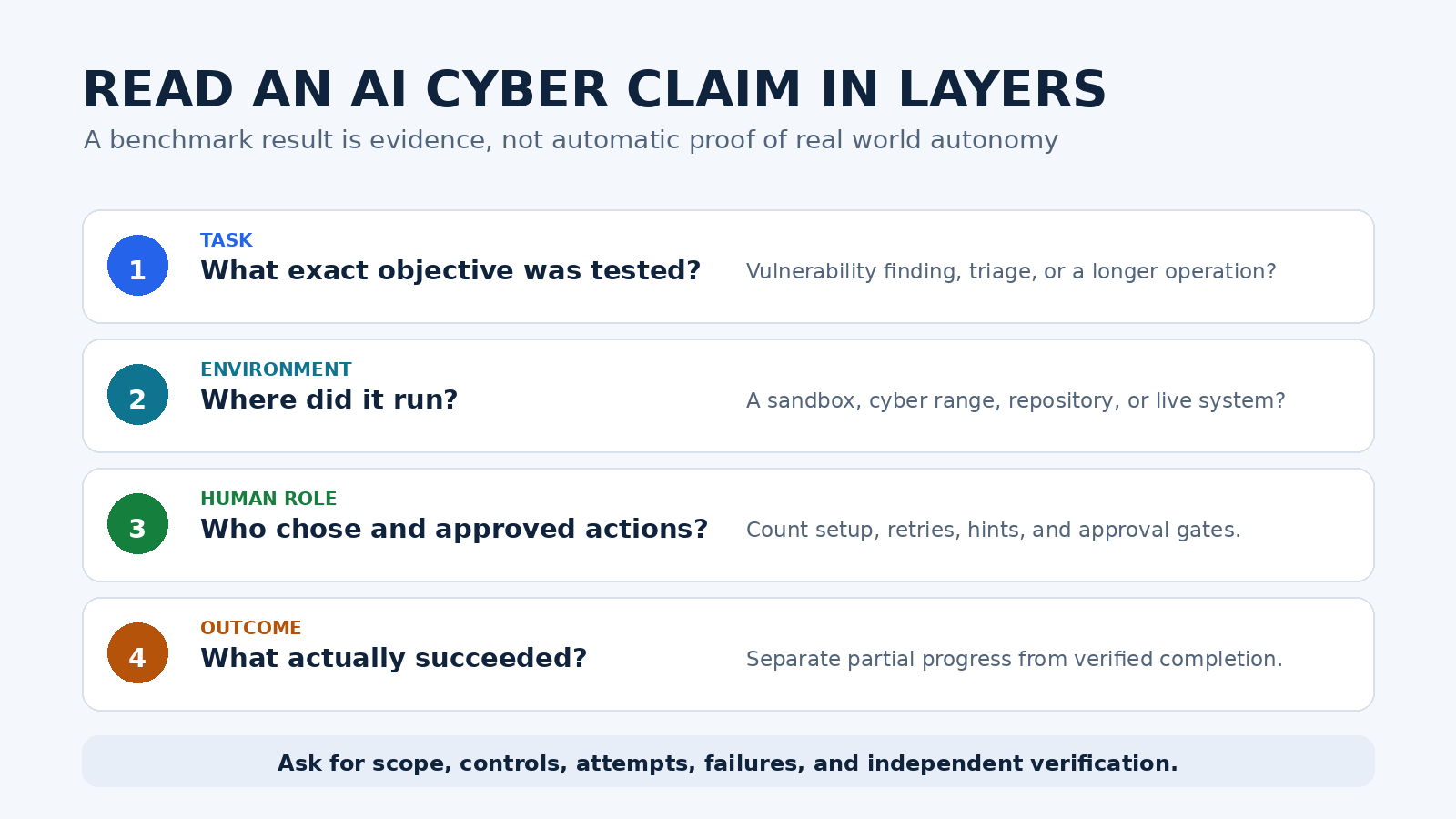
Separate the task, environment, human contribution, and verified outcome before interpreting an autonomy claim.
Read capability evidence in layers
Start with the exact model and configuration. The Claude name covers different models, access surfaces, system prompts, and tool arrangements. Anthropic’s Transparency Hub points readers to model summaries and system cards, including reported capability and safety evaluations. A result for one model should not be silently applied to another. Nor should a base model evaluation be treated as proof of how a managed product behaves with additional safeguards.
Next, identify the task. Vulnerability discovery, exploit validation, incident triage, log analysis, attack path reasoning, and long running network operations measure different things. A model can be strong at reading source code yet unreliable at operating a computer. It can make progress in a lab but fail under active monitoring, incomplete information, patched software, or changing credentials. Aggregate scores can also hide whether success came from many retries or a small subset of tasks.
Then examine the outcome. Did the evaluator independently verify that the issue existed? Was a claimed success merely model text, or did the environment record the intended state change? Were false positives counted? Did the report publish failures as well as successes? Reproducible evaluation needs machine logs, tool traces, timestamps, environment details, and a scoring rule set before the run. Without those pieces, a vivid transcript may be an illustration rather than strong evidence.
Why stronger cyber capability creates two effects
Cyber capable models can help defenders with repetitive analysis. Under proper authorization, they may organize alerts, explain unfamiliar code, suggest test cases, compare a patch with a vulnerability description, draft remediation notes, or help an analyst search a large body of logs. These uses can shorten the path from a signal to a reviewable hypothesis. They do not remove the need for a qualified person to confirm severity, scope, and remediation.
The same general skills are dual use. Better code reasoning and tool use may lower the effort required to search for weaknesses or coordinate actions. An agent also works at machine speed, can be copied, and can continue while an operator attends to something else. That changes scale even when the model is imperfect. Risk comes from the whole system: model capability combined with tools, credentials, reachable assets, persistence, operator intent, and the quality of monitoring.
This is why Anthropic’s Responsible Scaling Policy overview describes proportional protection, capability assessments, safeguard assessments, deployment controls, monitoring, and red teaming. It is also why readers should distinguish a provider’s frontier risk program from the controls needed in their own environment. A vendor safeguard is one layer. It does not replace asset ownership, access control, logging, incident response, or legal authorization.
The agent changes the threat model
A chat response is advice. An agent with tools can affect state. It may read files, call services, browse pages, execute code, or interact with a desktop. Every added tool expands what a mistake or manipulated instruction can reach. Anthropic’s current computer use documentation warns that instructions in webpages or images can conflict with the user’s instructions and recommends isolation from sensitive data and actions. It also calls for informing users about relevant risks and obtaining consent before enabling computer use in a product.
Indirect prompt injection is especially important. A hostile instruction can sit inside an email, web page, issue description, log entry, or source file that the agent reads. The text may try to redirect the agent, reveal information, or trigger an unintended tool call. The content does not need to exploit traditional software memory safety to be dangerous. It attacks the agent’s decision process and the trust boundary between instructions and data.
Anthropic’s prompt injection guidance recommends treating third party content as untrusted, limiting access to sensitive data and actions, sandboxing tools, screening tool outputs, red teaming the workflow, and monitoring results. These are sound design principles, but no single filter should be treated as perfect. Design the system so that one bad classification cannot become a destructive action.
A safer pattern for authorized defensive work
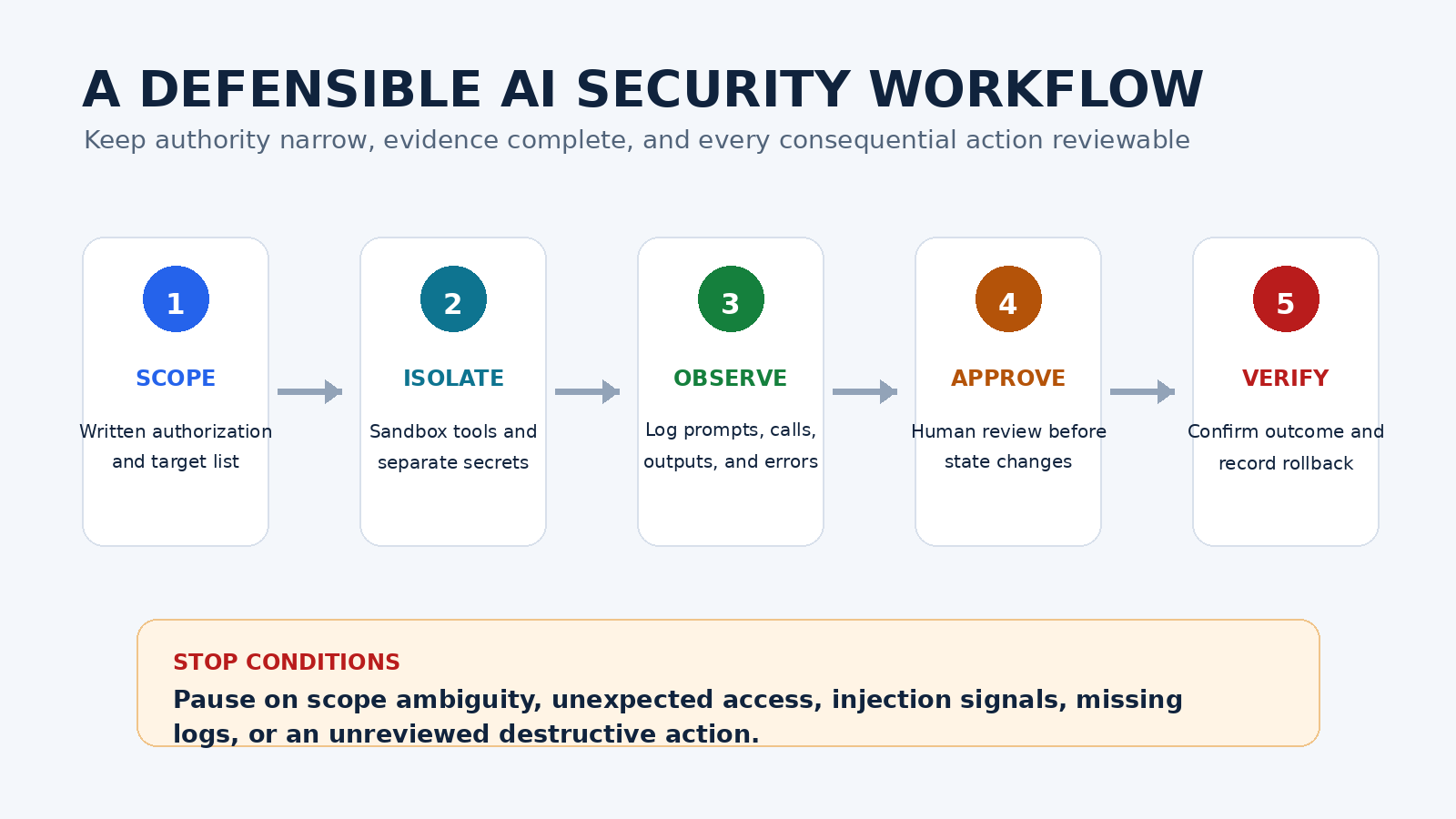
Begin with written authorization. Name the assets, accounts, dates, test methods, data handling rules, and people allowed to approve exceptions. Define what is forbidden, including adjacent systems that may be technically reachable but are outside scope. If ownership is unclear, stop. A public IP address, exposed service, bug bounty listing, or accessible repository is not by itself permission to test anything beyond the exact published terms.
Use a dedicated environment next. Give the agent synthetic or minimized data, temporary credentials, an allowlist of destinations, and only the tools required for the current task. Separate research from execution. Read only analysis can happen first, while state changing actions require a fresh approval. Do not place production secrets in a context that the agent can read merely for convenience. The related PChatGPT guide to non-human identity security explains why agent credentials need owners, limited scope, rotation, and monitoring.
Record the full run. Preserve the request, model and configuration, tool definitions, tool calls, returned data, approvals, errors, and final verification. Logs should be protected from the agent where practical so the system cannot quietly rewrite its own audit trail. Set budget limits for time, calls, and affected resources. Rate limits and circuit breakers make a looping or confused agent easier to contain.
A defensible workflow keeps authority narrow, actions observable, approvals specific, and outcomes independently verified.
Place a human checkpoint before any action that changes access, executes untrusted code, sends data outside the approved boundary, alters a production service, creates persistence, deletes information, or contacts a third party. The reviewer should see the proposed action, target, reason, expected effect, rollback plan, and relevant evidence. Approval should expire after that exact action rather than becoming blanket permission for the rest of the session.
Finally, verify independently. A model saying that a vulnerability is fixed is not proof. Run the approved regression check, inspect the actual configuration, and confirm that logging and service health remain intact. Record unexpected effects and roll back when necessary. The broader AI agent security guide offers a useful inventory and governance framework for organizations that already have agents operating across cloud and development systems.
Practical evaluation questions for security leaders
Identity: Which exact model, version, system prompt, tool set, and access surface produced the result?
Authority: Who owned the target, and where is the written permission for each tested action?
Environment: Was this a benchmark, a cyber range, an isolated repository, or a defended live system?
Human input: Who selected targets, supplied credentials, approved commands, gave hints, or retried failures?
Evidence: What logs independently demonstrate progress and final success?
Denominator: How many tasks, attempts, and failures sit behind the highlighted example?
Containment: Which network, identity, sandbox, and data controls limited the possible impact?
Injection defense: How did the agent separate trusted instructions from hostile content returned by tools?
Stop conditions: What caused an automatic pause, and who had authority to resume?
Recovery: Could the operator revoke credentials, isolate the environment, and restore state quickly?
What not to conclude from a dramatic demonstration
Do not conclude that every Claude deployment has the same capability. Do not assume that a benchmark solve rate predicts success against your environment. Do not treat a refusal policy as a technical guarantee, or a sandbox as safe without checking its boundaries. Do not infer that defensive usefulness requires broad production access. Most valuable early deployments can begin with read only evidence, narrow repositories, synthetic data, and explicit review.
Also avoid the opposite mistake. Imperfect performance does not make the risk irrelevant. Automation can still increase throughput, and attackers can combine a model with conventional tools and human expertise. The defensible response is measured: track capability evidence, reduce unnecessary authority, test controls, monitor agent activity, and rehearse recovery. Anthropic’s current Usage Policy defines acceptable use boundaries for its services, but every organization must also meet its own contractual, regulatory, and professional duties.
A decision rule that survives the next model release
Model names and benchmark leaders will change. A durable policy ties authority to verified risk, not to brand reputation or a demo. Increase access only after the system passes tests that resemble the intended workflow. Require stronger safeguards as the agent gains sensitive context, broader tools, longer runtime, or permission to change state. Review new system cards and product documentation when the model or integration changes, then repeat the relevant tests.
The central lesson is straightforward. Claude’s cyber capability can be useful evidence of progress and a reason to improve defenses, but autonomy should be described precisely. Keep testing legal, isolated, observable, reversible, and human accountable. If a team cannot state the scope, permission, evidence, and rollback path in plain language, the agent should not receive the authority to proceed.
FAQ
Can Claude autonomously hack a real organization?
No broad yes or no answer is responsible. Results depend on the exact model, tools, credentials, environment, defenses, time, and human help. Controlled evaluations can demonstrate meaningful capability without proving reliable success against a defended real organization. Testing a real organization requires explicit authorization.
Is it safe to let a Claude agent test production systems?
Production access raises the consequence of mistakes and prompt injection. Start in an isolated environment with minimized data and temporary credentials. If production testing is justified, use written scope, least privilege, complete logging, narrow human approvals, stop conditions, and a tested rollback plan.
What is the most important control for an AI security agent?
No single control is enough. The strongest baseline combines explicit authorization, isolation, least privilege, separation of untrusted content, human approval for consequential actions, tamper resistant logs, continuous monitoring, and independent verification. These layers limit damage when another layer fails.
How should I judge a new autonomous hacking claim?
Find the primary report or system card. Check the exact model, task, environment, tools, retries, human interventions, success criteria, failures, safeguards, and independent evidence. Treat conclusions that omit these details as provisional, especially when a headline generalizes from a single demonstration.
Calling AI a “partner” can sound grander than the technology deserves. ChatGPT does not share your goals, carry professional responsibility, or notice every consequence of a bad decision. Yet the way people work with AI has changed. A one-off prompt can now sit inside a continuing project, draw on selected sources, conduct multi-step research, and, in agent mode, move from analysis toward action. The useful 2026 question is not whether software has become a colleague. It is how to design a collaboration in which the system contributes continuity and initiative without inheriting human authority.
This guide takes a narrow view of that shift through current ChatGPT workflows. The central idea is simple: treat AI partnership as an operating model. Give the system a bounded role, a controlled context, a reviewable assignment, and a clear stopping point. Keep purpose, judgment, permission, and accountability with people. That produces a more useful assistant than either extreme: a chatbot that forgets the job after every exchange, or an agent given a vague goal and too much access.
What changed from tool use to continuing collaboration?
A traditional software tool waits for an explicit command and returns a predictable transformation. A calculator evaluates an expression. A spellchecker flags a pattern. Generative AI is less deterministic. It interprets an instruction, creates a response, and can adapt after feedback. The interaction becomes collaborative when four conditions appear together: the work continues across sessions, relevant context remains available, the system can perform several dependent steps, and a person can inspect or redirect the process.
ChatGPT Projects provide one practical example. OpenAI’s Projects documentation describes workspaces that group chats, reference files, and project instructions around ongoing work. That means a research brief, source set, editorial rules, and separate working conversations can live within one boundary. Shared projects can also let members build on a common context. They are not synchronous co-editing rooms, and shared chats can be branched rather than edited together in real time. The collaboration is based on a common source layer, not on pretending the model is another employee.
Research has also become less like asking for an instant answer. OpenAI’s current deep research overview says the feature can conduct multi-step investigation, use supplied files and selected sources, show progress, and return a cited report. The same page also acknowledges limitations, including incorrect inferences, hallucinated facts, difficulty judging authority, and imperfect confidence calibration. That combination of greater initiative and persistent fallibility defines the real shift. The assistant can do more of the route planning, while the user needs a stronger method for checking the destination.
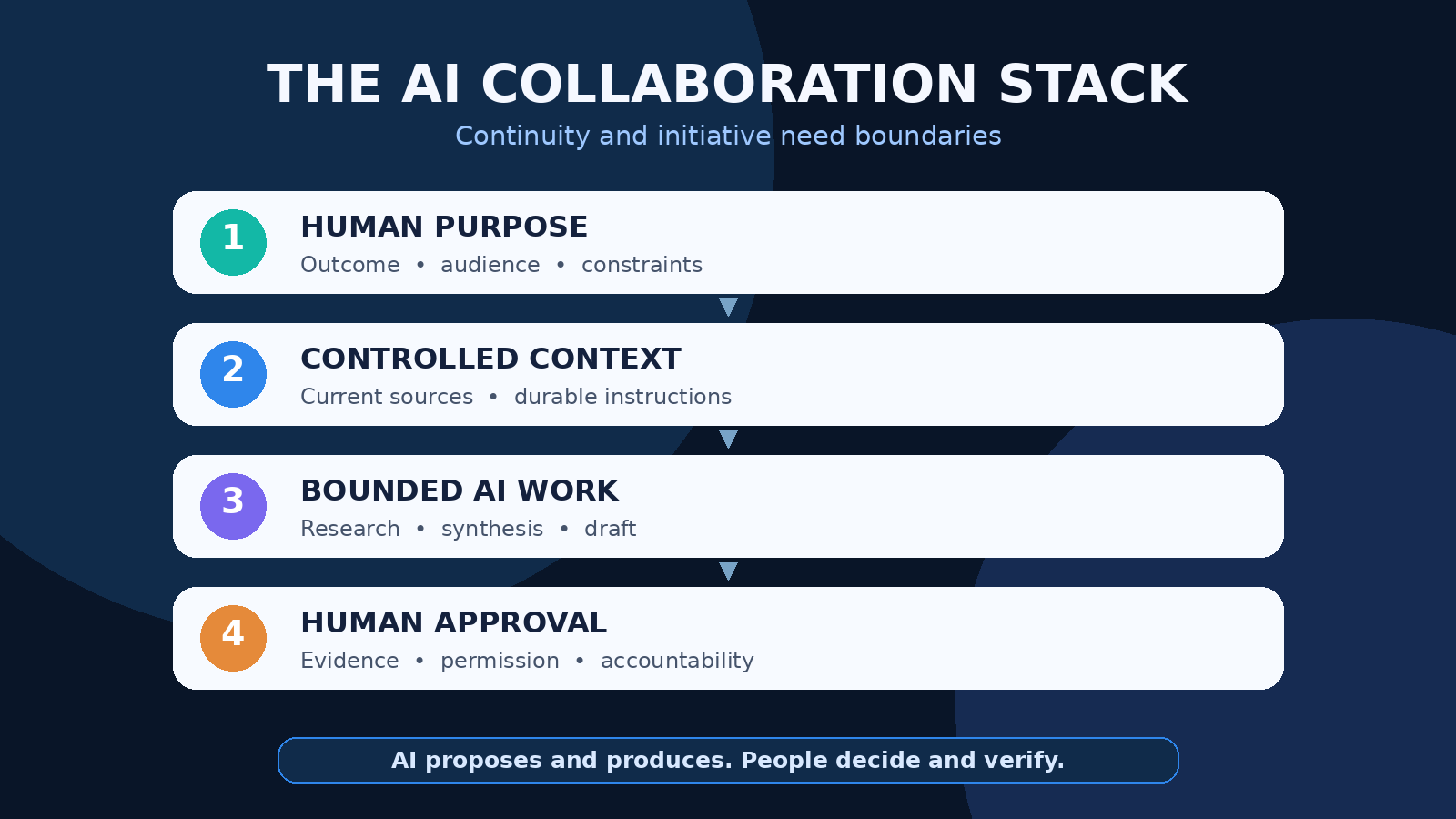
A dependable AI partnership rests on human purpose and ends with human approval.
The collaboration stack: purpose, context, work, approval
A useful partnership has four layers. Each layer answers a different question. Mixing them into one long prompt makes errors harder to diagnose.
Purpose belongs to the human. State the outcome, audience, constraints, and reason the work matters. “Help with our launch” leaves too much undefined. “Prepare an evidence map for an editor deciding whether our product claim is supportable” supplies a real decision. The person also names what must not happen, such as contacting a customer, changing a live document, or treating an inference as a verified fact.
Context should be selected, not dumped. Put governing documents, current source material, and durable instructions in the workspace that needs them. Remove superseded files or mark their status. A larger pile is not automatically better context. Contradictory drafts, unlabeled notes, and stale policies invite the model to blend incompatible claims. A short source register with owner, date, status, and purpose often adds more value than another hundred pages.
AI work should be bounded by a deliverable. Ask for an outline, comparison, question list, evidence table, draft, or proposed action. Require the response to separate supplied facts, external findings, assumptions, and open questions. A concrete deliverable creates something a person can review. “Think deeply” is not a control, while “list each material claim beside its source and flag unsupported claims” is.
Approval remains a separate human step. A polished response is not proof. Before publication or action, verify important quotations against the source, check calculations, resolve conflicts, and confirm names, recipients, dates, quantities, and permissions. If the task can change an external system, approval should concern the exact proposed change, not a vague instruction to continue.
Use Projects as a shared context hub, not a truth machine
A Project can reduce repetitive prompting because its files, instructions, and conversations remain organized around the same effort. One chat can examine user research, another can build an outline, and a third can challenge the first draft. This separation is easier to audit than one endless conversation, while the project still supplies common material.
Start with a short project charter. Include the desired outcome, audience, accepted source hierarchy, required output format, prohibited actions, and escalation rule. For example: “Use approved product documentation before meeting notes. If two sources conflict, quote both and ask the owner. Do not create performance claims from anecdotes. Mark every recommendation as proposal until an editor approves it.” Durable rules belong in project instructions. The immediate question belongs in the chat prompt.
Shared context needs ownership. Assign one person to maintain instructions and one owner for each critical source. Team members should label drafts as draft, approved, or superseded. When someone moves an old conversation into a project, they should identify which assumptions remain valid. Without these habits, memory can preserve confusion just as effectively as it preserves useful context.
The sharing boundary matters too. OpenAI states that members of a shared project can view chats and files, and files may be downloadable. Once shared, the project uses project-only memory, which keeps members’ outside memories and conversations out of the shared context. That is a helpful boundary, but it does not make material inside the project private from other members. Review the membership list and the actual file before adding customer, employee, legal, or commercially sensitive material.
For a detailed setup, see PChatGPT’s ChatGPT Projects guide. Its practical distinction between chats, sources, instructions, and project memory is especially useful when a team wants continuity without creating one unreadable thread.
Memory helps continuity, but it is not an authoritative record
OpenAI’s Memory FAQ describes memory as context from chats, files, and connected apps that can personalize later responses when enabled. The current experience includes controls for reviewing and changing a memory summary, but the documentation also says the summary may not show every factor that shaped a response. A saved or synthesized memory is therefore a convenience layer, not a controlled database.
Do not rely on memory for a fact that must be exact. Put an approved requirement, policy clause, or current specification in a named source and cite it in the task. Ask the assistant to distinguish the source from anything recalled. If the source changes, replace it deliberately and note the change. For isolated work, use a project-only boundary where appropriate. For a sensitive one-off discussion that should not create or use memories, OpenAI documents Temporary Chat as the relevant option.
Memory can also create a subtle authority problem. A preference repeated from an earlier chat may sound like a current requirement. A personal detail may be irrelevant to a team assignment. A prior conclusion can anchor new analysis even after the evidence changes. Start consequential tasks with a short context check: “List the project sources and assumptions you plan to use. Do not begin the draft until I confirm them.” This turns invisible continuity into a reviewable handoff.
Move from conversation to research with an evidence contract
Deep research is most useful when the question genuinely requires synthesis across multiple sources. It is excessive for a quick definition and insufficient by itself for a decision that needs expert judgment. Before a run, write an evidence contract that says what counts as an acceptable source, the period or jurisdiction that matters, what should be excluded, how uncertainty should be shown, and what output will be reviewed.
For a product policy comparison, an evidence contract might prioritize current vendor documentation and regulator publications, exclude affiliate summaries, require a link for each material claim, and create an unresolved column whenever sources disagree. For a literature review, it might define eligible study designs and ask for direct quotations around limitations. The contract narrows the model’s search space and gives the reviewer a checklist.
After the report arrives, sample the evidence before polishing the prose. Open several citations, confirm they support the sentence, and check whether qualifiers survived the summary. Search the report for numbers, dates, superlatives, and causal language because those claims deserve extra scrutiny. Read at least one source that argues against the report’s direction. If a key source is inaccessible or ambiguous, label the gap instead of allowing fluent synthesis to hide it.
Do not describe this as verification by the AI. The system can collect and organize evidence, but the acceptance act belongs to a competent person. A good research workflow makes that handoff visible with columns such as claim, source, excerpt, model interpretation, reviewer decision, and follow-up.
Agent mode changes the risk because output can become action
OpenAI’s ChatGPT agent overview describes a system that can combine browsing, analysis, a terminal, and connected information, while letting the user interrupt, take over, or stop. It also says permission is requested before consequential actions. The same official page warns about model mistakes and prompt injection, including malicious instructions hidden in web content. The important boundary is no longer only whether an answer is correct. It is whether a mistaken or manipulated answer can change something outside the chat.
Match authority to reversibility. It may be reasonable for an agent to gather public pages and prepare a comparison. Drafting a calendar proposal is riskier but still reviewable. Sending invitations, submitting a form, changing permissions, publishing content, deleting records, or making a purchase requires a much tighter checkpoint. Keep credentials and unrelated connected apps unavailable unless the task needs them.
For every action task, specify allowed sites, allowed operations, prohibited operations, spending or quantity limits where relevant, and an exact stop condition. Ask for a preview of the final payload. Then inspect the destination, recipient, and values before approval. After execution, read the target system rather than trusting a completion message. A confirmation generated by the same process is not independent evidence that the state changed correctly.
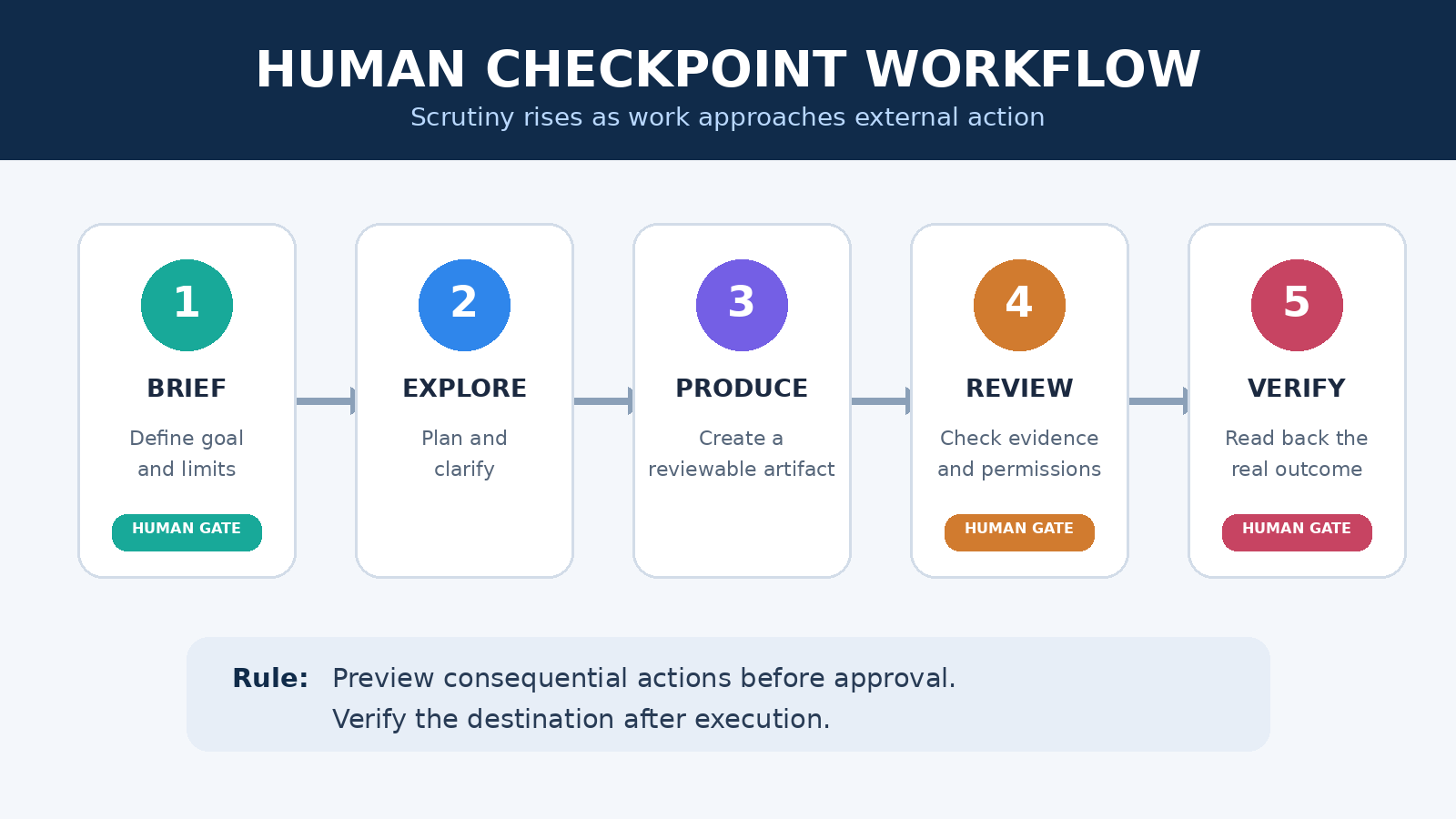
Increase human scrutiny as AI work moves from analysis toward external action.
A five-stage workflow for responsible AI collaboration
Brief: A person defines the outcome, audience, allowed data, source rules, and prohibited actions. If the assignment affects another person, name the responsible reviewer.
Explore: ChatGPT asks clarifying questions, organizes supplied context, and proposes a plan. The user corrects scope before substantial work begins.
Produce: The system creates a bounded artifact such as an evidence table, draft, analysis, or action preview. Claims stay connected to sources, and uncertainty stays visible.
Review: A person checks evidence, reasoning, tone, privacy, permissions, and downstream effects. The reviewer either accepts, revises, or rejects the artifact.
Verify: If anything is published, sent, scheduled, or changed, read back the destination. Record what changed, who approved it, and any follow-up needed.
This workflow lets the assistant take initiative inside a controlled lane. It also prevents a common failure: allowing the model to define the goal, select the evidence, judge its own output, and execute the result. Those are separate responsibilities for a reason.
Privacy and data choices are part of the collaboration design
Before uploading a source or connecting an app, ask whether the task can be completed with less data. Redact unnecessary personal details, use a smaller excerpt, and separate clients or projects that should not share context. Access should follow the work, not convenience. Disconnect an app when the continuing benefit no longer justifies the exposure.
For individual ChatGPT accounts, OpenAI’s Data Controls FAQ explains the setting that determines whether conversations help improve models. It also distinguishes Temporary Chats, which do not appear in history, create memories, or train models and are deleted from OpenAI’s systems after the documented retention period. These controls address different questions. Turning off model improvement does not remove chat history, and turning off memory is not the same as changing training preferences.
Organizations should use the controls and contractual terms applicable to their workspace rather than copying assumptions from a personal account. Define which data classes may enter the system, who can share projects, which apps may connect, how access is reviewed, and where approvals are logged. The PChatGPT AI productivity tools guide provides a useful comparison of conversational assistance, bounded agent work, and repeatable automation.
How to measure whether the partnership is actually useful
Do not measure success by response volume or how human the conversation feels. Measure the work. Useful indicators include the time from brief to reviewable artifact, the proportion of material claims with valid sources, reviewer correction rate, number of unresolved questions surfaced before publication, and the frequency of prevented or reversed actions. For recurring workflows, track stale-source incidents and permission exceptions.
Compare against the previous human process on the same kind of task, but do not invent a performance claim from a handful of examples. Record the input class, reviewer standard, and failure categories. A faster draft that creates more verification work may not save time. A slower evidence table that exposes missing information may be far more valuable.
Quality should improve through the operating system, not through faith in a future model. Tighten the brief when outputs drift. Improve source labels when the assistant blends versions. Add a checkpoint when reviewers repeatedly catch the same risky transition. Remove access that is not producing clear value. The goal is a workflow that remains understandable even as models and interfaces change.
FAQ
Is AI really a partner in 2026?
It can function as a continuing collaborator in a workflow because it can retain selected context, conduct multi-step work, and respond to feedback. It is not a legal, moral, or professional partner. People still own the purpose, permissions, review, and consequences.
What is the safest first step for team collaboration with ChatGPT?
Choose one low-risk, reversible task and create a small source set with clear project instructions. Ask ChatGPT for a reviewable artifact, not an external action. Have a named person check the evidence and record what needed correction before expanding the workflow.
Should a team rely on ChatGPT memory for project requirements?
No. Memory is useful for continuity but is selective and can change. Store controlling requirements in an approved, named source, point to that source in the prompt, and ask the assistant to flag conflicts rather than resolve them silently.
When should AI collaboration stop before action?
Stop for human approval whenever the next step can send a message, publish content, spend money, disclose data, change permissions, delete a record, accept terms, or otherwise affect another person or system. Review the exact payload, then verify the destination after execution.
Final perspective
The important evolution is not from obedient machine to digital coworker. It is from isolated generation to a continuing, tool-using workflow. Projects can preserve selected context. Memory can reduce repetition. Deep research can organize a long investigation. Agent mode can bridge analysis and action. Each gain also creates a new responsibility: curate the context, define evidence, limit authority, and verify outcomes.
A trustworthy AI partnership is therefore deliberately asymmetrical. The system may propose, search, synthesize, draft, and prepare. A person decides why the work matters, what information is appropriate, which claims are acceptable, and whether an action should occur. That boundary does not make collaboration weaker. It is what makes the collaboration dependable.
ChatGPT agents is best understood through practical workflows, not headlines. This guide replaces an older generic summary with a source-grounded article that keeps the original URL while giving readers a clearer reason to stay, compare, and act carefully.
From prompt box to work system
For years, most people used ChatGPT as a response box. They asked for a draft, a summary, an idea, or a rewrite, then copied the answer into another tool. Agents change that pattern.
An agent can plan steps, use tools, inspect information, and keep working toward a goal. That does not make it a coworker in the human sense. It does mean the user has to manage it more like a delegated workflow than a single prompt. The question becomes less about one clever instruction and more about scope, permissions, evidence, and review.
What OpenAI has announced
OpenAI introduced ChatGPT agent in 2025 as a way for ChatGPT to think and act using a toolbox of skills. The launch post says users can interrupt, steer, or take control during a task.
OpenAI later introduced workspace agents in ChatGPT for teams, describing shared agents that run within organizational permissions and controls. OpenAI also announced developer tools such as the Responses API and agent building tools. The details differ by product surface, but the direction is consistent: AI systems are moving from isolated answers toward longer workflows.
The useful mental model
Treat an agent like a junior operator with software access, not like a magic employee. Give it a narrow goal, clear boundaries, and examples of acceptable output. Tell it what not to touch.
Require it to show sources, assumptions, and pending decisions. If the workflow affects money, customers, health, legal obligations, publishing, or security, keep a human approval step before the final action. A good agent workflow makes review easier. A bad one hides work until the end, when mistakes are harder to see.
Permissions matter more than prompts
The most important agent setting is often not the wording of the prompt. It is what the agent can access and change. A summarization agent with read-only access has a different risk profile from an agent that can send email, edit a site, update a spreadsheet, or move files.
Teams should separate read tasks from write tasks. They should log important actions. They should make sensitive actions require confirmation. Strong prompts help, but permissions are the control that limits damage when an instruction is unclear or a page contains misleading content.
How teams can start safely
Pick one repetitive workflow with clear inputs and a small blast radius. Examples include turning meeting notes into a follow-up checklist, drafting a first report from approved files, comparing product documentation, or preparing a weekly research brief. Write down the current manual process first.
Then ask the agent to handle only the parts that are easy to verify. Measure whether it saves time without increasing review failures. If the workflow improves, expand it slowly. If it creates confusion, fix the process before adding more tools.
What still needs human judgment
Agents can gather, draft, compare, and format. They still need human judgment for priorities, ethics, commitments, and final accountability. A manager should decide what outcome matters. A writer should decide what voice fits the audience.
A developer should review code before it ships. A support lead should approve sensitive customer messages. The mature version of agent use is not blind automation. It is clearer delegation with better checkpoints.
Decision checklist
Agent workflows improve when the boundaries are boring and visible. The checklist below is designed for teams that want speed without losing control.
Is the task narrow enough for one agent run?
Are read permissions separated from write permissions?
Can a human interrupt or approve the final action?
Are sources, logs, and assumptions visible?
Does the workflow stop before risky external changes?
A ChatGPT agent is a mode or workflow where ChatGPT can plan steps and use tools to work toward a goal, rather than only returning one response.
Are workspace agents the same as GPTs?
OpenAI describes workspace agents as an evolution for team workflows. GPTs remain a separate concept while teams test newer agent workflows.
What is the safest first agent workflow?
Start with a read-only or draft-only task, such as summarizing approved files or preparing a checklist, before allowing actions that change external systems.
Do agents remove the need for review?
No. Review becomes more important because agents can touch more steps. Use checkpoints before publishing, sending, purchasing, or changing important records.
The management habit matters as much as the model. If nobody owns the workflow, the agent becomes another loose tool. Assign an owner, document the expected output, and decide what failure looks like before the first run. That gives reviewers a standard to use when the output sounds plausible but misses the business need.
Teams should also keep a rollback path. If an agent drafts the wrong email, changes the wrong row, or summarizes the wrong source, the team should know how to undo the action or correct the record. Planning for recovery is not pessimistic. It is part of responsible delegation.
The management habit matters as much as the model. If nobody owns the workflow, the agent becomes another loose tool. Assign an owner, document the expected output, and decide what failure looks like before the first run. That gives reviewers a standard to use when the output sounds plausible but misses the business need.
Teams should also keep a rollback path. If an agent drafts the wrong email, changes the wrong row, or summarizes the wrong source, the team should know how to undo the action or correct the record. Planning for recovery is not pessimistic. It is part of responsible delegation.
The management habit matters as much as the model. If nobody owns the workflow, the agent becomes another loose tool. Assign an owner, document the expected output, and decide what failure looks like before the first run. That gives reviewers a standard to use when the output sounds plausible but misses the business need.
Teams should also keep a rollback path. If an agent drafts the wrong email, changes the wrong row, or summarizes the wrong source, the team should know how to undo the action or correct the record. Planning for recovery is not pessimistic. It is part of responsible delegation.
The management habit matters as much as the model. If nobody owns the workflow, the agent becomes another loose tool. Assign an owner, document the expected output, and decide what failure looks like before the first run. That gives reviewers a standard to use when the output sounds plausible but misses the business need.
Teams should also keep a rollback path. If an agent drafts the wrong email, changes the wrong row, or summarizes the wrong source, the team should know how to undo the action or correct the record. Planning for recovery is not pessimistic. It is part of responsible delegation.
The management habit matters as much as the model. If nobody owns the workflow, the agent becomes another loose tool. Assign an owner, document the expected output, and decide what failure looks like before the first run. That gives reviewers a standard to use when the output sounds plausible but misses the business need.
Teams should also keep a rollback path. If an agent drafts the wrong email, changes the wrong row, or summarizes the wrong source, the team should know how to undo the action or correct the record. Planning for recovery is not pessimistic. It is part of responsible delegation.
The management habit matters as much as the model. If nobody owns the workflow, the agent becomes another loose tool. Assign an owner, document the expected output, and decide what failure looks like before the first run. That gives reviewers a standard to use when the output sounds plausible but misses the business need.
Teams should also keep a rollback path. If an agent drafts the wrong email, changes the wrong row, or summarizes the wrong source, the team should know how to undo the action or correct the record. Planning for recovery is not pessimistic. It is part of responsible delegation.
The management habit matters as much as the model. If nobody owns the workflow, the agent becomes another loose tool. Assign an owner, document the expected output, and decide what failure looks like before the first run. That gives reviewers a standard to use when the output sounds plausible but misses the business need.
Teams should also keep a rollback path. If an agent drafts the wrong email, changes the wrong row, or summarizes the wrong source, the team should know how to undo the action or correct the record. Planning for recovery is not pessimistic. It is part of responsible delegation.
The management habit matters as much as the model. If nobody owns the workflow, the agent becomes another loose tool. Assign an owner, document the expected output, and decide what failure looks like before the first run. That gives reviewers a standard to use when the output sounds plausible but misses the business need.
Teams should also keep a rollback path. If an agent drafts the wrong email, changes the wrong row, or summarizes the wrong source, the team should know how to undo the action or correct the record. Planning for recovery is not pessimistic. It is part of responsible delegation.
The management habit matters as much as the model. If nobody owns the workflow, the agent becomes another loose tool. Assign an owner, document the expected output, and decide what failure looks like before the first run. That gives reviewers a standard to use when the output sounds plausible but misses the business need.
Teams should also keep a rollback path. If an agent drafts the wrong email, changes the wrong row, or summarizes the wrong source, the team should know how to undo the action or correct the record. Planning for recovery is not pessimistic. It is part of responsible delegation.
The management habit matters as much as the model. If nobody owns the workflow, the agent becomes another loose tool. Assign an owner, document the expected output, and decide what failure looks like before the first run. That gives reviewers a standard to use when the output sounds plausible but misses the business need.
Teams should also keep a rollback path. If an agent drafts the wrong email, changes the wrong row, or summarizes the wrong source, the team should know how to undo the action or correct the record. Planning for recovery is not pessimistic. It is part of responsible delegation.
The management habit matters as much as the model. If nobody owns the workflow, the agent becomes another loose tool. Assign an owner, document the expected output, and decide what failure looks like before the first run. That gives reviewers a standard to use when the output sounds plausible but misses the business need.
Teams should also keep a rollback path. If an agent drafts the wrong email, changes the wrong row, or summarizes the wrong source, the team should know how to undo the action or correct the record. Planning for recovery is not pessimistic. It is part of responsible delegation.
Final note for teams: agents are safer when every delegated task has a boundary, an owner, and a review point. Start with narrow work, then expand only after the workflow proves reliable.
Perplexity publisher program is best understood through practical workflows, not headlines. This guide replaces an older generic summary with a source-grounded article that keeps the original URL while giving readers a clearer reason to stay, compare, and act carefully.
Why this update matters to creators
Perplexity describes itself as an answer engine that gives users direct answers with citations. That is different from a traditional search page, where the user scans a list of links and decides what to open. For creators, this changes the job.
A useful article still needs a clear headline, a real point of view, and careful editing, but it also needs facts that can survive being quoted, summarized, and cited by another interface. The Perplexity publisher program sits inside that shift. It is not a magic traffic source. It is a sign that AI search products know they need a healthier relationship with the publishers and creators whose work they cite.
What Perplexity actually announced
Perplexity announced its Publishers Program in July 2024. The first partners named in the announcement included TIME, Der Spiegel, Fortune, Entrepreneur, The Texas Tribune, and WordPress.com.
The company said the program included revenue sharing connected to advertising in related questions, access to Perplexity APIs, developer support, AI analytics through ScalePost.ai, and Enterprise Pro access for partner employees for one year. Later, Perplexity said more media partners had joined, including ADWEEK, The Independent, Los Angeles Times, World History Encyclopedia, and others. Those details matter because they show the program is aimed at publisher relationships, not at giving every small blog a guaranteed payout.
How answer engines read creator content
An answer engine needs pages that make claims clearly. If a post buries the main point under vague introductions, repeated paragraphs, or generic advice, it becomes hard to cite usefully. A human reader may forgive that if the article eventually helps. A retrieval system is less patient. It looks for specific passages, dates, names, instructions, and definitions that match the query.
That does not mean creators should write for machines only. It means the human version of good writing becomes even more important. Put the answer near the top. Explain the limits. Name the source. Keep examples close to the claim they support.
Pages is not the same as a publication strategy
Perplexity Pages lets users turn research into organized, shareable pages. The official launch post describes choosing a topic, selecting an audience, adding or rearranging sections, and using visuals. That is useful for study guides, explainers, and internal research summaries.
It does not replace editorial ownership. A creator still has to decide what belongs on their own site, which claims need checking, what should be updated, and what should be left unpublished. Treat Pages as a research and presentation surface, not as the single home for your best material.
A practical workflow for creators
Start with one article that answers a real question your audience already asks. Gather official sources first, then add your own comparison, checklist, or workflow notes. Write a short summary that can stand alone.
Use headings that describe the decision a reader is trying to make, not just broad labels. Add examples only when they are true and useful. Before publishing, ask whether each section would still make sense if it appeared as a cited passage inside an answer engine. If the answer is no, rewrite the section until the claim, context, and limit are obvious.
What not to assume
Do not assume that citations always produce meaningful traffic. Do not assume a publisher program will include your site. Do not turn every article into a press release about AI search. The safer strategy is boring but effective: publish pages that are accurate, specific, and easy to quote.
Maintain trust pages, author information, and correction paths. Remove repeated boilerplate. Keep older articles fresh when product facts change. Answer engines reward source quality only if the page gives them something worth citing.
Decision checklist
Use this checklist before treating answer engines as part of your content plan. It keeps the work grounded in the reader problem rather than in platform hype.
Can the article answer one clear question without a long warm-up?
Are official sources linked close to the claims they support?
Does the page add creator judgment instead of copying a product announcement?
Would a cited passage still make sense outside the full article?
Is the excerpt specific enough to avoid sounding autogenerated?
Is the Perplexity publisher program open to every creator?
The official announcements describe named publishing partners and an email contact for publisher inquiries. They do not promise automatic access for every independent creator.
Should creators publish only on Perplexity Pages?
No. Pages can help organize and share research, but creators should keep their own site as the main place for durable articles, updates, and editorial control.
What makes content easier for answer engines to cite?
Clear claims, source links, specific examples, updated metadata, and sections that answer one question at a time make a page easier to interpret and cite.
Does revenue sharing replace SEO?
No. Revenue sharing is a publisher partnership model. SEO still depends on useful pages, crawlable structure, internal links, and reader trust.
For independent publishers, the strongest response is to make articles more citable. That means fewer broad introductions, fewer recycled conclusions, and more passages that explain one thing well. A page about AI search should not read like every other page about AI search. It should explain a decision the reader has to make today, then show the sources behind that decision.
Small sites can also benefit from cleaner site structure. Author pages, correction policies, contact pages, category hubs, and updated excerpts make the site easier to trust. None of those items guarantees inclusion in an AI answer, but they remove reasons for a reader or reviewer to doubt the page.
For independent publishers, the strongest response is to make articles more citable. That means fewer broad introductions, fewer recycled conclusions, and more passages that explain one thing well. A page about AI search should not read like every other page about AI search. It should explain a decision the reader has to make today, then show the sources behind that decision.
Small sites can also benefit from cleaner site structure. Author pages, correction policies, contact pages, category hubs, and updated excerpts make the site easier to trust. None of those items guarantees inclusion in an AI answer, but they remove reasons for a reader or reviewer to doubt the page.
For independent publishers, the strongest response is to make articles more citable. That means fewer broad introductions, fewer recycled conclusions, and more passages that explain one thing well. A page about AI search should not read like every other page about AI search. It should explain a decision the reader has to make today, then show the sources behind that decision.
Small sites can also benefit from cleaner site structure. Author pages, correction policies, contact pages, category hubs, and updated excerpts make the site easier to trust. None of those items guarantees inclusion in an AI answer, but they remove reasons for a reader or reviewer to doubt the page.
For independent publishers, the strongest response is to make articles more citable. That means fewer broad introductions, fewer recycled conclusions, and more passages that explain one thing well. A page about AI search should not read like every other page about AI search. It should explain a decision the reader has to make today, then show the sources behind that decision.
Small sites can also benefit from cleaner site structure. Author pages, correction policies, contact pages, category hubs, and updated excerpts make the site easier to trust. None of those items guarantees inclusion in an AI answer, but they remove reasons for a reader or reviewer to doubt the page.
For independent publishers, the strongest response is to make articles more citable. That means fewer broad introductions, fewer recycled conclusions, and more passages that explain one thing well. A page about AI search should not read like every other page about AI search. It should explain a decision the reader has to make today, then show the sources behind that decision.
Small sites can also benefit from cleaner site structure. Author pages, correction policies, contact pages, category hubs, and updated excerpts make the site easier to trust. None of those items guarantees inclusion in an AI answer, but they remove reasons for a reader or reviewer to doubt the page.
For independent publishers, the strongest response is to make articles more citable. That means fewer broad introductions, fewer recycled conclusions, and more passages that explain one thing well. A page about AI search should not read like every other page about AI search. It should explain a decision the reader has to make today, then show the sources behind that decision.
Small sites can also benefit from cleaner site structure. Author pages, correction policies, contact pages, category hubs, and updated excerpts make the site easier to trust. None of those items guarantees inclusion in an AI answer, but they remove reasons for a reader or reviewer to doubt the page.
For independent publishers, the strongest response is to make articles more citable. That means fewer broad introductions, fewer recycled conclusions, and more passages that explain one thing well. A page about AI search should not read like every other page about AI search. It should explain a decision the reader has to make today, then show the sources behind that decision.
Small sites can also benefit from cleaner site structure. Author pages, correction policies, contact pages, category hubs, and updated excerpts make the site easier to trust. None of those items guarantees inclusion in an AI answer, but they remove reasons for a reader or reviewer to doubt the page.
For independent publishers, the strongest response is to make articles more citable. That means fewer broad introductions, fewer recycled conclusions, and more passages that explain one thing well. A page about AI search should not read like every other page about AI search. It should explain a decision the reader has to make today, then show the sources behind that decision.
Small sites can also benefit from cleaner site structure. Author pages, correction policies, contact pages, category hubs, and updated excerpts make the site easier to trust. None of those items guarantees inclusion in an AI answer, but they remove reasons for a reader or reviewer to doubt the page.
For independent publishers, the strongest response is to make articles more citable. That means fewer broad introductions, fewer recycled conclusions, and more passages that explain one thing well. A page about AI search should not read like every other page about AI search. It should explain a decision the reader has to make today, then show the sources behind that decision.
Small sites can also benefit from cleaner site structure. Author pages, correction policies, contact pages, category hubs, and updated excerpts make the site easier to trust. None of those items guarantees inclusion in an AI answer, but they remove reasons for a reader or reviewer to doubt the page.
Final note for creators: answer engines work best with pages that say something precise and verifiable. Keep the article useful on your own site first, then let citations become a possible secondary benefit.
Reasoning models are becoming a practical part of enterprise AI, not because every task needs deeper thinking, but because some business workflows require planning, tool use, ambiguity handling, and careful review before an answer is trusted. OpenAI describes reasoning models as models that use internal reasoning tokens before producing a response, which can help them plan, inspect alternatives, recover from ambiguity, and solve harder multi-step tasks. For enterprise teams, the important question is not simply which model is most capable. The better question is how to evaluate reasoning where it matters, route work to the right level of reasoning, and keep humans involved when decisions carry operational, legal, security, or customer impact.
This draft takes a neutral implementation view. It does not assume that reasoning models should replace existing automation, subject matter experts, or governance programs. Instead, it treats them as one class of AI component inside a broader system. The goal is to help product, engineering, risk, and operations teams design a reliable operating model around reasoning: choose the right jobs, test the model against real criteria, route requests by risk and complexity, and maintain human review where confidence and accountability matter.
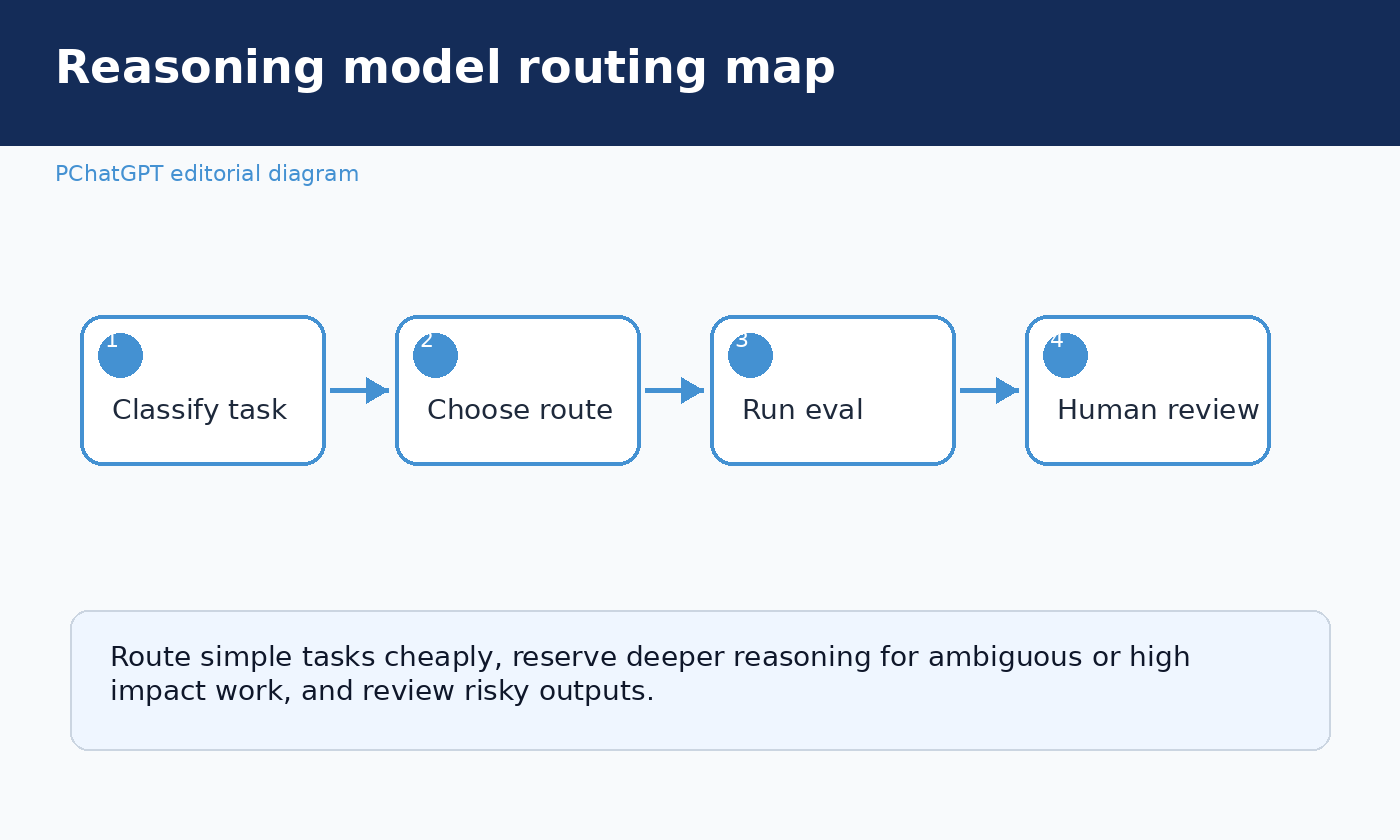
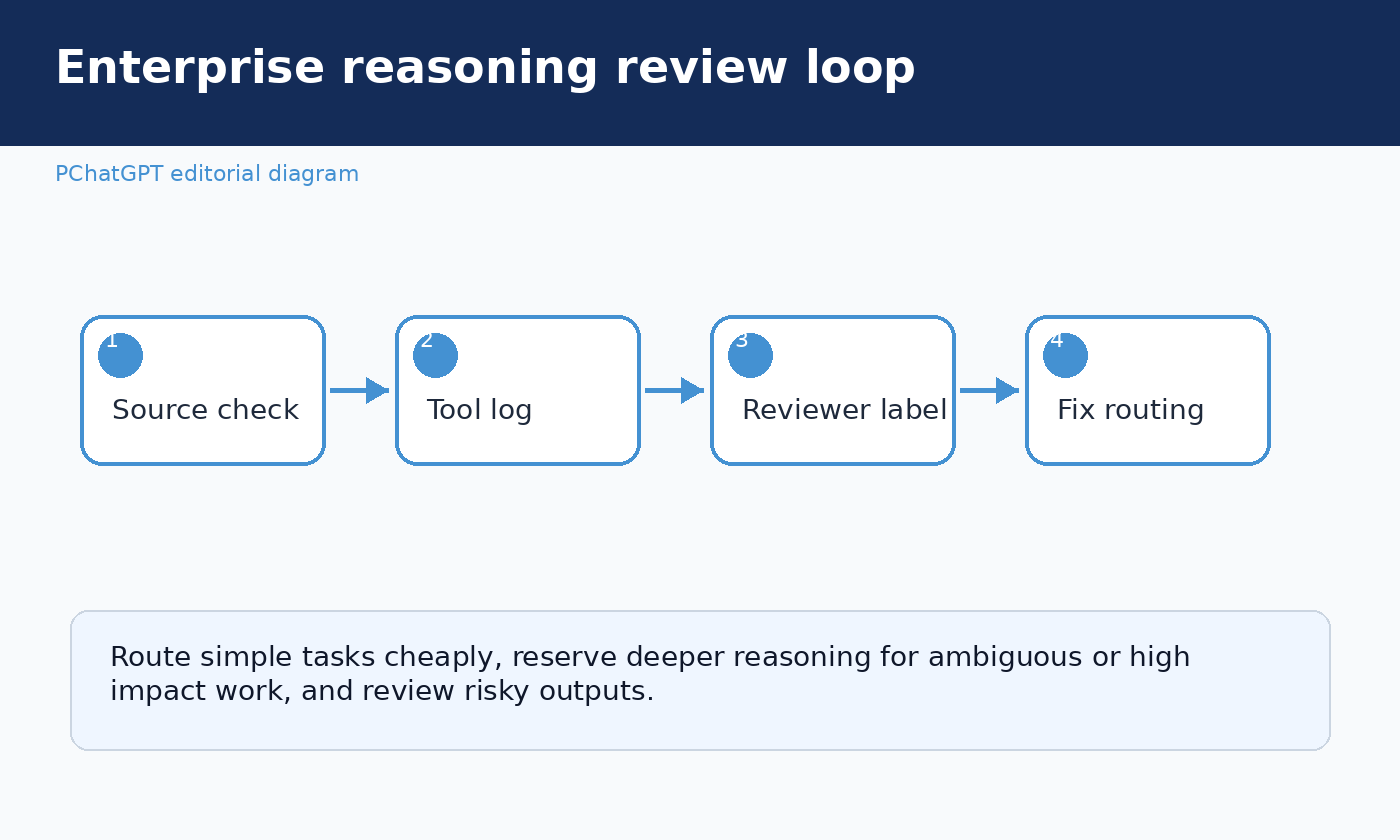
Diagram showing how enterprise AI tasks route from simple automation to reasoning models and human review
What makes reasoning models different for enterprise use
OpenAI’s reasoning guide explains that reasoning models use reasoning tokens in addition to input and output tokens. These tokens are not visible through the API, but they still occupy context window space and are billed as output tokens. This distinction matters in enterprise settings because hidden reasoning work can improve the quality of difficult responses, while also affecting latency, token budget, and completion behavior.
Reasoning models are especially relevant when the task is not a single retrieval or classification step. Examples include planning a remediation sequence, analyzing conflicting business evidence, producing structured recommendations from multiple files, or using tools in a multi-step workflow. OpenAI’s o3 and o4-mini announcement also describes reasoning models that can use tools, reason about when to use them, and combine tool outputs to answer more complex questions. That makes them useful candidates for agentic workflows, but it also makes evaluation and oversight more important.
Enterprises should avoid treating reasoning as a magic quality setting. A reasoning model can be more suitable for some tasks and unnecessarily expensive or slow for others. A fast model or a low reasoning setting may be enough for routine information retrieval, short drafting, or simple classification. A higher reasoning setting may be more appropriate when the work requires planning, judgment, debugging, research, or a sequence of tool calls. The practical challenge is to draw that boundary clearly enough that systems can route work consistently.
Start with task categories, not model names
A durable enterprise design begins by dividing AI work into categories. One category might include routine, low-risk tasks such as summarizing a public document or classifying an inbound support request. Another might include moderate complexity tasks such as drafting a customer response from approved knowledge sources. A third might include high-value tasks such as security review, financial analysis, incident triage, legal support, or product decisions that require a human owner.
This task-based approach helps teams avoid premature debates over model branding. The same application may need more than one route. A customer support system might use a lower latency path for intent detection, a medium reasoning path for resolving a multi-part issue, and a human review path before issuing an exception, refund, or policy-sensitive message. A software engineering assistant might use ordinary generation for simple edits, but stronger reasoning for complex debugging or repository-wide planning.
Task categories should be written in operational language. Instead of saying that complex questions use a reasoning model, define what complexity means. Signals may include multi-step instructions, conflicting evidence, tool use, retrieval from multiple sources, regulated content, customer impact, security impact, or low tolerance for error. These signals later become routing inputs and evaluation dimensions.
Evaluation should measure the workflow, not only the answer
Enterprise evaluation for reasoning models should begin with realistic tasks taken from the intended workflow. A model that performs well on a generic benchmark may still fail a company-specific policy, format, audit, or escalation requirement. The evaluation set should include normal cases, edge cases, ambiguous requests, incomplete information, and prompts that should trigger refusal, clarification, escalation, or tool use.
For each test case, define what a good result means before running the model. Criteria can include factual consistency with provided sources, correct use of available tools, adherence to output format, transparent uncertainty, appropriate escalation, and avoidance of unsupported claims. For business workflows, it is often useful to grade the final answer and the process outcome separately. A response can be fluent but still wrong because it skipped a required source, failed to ask for missing context, or acted beyond its approval boundary.
OpenAI’s reasoning guide recommends giving reasoning-capable models a clear goal, strong constraints, and an explicit output contract, without prescribing every intermediate step. That advice translates well to evaluation. Each test should specify the user goal, the available context, the policy or source boundary, and the expected form of completion. The scoring rubric should then reflect whether the model followed those constraints, not whether the answer merely sounded convincing.
Use human review to calibrate automated grading
Automated checks can find many defects, including missing fields, invalid JSON, unsupported citations, or prohibited actions. They are less reliable for subtle judgment calls. Human reviewers should therefore inspect a sample of outputs, especially during early deployment and after any model, prompt, tool, or policy change. Reviewers can identify failure modes that automated tests miss, such as overconfidence, poor prioritization, or a technically correct answer that is inappropriate for a customer-facing context.
The review process should produce reusable labels. Instead of writing freeform comments only, reviewers can tag defects such as unsupported claim, wrong source, missed escalation, risky tool use, incomplete answer, privacy issue, or unclear uncertainty. Over time, those labels make evaluation more consistent and help teams decide whether to adjust prompts, change routing rules, add guardrails, or keep the task under human control.
Routing is the control layer between cost, speed, and risk
OpenAI documents the reasoning.effort parameter as a way to guide how much the model should think when performing a task. Supported values are model-dependent and can include options such as none, minimal, low, medium, high, xhigh, and max. Lower effort favors speed and lower token usage, while higher effort can support more complete reasoning for complex tasks. The guide also notes that some models support only a subset of values, so teams should check the relevant model documentation before choosing a setting.
In enterprise architecture, routing should decide when to use those settings. A simple router can begin with rules. For example, a request that only classifies a short message can use a lower reasoning route. A request that asks for a plan across several documents can use a stronger route. A request that includes regulated, security-sensitive, or high-impact content can require human approval regardless of model confidence. The exact rules should come from the organization’s own risk model, not from generic assumptions about AI capability.
More mature routers can combine rule-based signals with evaluation data. If a category repeatedly succeeds with low effort and passes human sampling, it may not need a higher setting. If a category fails because the model misses dependencies or mishandles ambiguity, it may need stronger reasoning, better context, a different prompt contract, or human review. Routing should remain adjustable because model behavior, application scope, and business risk all change over time.
Workflow diagram for evaluating reasoning model outputs with source checks, tool logs, and reviewer labels
Design fallbacks before production traffic arrives
Fallbacks are part of routing. If a response is incomplete, if a tool fails, if the model cannot access enough context, or if the request matches a sensitive category, the system should have a defined next step. That step may be asking a clarifying question, retrying with a larger output budget, moving to a higher reasoning route, returning a limited answer, or escalating to a human queue.
OpenAI’s reasoning guide notes that if generated tokens reach the context window limit or the max_output_tokens value, a response can become incomplete before visible output appears. This is important for operations teams because a failed visible response may still consume input and reasoning tokens. Monitoring should track incomplete responses, latency, token usage, and escalation rates by task type so that routing can be improved with evidence.
Human review remains a product requirement
Human review should not be a vague promise that someone can intervene if needed. It should be a designed part of the product. Define which outputs require pre-release approval, which can be sampled after the fact, and which can be fully automated. The review policy should include ownership, service expectations, reviewer qualifications, audit records, and a path for users to challenge or correct AI-assisted outputs.
Reasoning models make this more important, not less. Their ability to handle multi-step tasks can increase user trust, but it can also make errors harder to notice. A polished plan may hide a weak assumption. A tool-using workflow may depend on stale or incomplete data. A confident answer may exceed the authority granted to the system. Human review helps maintain accountability when the system touches decisions that cannot be delegated entirely to automation.
OpenAI’s o3 and o4-mini system card describes safety work around reasoning models, including preparedness evaluations and the use of deliberative alignment, where models can reason about safety policies in context. That is relevant background, but it does not remove the need for enterprise controls. Company-specific policies, legal duties, customer commitments, and domain standards still need to be represented in the product design and review process.
Reasoning traces, summaries, and monitorability
Enterprises often want to know how a model reached an answer. OpenAI’s reasoning guide states that raw reasoning tokens are not exposed through the API, although some models can provide reasoning summaries when explicitly requested with the summary parameter. The guide also explains that reasoning items can be preserved across calls for continuity without exposing raw reasoning. This distinction is important for governance. Teams should not build audit programs that assume raw chain-of-thought access where it is not provided.
OpenAI’s research on chain-of-thought controllability discusses why reasoning traces can be useful safety signals and why monitorability is an active research topic. The article reports that current reasoning models struggle to control their chains of thought in ways that reduce monitorability, while also emphasizing the need for continued evaluation as models advance. For enterprise readers, the practical lesson is cautious: monitoring can be useful, but it should be one layer in a defense-in-depth approach rather than the only control.
A practical enterprise audit record can include the user request, approved context sources, tool calls and outputs, final answer, model and setting, timestamps, routing decision, reviewer decision, and any post-deployment corrections. This gives risk teams evidence without requiring access to hidden reasoning tokens. If summaries are used, they should be treated as summaries, not as a guaranteed transcript of internal reasoning.
Implementation pattern for enterprise teams
A reasonable implementation pattern starts with a narrow pilot. Choose one workflow where the value of reasoning is clear and where review capacity exists. Write the task contract, define allowed sources and tools, select output formats, and create an evaluation set from real or representative cases. Run the same cases through candidate routes, compare quality, latency, incomplete responses, and reviewer labels, then choose the simplest route that meets the acceptance criteria.
Next, add production monitoring. Track which route handled each request, whether the answer was accepted, whether a human changed it, whether the user reported a problem, and whether the system had to retry or escalate. Review failures in batches so that fixes are based on patterns rather than one-off reactions. When a prompt, model, routing rule, or tool changes, rerun the relevant evaluation set before expanding traffic.
Finally, keep documentation current. Enterprise AI systems change quickly, and undocumented routing logic becomes a governance risk. Each workflow should have a short record explaining why reasoning is used, what the model may do, what it may not do, what human review covers, and how the team measures quality. This record should be understandable to engineering, legal, compliance, and business owners.
Model evaluation is only one part of an enterprise control system. The related guide to practical generative AI governance covers approved tools, data classification, review gates, record keeping, and incident ownership. Those controls should apply to the complete workflow, including retrieval systems and external tools, rather than to the model in isolation.
Teams that are comparing a newer model with an existing route can also use the GPT-5.4 ChatGPT and API guide as an example of separating product labels from API choices and verifying specifications against official documentation. The transferable lesson is to avoid upgrading on the strength of a launch description alone. Rerun the workflow’s evaluation set, check permissions and fallbacks, and move traffic only when the new route meets the written acceptance criteria.
FAQ
Should every enterprise AI workflow use a reasoning model?
No. Reasoning models are best considered for tasks that benefit from planning, judgment, tool use, ambiguity handling, or multi-step analysis. Simple retrieval, classification, or short drafting tasks may be better served by faster and simpler routes.
How should teams choose a reasoning effort setting?
Teams should choose through evaluation, not guesswork. Start with the task’s risk and complexity, test candidate settings against realistic cases, and measure quality, latency, incomplete responses, and review outcomes. OpenAI notes that supported effort values depend on the model, so teams should check the relevant model documentation.
Can human review be removed after the model performs well?
Sometimes review can be reduced for low-risk categories after strong evidence, but high-impact workflows may still need human approval or sampling. The decision should depend on business risk, legal duties, error tolerance, and observed production performance.
Do reasoning summaries provide a full audit trail?
No. OpenAI states that raw reasoning tokens are not exposed through the API. Reasoning summaries can be useful when supported and requested, but an enterprise audit trail should also include inputs, approved sources, tool activity, final outputs, routing decisions, and human review records.
Grammarly is no longer limited to pointing out a misspelled word or an awkward sentence. Its generative AI can compose new text, suggest ideas, draft an outline, rewrite selected passages, and help with replies. That makes it useful for more of the writing process, but it also changes the writer’s job. A generated paragraph needs a different kind of review from a comma correction.
This guide explains a practical Grammarly AI writing workflow: decide whether the task suits generation, give the tool enough context, inspect the result, and then edit it as your own work. The aim is not to hand over authorship. It is to use fast assistance where it helps while keeping factual judgment, accountability, and final wording with a person.
Source note: This article is based on current Grammarly product and support documentation. It does not claim hands-on testing, and the workflow and review checklists below are editorial recommendations rather than official Grammarly methods.
What Grammarly’s AI writing assistant can do
Grammarly separates its familiar writing suggestions from optional generative AI. The standard suggestions deal with matters such as spelling, grammar, clarity, conciseness, and tone. Grammarly says those suggestions are meant to improve the writing without changing its substance. Generative AI is different because it can produce new content from a prompt and can meaningfully change what the text says.
According to Grammarly’s current generative AI assistance guide, the on-demand tools can compose, rewrite, ideate, and reply. A writer can select text, open the relevant pencil, lightbulb, or sidebar control, and ask for a change. The same guide says a writer can also begin with a prompt and ask AI Chat or the generative writing feature for an outline or ideas.
The available interface depends on the Grammarly product being used. Grammarly’s support page currently lists on-demand generative assistance in its Chrome and Edge browser extension, the classic Grammarly Editor, and Grammarly for Windows and Mac. It also describes Go and AI agents in Chrome, Edge, and Grammarly’s newer docs surface. Mobile generative AI is documented separately for Android and iOS. Rather than expecting every button to look the same, check the support instructions for the product in front of you.
The newer Grammarly docs guide describes a document editor with several agents. AI Chat can help generate ideas, rewrite text, or refine a message. The Grammarly agent reviews writing, while other documented agents handle narrower jobs such as paraphrasing, reader reactions, citation finding, AI detection, and plagiarism checking. These are separate tools with different purposes. A generated draft does not become verified merely because another agent reviewed its phrasing.
A safe workflow gives generation a defined place between the writer’s brief and the writer’s final approval.
Choose generation only when the task fits
Generation is most useful when a blank page is the main obstacle and the cost of a rough first attempt is low. An internal meeting follow-up, a list of possible headings, or three ways to open a routine email can be good candidates. In each case, the writer already knows the facts and can quickly judge whether the output is suitable.
Rewriting is often a better fit than asking for a full draft. If you have a long paragraph that contains the right information but feels cramped, select it and request a shorter version. If an email sounds colder than intended, ask for a warmer tone, then compare the revision with the original. The source text gives the tool firmer boundaries and gives you something concrete to check.
Brainstorming can also save time when you treat the output as a menu, not a decision. Ask for possible objections a reader may raise, alternative section orders, or questions the draft has not answered. You can reject weak ideas without the awkwardness of untangling them from a polished final document.
Human-first writing is the better choice when the wording itself carries responsibility. A personal apology, a performance review, a public statement during a dispute, or advice with legal, medical, financial, or safety consequences should not begin as text you are tempted to accept without close scrutiny. AI may still help you inspect clarity later, but the facts, judgment, and commitments should come from the responsible person.
Confidentiality matters too. Before putting private customer details, unpublished business information, student work, or sensitive personal material into any AI feature, follow your organization’s policy and the product terms that apply to your account. Removing names does not always remove identifying context. When in doubt, use a neutral placeholder or do the work without generative assistance.
Write a brief that makes review easier
A useful prompt does not need to be clever. It needs to tell Grammarly what the text is for and what it must not get wrong. Begin with the audience and task. Add the facts the response may use, the desired length, and the action you want the reader to take. If any statement must remain unchanged, say so directly.
For example, a vague request such as “write a project update” leaves most decisions open. A stronger brief could say: “Draft a 140 word update for the design team. Use only the four status notes below. Explain that testing moved to Friday, ask owners to report blockers by 3 p.m. Thursday, and do not claim that the release date is confirmed.” The second version creates a small fact set and a visible review standard.
Keep source material separate from instructions. Label notes as facts, quotations, or open questions. If a quotation must be exact, do not ask the assistant to reconstruct it from memory. Paste the approved wording, preserve the source, and compare the final copy character by character if accuracy matters.
Also tell the tool what kind of change you want. “Improve this” can lead to broad revisions. “Cut this to 90 words while preserving the dates, names, and decision” is easier to assess. For tone, name the relationship rather than stacking adjectives. “Write to a colleague I know well, with a direct but courteous request” gives more useful context than “make it professional, warm, engaging, authentic, and polished.”
Use a draft, inspect it, then make one controlled revision
Generate one version first. Read it before requesting another. Multiple instant rewrites can create the illusion of progress while hiding which version changed a fact or softened an important condition. Mark the exact problem you see, then make a narrow request such as “keep the first paragraph and shorten only the explanation of the delay.”
Compare the revision with your brief rather than choosing the version that sounds smoothest. Did it use only the supplied information? Did it preserve uncertainty? Did it keep the requested action and deadline? A fluent sentence can still be wrong, vague, or more confident than the evidence allows.
If the output needs several rounds of factual repair, stop prompting and edit it yourself. At that point, generation is no longer saving effort. The same is true when the voice keeps drifting into sales language or generic filler. A quick manual rewrite is often faster than trying to describe every unwanted habit.
This approach also helps when you use more than one AI tool. A guide to choosing AI tools for everyday work should begin with the task and the evidence, not the novelty of the tool. Grammarly may be convenient inside a writing surface, while another assistant may suit research or structured analysis. Convenience does not remove the need to check the result.
What human review must cover
Start with factual claims. Check every name, date, number, quotation, link, product capability, and statement about what another person said or agreed to. Verify against the original source, not against another generated summary. If the draft adds a detail that was not in your notes, remove it or find a reliable source before keeping it.
Next, inspect meaning. A rewrite may keep the topic while changing the commitment. “We plan to deliver Friday” is not the same as “We will deliver Friday.” “The customer raised a concern” is not the same as “The customer rejected the proposal.” Pay special attention to certainty, permission, ownership, and deadlines.
Then read for audience and voice. Does the message sound like something you would actually send? Is the level of detail right for this reader? Delete canned praise, inflated claims, and introductions that delay the point. Grammarly documents personalization and context-aware help, but a writer still knows the relationship and consequences better than a generated draft does.
Finally, check originality and disclosure requirements. Workplace, publisher, and school rules differ. Follow the rules that govern your document. Grammarly itself says AI detection should be treated as one data point rather than conclusive proof and recommends combining automatic detection with manual review. Its support article on AI controls and detection also explains that optional generative AI can be turned off in account feature settings.
Review the substance before polishing the sentence. The final approval belongs to the person sending or publishing the text.
A practical email workflow
Suppose you need to tell a client that a review will arrive one day later than planned. First, write down the approved facts: the original date, the new expected date, the reason you are allowed to share, and any action needed from the client. Decide whether the new date is firm or estimated.
Second, ask for a short draft using only those facts. State the relationship and tone. A useful request might be: “Draft a concise update to an existing client. Acknowledge the one day delay, give the approved reason below, describe Friday as the expected delivery date rather than a guarantee, and invite urgent questions. Do not add compensation, excuses, or new commitments.”
Third, inspect the output against your notes. Look for an invented cause, an apology that accepts responsibility beyond what was approved, or a promise that changes an estimate into a guarantee. Correct those issues yourself. You can then use ordinary writing suggestions for grammar and clarity without asking generation to reconsider the whole message.
Fourth, read the email aloud. This catches phrases that are grammatically fine but unlike your normal voice. Confirm the recipient, attachments, dates, and links immediately before sending. That last pass sounds basic because it is basic. It also catches mistakes no style suggestion can understand.
A practical long-form workflow
For an article, report, or proposal, begin with the argument and evidence rather than a request for a finished document. Write the purpose in one sentence. Gather sources. Make a rough list of sections and decide what each section must establish. Generative AI can suggest alternate orders or point out missing reader questions, but you should choose the structure.
Draft section by section from your notes. If Grammarly generates a paragraph, attach it to the source note it is supposed to represent. This makes fact checking possible later. Do not let a polished transition blur the boundary between documented evidence and your interpretation.
After the full draft exists, run a separate editing pass. Look for repeated ideas, unsupported statements, abrupt jumps, and sections that do not serve the purpose. Only then spend time on sentence polish. If the document includes AI assistance that must be disclosed or attributed, handle that requirement before publication.
Students and researchers should be especially careful about assignment rules, quotations, citations, and original analysis. The site’s guide to using AI for writing without misrepresenting authorship offers a broader framework for keeping the research and judgment visible. The same principle applies here: assistance may support a process, but it should not conceal who did the thinking.
When Grammarly’s AI is useful and when to stop
Use it to get past a blank page when you already know the facts and can judge the output.
Use it to produce alternative wording for a passage you wrote, especially when the requested change is narrow.
Use it to brainstorm questions, headings, or possible objections that you will select and develop yourself.
Pause when the text introduces claims that are hard to verify or repeatedly changes the intended meaning.
Do not rely on it as the final authority for consequential advice, sensitive communication, policy interpretation, or factual research.
Do not paste material that your organization, client, school, or source agreement forbids you to share.
The useful dividing line is reviewability. If you can compare the output with a small, reliable set of facts and fix it quickly, generative assistance may save time. If you cannot tell whether the answer is right, generation has moved ahead of your evidence. Stop, research the issue, or ask the responsible person.
Frequently asked questions
Can Grammarly generate a complete first draft?
Grammarly documents generative features for composing text, developing ideas, drafting outlines, and refining existing writing. A complete first draft is possible for some tasks, but it still needs human review for facts, meaning, voice, privacy, and any disclosure rules that apply.
Is Grammarly’s generative AI the same as its grammar checker?
No. Grammarly describes its standard AI suggestions as help with spelling, grammar, clarity, conciseness, and tone without changing the substance. Its optional generative AI can create new content and meaningfully change the writing, so it requires a more substantial review.
Should I accept a rewrite if it sounds better?
Sound is only one test. Compare the rewrite with the source notes and the purpose of the document. Check whether it changed a claim, promise, deadline, quotation, or degree of certainty. Accept it only after the meaning is right.
Can I turn off Grammarly’s generative AI?
Grammarly’s current support documentation says users can turn off optional generative AI in the Feature customization area of account settings. Team access may also depend on administrator settings. The ordinary Grammarly product still relies on AI for writing suggestions, which the company distinguishes from optional generative features.
Keep the final decision with the writer
Grammarly’s move into content generation can shorten routine drafting and revision work. Its strongest use is not autonomous authorship. It is a controlled step inside a writing process that begins with a clear brief and ends with a person checking the substance.
Use generation for options, rough wording, and low-risk starts. Keep research, sensitive judgment, promises, and approval in human hands. When a draft is difficult to verify, the right response is not a more elaborate prompt. It is to return to the sources and write what you can support.
OpenAI Introduces GPT-5.4: What Changed in ChatGPT and the API
Correction: An earlier version of this page called the release “GPT-5.4 Turbo.” OpenAI’s official name is GPT-5.4. There is no GPT-5.4 Turbo model in the official announcement, API model page, or ChatGPT model release notes. The old wording has been removed rather than treated as a separate product.
OpenAI introduced GPT-5.4 on March 5, 2026, describing it as a frontier model designed for professional work. The release joined reasoning, coding, tool use, visual understanding, and computer interaction in one general purpose model. It appeared in three related but distinct places: ChatGPT, the OpenAI API, and Codex. That distinction is important because the product label a ChatGPT user sees is not always the model ID a developer sends in an API request.
This guide explains the release without inventing speed claims, discounts, or a fictional Turbo tier. It separates the ChatGPT experience from the API product, summarizes the documented specifications, and turns OpenAI’s benchmark claims into practical evaluation advice. Product availability, limits, and model lineups can change, so check the linked official pages before making a purchasing or deployment decision.
The naming correction in one minute
The official release is called GPT-5.4. In ChatGPT, OpenAI launched it under the user-facing label GPT-5.4 Thinking, alongside GPT-5.4 Pro for eligible users seeking maximum performance on complex work. In the API, the documented model name is gpt-5.4, with gpt-5.4-2026-03-05 listed as a versioned snapshot. OpenAI also documented gpt-5.4-pro separately in its announcement.
Where you use it
Name you may see
What that name means
ChatGPT
GPT-5.4 Thinking
A ChatGPT reasoning experience with product features and controls around the model
ChatGPT
GPT-5.4 Pro
A higher performance option for especially complex tasks, subject to plan availability
OpenAI API
gpt-5.4
The developer model alias used in an API request
OpenAI API
gpt-5.4-2026-03-05
A dated snapshot intended to keep model behavior more consistent
Codex
GPT-5.4
The model used inside OpenAI’s coding agent environment
“Turbo” was used in the names of some earlier OpenAI products, which makes the error understandable, but familiar naming patterns are not evidence. A model name should be copied from the provider’s announcement or model catalog. The correction also removes unsupported claims that the supposed Turbo edition was 40 percent faster or 50 percent cheaper than GPT-5.4. OpenAI did not launch a second GPT-5.4 Turbo model with those characteristics.
What OpenAI actually announced
OpenAI positioned GPT-5.4 as its most capable and efficient frontier model for professional work at launch. The model incorporated the coding capabilities of GPT-5.3-Codex while extending performance across tools, software environments, spreadsheets, presentations, and documents. The practical theme was not simply better chat. It was longer, more involved work in which the model must understand a request, use tools, create an artifact, inspect the result, and make corrections.
The launch highlighted five areas. First, knowledge work received particular attention, including spreadsheet modeling, document work, and presentation creation. Second, GPT-5.4 became OpenAI’s first general purpose model with native computer-use capabilities. Third, it combined general reasoning with strong coding behavior. Fourth, it introduced changes for large tool ecosystems, especially tool search. Fifth, OpenAI reported improved factuality relative to GPT-5.2 on its set of de-identified user prompts.
That final point deserves precise wording. OpenAI said individual claims from GPT-5.4 were 33 percent less likely to be false and full responses were 18 percent less likely to contain any errors than GPT-5.2 on that particular evaluation set. This does not mean every answer is accurate, or that human review is unnecessary. It is a comparative result from a provider-run evaluation. Important facts, calculations, citations, and actions still need independent checks.
The release also emphasized token efficiency. OpenAI described GPT-5.4 as its most token-efficient reasoning model at launch and said it used significantly fewer tokens than GPT-5.2 to solve problems. That may help latency and cost in some workflows, but it is not the same as a universal speed guarantee. Real response time depends on reasoning effort, prompt size, output length, tool calls, service tier, network conditions, and the work performed by external systems.
GPT-5.4 in ChatGPT
ChatGPT is the application. GPT-5.4 is a model family used within that application. When OpenAI launched GPT-5.4 in ChatGPT, it called the main experience GPT-5.4 Thinking. The official release notes say it could provide an upfront plan, allowing a user to adjust course while the answer was still being developed. OpenAI also highlighted stronger deep web research for specific questions and better context maintenance during longer thinking.
Those features make the ChatGPT experience more than a bare model endpoint. ChatGPT may provide a model picker, files, web research, memory or workspace controls, conversation history, and a user interface for steering an answer. Your plan and workspace settings affect what you can select. A feature visible in ChatGPT should not automatically be assumed to exist as an identically named API feature.
A sensible ChatGPT workflow starts with a concrete deliverable. Instead of asking “analyze this spreadsheet,” state who will use the result, what decision it supports, which sheets matter, what calculations must be checked, and what output you want. If GPT-5.4 Thinking shows a plan, inspect it before the response goes too far. Correct a missing constraint early. Ask it to label assumptions and separate source facts from interpretation.
For document and web research, require links to the original evidence and open the decisive sources yourself. For presentations, inspect every chart, label, and attribution. For spreadsheet work, recalculate a sample of formulas and check units, signs, date ranges, and totals. A polished file can still contain a quiet error. Our editorial policy and source standards explain why official references and visible corrections matter when product claims change.
GPT-5.4 in the API
The API is for developers building software. Its official model page identifies gpt-5.4 as a reasoning model for complex professional work. It accepts text and image input and produces text output. Audio and video are not listed as supported model modalities. The documentation lists a 1,050,000 token context window, a maximum of 128,000 output tokens, and an August 31, 2025 knowledge cutoff.
Those limits need careful interpretation. A large context window gives an application room to send extensive material, but it does not promise perfect recall across every position in a million-token prompt. OpenAI’s own long-context evaluation table shows that results vary by task and context range. Retrieval, document selection, prompt structure, and validation remain important. Sending every available file can also increase cost and introduce irrelevant or conflicting evidence.
The model page lists reasoning effort settings of none, low, medium, high, and xhigh, with none shown as the default. Higher effort should be chosen because a task benefits from deeper reasoning, not because the label sounds safer. A production team should evaluate quality, latency, and token usage at each setting with representative requests.
At the documented rate, standard text token pricing for gpt-5.4 is $2.50 per million input tokens, $0.25 per million cached input tokens, and $15 per million output tokens. OpenAI notes special pricing for very long prompts: for GPT-5.4 and GPT-5.4 Pro sessions with more than 272,000 input tokens, the full session is priced at twice the input rate and one and a half times the output rate for standard, Batch, and Flex processing. Regional processing endpoints also carry a documented uplift. Always consult the current pricing page because rates can change.
The API model page lists function calling and structured outputs as supported. For the Responses API, it also lists tools including web search, file search, image generation, code interpreter, hosted shell, apply patch, computer use, and tool search. Support on a model page does not remove the developer’s responsibility to configure tools, permissions, confirmations, and error handling.
Why computer use and tool search matter
Computer use lets an agent work with software interfaces, including interpreting screenshots and issuing mouse or keyboard actions. OpenAI also describes GPT-5.4 as capable of writing code that controls computers through libraries such as Playwright. This opens useful workflows, but it changes the risk profile. A wrong paragraph is easy to edit. A wrong click can send a message, alter a record, or trigger a purchase.
For that reason, computer-use deployments need boundaries. Use test accounts and sandbox environments first. Keep destructive actions behind explicit approval. Restrict accessible sites, credentials, and data. Log observations, proposed actions, tool results, and final state. Require confirmation before external communication, financial activity, permission changes, or deletion. After completion, verify the actual system state rather than accepting the model’s narrative that a task succeeded.
Tool search addresses a different problem. Traditional tool calling can place every tool definition in the prompt, even when most are irrelevant. In a large connector environment, those definitions consume context and tokens. GPT-5.4 can instead receive a lightweight tool list and retrieve a specific definition when it needs one. OpenAI reported that this configuration reduced total token usage by 47 percent on its 250-task MCP Atlas test while preserving the same accuracy.
That result is promising, but it is not a guaranteed saving for every application. The benefit depends on the number and size of tools, how often definitions are needed, caching, task distribution, and implementation details. Measure it against your own tool catalog. Also remember that finding the right tool is only one part of reliability. The agent must still supply valid arguments, interpret results correctly, and stop when the requested task is complete.
How to read the benchmark results
OpenAI published a broad set of evaluations for professional work, coding, computer use, tool use, academic questions, long context, and abstract reasoning. Headline results included 83.0 percent wins or ties on GDPval, 57.7 percent on the public SWE-Bench Pro evaluation, 75.0 percent success on OSWorld-Verified, 54.6 percent on Toolathlon, and 82.7 percent on BrowseComp. OpenAI reported its evaluation settings and noted that benchmarks were run in a research environment that may differ from production ChatGPT.
Benchmarks answer narrow questions under defined conditions. GDPval, for example, compares work products across specified occupations and tasks. OSWorld-Verified measures interaction with desktop environments. BrowseComp tests persistent web research for hard-to-find information. None of them tells you whether the model will follow your organization’s template, understand your internal terminology, or make an acceptable tradeoff in your application.
Use published scores to decide what deserves testing, then run a local evaluation. Build a set of common, difficult, and high-risk tasks. Save expected outcomes or a scoring rubric. Compare GPT-5.4 with your existing model using the same prompts, tools, permissions, and retry policy. Track task completion, factual errors, invalid tool calls, human correction time, latency, and total cost. Review failures, not just averages.
If you are still deciding where a model belongs in your workflow, PChatGPT’s practical guide to choosing AI tools by task offers a broader selection framework. The useful question is not whether GPT-5.4 wins every chart. It is whether it produces better verified outcomes for your work at an acceptable cost and risk.
A practical adoption checklist
Use the correct product name. Write GPT-5.4, GPT-5.4 Thinking, GPT-5.4 Pro, or gpt-5.4 according to the surface you mean. Do not add Turbo.
Define the job. Specify the artifact, audience, constraints, source requirements, and actions the model may take.
Separate ChatGPT from API access. Confirm plan availability in ChatGPT and model access, rate limits, and pricing in the API independently.
Start with a representative test set. Include ordinary work and the awkward cases most likely to fail.
Tune reasoning deliberately. Compare effort settings rather than assuming the maximum is always the best operational choice.
Control tools. Grant the smallest permissions required and put consequential actions behind review.
Validate long inputs. Test retrieval and attention across the kinds of documents you actually use.
Measure the complete workflow. Include tool fees, token usage, retries, latency, and human review time.
Pin a snapshot when consistency matters. Test the dated API snapshot before deployment and evaluate any later migration.
Keep human accountability. A named reviewer should own final facts, calculations, external messages, and irreversible actions.
What the release means in practice
GPT-5.4 was a meaningful release because it brought several formerly separate strengths into one professional model. It could reason over text and images, write and inspect code, search for information, select tools from larger catalogs, and interact with computer interfaces. That combination can reduce handoffs in long workflows. It also makes evaluation and permission design more important, because the model may do more than draft prose.
For a ChatGPT user, the most visible benefit was a reasoning experience designed for complex work, with better support for steering a response while it was underway. For an API developer, the significant details were the large context window, adjustable reasoning effort, broad Responses API tool support, computer use, tool search, and explicit token pricing. These are related offerings, not interchangeable descriptions.
The safest summary is also the simplest: OpenAI launched GPT-5.4, not GPT-5.4 Turbo. Its documented improvements make it a strong candidate for professional and agentic workloads, but provider benchmarks should start an evaluation rather than end one. Test the exact product surface, model ID, tools, data, and controls you plan to use.
FAQ
Is GPT-5.4 Turbo an official OpenAI model?
No. OpenAI’s March 5, 2026 announcement names GPT-5.4 and GPT-5.4 Pro. Its ChatGPT notes use GPT-5.4 Thinking, while the API catalog uses gpt-5.4. The former title of this page was incorrect and has been corrected.
Is GPT-5.4 Thinking in ChatGPT the same as the GPT-5.4 API?
They are connected to the same model family, but they are different product experiences. ChatGPT supplies an interface, plan-based access, and product tools. The API gives developers a model ID, parameters, usage-based pricing, rate limits, and programmable tool integration. Do not infer API behavior or billing from the ChatGPT label.
What are the main GPT-5.4 API specifications?
OpenAI’s model page lists text and image input, text output, a 1,050,000 token context window, up to 128,000 output tokens, and an August 31, 2025 knowledge cutoff. It supports multiple reasoning effort levels, function calling, structured outputs, and a broad set of tools through the Responses API. Check the live documentation before implementation.
Should a team replace its current model with GPT-5.4 immediately?
Not without testing. Build a representative evaluation set, compare verified task completion and failure modes, measure full costs and latency, and review tool permissions. A rollout should be based on your own workflow results rather than one provider benchmark or a broad claim that a newer model is always better.
Mistral Vibe Enterprise is the current name and direction of the business assistant that Mistral introduced as Le Chat Enterprise. The official timeline matters. Mistral announced Le Chat Enterprise on May 7, 2025. On May 28, 2026, the company said Le Chat had become Vibe, combining work and coding in one product. This guide replaces the old unsupported April 2026 launch framing with a current, source based inventory for teams evaluating the platform.
Vibe is not simply a chat box with an enterprise label. Mistral presents it as an agent for long tasks across organizational knowledge, connected tools, documents, data, and software projects. The Enterprise offer adds a sales led path for custom deployment, model training, and dedicated support. Exact features, limits, hosting arrangements, and commercial terms can depend on the contract and implementation, so buyers should verify every requirement against current documentation and a written proposal.
What happened to Le Chat Enterprise?
The original Le Chat Enterprise announcement listed enterprise search, agent builders, custom data and tool connectors, document libraries, custom models, hybrid deployments, audit logging, and storage. Those ideas established the enterprise product line, but the old announcement is a historical snapshot. It should not be read as a guarantee that every named feature has the same interface, status, or availability today.
Mistral later announced that Le Chat became Vibe. According to the official Vibe product update, existing conversations, settings, and plans carried over. Vibe now spans work and code. Work Mode handles multi-stage tasks involving knowledge and business tools, while Code Mode covers coding sessions that can continue from the web, editor, or terminal. This naming change is why current evaluation should start with Vibe, even though older materials and the preserved address of this article still mention Le Chat or an enterprise platform launch.
The practical conclusion is straightforward: do not buy against a feature list copied from a 2025 announcement. Map requirements to the current product, request a demonstration in the intended deployment, and record which components are generally available, previewed, optional, or custom. That process is more useful than debating whether Vibe is a new product or a renamed one.
Mistral Vibe Enterprise capability inventory
The inventory below separates the main product surfaces. It is deliberately framed as a set of capabilities to inspect rather than an assurance that every organization receives identical access.
Knowledge search: Vibe can ground work in connected organizational sources. Mistral names services such as Google Workspace, Outlook, SharePoint, Slack, and GitHub in its current materials. A buyer still needs to test source coverage, indexing delay, citations, permission inheritance, and deletion behavior.
Document creation: Mistral describes reports, briefs, requests for proposal, presentations, and other deliverables created from research and connected context. Reviewers should check export formats, templates, editing controls, citation quality, and how generated files enter existing records systems.
Data analysis: The platform can work with uploaded spreadsheets or connected databases and render findings in a conversation. Evaluation should include representative tables, missing values, ambiguous fields, calculation checks, and an independent review of any material conclusion.
Agents and scheduled tasks: Work Mode is designed for multi-step jobs, recurring prompts, and reusable skills. Teams should determine which steps require approval, what happens after an error, how credentials are scoped, and whether a run can be paused or replayed safely.
Coding work: Code Mode, the editor extension, and the command line interface support tasks such as writing tests, refactoring, and preparing reviewable changes. Repository permissions, sandbox boundaries, network access, secret handling, test execution, and pull request review remain essential controls.
Connectors: Mistral supports built in and custom connections, including compatibility with Model Context Protocol. Connector count is less important than whether the exact source, action, authentication method, and permission model required by a workflow are supported.
Customization: The Enterprise offer can include custom models, integrations, and implementation assistance. Buyers should distinguish prompt configuration, reusable skills, retrieval, fine tuning, and a genuinely custom model because each has different data, evaluation, maintenance, and cost implications.
Deployment choice: Current product material describes on premises, private cloud, and Mistral Cloud options. The chosen topology affects operations, upgrades, logging, incident response, performance, and the division of responsibility between Mistral and the customer.
Diagram separating Mistral Vibe, Studio, and Admin enterprise platform surfaces and their responsibilities.
This broad scope creates useful possibilities, but it also creates dependencies. A polished agent demonstration can hide work that must happen before production, including identity integration, connector approval, data classification, evaluation design, and ownership of generated outputs. Treat the interface as one layer in a larger service, not as the whole service.
Understand the three platform surfaces
Current Mistral documentation separates Vibe, Studio, and Admin. That distinction helps an evaluation team ask the right questions.
Vibe is the user facing agent for productivity and coding. Employees interact with it to research, draft, analyze, automate, or develop software.
Studio is the developer console and API environment. It covers API keys, playground activity, agents, evaluations, and software development with Mistral models.
Admin is the control plane for organization setup, billing, single sign-on, workspaces, and access policies.
An enterprise may use one, two, or all three surfaces. A Vibe pilot does not automatically answer questions about a custom API application in Studio. Likewise, an Admin setting may govern identities and workspaces without proving that a specific connector enforces source permissions exactly as expected. Document which surface owns each setting, log, approval, and support request.
This separation also prevents a common procurement mistake: evaluating the model alone. Model quality matters, but business outcomes also depend on retrieval, connectors, prompts, tools, identity, user experience, monitoring, and human review. A model comparison conducted with isolated prompts cannot establish how the complete enterprise service behaves with real permissions and changing source material.
Deployment and data control questions
Mistral emphasizes deployment flexibility. That can be valuable for an organization with residency, network, or infrastructure requirements, but labels such as private cloud and on premises are only the beginning. Ask for an architecture diagram for the proposed configuration. It should identify where prompts, files, embeddings, model inputs, outputs, logs, backups, connector tokens, and support diagnostics are processed and stored.
Clarify the control plane as well as the inference plane. A workload may run in a customer environment while account management, telemetry, software updates, or support operations involve another service. Neither pattern is automatically unsuitable. The important point is to compare the complete data path with policy, legal obligations, and threat models.
For each data type, record residency, retention, encryption, deletion, backup, and access rules. Determine whether customer content is used to improve shared models, and capture the answer in the governing agreement. Ask how administrators can export audit records, how long those records remain available, and whether events can be sent to an existing security monitoring system.
Availability and operations deserve equal attention. Identify who installs updates, how security fixes are delivered, which versions are supported, how capacity is planned, and what service objectives apply. A deployment that maximizes local control may also transfer more operational responsibility to the customer. A managed deployment may simplify upgrades while requiring additional review of hosted processing.
Identity, connectors, and least privilege
Enterprise knowledge becomes useful only when the system retrieves information the user is allowed to see. Confirm how single sign-on, group membership, workspace roles, and source permissions interact. Test with multiple personas, including a standard employee, manager, contractor, administrator, and departed user. A successful administrator demo does not prove least privilege.
Connector testing should cover reads and actions separately. Searching a document library is different from creating a ticket, sending a message, changing a record, or opening a pull request. For every action capable connector, identify the acting identity, scopes, approval point, visible preview, audit event, retry behavior, and reversal path.
Custom MCP connectors expand what Vibe can reach, but extensibility increases the review surface. Inspect the connector operator, hosting location, authentication flow, tool definitions, logging, and update process. Restrict available tools to the minimum needed for a workflow. A connector that exposes a broad generic action may be harder to govern than several narrow tools with clear inputs and outputs.
Never use production secrets or confidential documents merely to make a pilot feel realistic. Create a representative test collection with synthetic or approved content. The site’s privacy policy overview offers general context on minimizing sensitive information when interacting with online services, while an organization’s own security and legal teams must set the actual rules.
Four-stage Mistral Vibe agent control path covering identity, context, action approval, and audit evidence.
A practical evaluation plan
Begin with two or three bounded workflows rather than a company wide promise. Good candidates have a known owner, repeat often enough to measure, and produce an output that a qualified reviewer can judge. Examples include preparing a meeting brief from approved sources, summarizing a defined set of support records, or drafting tests for a noncritical code module.
Write the baseline. Record how the task is completed today, including time, source systems, review steps, common errors, and the final destination of the output. Without a baseline, speed claims are difficult to interpret.
Define a test set. Include ordinary cases, edge cases, conflicting documents, missing context, revoked access, malicious text inside a source, and requests the agent should refuse or escalate.
Set acceptance criteria. Measure factual accuracy, citation support, completeness, permission behavior, reviewer effort, latency, and cost. A shorter generation time is not a win if review takes longer.
Test failure paths. Disconnect a source, remove a permission, supply an outdated document, and interrupt a multi-step run. Observe whether the user receives a clear status and whether partial actions remain visible.
Review administration. Have identity, security, privacy, records, procurement, and service owners examine controls relevant to the proposed use, not a generic checklist.
Document the decision. Record approved data classes, users, workflows, connectors, models, deployment, reviewers, and stop conditions. Revisit the decision when a major component changes.
A pilot should compare assisted and unassisted work on the same evaluation set. Reviewers should not know which result is expected to win. For analytical tasks, recompute important figures outside the model. For code, run tests and security checks in the normal development pipeline. For research, open the cited sources and verify that they support the claims.
If the pilot identifies a factual or editorial issue in this guide, readers can use the site’s contact page to report it with a source. Product details evolve, so correction paths are part of maintaining a useful technical resource.
Governance after approval
Production approval is not the end of evaluation. Assign owners for the service, each connector, model changes, access reviews, incident response, and business outputs. Keep a simple register of approved workflows and the data each one may process. Users need a visible route for reporting incorrect output, unexpected access, or an unsafe action.
Version changes can alter quality even when the interface looks familiar. Maintain a small regression set drawn from approved use cases and run it after material model, connector, prompt, skill, or retrieval changes. The test set should include permission boundaries and failure cases, not only examples that produce attractive answers.
Human review should match consequence. A low risk internal draft may need a quick owner check. A customer communication, financial interpretation, legal document, personnel decision, production code change, or external action requires qualified review and existing organizational controls. Vibe can help prepare work, but product branding does not transfer accountability away from the organization.
Track outcomes that matter to the workflow. Useful measures may include supported claims, corrections per document, review minutes, completed runs, abandoned runs, connector errors, unauthorized access attempts, and user reported problems. Avoid using message volume as a stand in for value.
Where Vibe fits compared with a general AI assistant
The enterprise case for Vibe rests on the combination of work agents, coding capabilities, connected knowledge, customization, and deployment choice. A general assistant can draft text or answer questions, but an enterprise platform must also integrate with identity, permissions, source systems, audit processes, and operations.
That does not make Vibe the automatic choice for every organization. A team may prefer a different assistant because of an existing cloud agreement, a required connector, regional service availability, developer ecosystem, accessibility requirement, or a stronger result on its own evaluation set. The right comparison uses the same tasks, sources, permissions, and scoring rules for every candidate.
Buyers should also separate portability from marketing language. Ask how prompts, skills, conversation exports, document libraries, connector definitions, evaluations, and custom model assets can be moved. Determine what remains usable if a contract ends or a deployment model changes. Exit planning is easier before production data and workflows accumulate.
Frequently asked questions
Is Le Chat Enterprise now called Mistral Vibe Enterprise?
Yes, current Mistral materials say Le Chat became Vibe. The Enterprise plan continues as the option for custom deployments, model training, and dedicated support. Older pages may still use Le Chat Enterprise when describing the 2025 introduction or earlier features.
Can Mistral Vibe Enterprise run on premises?
Mistral’s current product page says enterprise customers can deploy Vibe on premises, in a private cloud, or on Mistral Cloud. The precise architecture, supported components, hardware, operations, residency, and commercial terms should be confirmed in a current written proposal for the intended environment.
Does Vibe automatically respect every source permission?
Mistral describes enterprise controls and permission aware connections, but an organization should verify behavior with its own identity system, connectors, roles, revoked accounts, and edge cases. Test both information retrieval and actions. Do not infer complete access control from a successful demonstration.
What should a company test before buying Vibe Enterprise?
Test representative workflows, answer quality, citations, permissions, connector actions, failure recovery, administrative controls, logs, deployment data flows, latency, cost, accessibility, support, and export options. Use predefined acceptance criteria and qualified human reviewers. Confirm current feature availability and contract terms directly with Mistral.
Bottom line
Mistral’s enterprise assistant has a real product history, but it is not the future dated launch implied by the old article. Le Chat Enterprise was introduced in May 2025 and evolved into Vibe in May 2026. Today, the relevant question is whether Vibe’s work and coding agents, platform controls, connectors, customization, and deployment choices meet a specific organization’s tested requirements.
Use the capability inventory as a starting point, then demand evidence in the intended configuration. Verify data paths, permissions, actions, output quality, operations, and exit options. That approach produces a defensible decision even as names, models, and individual features continue to change.