
AI answer engines are changing a familiar publishing exchange. A search engine traditionally sends a reader to a page where the publisher can present the full article, build recognition, invite a subscription, or show advertising. An answer engine may instead assemble a response from several sources and place citations beside it. A citation can lead to a publisher, but the answer may also satisfy the reader before any click happens.
Perplexity’s Publishers Program is one attempt to address that tension. The company announced the program in July 2024 with six launch partners: TIME, Der Spiegel, Fortune, Entrepreneur, The Texas Tribune, and WordPress.com. Its announcement described revenue sharing, access to Perplexity APIs and developer support, and one year of Enterprise Pro for employees of partner organizations.[1] A December 2024 update added more media partners and said participating publishers would also receive analytics while they remained in the program.[2]
Those are concrete features, but they are not enough to support a traffic or revenue forecast. Creators should read the program as a partnership offer whose practical value depends on details that the two public announcements do not fully explain. Before relying on AI answer traffic, verify how citations appear, what the reporting measures, which uses generate compensation, and what happens if the product changes.
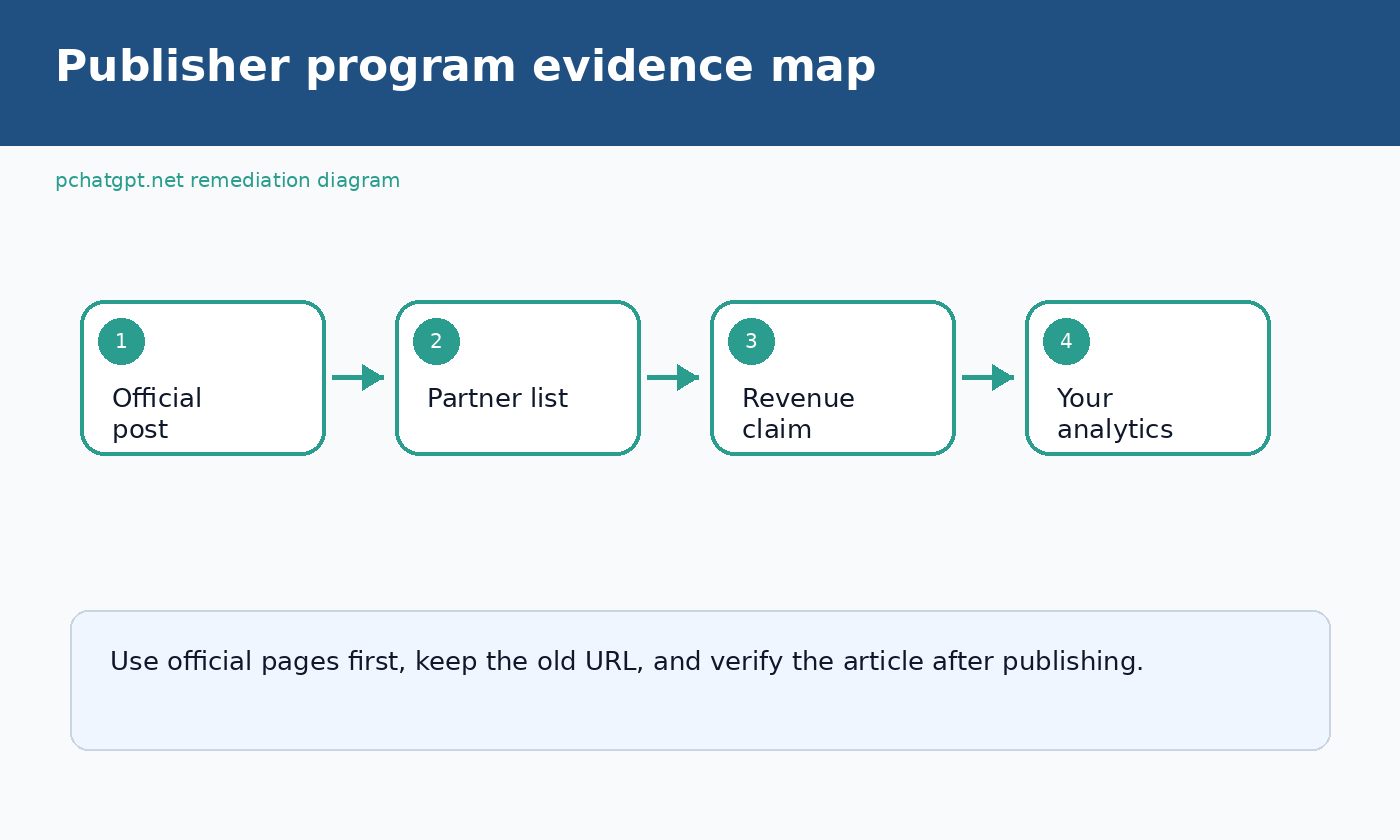
What Perplexity has publicly promised
The first announcement says Perplexity has included citations in its answers from the beginning. It connects those citations with publisher credit and user trust, then describes a program intended to support media organizations and online creators as the answer engine grows.[1] That wording matters. Citation is the baseline product behavior described in the post; formal program benefits are a separate layer available to partners.
Revenue sharing tied to referenced content
Perplexity said it planned to introduce advertising through related questions. Brands would be able to pay to place specific follow up questions in the answer interface and on Pages. When Perplexity earned revenue from an interaction in which a publisher’s content was referenced, the publisher would receive a share.[1] The later expansion post says participating publishers share revenue generated from advertising.[2]
This is more specific than a general promise to support journalism, but it still leaves important commercial questions open in the public material. Neither announcement gives a percentage, a sample calculation, a payment threshold, or a schedule for reporting and settlement. The posts also do not define every event that counts as an eligible interaction. A creator assessing a contract should therefore ask for the actual formula and definitions rather than model expected income from the announcement alone.
Tools publishers can use on their own sites
Program partners were offered free access to Perplexity’s Online LLM APIs and developer support. The launch post says a publisher could use those resources to build a custom answer engine that answers visitors’ questions while citing only that publisher’s content. It also says partners could integrate related questions into their stories.[1]
That benefit is different from referral traffic. It gives a publisher a possible on-site product, but the publisher would still need to decide what readers need, how answers should be presented, and how errors or weak citations will be handled. API access is an input, not a finished audience strategy. Ask who pays for implementation, what usage limits apply, how support works, and whether access continues if the partnership ends.
Research access and analytics
The original offer included one year of Enterprise Pro for all employees of a publisher partner. Perplexity described this version as having enhanced data privacy and security capabilities and positioned it as a research and fact checking tool for creators.[1] The expansion announcement repeated the one-year organization-wide benefit. It also said partners would receive analytics to track trends and content performance for as long as they stayed in the program.[2]
Analytics may be the most useful part of the offer for an editorial team trying to understand answer engines, but only if the measurements are clear. A dashboard can count citations, exposures, referrals, eligible interactions, or other events. Those numbers are not interchangeable. Publishers need a data dictionary and enough detail to reconcile platform reporting with their own analytics.
The distinction between citation, exposure, and a visit
A creator can be cited without receiving a visit. A source link may be visible, collapsed, attached to a sentence, or presented among several references. Even when a reader notices it, that reader may already have the information needed. This does not make citation meaningless. It does mean that citation volume should not be reported as website traffic.
Use separate terms in internal reports:
- Citation: the publisher’s page or domain appears as a source in an answer.
- Exposure: a user had a reasonable chance to see the citation, based on the platform’s stated measurement.
- Referral: a user clicked through to the publisher’s site.
- Engaged visit: the referred reader did something the publisher considers meaningful, such as reading further or joining a newsletter.
- Compensated interaction: an event that meets the program’s contractual revenue-sharing rules.
Only the last three can be connected directly to a publisher’s site analytics or commercial records, and even then attribution settings matter. Perplexity’s announcements do not claim that every citation produces a referral or a payment. They describe citations as a standard part of answers and revenue sharing as a program benefit tied to advertising revenue and referenced content.[1] Keeping those ideas separate prevents an impressive citation count from becoming an unsupported business projection.
Questions to settle before joining or depending on the program
Who is eligible, and what content is covered?
The two official posts identify launch partners and later additions, including publishers in the United Kingdom, Japan, Spain, and Latin America. They cover large news organizations, specialist publications, local reporting groups, and publishing platforms.[2] That variety shows the program was not limited to one editorial category. It does not establish open eligibility for every independent creator.
Ask whether participation is by invitation or application, whether an individual site can qualify, and whether all pages on an accepted domain are covered. A network should confirm how its member sites are treated. A creator using a hosted platform should also establish whether the platform’s participation gives the creator any direct reporting or financial rights. WordPress.com’s presence among the launch partners should not be treated as proof that every WordPress site automatically receives every program benefit.[1]
How is compensation calculated?
Request the current agreement, not a summary of the 2024 announcement. It should explain what revenue enters the pool, how referenced content is matched to an interaction, whether several cited publishers divide a share, and which deductions apply. Confirm payment currency, thresholds, timing, dispute procedures, and tax documentation. None of these details appears in the two public posts.
There is also a timing issue. The launch announcement described related-question advertising as something Perplexity would introduce in the coming months.[1] The December update says partners would share advertising revenue, but it does not publish operating results or a standard payout example.[2] Creators should verify the present product and terms rather than assuming the launch description still maps exactly to current practice.
What does the analytics dashboard measure?
Ask for field definitions before evaluating a dashboard. Does a citation count each generated answer, each user session, or each distinct source URL? Can the publisher see the query, country, device, answer placement, and destination page? Are bots and repeated requests removed? How long is data retained, and can it be exported?
Then compare platform data with first-party records. Use tagged links where available, inspect referrer information, and monitor landing-page behavior. A mismatch is not automatically evidence that either side is wrong. The systems may count different stages of the journey. The goal is to know what each number represents well enough to make editorial decisions without pretending that unlike measures are the same.
How are attribution and corrections handled?
The launch post says Perplexity updated how its systems index and cite sources and was gathering publisher feedback for its product roadmap.[1] That indicates citation behavior can change. Publishers should ask how they can report a missing citation, an incorrect attribution, a stale excerpt, or an answer that misrepresents the cited page. The response process needs an owner, a channel, and a reasonable expected time frame.
Run periodic checks using questions for which your site has strong, original material. Record whether the page is cited, where the citation appears, and whether the answer accurately reflects the article. Do not optimize around one test. Answer generation can vary, and a small manual sample cannot stand in for program analytics. It can, however, reveal obvious attribution problems worth escalating.
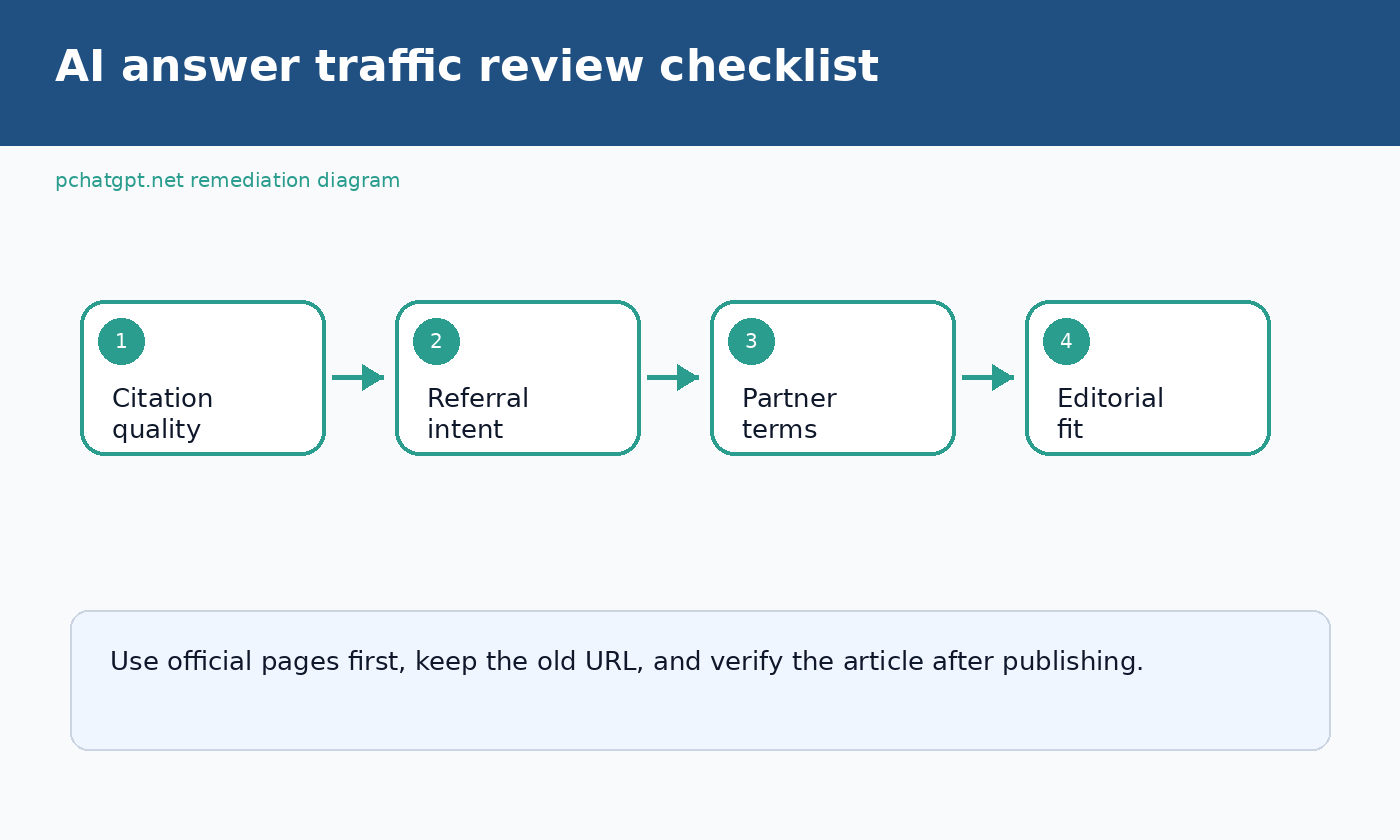
A practical measurement plan for creators
Start with a limited review period and a written baseline. Record existing referrals from Perplexity, the landing pages receiving them, engagement on those pages, and any measurable reader actions. Keep this baseline separate from referrals from conventional search or social platforms. If the site has no meaningful Perplexity traffic yet, that is still a useful starting point.
Next, build a small content sample. Include reporting or guides that are original, updated, and likely to answer a defined question. Avoid changing the entire editorial calendar in response to an untested distribution channel. For each page, note publication and update dates, referral sessions, engagement, citations reported by the partner tools, and any compensated interactions. Review the sample at a fixed interval.
Qualitative checks belong beside the numbers. Is the citation attached to the part of the answer your page supports? Does the answer preserve qualifications from the article? Is another site credited for your original work? Does the referral land on the correct canonical page? These checks help a publisher distinguish a traffic question from an attribution or content-quality problem.
For a broader look at answer engines and creator strategy, see what answer engines mean for creators. When testing generated answers, use a repeatable source-checking process rather than accepting fluent output at face value. This guide to research, deep research, and verification explains the habits that make those checks more reliable.
Build for direct readers as well as answer engines
A partnership can add distribution, tools, and data, but it should not become the only route between a creator and an audience. Keep investing in reasons to visit the original page: firsthand reporting, useful context, transparent sourcing, clear corrections, and material that cannot be reduced cleanly to a short answer. Once a referred reader arrives, the site should make the next useful action obvious without burying the article under prompts.
Maintain channels the publisher can reach directly, such as email subscriptions or member accounts, when those channels fit the publication. The point is not to reject AI discovery. It is to avoid confusing access to a third-party product with ownership of the reader relationship. Program terms, answer layouts, citation practices, and advertising products can change. A direct audience gives the publisher a steadier reference point when evaluating those changes.
Perplexity said in its first announcement that the program could adapt and mentioned bundled subscriptions as one possible future collaboration.[1] That language is a proposal, not a commitment that a specific bundle will be available to every partner. Treat future features the same way: evaluate them when terms, technical requirements, and reporting are concrete.
A decision standard that does not depend on hype
The Publishers Program has identifiable components. Perplexity publicly described advertising revenue sharing, API access with developer support, employee access to Enterprise Pro for one year, and partner analytics.[1][2] It also expanded the partner list after launch and reported interest from more than 100 publishers in the December 2024 post.[2] Those facts show activity around the program, but they do not establish a typical result for an individual creator.
A sensible decision rests on verifiable terms and observed outcomes. Join or test the program if the agreement is understandable, the reporting can be audited, the integration cost is proportionate, and the relationship improves something the publication already values. Reassess if citation grows without useful referrals, if compensation cannot be reconciled, or if technical work absorbs more resources than the benefits justify.
Most of all, avoid building a forecast from the word “citation.” Ask what was displayed, what was clicked, what was compensated, and what the publisher learned. That is a less exciting story than guaranteed AI traffic, but it is the one the available evidence supports.
FAQ
Does a Perplexity citation guarantee traffic to a publisher?
No. The official announcements say Perplexity includes citations in answers, but they do not promise that every citation will produce a click or a visit.[1] Publishers should measure referrals in their own analytics and keep citation counts separate.
Does every cited creator receive revenue sharing?
The public posts describe revenue sharing as a benefit for publishers in the program. They do not say that every site cited by Perplexity automatically receives payment.[1] A creator should confirm eligibility and obtain the current agreement before expecting compensation.
What benefits did Perplexity announce for program partners?
The launch post listed advertising revenue sharing, free access to Online LLM APIs with developer support, and one year of Enterprise Pro for partner employees. The later post also described analytics for partners while they remain in the program.[1][2]
What should a small publisher verify first?
Confirm whether the site is eligible and which content is covered. Then ask for the revenue formula, analytics definitions, payment rules, correction process, API limits, and exit terms. Compare reported citations and interactions with first-party referral and engagement data before changing the publication’s strategy.
Sources
- Perplexity, “Introducing the Perplexity Publishers’ Program,” July 30, 2024.
- Perplexity, “Perplexity expands publisher program with 15 new media partners,” December 5, 2024.
Related update: Perplexity AI Raises $1B for Answer Engine Expansion: What It Means for Global Content Creators.