
The old claim that DeepSeek V4 would run on Huawei chips mixed a model release with a hardware deployment prediction. Those are no longer the same question. DeepSeek’s official API documentation now lists DeepSeek V4 model names, so the model family itself is not merely a rumor. However, that API listing does not identify the processors behind the hosted service. The current official materials reviewed for this update do not establish a general, production-ready DeepSeek V4 deployment on Huawei Ascend hardware.
The useful conclusion is narrower: DeepSeek V4 is available through DeepSeek’s service, Huawei has an Ascend software stack for model inference, and earlier DeepSeek releases have documented Ascend paths. None of that automatically proves that a particular V4 checkpoint, precision, server configuration, or workload works on a particular Huawei system. This guide explains what is verified, what remains unverified, and how to test a deployment claim without filling gaps with guesses.
DeepSeek V4 and Huawei Ascend: the short answer
- Verified model fact: the official DeepSeek API documentation lists DeepSeek V4 service model identifiers and shows how to call them.
- Verified platform fact: Huawei publishes MindIE information for inference on Ascend and maintains the CANN software stack.
- Verified precedent: DeepSeek’s official DeepSeek V3 repository says the BF16 version of V3 was adapted to Huawei Ascend NPUs through MindIE.
- Not established by those facts: they do not prove that every DeepSeek V4 variant or weight package can be deployed on every Ascend product, nor do they prove production performance, training support, capacity, cost, or availability.
That distinction matters because “runs on Huawei chips” sounds binary while deployment is a chain of dependencies. A model may load but fail on a required operator. It may return a valid answer but miss latency targets. A hosted endpoint may use undisclosed infrastructure. A vendor demonstration may use code or weights that customers cannot obtain. Treat compatibility as a testable statement with a defined scope, not as a slogan.
Start with the exact DeepSeek model you can identify
A model name in an API request is not necessarily a downloadable checkpoint name. An API alias can be updated behind the same identifier, while a local deployment needs an exact artifact, architecture, tokenizer, configuration, license, and revision. Record whether the claim concerns DeepSeek’s hosted API, open weights, a partner distribution, or an internal build. If the claimant cannot say which one, there is not yet enough information to reproduce the result.
For the hosted service, the DeepSeek API page is the primary reference. It verifies which public service identifiers DeepSeek accepts and provides request examples. It does not reveal the service’s accelerator vendor. An API response can confirm that an endpoint works, but it cannot prove the endpoint ran on Ascend. Hardware attribution requires a separate statement or evidence from the operator of that infrastructure.
For open releases, use the model owner’s repository and model card. The official DeepSeek V3 repository is a useful example because it describes architecture, weights, precision options, and supported inference routes. It explicitly mentions MindIE adaptation for V3 in BF16. That is meaningful evidence for V3, but it should not be silently carried forward to V4. Changes in attention, routing, quantization, kernels, or serving behavior can turn a working V3 path into an incomplete V4 path.
DeepSeek’s official V3.2 experimental repository illustrates another reason to check the exact release. Its documentation distinguishes model architecture, inference code, and accelerator-specific containers. A nearby version can have different implementation requirements. Compatibility belongs to a versioned combination, not to the brand name alone.
What the Huawei software layer actually proves
Huawei’s Ascend platform is more than a chip. CANN supplies the heterogeneous computing software foundation, while MindIE focuses on model inference and serving. A deployment also depends on firmware, drivers, operating system support, framework integration, collective communication, kernels, memory management, and service configuration. The presence of MindIE support is a necessary signal for some deployment paths, but a product page alone is not a compatibility certificate for an unnamed V4 build.
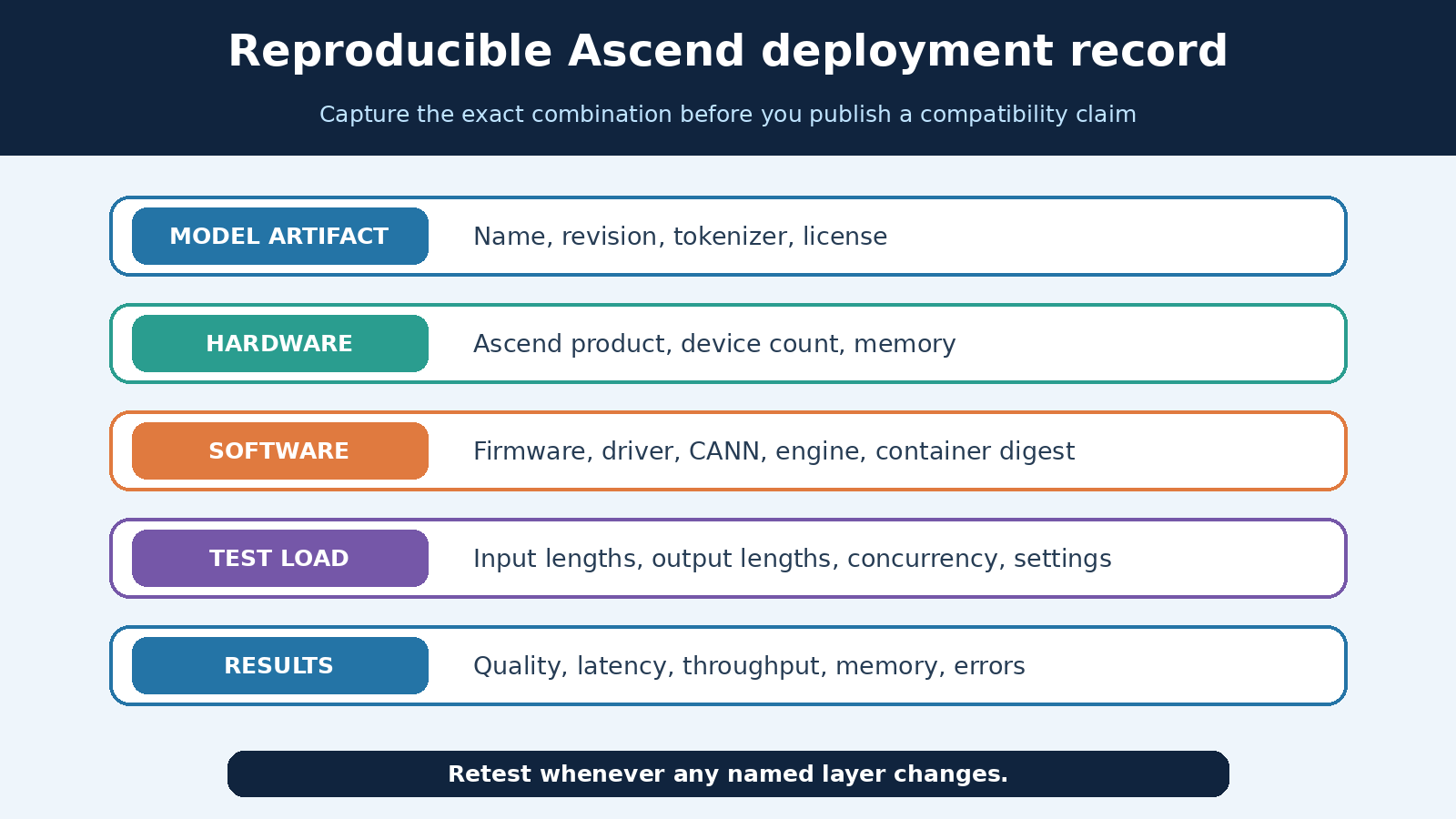
Ask for the complete environment matrix: Ascend product, number of devices, memory per device, firmware, driver, CANN version, MindIE or another engine version, container digest, model artifact revision, precision, quantization method, parallelism settings, and maximum tested sequence length. These are not decorative details. They define what “works” means and allow another team to recreate the setup.
Also separate inference from training. The fact that a model can generate tokens on an NPU says nothing by itself about pretraining or fine-tuning support. Training introduces optimizer state, gradient communication, checkpointing, numerical stability, and a very different memory profile. If the evidence shows inference, describe it as inference. If it shows a limited fine-tuning method, do not upgrade that into a claim about full training.
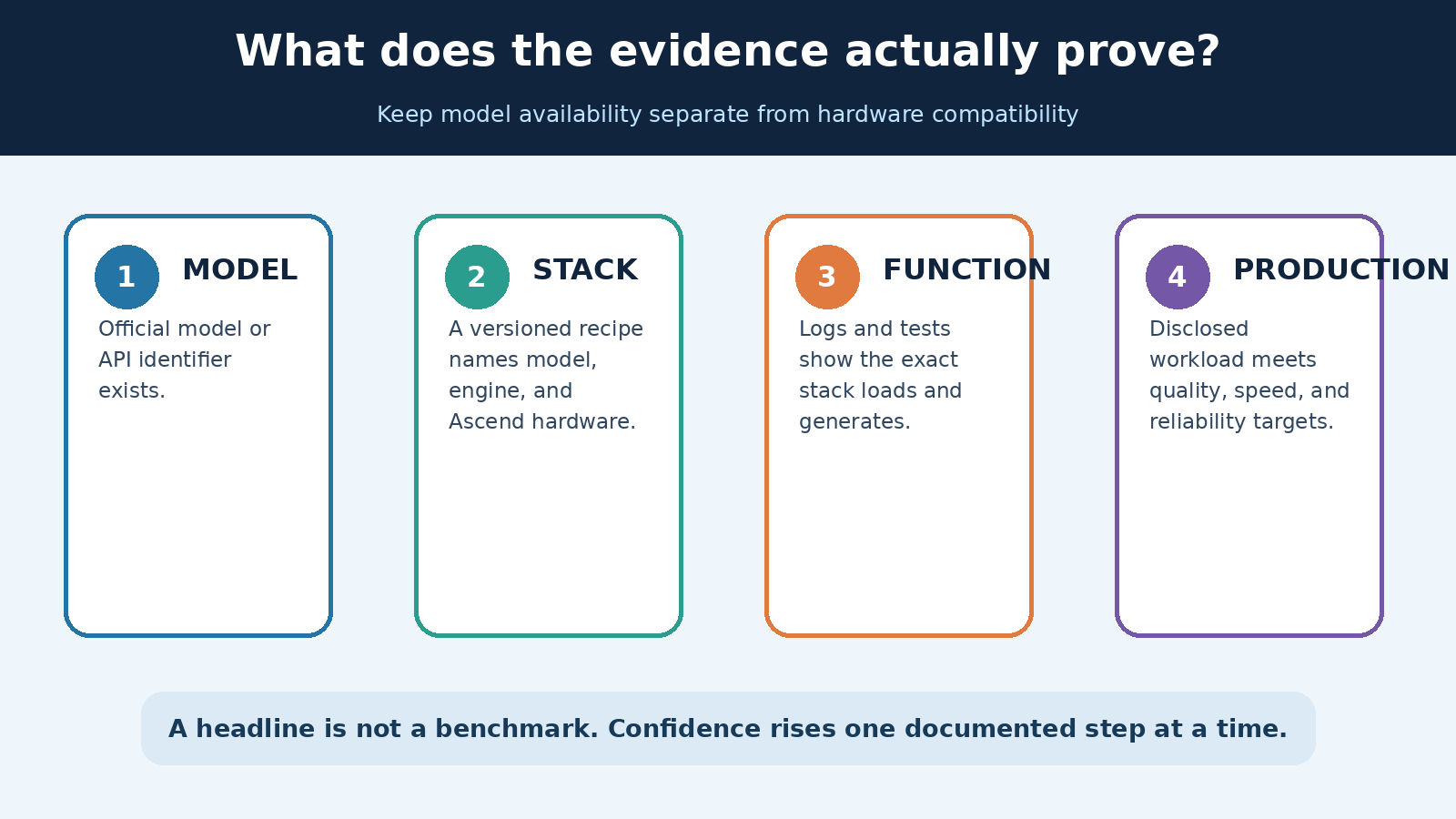
Four levels of evidence for a compatibility claim
A practical review gets easier when evidence is sorted by strength.
- Availability evidence: a model owner lists an API model, publishes weights, or identifies a release. This proves that the named model exists in that channel.
- Compatibility evidence: a versioned support matrix, official deployment recipe, or maintained implementation names the model artifact and hardware. This supports a specific path, not every path.
- Functional evidence: logs, health checks, deterministic prompts, and output validation show that the exact stack loads and serves correctly.
- Production evidence: a disclosed benchmark and operational trial show useful throughput, latency, reliability, and output quality under a representative workload.
A press headline usually provides only the first level, sometimes less. A deployment decision needs all four. The honest answer can therefore be “the model is verified, the platform exists, but this exact pairing still needs a reproducible recipe and workload test.” That answer is more useful than either dismissing the possibility or declaring victory early.
How to validate DeepSeek V4 on an Ascend system
Begin with a written claim. For example: “This exact model artifact can serve text generation on this Ascend cluster, using this software image and precision, at this sequence length.” Add measurable acceptance criteria. Without that sentence, teams can run different tests and still believe they evaluated the same thing.
Next, collect the primary documentation. Check DeepSeek for the model or API identifier and any downloadable artifact. Check Huawei’s compatibility information, release notes, and deployment documentation for the exact engine version. If an integration partner supplies the recipe, record that it is partner evidence rather than a statement from DeepSeek or Huawei. Save page dates, version numbers, image digests, and repository commits because rolling documentation can change.
Then conduct a minimal load test in an isolated environment. Confirm that model files are intact, the tokenizer matches, all devices are visible, the engine recognizes the architecture, and startup completes without silently falling back to another backend. Capture configuration and logs. A single attractive response is weak evidence because many serving layers can route requests elsewhere. Network isolation or endpoint tracing can help establish where inference occurred.
After the model loads, test correctness before speed. Use a fixed prompt suite that covers short and long inputs, structured output, multilingual text if relevant, tool-call formatting if supported, refusal behavior, and edge cases important to the application. Compare outputs or task scores with a trusted reference under settings that are as similar as possible. Precision changes and custom kernels can affect quality even when generation appears normal.
Only then measure performance. Report time to first token, inter-token latency, end-to-end latency, throughput, concurrency, peak device memory, host memory, error rate, and restart behavior. State prompt length, generated length, batch policy, warmup, sampling settings, request distribution, and measurement window. An isolated short-prompt result should not be presented as a production capacity forecast.
Design a benchmark that answers your real question
Suppose you ask whether an Ascend deployment is “fast enough.” That question has no answer until fast enough is connected to a service. An interactive assistant may prioritize first-token latency. A document pipeline may prioritize tokens per hour. A coding service may need long context and stable structured output. An internal batch job may tolerate latency but require predictable completion and low failure rates.
Use production-shaped input distributions instead of one convenient sequence length. Include concurrency ramps, cold starts, long-running requests, cancellation, overload, and recovery after a worker or network fault. Keep the prompt set and scoring method fixed when comparing hardware or software versions. Publish unsuccessful runs as well as successful ones, because operator failures and memory limits define the usable envelope.
Do not invent a price comparison from hardware labels. A defensible cost model needs quoted acquisition or service terms, utilization, power, cooling, networking, support, staffing, spare capacity, and the measured throughput of the tested configuration. If those inputs are unavailable, report technical measurements and leave the cost conclusion open. Readers interested in the broader local deployment tradeoffs can also use this guide to local LLM tools and models.
Red flags in DeepSeek hardware reports
- The report says “DeepSeek V4” but gives no API alias, checkpoint, revision, or artifact source.
- “Huawei chips” is used without an Ascend product, device count, memory, or software versions.
- A V3 or distilled-model deployment is offered as proof for V4.
- A hosted API call is treated as proof of the server’s hardware.
- A successful startup is treated as proof of output quality and sustained performance.
- Peak tokens per second appears without prompt lengths, concurrency, warmup, precision, or error rate.
- Inference support is described as training support.
- A vendor slide is cited while the deployment recipe, logs, and benchmark method remain unavailable.
None of these red flags proves that a claim is false. They show that the claim is underspecified. Ask for the missing evidence and adjust confidence to match what can be inspected. This approach also works for other forward-looking infrastructure stories, including claims about a new accelerator architecture. For an example of separating a published roadmap from deployment reality, see this guide to NVIDIA’s Rubin architecture and timeline.
A decision record for engineering teams
End the evaluation with a one-page decision record. Name the model artifact, hardware, software image, owner, test date, workload, quality checks, performance results, unresolved risks, and the evidence links. Give the result one of four labels: documented only, loads successfully, validated for the test workload, or approved for production. This prevents a narrow lab success from turning into a company-wide compatibility claim through repetition.
Set a retest trigger for any change to weights, tokenizer, serving engine, CANN, driver, firmware, precision, quantization, parallelism, or hardware. Model and accelerator stacks move quickly, and an old result can become misleading even when every sentence was accurate on the day it was written. Versioned evidence is the cure.
FAQ
Is DeepSeek V4 officially available?
Yes, DeepSeek’s official API documentation currently lists V4 service model identifiers. That verifies availability through the documented DeepSeek API channel. It does not, by itself, identify downloadable weights or the hardware used to operate the hosted service.
Does DeepSeek officially confirm that V4 runs on Huawei Ascend?
The official sources reviewed for this update do not provide enough information to make a general claim that DeepSeek V4 runs in production on Huawei Ascend. DeepSeek does document a MindIE path for the BF16 version of V3, which is evidence for that specific earlier model and configuration, not automatic proof for V4.
What would prove a DeepSeek V4 Ascend deployment?
A strong proof package would identify the exact model artifact, Ascend hardware, firmware, driver, CANN and serving-engine versions, precision, configuration, and container digest. It would include startup and device logs, functional tests, quality checks, and a reproducible benchmark under a disclosed workload. Production approval also requires reliability and operational testing.
Can V3 compatibility be used to predict V4 compatibility?
It is useful precedent, but not proof. A later model may change operators, attention behavior, routing, memory needs, precision support, or serving code. V3 compatibility makes a V4 port plausible, yet the exact V4 release still needs a versioned implementation and direct validation.
Bottom line
DeepSeek V4’s API availability is verifiable. Huawei’s Ascend inference software is verifiable. DeepSeek V3’s documented MindIE adaptation is verifiable. A broad statement that DeepSeek V4 runs on Huawei chips is not established merely by combining those facts. Keep the model claim and hardware claim separate, define the exact stack, and move from documentation to functional, quality, performance, and operational evidence. That is how a promising compatibility story becomes an engineering result you can trust.