
Correction notice: An earlier version of this page overstated a funding discussion as a completed $1 billion raise. That statement was not supported by the cited reporting. The page has been corrected and reframed as a guide to verifying AI funding claims.
Funding news moves quickly, and a single missing verb can turn a tentative conversation into an event that never happened. The difference between “is in talks to raise” and “has raised” is not stylistic. One describes negotiations that may change or fail. The other says money was secured through a completed financing.
Perplexity provides a useful case study. On March 20, 2025, CNBC reported that the company was in early talks to raise between $500 million and $1 billion at an $18 billion post-money valuation. CNBC attributed the information to a source familiar with the situation. The report did not say that Perplexity had completed a $1 billion round.
The distinction matters for anyone writing about startups, AI companies, or private markets. A headline can be numerically accurate yet still be false if it assigns the wrong status to the number. This guide shows how to identify that problem before publication and how to correct it when it slips through.
What the reporting actually established
The March 2025 CNBC report supports a narrow set of statements. Perplexity was in early funding talks. The amount under discussion ranged from $500 million to $1 billion. The proposed post-money valuation was $18 billion. CNBC said the information came from a source familiar with the talks and reported that Perplexity’s valuation in December had been $9 billion.
Those facts support wording such as, “Perplexity was reported to be discussing a round of $500 million to $1 billion.” They do not support, “Perplexity raised $1 billion.” They also do not prove that a round later closed on the same terms. To make that later claim, a writer would need a subsequent source that explicitly reported completion.
There is a useful contrast in earlier reporting. On April 23, 2024, Bloomberg reported that Perplexity had raised about $63 million in a new funding round that valued the company at more than $1 billion. Here, “had raised” describes financing as completed, while “valued at” describes the resulting valuation. The amount invested and the company valuation were separate figures.
Five numbers that writers often confuse
Amount raised is the capital secured in a financing. A source should use completion language such as “raised,” “closed,” or “announced the completion of” before a writer treats the amount as final.
Target amount is what a company hopes to obtain. A target can be a single figure or a range. It may rise, fall, or disappear during negotiations, so it must keep a qualifier such as “seeking” or “in talks to raise.”
Valuation is an estimate of the company’s value under the terms of a transaction. It is not cash received. A company discussing a $1 billion investment at an $18 billion post-money valuation is not thereby raising $18 billion.
Post-money valuation refers to valuation after the contemplated investment is included. Writers do not need to calculate ownership percentages unless the source supplies enough terms and the article genuinely requires that analysis. Repeating the reported valuation with its label is safer than improvising.
Annualized revenue, including annual recurring revenue when a source uses that measure, describes revenue pace, not financing. It should never be added to a funding amount or treated as part of a valuation. Revenue and capital raised answer different questions.
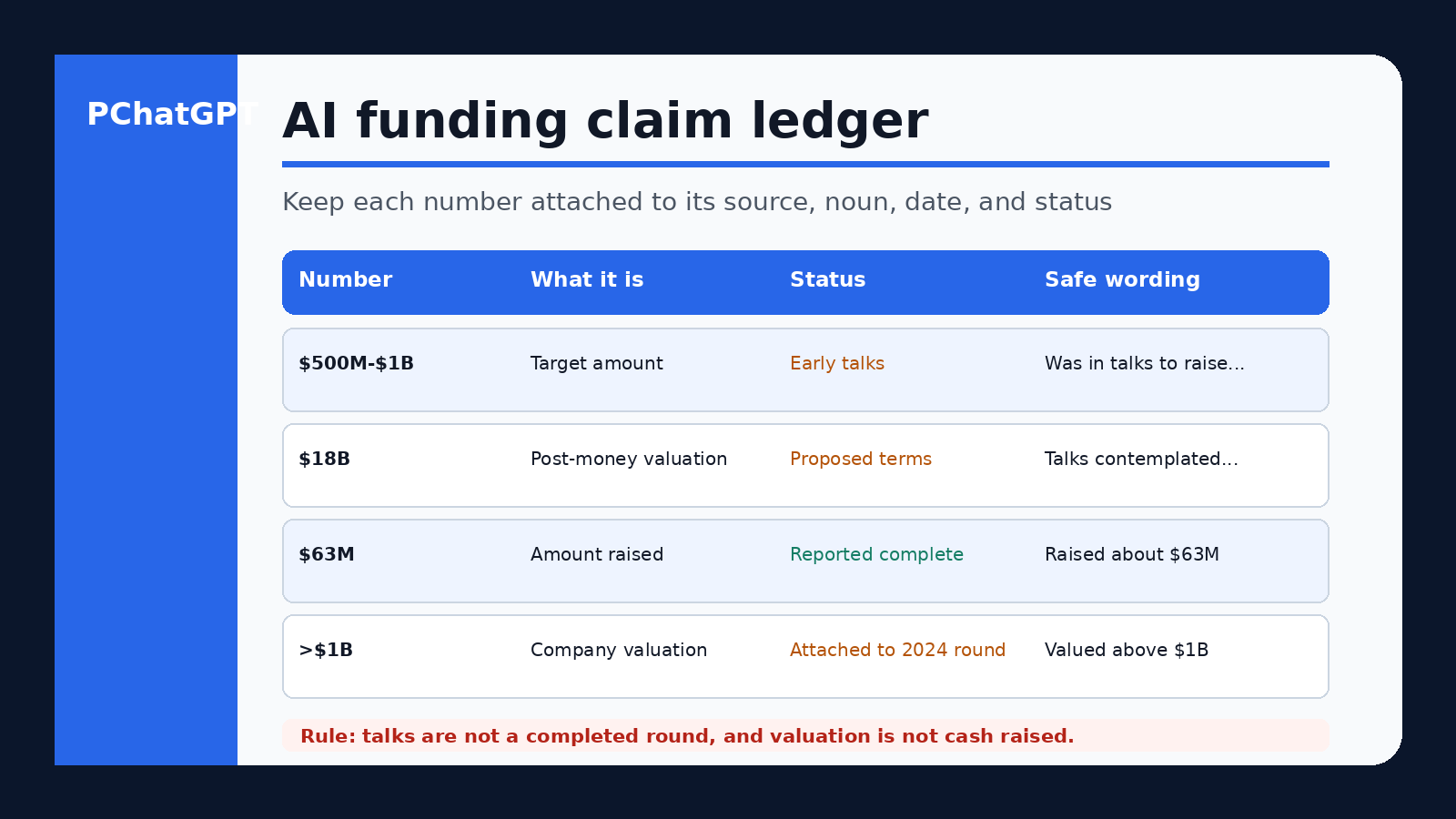
A claim ledger for the Perplexity case
| Claim element | What the source says | Status | Safe wording |
|---|---|---|---|
| March 2025 amount | $500 million to $1 billion | Early talks | Was in early talks to raise between $500 million and $1 billion |
| March 2025 valuation | $18 billion post-money | Proposed terms reported by CNBC | The talks contemplated an $18 billion post-money valuation |
| December valuation | $9 billion | Prior valuation reported by CNBC | CNBC said the December valuation was $9 billion |
| April 2024 financing | About $63 million | Reported as raised | Bloomberg reported that Perplexity raised about $63 million |
| April 2024 valuation | More than $1 billion | Valuation attached to the completed round | The round valued the company at more than $1 billion |
A claim ledger forces each number to carry its date, source, noun, and status. Without those fields, a writer may accidentally join a funding amount from one report to a valuation or completion status from another. The ledger also makes review faster because an editor can compare every sentence with the exact proposition the source supports.
Primary sources and secondary reporting
A primary source comes from a participant or an official record, such as a company announcement or a filing. It can provide direct evidence that a round closed, but it may omit context or present terms selectively. A secondary source is reporting produced by a news organization. It may add independent sourcing and explanation, though some details can rely on unnamed people familiar with private discussions.
Neither label is a shortcut for truth. Ask what a source is in a position to know, what it actually states, and whether another reliable source confirms the same event. In the CNBC case, the attribution matters because the claim concerned confidential, early talks. The wording must preserve both the preliminary status and the source’s distance from the negotiation.
For a broader research process, use our guide to research with ChatGPT Search, Deep Research, and verification. Search tools can help locate reports, but the writer still has to open the source, check its date, and read the sentence surrounding each number.
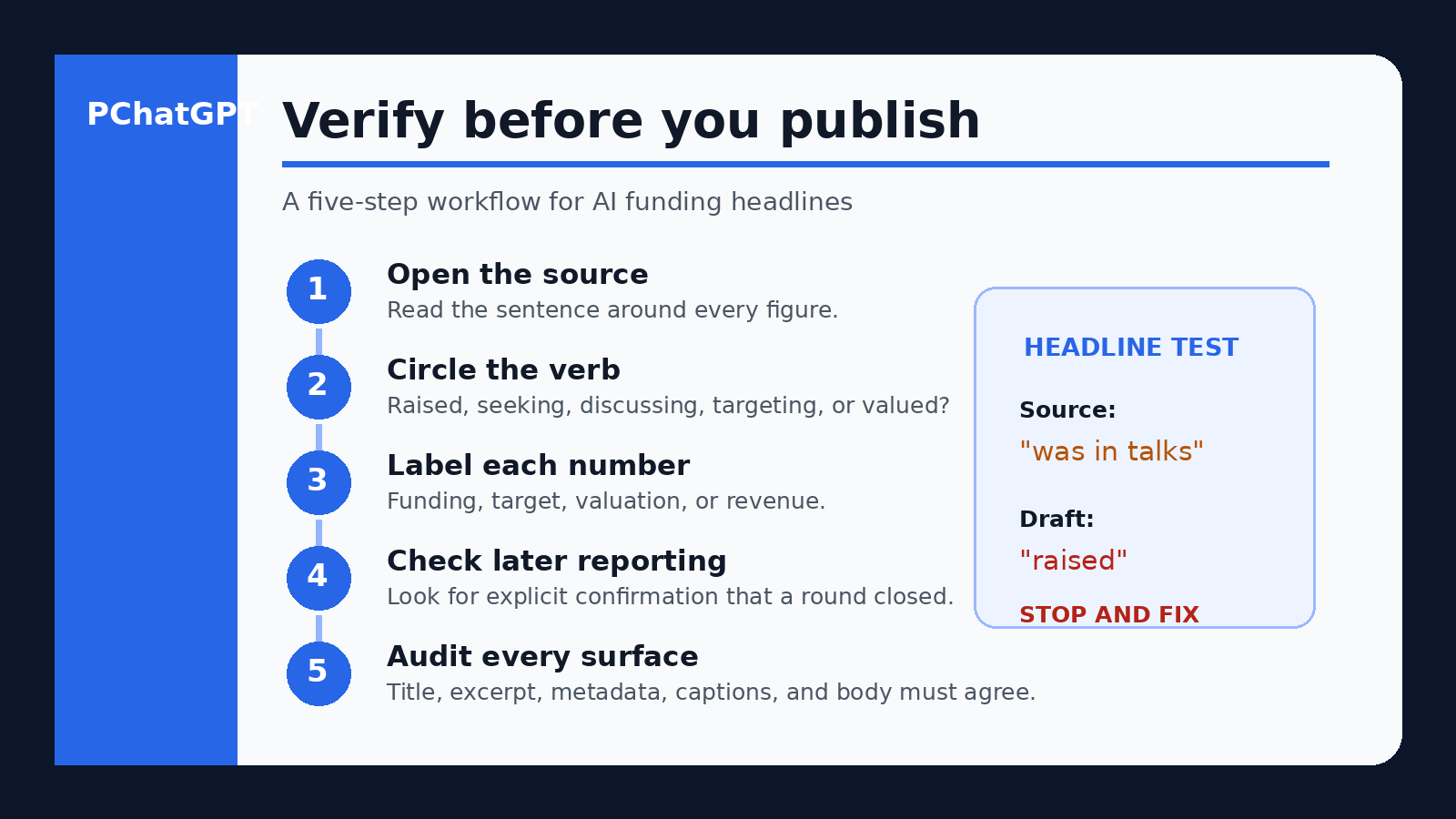
Practical prepublication checklist
- Copy the exact sentence that contains the funding claim into your notes.
- Circle the operative verb: “raised,” “seeking,” “discussing,” “targeting,” or “valued.”
- Record the publication date and the date of the event, if the source gives one.
- Label every figure as amount raised, target, valuation, or revenue.
- Preserve ranges. Do not convert “$500 million to $1 billion” into “$1 billion.”
- Note whether the source is the company, a filing, a named participant, or an unnamed person familiar with the matter.
- Search for a later report that says whether the talks ended in a closed round.
- Draft the headline last, then compare its verb with the source’s verb.
- Check that the headline, excerpt, image caption, and body all describe the same status.
- Keep the source links in the published article so readers can inspect the evidence.
One final test catches many errors: remove the dollar figures and read only the verbs. If the source says “was in talks” but the draft says “raised,” the article has changed a possibility into a fact.
Audit the whole publishing package
Correct body copy can still be undermined by a careless title or summary. Review every place where the claim appears, including the page title, search snippet, social description, image text, newsletter subject line, and internal anchor text. Each version should preserve the same date and level of certainty.
Be especially wary of compression. Short formats encourage writers to drop words such as “reportedly,” “talks,” or “up to,” yet those words may carry the central factual distinction. If the accurate claim does not fit, shorten the background rather than the qualification. “Perplexity discussed funding at an $18 billion valuation” is brief and still signals that the financing was under discussion.
Archive your notes with the final article. A small record containing the source URL, publication date, quoted sentence, and approved wording gives future editors a way to review the claim without reconstructing the research. It also makes later updates easier when a negotiation produces a new report.
How to correct a funding claim
A quiet rewrite hides the editorial record. A useful correction names the error, supplies the accurate wording, and tells readers that the page changed. The notice should appear where a returning reader can find it, not only in revision history.
- Freeze the disputed claim and save the source that was used.
- Check the source’s exact verb, amount, date, valuation type, and attribution.
- Replace unsupported completion language throughout the title, excerpt, body, captions, and metadata.
- Add a dated correction note that states what was wrong and what is now accurate.
- Retain links to the evidence and inspect internal links or social previews that may repeat the old claim.
- After publication, open the public page and confirm that the correction and revised metadata appear.
For transparency, this page keeps its original URL so existing links lead readers to the correction instead of preserving the error. A related guide on the Perplexity publisher program explains what creators should verify before relying on AI answer traffic.
FAQ
Did Perplexity raise $1 billion in March 2025?
The cited CNBC report did not establish that. It said Perplexity was in early talks to raise between $500 million and $1 billion at an $18 billion post-money valuation. A completed $1 billion raise would require later, explicit confirmation.
Is an $18 billion valuation the same as $18 billion raised?
No. The valuation describes the company’s value under the reported terms. The contemplated investment amount in CNBC’s report was between $500 million and $1 billion.
Why can a funding range not be shortened to its upper limit?
The upper limit is only one possible outcome under discussion. Removing the lower bound makes the report sound more definite and can mislead readers about both size and certainty.
What should a creator do when no later source confirms a round?
Keep the original status and date: the company “was reported to be in talks” at that time. Do not infer completion from silence, repetition by other sites, or the passage of time.