Reasoning models are becoming a practical part of enterprise AI, not because every task needs deeper thinking, but because some business workflows require planning, tool use, ambiguity handling, and careful review before an answer is trusted. OpenAI describes reasoning models as models that use internal reasoning tokens before producing a response, which can help them plan, inspect alternatives, recover from ambiguity, and solve harder multi-step tasks. For enterprise teams, the important question is not simply which model is most capable. The better question is how to evaluate reasoning where it matters, route work to the right level of reasoning, and keep humans involved when decisions carry operational, legal, security, or customer impact.
This draft takes a neutral implementation view. It does not assume that reasoning models should replace existing automation, subject matter experts, or governance programs. Instead, it treats them as one class of AI component inside a broader system. The goal is to help product, engineering, risk, and operations teams design a reliable operating model around reasoning: choose the right jobs, test the model against real criteria, route requests by risk and complexity, and maintain human review where confidence and accountability matter.
What makes reasoning models different for enterprise use
OpenAI’s reasoning guide explains that reasoning models use reasoning tokens in addition to input and output tokens. These tokens are not visible through the API, but they still occupy context window space and are billed as output tokens. This distinction matters in enterprise settings because hidden reasoning work can improve the quality of difficult responses, while also affecting latency, token budget, and completion behavior.
Reasoning models are especially relevant when the task is not a single retrieval or classification step. Examples include planning a remediation sequence, analyzing conflicting business evidence, producing structured recommendations from multiple files, or using tools in a multi-step workflow. OpenAI’s o3 and o4-mini announcement also describes reasoning models that can use tools, reason about when to use them, and combine tool outputs to answer more complex questions. That makes them useful candidates for agentic workflows, but it also makes evaluation and oversight more important.
Enterprises should avoid treating reasoning as a magic quality setting. A reasoning model can be more suitable for some tasks and unnecessarily expensive or slow for others. A fast model or a low reasoning setting may be enough for routine information retrieval, short drafting, or simple classification. A higher reasoning setting may be more appropriate when the work requires planning, judgment, debugging, research, or a sequence of tool calls. The practical challenge is to draw that boundary clearly enough that systems can route work consistently.
Start with task categories, not model names
A durable enterprise design begins by dividing AI work into categories. One category might include routine, low-risk tasks such as summarizing a public document or classifying an inbound support request. Another might include moderate complexity tasks such as drafting a customer response from approved knowledge sources. A third might include high-value tasks such as security review, financial analysis, incident triage, legal support, or product decisions that require a human owner.
This task-based approach helps teams avoid premature debates over model branding. The same application may need more than one route. A customer support system might use a lower latency path for intent detection, a medium reasoning path for resolving a multi-part issue, and a human review path before issuing an exception, refund, or policy-sensitive message. A software engineering assistant might use ordinary generation for simple edits, but stronger reasoning for complex debugging or repository-wide planning.
Task categories should be written in operational language. Instead of saying that complex questions use a reasoning model, define what complexity means. Signals may include multi-step instructions, conflicting evidence, tool use, retrieval from multiple sources, regulated content, customer impact, security impact, or low tolerance for error. These signals later become routing inputs and evaluation dimensions.
Evaluation should measure the workflow, not only the answer
Enterprise evaluation for reasoning models should begin with realistic tasks taken from the intended workflow. A model that performs well on a generic benchmark may still fail a company-specific policy, format, audit, or escalation requirement. The evaluation set should include normal cases, edge cases, ambiguous requests, incomplete information, and prompts that should trigger refusal, clarification, escalation, or tool use.
For each test case, define what a good result means before running the model. Criteria can include factual consistency with provided sources, correct use of available tools, adherence to output format, transparent uncertainty, appropriate escalation, and avoidance of unsupported claims. For business workflows, it is often useful to grade the final answer and the process outcome separately. A response can be fluent but still wrong because it skipped a required source, failed to ask for missing context, or acted beyond its approval boundary.
OpenAI’s reasoning guide recommends giving reasoning-capable models a clear goal, strong constraints, and an explicit output contract, without prescribing every intermediate step. That advice translates well to evaluation. Each test should specify the user goal, the available context, the policy or source boundary, and the expected form of completion. The scoring rubric should then reflect whether the model followed those constraints, not whether the answer merely sounded convincing.
Use human review to calibrate automated grading
Automated checks can find many defects, including missing fields, invalid JSON, unsupported citations, or prohibited actions. They are less reliable for subtle judgment calls. Human reviewers should therefore inspect a sample of outputs, especially during early deployment and after any model, prompt, tool, or policy change. Reviewers can identify failure modes that automated tests miss, such as overconfidence, poor prioritization, or a technically correct answer that is inappropriate for a customer-facing context.
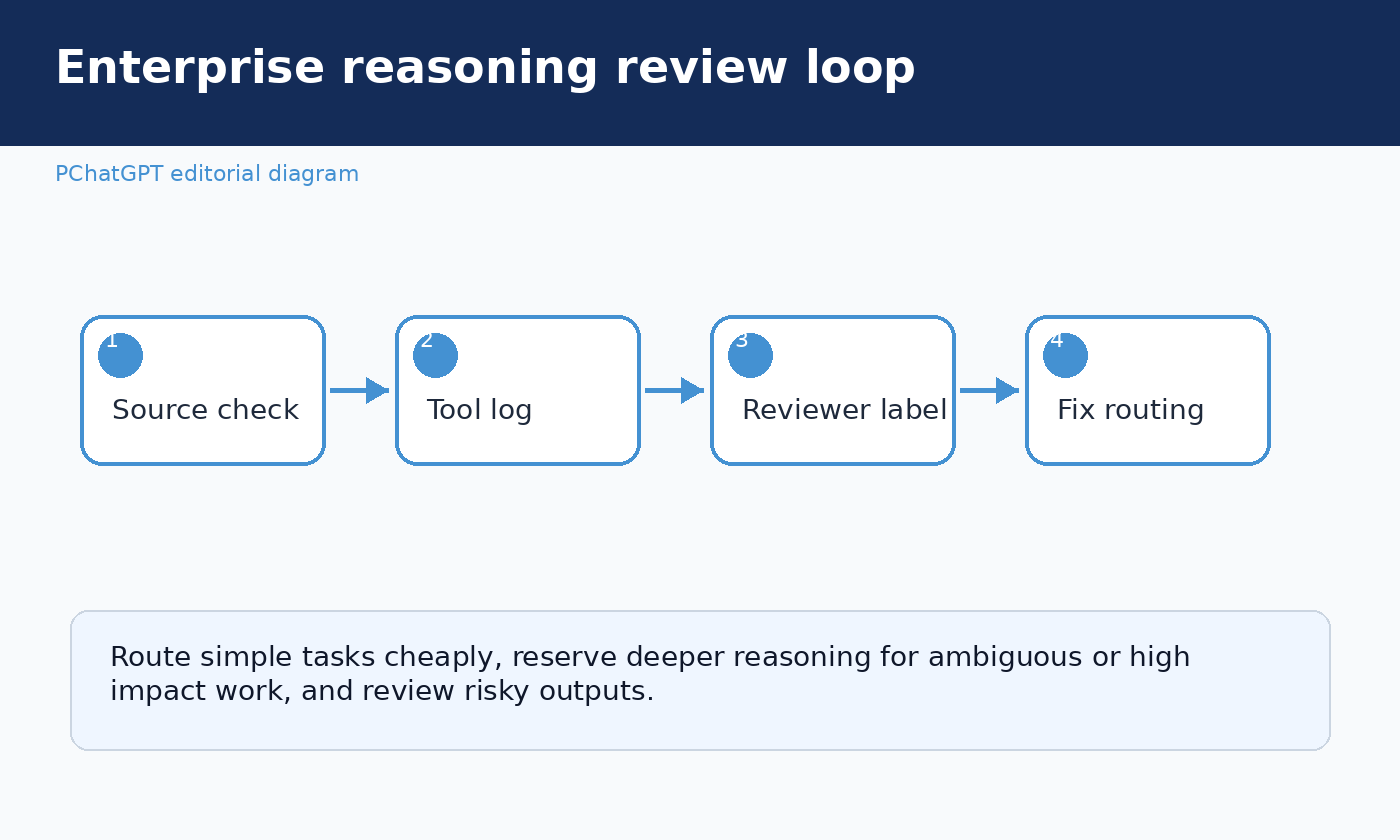
The review process should produce reusable labels. Instead of writing freeform comments only, reviewers can tag defects such as unsupported claim, wrong source, missed escalation, risky tool use, incomplete answer, privacy issue, or unclear uncertainty. Over time, those labels make evaluation more consistent and help teams decide whether to adjust prompts, change routing rules, add guardrails, or keep the task under human control.
Routing is the control layer between cost, speed, and risk
OpenAI documents the reasoning.effort parameter as a way to guide how much the model should think when performing a task. Supported values are model-dependent and can include options such as none, minimal, low, medium, high, xhigh, and max. Lower effort favors speed and lower token usage, while higher effort can support more complete reasoning for complex tasks. The guide also notes that some models support only a subset of values, so teams should check the relevant model documentation before choosing a setting.
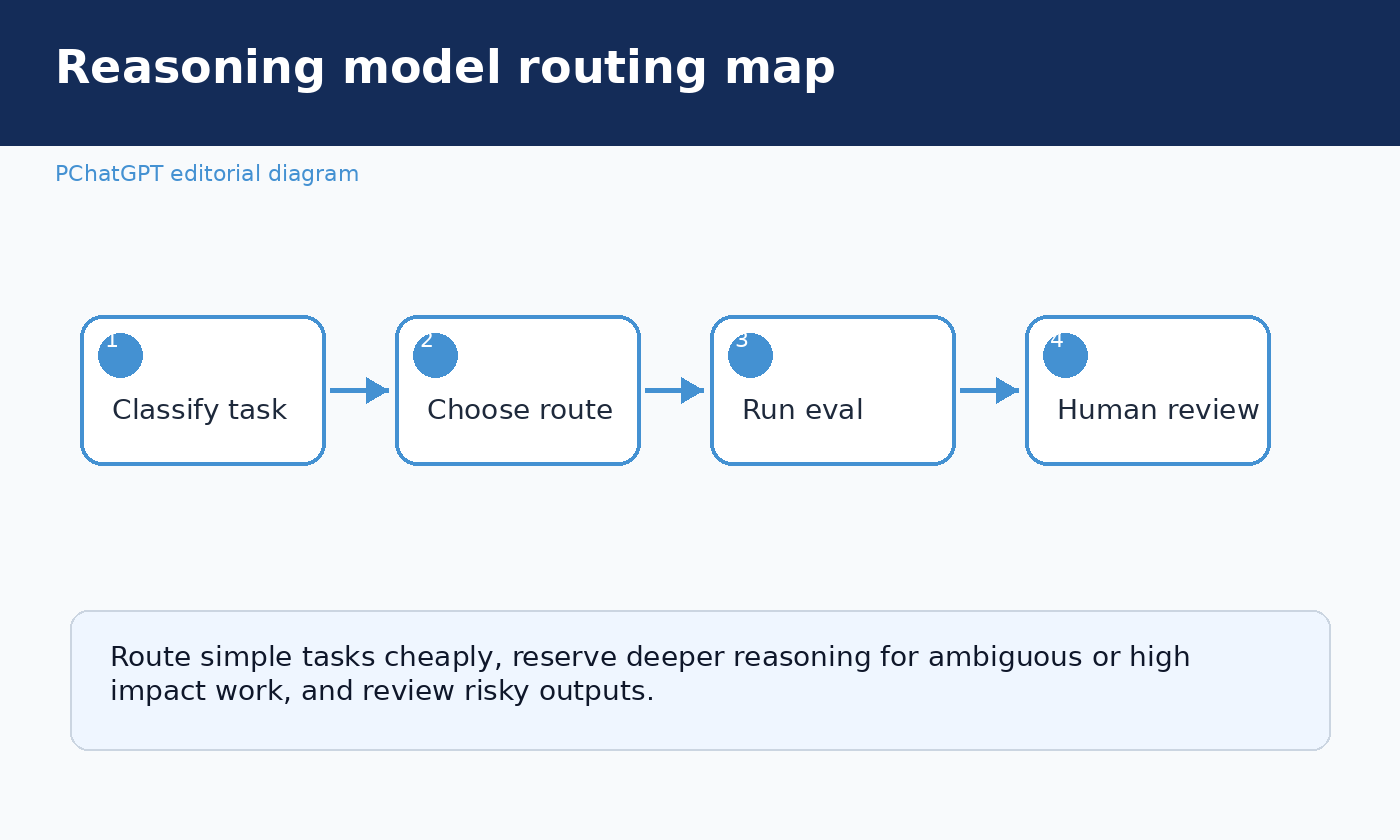
In enterprise architecture, routing should decide when to use those settings. A simple router can begin with rules. For example, a request that only classifies a short message can use a lower reasoning route. A request that asks for a plan across several documents can use a stronger route. A request that includes regulated, security-sensitive, or high-impact content can require human approval regardless of model confidence. The exact rules should come from the organization’s own risk model, not from generic assumptions about AI capability.
More mature routers can combine rule-based signals with evaluation data. If a category repeatedly succeeds with low effort and passes human sampling, it may not need a higher setting. If a category fails because the model misses dependencies or mishandles ambiguity, it may need stronger reasoning, better context, a different prompt contract, or human review. Routing should remain adjustable because model behavior, application scope, and business risk all change over time.
Design fallbacks before production traffic arrives
Fallbacks are part of routing. If a response is incomplete, if a tool fails, if the model cannot access enough context, or if the request matches a sensitive category, the system should have a defined next step. That step may be asking a clarifying question, retrying with a larger output budget, moving to a higher reasoning route, returning a limited answer, or escalating to a human queue.
OpenAI’s reasoning guide notes that if generated tokens reach the context window limit or the max_output_tokens value, a response can become incomplete before visible output appears. This is important for operations teams because a failed visible response may still consume input and reasoning tokens. Monitoring should track incomplete responses, latency, token usage, and escalation rates by task type so that routing can be improved with evidence.
Human review remains a product requirement
Human review should not be a vague promise that someone can intervene if needed. It should be a designed part of the product. Define which outputs require pre-release approval, which can be sampled after the fact, and which can be fully automated. The review policy should include ownership, service expectations, reviewer qualifications, audit records, and a path for users to challenge or correct AI-assisted outputs.
Reasoning models make this more important, not less. Their ability to handle multi-step tasks can increase user trust, but it can also make errors harder to notice. A polished plan may hide a weak assumption. A tool-using workflow may depend on stale or incomplete data. A confident answer may exceed the authority granted to the system. Human review helps maintain accountability when the system touches decisions that cannot be delegated entirely to automation.
OpenAI’s o3 and o4-mini system card describes safety work around reasoning models, including preparedness evaluations and the use of deliberative alignment, where models can reason about safety policies in context. That is relevant background, but it does not remove the need for enterprise controls. Company-specific policies, legal duties, customer commitments, and domain standards still need to be represented in the product design and review process.
Reasoning traces, summaries, and monitorability
Enterprises often want to know how a model reached an answer. OpenAI’s reasoning guide states that raw reasoning tokens are not exposed through the API, although some models can provide reasoning summaries when explicitly requested with the summary parameter. The guide also explains that reasoning items can be preserved across calls for continuity without exposing raw reasoning. This distinction is important for governance. Teams should not build audit programs that assume raw chain-of-thought access where it is not provided.
OpenAI’s research on chain-of-thought controllability discusses why reasoning traces can be useful safety signals and why monitorability is an active research topic. The article reports that current reasoning models struggle to control their chains of thought in ways that reduce monitorability, while also emphasizing the need for continued evaluation as models advance. For enterprise readers, the practical lesson is cautious: monitoring can be useful, but it should be one layer in a defense-in-depth approach rather than the only control.
A practical enterprise audit record can include the user request, approved context sources, tool calls and outputs, final answer, model and setting, timestamps, routing decision, reviewer decision, and any post-deployment corrections. This gives risk teams evidence without requiring access to hidden reasoning tokens. If summaries are used, they should be treated as summaries, not as a guaranteed transcript of internal reasoning.
Implementation pattern for enterprise teams
A reasonable implementation pattern starts with a narrow pilot. Choose one workflow where the value of reasoning is clear and where review capacity exists. Write the task contract, define allowed sources and tools, select output formats, and create an evaluation set from real or representative cases. Run the same cases through candidate routes, compare quality, latency, incomplete responses, and reviewer labels, then choose the simplest route that meets the acceptance criteria.
Next, add production monitoring. Track which route handled each request, whether the answer was accepted, whether a human changed it, whether the user reported a problem, and whether the system had to retry or escalate. Review failures in batches so that fixes are based on patterns rather than one-off reactions. When a prompt, model, routing rule, or tool changes, rerun the relevant evaluation set before expanding traffic.
Finally, keep documentation current. Enterprise AI systems change quickly, and undocumented routing logic becomes a governance risk. Each workflow should have a short record explaining why reasoning is used, what the model may do, what it may not do, what human review covers, and how the team measures quality. This record should be understandable to engineering, legal, compliance, and business owners.
Official sources used
- OpenAI API docs: Reasoning models
- OpenAI: Introducing OpenAI o3 and o4-mini
- OpenAI: OpenAI o3 and o4-mini System Card
- OpenAI: Reasoning models struggle to control their chains of thought, and that is good
Connect model decisions to broader governance
Model evaluation is only one part of an enterprise control system. The related guide to practical generative AI governance covers approved tools, data classification, review gates, record keeping, and incident ownership. Those controls should apply to the complete workflow, including retrieval systems and external tools, rather than to the model in isolation.
Teams that are comparing a newer model with an existing route can also use the GPT-5.4 ChatGPT and API guide as an example of separating product labels from API choices and verifying specifications against official documentation. The transferable lesson is to avoid upgrading on the strength of a launch description alone. Rerun the workflow’s evaluation set, check permissions and fallbacks, and move traffic only when the new route meets the written acceptance criteria.
FAQ
Should every enterprise AI workflow use a reasoning model?
No. Reasoning models are best considered for tasks that benefit from planning, judgment, tool use, ambiguity handling, or multi-step analysis. Simple retrieval, classification, or short drafting tasks may be better served by faster and simpler routes.
How should teams choose a reasoning effort setting?
Teams should choose through evaluation, not guesswork. Start with the task’s risk and complexity, test candidate settings against realistic cases, and measure quality, latency, incomplete responses, and review outcomes. OpenAI notes that supported effort values depend on the model, so teams should check the relevant model documentation.
Can human review be removed after the model performs well?
Sometimes review can be reduced for low-risk categories after strong evidence, but high-impact workflows may still need human approval or sampling. The decision should depend on business risk, legal duties, error tolerance, and observed production performance.
Do reasoning summaries provide a full audit trail?
No. OpenAI states that raw reasoning tokens are not exposed through the API. Reasoning summaries can be useful when supported and requested, but an enterprise audit trail should also include inputs, approved sources, tool activity, final outputs, routing decisions, and human review records.