Mistral Vibe Enterprise is the current name and direction of the business assistant that Mistral introduced as Le Chat Enterprise. The official timeline matters. Mistral announced Le Chat Enterprise on May 7, 2025. On May 28, 2026, the company said Le Chat had become Vibe, combining work and coding in one product. This guide replaces the old unsupported April 2026 launch framing with a current, source based inventory for teams evaluating the platform.
Vibe is not simply a chat box with an enterprise label. Mistral presents it as an agent for long tasks across organizational knowledge, connected tools, documents, data, and software projects. The Enterprise offer adds a sales led path for custom deployment, model training, and dedicated support. Exact features, limits, hosting arrangements, and commercial terms can depend on the contract and implementation, so buyers should verify every requirement against current documentation and a written proposal.
What happened to Le Chat Enterprise?
The original Le Chat Enterprise announcement listed enterprise search, agent builders, custom data and tool connectors, document libraries, custom models, hybrid deployments, audit logging, and storage. Those ideas established the enterprise product line, but the old announcement is a historical snapshot. It should not be read as a guarantee that every named feature has the same interface, status, or availability today.
Mistral later announced that Le Chat became Vibe. According to the official Vibe product update, existing conversations, settings, and plans carried over. Vibe now spans work and code. Work Mode handles multi-stage tasks involving knowledge and business tools, while Code Mode covers coding sessions that can continue from the web, editor, or terminal. This naming change is why current evaluation should start with Vibe, even though older materials and the preserved address of this article still mention Le Chat or an enterprise platform launch.
The practical conclusion is straightforward: do not buy against a feature list copied from a 2025 announcement. Map requirements to the current product, request a demonstration in the intended deployment, and record which components are generally available, previewed, optional, or custom. That process is more useful than debating whether Vibe is a new product or a renamed one.
Mistral Vibe Enterprise capability inventory
The inventory below separates the main product surfaces. It is deliberately framed as a set of capabilities to inspect rather than an assurance that every organization receives identical access.
- Knowledge search: Vibe can ground work in connected organizational sources. Mistral names services such as Google Workspace, Outlook, SharePoint, Slack, and GitHub in its current materials. A buyer still needs to test source coverage, indexing delay, citations, permission inheritance, and deletion behavior.
- Document creation: Mistral describes reports, briefs, requests for proposal, presentations, and other deliverables created from research and connected context. Reviewers should check export formats, templates, editing controls, citation quality, and how generated files enter existing records systems.
- Data analysis: The platform can work with uploaded spreadsheets or connected databases and render findings in a conversation. Evaluation should include representative tables, missing values, ambiguous fields, calculation checks, and an independent review of any material conclusion.
- Agents and scheduled tasks: Work Mode is designed for multi-step jobs, recurring prompts, and reusable skills. Teams should determine which steps require approval, what happens after an error, how credentials are scoped, and whether a run can be paused or replayed safely.
- Coding work: Code Mode, the editor extension, and the command line interface support tasks such as writing tests, refactoring, and preparing reviewable changes. Repository permissions, sandbox boundaries, network access, secret handling, test execution, and pull request review remain essential controls.
- Connectors: Mistral supports built in and custom connections, including compatibility with Model Context Protocol. Connector count is less important than whether the exact source, action, authentication method, and permission model required by a workflow are supported.
- Customization: The Enterprise offer can include custom models, integrations, and implementation assistance. Buyers should distinguish prompt configuration, reusable skills, retrieval, fine tuning, and a genuinely custom model because each has different data, evaluation, maintenance, and cost implications.
- Deployment choice: Current product material describes on premises, private cloud, and Mistral Cloud options. The chosen topology affects operations, upgrades, logging, incident response, performance, and the division of responsibility between Mistral and the customer.
This broad scope creates useful possibilities, but it also creates dependencies. A polished agent demonstration can hide work that must happen before production, including identity integration, connector approval, data classification, evaluation design, and ownership of generated outputs. Treat the interface as one layer in a larger service, not as the whole service.
Understand the three platform surfaces
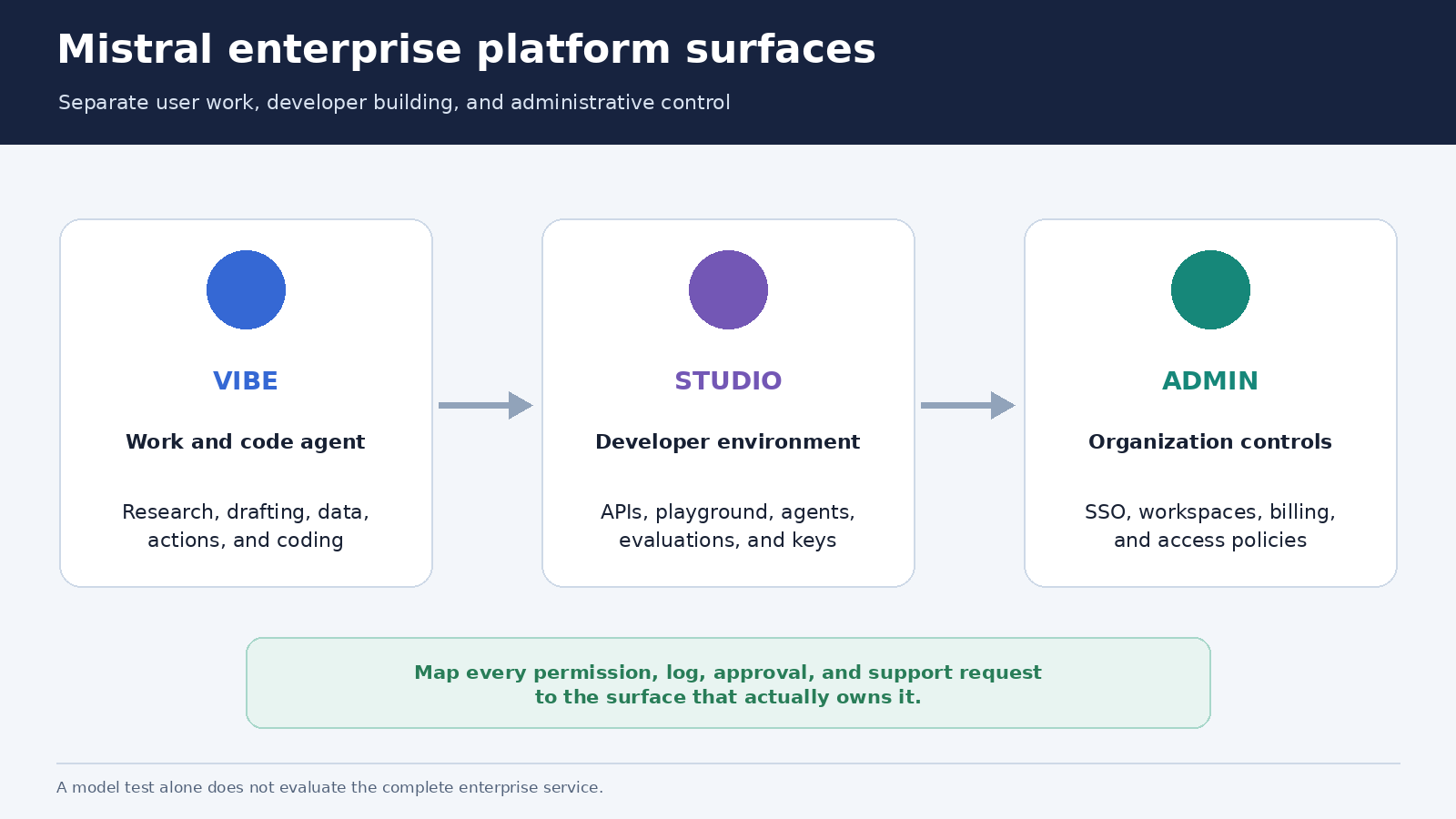
Current Mistral documentation separates Vibe, Studio, and Admin. That distinction helps an evaluation team ask the right questions.
- Vibe is the user facing agent for productivity and coding. Employees interact with it to research, draft, analyze, automate, or develop software.
- Studio is the developer console and API environment. It covers API keys, playground activity, agents, evaluations, and software development with Mistral models.
- Admin is the control plane for organization setup, billing, single sign-on, workspaces, and access policies.
An enterprise may use one, two, or all three surfaces. A Vibe pilot does not automatically answer questions about a custom API application in Studio. Likewise, an Admin setting may govern identities and workspaces without proving that a specific connector enforces source permissions exactly as expected. Document which surface owns each setting, log, approval, and support request.
This separation also prevents a common procurement mistake: evaluating the model alone. Model quality matters, but business outcomes also depend on retrieval, connectors, prompts, tools, identity, user experience, monitoring, and human review. A model comparison conducted with isolated prompts cannot establish how the complete enterprise service behaves with real permissions and changing source material.
Deployment and data control questions
Mistral emphasizes deployment flexibility. That can be valuable for an organization with residency, network, or infrastructure requirements, but labels such as private cloud and on premises are only the beginning. Ask for an architecture diagram for the proposed configuration. It should identify where prompts, files, embeddings, model inputs, outputs, logs, backups, connector tokens, and support diagnostics are processed and stored.
Clarify the control plane as well as the inference plane. A workload may run in a customer environment while account management, telemetry, software updates, or support operations involve another service. Neither pattern is automatically unsuitable. The important point is to compare the complete data path with policy, legal obligations, and threat models.
For each data type, record residency, retention, encryption, deletion, backup, and access rules. Determine whether customer content is used to improve shared models, and capture the answer in the governing agreement. Ask how administrators can export audit records, how long those records remain available, and whether events can be sent to an existing security monitoring system.
Availability and operations deserve equal attention. Identify who installs updates, how security fixes are delivered, which versions are supported, how capacity is planned, and what service objectives apply. A deployment that maximizes local control may also transfer more operational responsibility to the customer. A managed deployment may simplify upgrades while requiring additional review of hosted processing.
Identity, connectors, and least privilege
Enterprise knowledge becomes useful only when the system retrieves information the user is allowed to see. Confirm how single sign-on, group membership, workspace roles, and source permissions interact. Test with multiple personas, including a standard employee, manager, contractor, administrator, and departed user. A successful administrator demo does not prove least privilege.
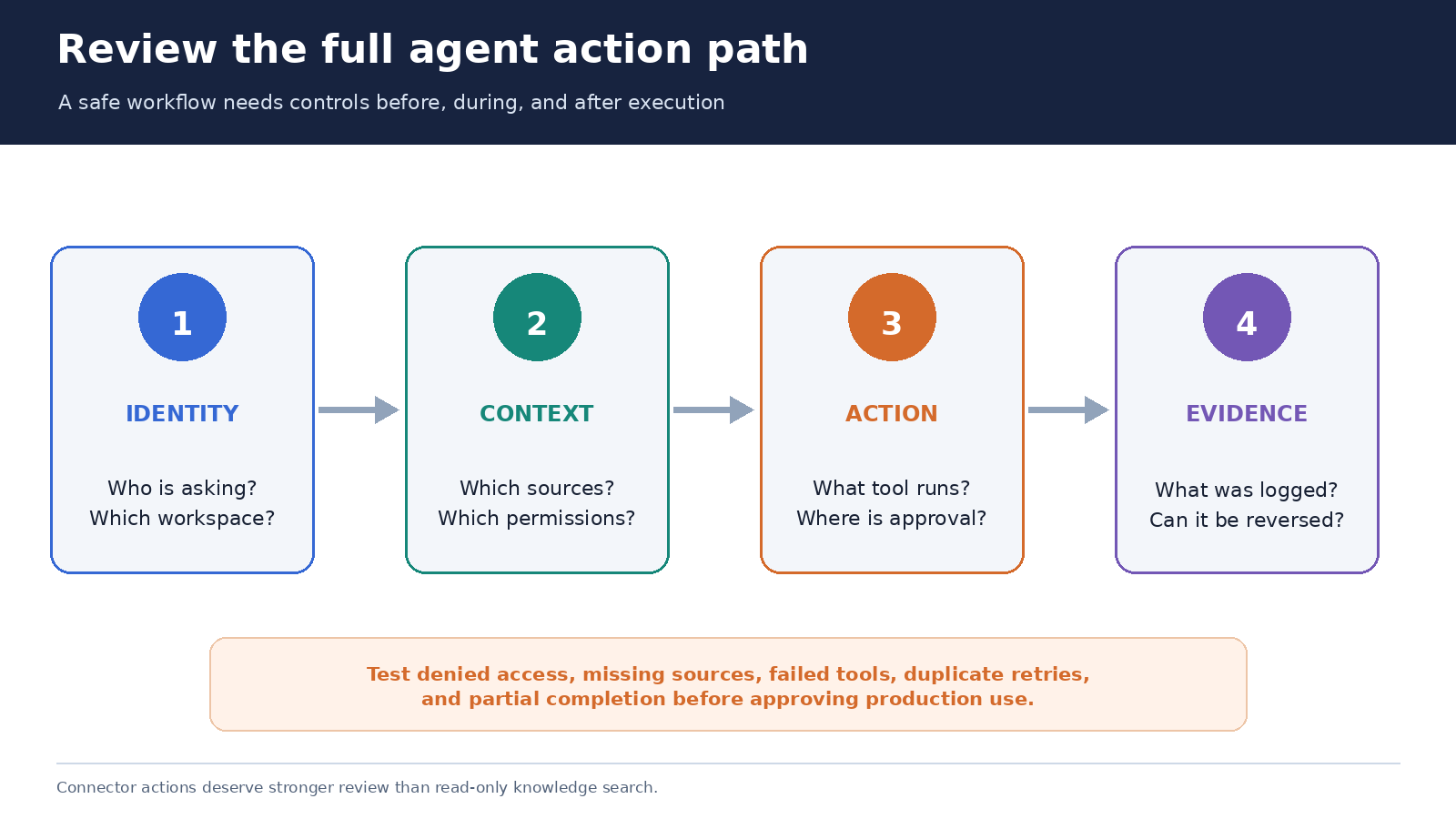
Connector testing should cover reads and actions separately. Searching a document library is different from creating a ticket, sending a message, changing a record, or opening a pull request. For every action capable connector, identify the acting identity, scopes, approval point, visible preview, audit event, retry behavior, and reversal path.
Custom MCP connectors expand what Vibe can reach, but extensibility increases the review surface. Inspect the connector operator, hosting location, authentication flow, tool definitions, logging, and update process. Restrict available tools to the minimum needed for a workflow. A connector that exposes a broad generic action may be harder to govern than several narrow tools with clear inputs and outputs.
Never use production secrets or confidential documents merely to make a pilot feel realistic. Create a representative test collection with synthetic or approved content. The site’s privacy policy overview offers general context on minimizing sensitive information when interacting with online services, while an organization’s own security and legal teams must set the actual rules.
A practical evaluation plan
Begin with two or three bounded workflows rather than a company wide promise. Good candidates have a known owner, repeat often enough to measure, and produce an output that a qualified reviewer can judge. Examples include preparing a meeting brief from approved sources, summarizing a defined set of support records, or drafting tests for a noncritical code module.
- Write the baseline. Record how the task is completed today, including time, source systems, review steps, common errors, and the final destination of the output. Without a baseline, speed claims are difficult to interpret.
- Define a test set. Include ordinary cases, edge cases, conflicting documents, missing context, revoked access, malicious text inside a source, and requests the agent should refuse or escalate.
- Set acceptance criteria. Measure factual accuracy, citation support, completeness, permission behavior, reviewer effort, latency, and cost. A shorter generation time is not a win if review takes longer.
- Test failure paths. Disconnect a source, remove a permission, supply an outdated document, and interrupt a multi-step run. Observe whether the user receives a clear status and whether partial actions remain visible.
- Review administration. Have identity, security, privacy, records, procurement, and service owners examine controls relevant to the proposed use, not a generic checklist.
- Document the decision. Record approved data classes, users, workflows, connectors, models, deployment, reviewers, and stop conditions. Revisit the decision when a major component changes.
A pilot should compare assisted and unassisted work on the same evaluation set. Reviewers should not know which result is expected to win. For analytical tasks, recompute important figures outside the model. For code, run tests and security checks in the normal development pipeline. For research, open the cited sources and verify that they support the claims.
If the pilot identifies a factual or editorial issue in this guide, readers can use the site’s contact page to report it with a source. Product details evolve, so correction paths are part of maintaining a useful technical resource.
Governance after approval
Production approval is not the end of evaluation. Assign owners for the service, each connector, model changes, access reviews, incident response, and business outputs. Keep a simple register of approved workflows and the data each one may process. Users need a visible route for reporting incorrect output, unexpected access, or an unsafe action.
Version changes can alter quality even when the interface looks familiar. Maintain a small regression set drawn from approved use cases and run it after material model, connector, prompt, skill, or retrieval changes. The test set should include permission boundaries and failure cases, not only examples that produce attractive answers.
Human review should match consequence. A low risk internal draft may need a quick owner check. A customer communication, financial interpretation, legal document, personnel decision, production code change, or external action requires qualified review and existing organizational controls. Vibe can help prepare work, but product branding does not transfer accountability away from the organization.
Track outcomes that matter to the workflow. Useful measures may include supported claims, corrections per document, review minutes, completed runs, abandoned runs, connector errors, unauthorized access attempts, and user reported problems. Avoid using message volume as a stand in for value.
Where Vibe fits compared with a general AI assistant
The enterprise case for Vibe rests on the combination of work agents, coding capabilities, connected knowledge, customization, and deployment choice. A general assistant can draft text or answer questions, but an enterprise platform must also integrate with identity, permissions, source systems, audit processes, and operations.
That does not make Vibe the automatic choice for every organization. A team may prefer a different assistant because of an existing cloud agreement, a required connector, regional service availability, developer ecosystem, accessibility requirement, or a stronger result on its own evaluation set. The right comparison uses the same tasks, sources, permissions, and scoring rules for every candidate.
Buyers should also separate portability from marketing language. Ask how prompts, skills, conversation exports, document libraries, connector definitions, evaluations, and custom model assets can be moved. Determine what remains usable if a contract ends or a deployment model changes. Exit planning is easier before production data and workflows accumulate.
Frequently asked questions
Is Le Chat Enterprise now called Mistral Vibe Enterprise?
Yes, current Mistral materials say Le Chat became Vibe. The Enterprise plan continues as the option for custom deployments, model training, and dedicated support. Older pages may still use Le Chat Enterprise when describing the 2025 introduction or earlier features.
Can Mistral Vibe Enterprise run on premises?
Mistral’s current product page says enterprise customers can deploy Vibe on premises, in a private cloud, or on Mistral Cloud. The precise architecture, supported components, hardware, operations, residency, and commercial terms should be confirmed in a current written proposal for the intended environment.
Does Vibe automatically respect every source permission?
Mistral describes enterprise controls and permission aware connections, but an organization should verify behavior with its own identity system, connectors, roles, revoked accounts, and edge cases. Test both information retrieval and actions. Do not infer complete access control from a successful demonstration.
What should a company test before buying Vibe Enterprise?
Test representative workflows, answer quality, citations, permissions, connector actions, failure recovery, administrative controls, logs, deployment data flows, latency, cost, accessibility, support, and export options. Use predefined acceptance criteria and qualified human reviewers. Confirm current feature availability and contract terms directly with Mistral.
Bottom line
Mistral’s enterprise assistant has a real product history, but it is not the future dated launch implied by the old article. Le Chat Enterprise was introduced in May 2025 and evolved into Vibe in May 2026. Today, the relevant question is whether Vibe’s work and coding agents, platform controls, connectors, customization, and deployment choices meet a specific organization’s tested requirements.
Use the capability inventory as a starting point, then demand evidence in the intended configuration. Verify data paths, permissions, actions, output quality, operations, and exit options. That approach produces a defensible decision even as names, models, and individual features continue to change.