
OpenAI Introduces GPT-5.4: What Changed in ChatGPT and the API
Correction: An earlier version of this page called the release “GPT-5.4 Turbo.” OpenAI’s official name is GPT-5.4. There is no GPT-5.4 Turbo model in the official announcement, API model page, or ChatGPT model release notes. The old wording has been removed rather than treated as a separate product.
OpenAI introduced GPT-5.4 on March 5, 2026, describing it as a frontier model designed for professional work. The release joined reasoning, coding, tool use, visual understanding, and computer interaction in one general purpose model. It appeared in three related but distinct places: ChatGPT, the OpenAI API, and Codex. That distinction is important because the product label a ChatGPT user sees is not always the model ID a developer sends in an API request.
This guide explains the release without inventing speed claims, discounts, or a fictional Turbo tier. It separates the ChatGPT experience from the API product, summarizes the documented specifications, and turns OpenAI’s benchmark claims into practical evaluation advice. Product availability, limits, and model lineups can change, so check the linked official pages before making a purchasing or deployment decision.
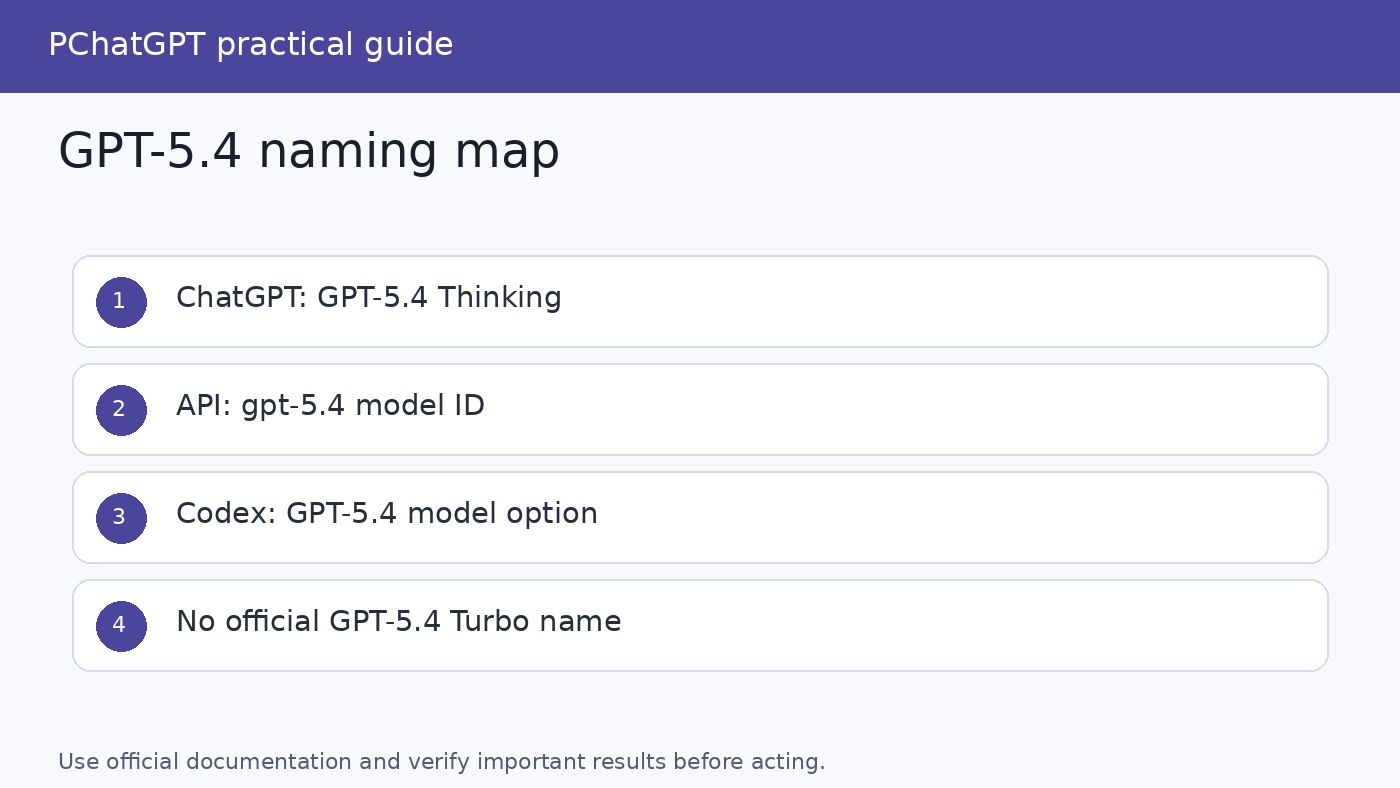
The naming correction in one minute
The official release is called GPT-5.4. In ChatGPT, OpenAI launched it under the user-facing label GPT-5.4 Thinking, alongside GPT-5.4 Pro for eligible users seeking maximum performance on complex work. In the API, the documented model name is gpt-5.4, with gpt-5.4-2026-03-05 listed as a versioned snapshot. OpenAI also documented gpt-5.4-pro separately in its announcement.
| Where you use it | Name you may see | What that name means |
|---|---|---|
| ChatGPT | GPT-5.4 Thinking | A ChatGPT reasoning experience with product features and controls around the model |
| ChatGPT | GPT-5.4 Pro | A higher performance option for especially complex tasks, subject to plan availability |
| OpenAI API | gpt-5.4 |
The developer model alias used in an API request |
| OpenAI API | gpt-5.4-2026-03-05 |
A dated snapshot intended to keep model behavior more consistent |
| Codex | GPT-5.4 | The model used inside OpenAI’s coding agent environment |
“Turbo” was used in the names of some earlier OpenAI products, which makes the error understandable, but familiar naming patterns are not evidence. A model name should be copied from the provider’s announcement or model catalog. The correction also removes unsupported claims that the supposed Turbo edition was 40 percent faster or 50 percent cheaper than GPT-5.4. OpenAI did not launch a second GPT-5.4 Turbo model with those characteristics.
What OpenAI actually announced
OpenAI positioned GPT-5.4 as its most capable and efficient frontier model for professional work at launch. The model incorporated the coding capabilities of GPT-5.3-Codex while extending performance across tools, software environments, spreadsheets, presentations, and documents. The practical theme was not simply better chat. It was longer, more involved work in which the model must understand a request, use tools, create an artifact, inspect the result, and make corrections.
The launch highlighted five areas. First, knowledge work received particular attention, including spreadsheet modeling, document work, and presentation creation. Second, GPT-5.4 became OpenAI’s first general purpose model with native computer-use capabilities. Third, it combined general reasoning with strong coding behavior. Fourth, it introduced changes for large tool ecosystems, especially tool search. Fifth, OpenAI reported improved factuality relative to GPT-5.2 on its set of de-identified user prompts.
That final point deserves precise wording. OpenAI said individual claims from GPT-5.4 were 33 percent less likely to be false and full responses were 18 percent less likely to contain any errors than GPT-5.2 on that particular evaluation set. This does not mean every answer is accurate, or that human review is unnecessary. It is a comparative result from a provider-run evaluation. Important facts, calculations, citations, and actions still need independent checks.
The release also emphasized token efficiency. OpenAI described GPT-5.4 as its most token-efficient reasoning model at launch and said it used significantly fewer tokens than GPT-5.2 to solve problems. That may help latency and cost in some workflows, but it is not the same as a universal speed guarantee. Real response time depends on reasoning effort, prompt size, output length, tool calls, service tier, network conditions, and the work performed by external systems.
GPT-5.4 in ChatGPT
ChatGPT is the application. GPT-5.4 is a model family used within that application. When OpenAI launched GPT-5.4 in ChatGPT, it called the main experience GPT-5.4 Thinking. The official release notes say it could provide an upfront plan, allowing a user to adjust course while the answer was still being developed. OpenAI also highlighted stronger deep web research for specific questions and better context maintenance during longer thinking.
Those features make the ChatGPT experience more than a bare model endpoint. ChatGPT may provide a model picker, files, web research, memory or workspace controls, conversation history, and a user interface for steering an answer. Your plan and workspace settings affect what you can select. A feature visible in ChatGPT should not automatically be assumed to exist as an identically named API feature.
A sensible ChatGPT workflow starts with a concrete deliverable. Instead of asking “analyze this spreadsheet,” state who will use the result, what decision it supports, which sheets matter, what calculations must be checked, and what output you want. If GPT-5.4 Thinking shows a plan, inspect it before the response goes too far. Correct a missing constraint early. Ask it to label assumptions and separate source facts from interpretation.
For document and web research, require links to the original evidence and open the decisive sources yourself. For presentations, inspect every chart, label, and attribution. For spreadsheet work, recalculate a sample of formulas and check units, signs, date ranges, and totals. A polished file can still contain a quiet error. Our editorial policy and source standards explain why official references and visible corrections matter when product claims change.
GPT-5.4 in the API
The API is for developers building software. Its official model page identifies gpt-5.4 as a reasoning model for complex professional work. It accepts text and image input and produces text output. Audio and video are not listed as supported model modalities. The documentation lists a 1,050,000 token context window, a maximum of 128,000 output tokens, and an August 31, 2025 knowledge cutoff.
Those limits need careful interpretation. A large context window gives an application room to send extensive material, but it does not promise perfect recall across every position in a million-token prompt. OpenAI’s own long-context evaluation table shows that results vary by task and context range. Retrieval, document selection, prompt structure, and validation remain important. Sending every available file can also increase cost and introduce irrelevant or conflicting evidence.
The model page lists reasoning effort settings of none, low, medium, high, and xhigh, with none shown as the default. Higher effort should be chosen because a task benefits from deeper reasoning, not because the label sounds safer. A production team should evaluate quality, latency, and token usage at each setting with representative requests.
At the documented rate, standard text token pricing for gpt-5.4 is $2.50 per million input tokens, $0.25 per million cached input tokens, and $15 per million output tokens. OpenAI notes special pricing for very long prompts: for GPT-5.4 and GPT-5.4 Pro sessions with more than 272,000 input tokens, the full session is priced at twice the input rate and one and a half times the output rate for standard, Batch, and Flex processing. Regional processing endpoints also carry a documented uplift. Always consult the current pricing page because rates can change.
The API model page lists function calling and structured outputs as supported. For the Responses API, it also lists tools including web search, file search, image generation, code interpreter, hosted shell, apply patch, computer use, and tool search. Support on a model page does not remove the developer’s responsibility to configure tools, permissions, confirmations, and error handling.
Why computer use and tool search matter
Computer use lets an agent work with software interfaces, including interpreting screenshots and issuing mouse or keyboard actions. OpenAI also describes GPT-5.4 as capable of writing code that controls computers through libraries such as Playwright. This opens useful workflows, but it changes the risk profile. A wrong paragraph is easy to edit. A wrong click can send a message, alter a record, or trigger a purchase.
For that reason, computer-use deployments need boundaries. Use test accounts and sandbox environments first. Keep destructive actions behind explicit approval. Restrict accessible sites, credentials, and data. Log observations, proposed actions, tool results, and final state. Require confirmation before external communication, financial activity, permission changes, or deletion. After completion, verify the actual system state rather than accepting the model’s narrative that a task succeeded.
Tool search addresses a different problem. Traditional tool calling can place every tool definition in the prompt, even when most are irrelevant. In a large connector environment, those definitions consume context and tokens. GPT-5.4 can instead receive a lightweight tool list and retrieve a specific definition when it needs one. OpenAI reported that this configuration reduced total token usage by 47 percent on its 250-task MCP Atlas test while preserving the same accuracy.
That result is promising, but it is not a guaranteed saving for every application. The benefit depends on the number and size of tools, how often definitions are needed, caching, task distribution, and implementation details. Measure it against your own tool catalog. Also remember that finding the right tool is only one part of reliability. The agent must still supply valid arguments, interpret results correctly, and stop when the requested task is complete.
How to read the benchmark results
OpenAI published a broad set of evaluations for professional work, coding, computer use, tool use, academic questions, long context, and abstract reasoning. Headline results included 83.0 percent wins or ties on GDPval, 57.7 percent on the public SWE-Bench Pro evaluation, 75.0 percent success on OSWorld-Verified, 54.6 percent on Toolathlon, and 82.7 percent on BrowseComp. OpenAI reported its evaluation settings and noted that benchmarks were run in a research environment that may differ from production ChatGPT.
Benchmarks answer narrow questions under defined conditions. GDPval, for example, compares work products across specified occupations and tasks. OSWorld-Verified measures interaction with desktop environments. BrowseComp tests persistent web research for hard-to-find information. None of them tells you whether the model will follow your organization’s template, understand your internal terminology, or make an acceptable tradeoff in your application.
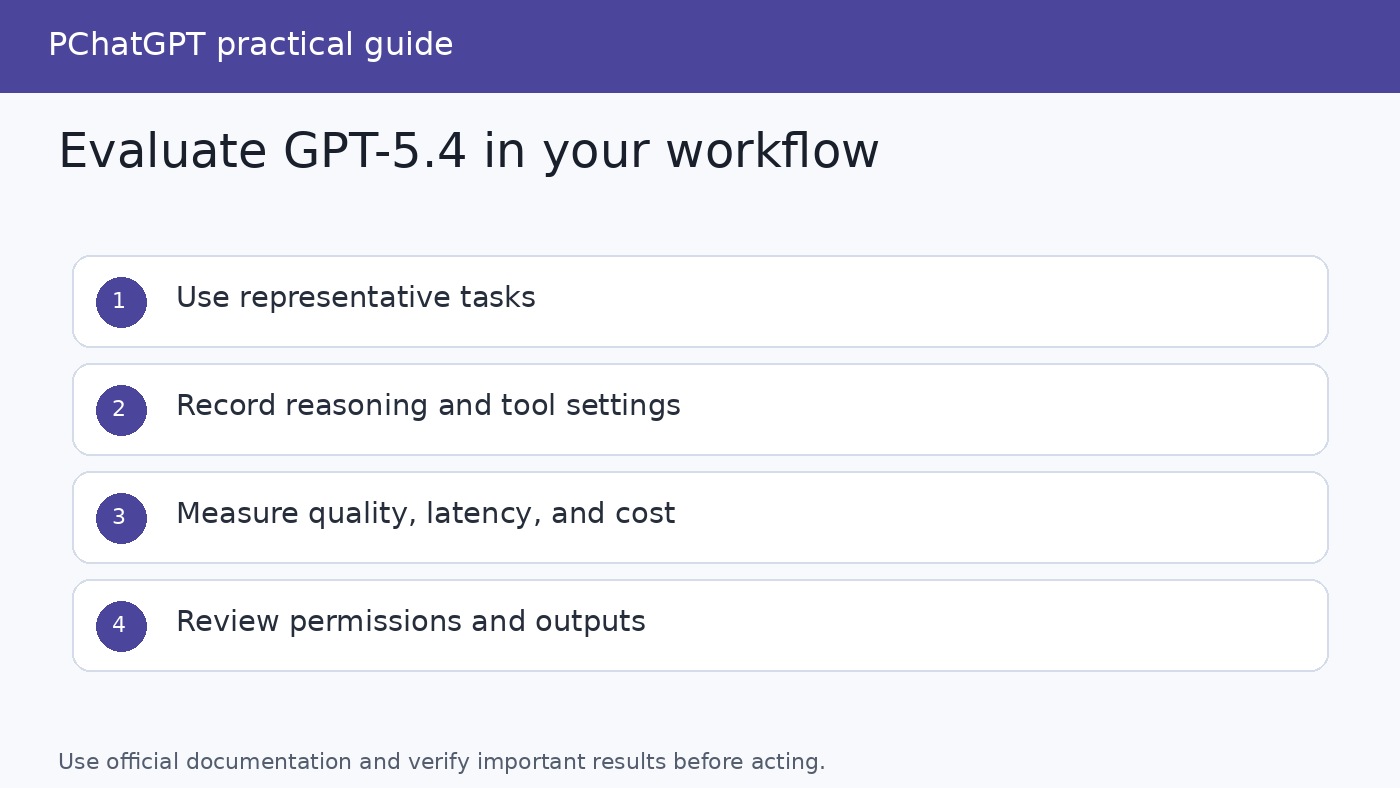
Use published scores to decide what deserves testing, then run a local evaluation. Build a set of common, difficult, and high-risk tasks. Save expected outcomes or a scoring rubric. Compare GPT-5.4 with your existing model using the same prompts, tools, permissions, and retry policy. Track task completion, factual errors, invalid tool calls, human correction time, latency, and total cost. Review failures, not just averages.
If you are still deciding where a model belongs in your workflow, PChatGPT’s practical guide to choosing AI tools by task offers a broader selection framework. The useful question is not whether GPT-5.4 wins every chart. It is whether it produces better verified outcomes for your work at an acceptable cost and risk.
A practical adoption checklist
- Use the correct product name. Write GPT-5.4, GPT-5.4 Thinking, GPT-5.4 Pro, or
gpt-5.4according to the surface you mean. Do not add Turbo. - Define the job. Specify the artifact, audience, constraints, source requirements, and actions the model may take.
- Separate ChatGPT from API access. Confirm plan availability in ChatGPT and model access, rate limits, and pricing in the API independently.
- Start with a representative test set. Include ordinary work and the awkward cases most likely to fail.
- Tune reasoning deliberately. Compare effort settings rather than assuming the maximum is always the best operational choice.
- Control tools. Grant the smallest permissions required and put consequential actions behind review.
- Validate long inputs. Test retrieval and attention across the kinds of documents you actually use.
- Measure the complete workflow. Include tool fees, token usage, retries, latency, and human review time.
- Pin a snapshot when consistency matters. Test the dated API snapshot before deployment and evaluate any later migration.
- Keep human accountability. A named reviewer should own final facts, calculations, external messages, and irreversible actions.
What the release means in practice
GPT-5.4 was a meaningful release because it brought several formerly separate strengths into one professional model. It could reason over text and images, write and inspect code, search for information, select tools from larger catalogs, and interact with computer interfaces. That combination can reduce handoffs in long workflows. It also makes evaluation and permission design more important, because the model may do more than draft prose.
For a ChatGPT user, the most visible benefit was a reasoning experience designed for complex work, with better support for steering a response while it was underway. For an API developer, the significant details were the large context window, adjustable reasoning effort, broad Responses API tool support, computer use, tool search, and explicit token pricing. These are related offerings, not interchangeable descriptions.
The safest summary is also the simplest: OpenAI launched GPT-5.4, not GPT-5.4 Turbo. Its documented improvements make it a strong candidate for professional and agentic workloads, but provider benchmarks should start an evaluation rather than end one. Test the exact product surface, model ID, tools, data, and controls you plan to use.
FAQ
Is GPT-5.4 Turbo an official OpenAI model?
No. OpenAI’s March 5, 2026 announcement names GPT-5.4 and GPT-5.4 Pro. Its ChatGPT notes use GPT-5.4 Thinking, while the API catalog uses gpt-5.4. The former title of this page was incorrect and has been corrected.
Is GPT-5.4 Thinking in ChatGPT the same as the GPT-5.4 API?
They are connected to the same model family, but they are different product experiences. ChatGPT supplies an interface, plan-based access, and product tools. The API gives developers a model ID, parameters, usage-based pricing, rate limits, and programmable tool integration. Do not infer API behavior or billing from the ChatGPT label.
What are the main GPT-5.4 API specifications?
OpenAI’s model page lists text and image input, text output, a 1,050,000 token context window, up to 128,000 output tokens, and an August 31, 2025 knowledge cutoff. It supports multiple reasoning effort levels, function calling, structured outputs, and a broad set of tools through the Responses API. Check the live documentation before implementation.
Should a team replace its current model with GPT-5.4 immediately?
Not without testing. Build a representative evaluation set, compare verified task completion and failure modes, measure full costs and latency, and review tool permissions. A rollout should be based on your own workflow results rather than one provider benchmark or a broad claim that a newer model is always better.