ChatGPT Futures Class of 2026 is a real OpenAI program, not a forecast or an unofficial label. OpenAI announced the inaugural group on May 6, 2026, recognizing 26 students and young builders from more than 20 universities and institutions. The company said each member would receive a $10,000 grant to continue their work and access to its frontier models.
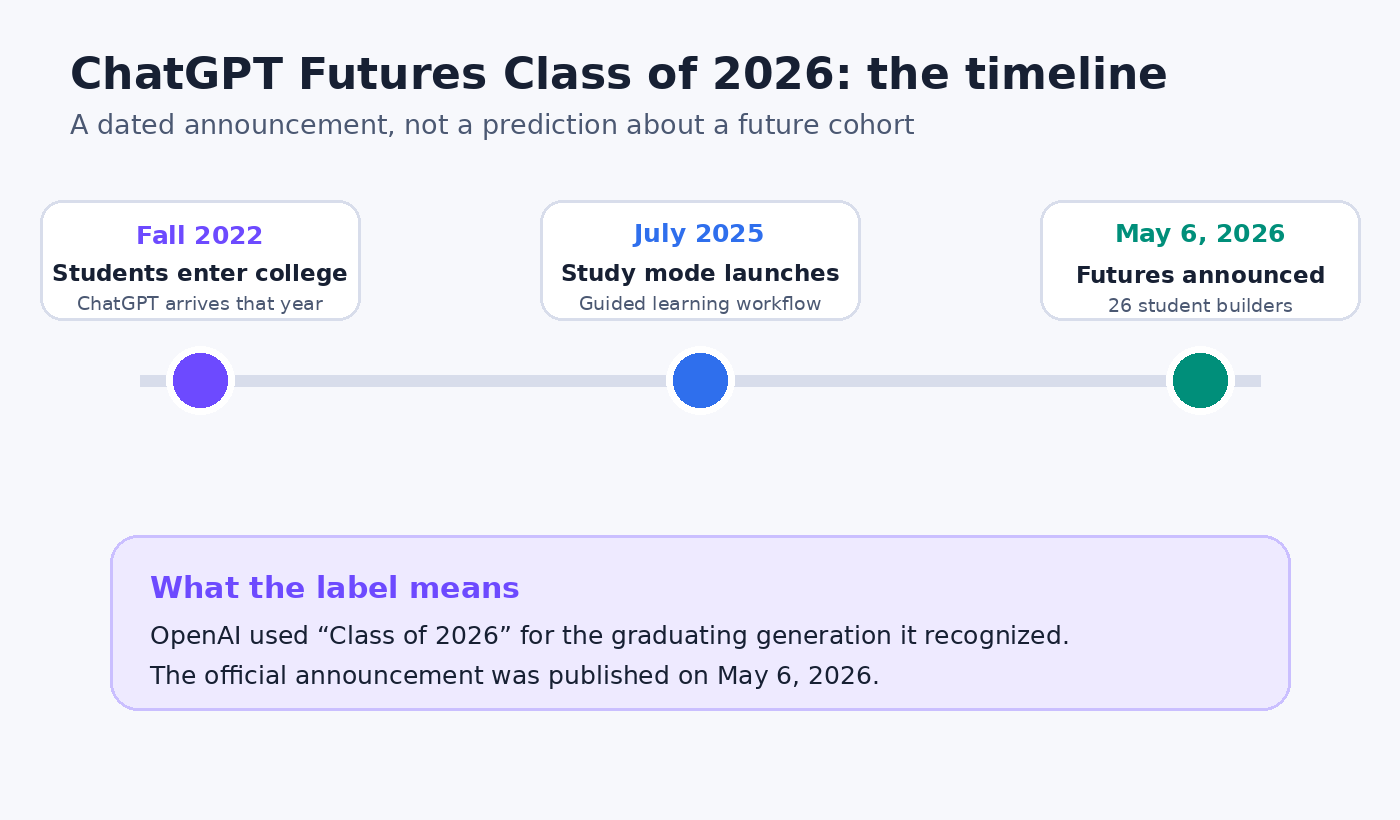
That timeline is important because the title can sound as if it predicts a graduating class that has not yet arrived. It does not. OpenAI published the announcement during the 2026 graduation season and used “Class of 2026” for the generation being recognized. OpenAI described this cohort as the first to begin and finish college with ChatGPT in the world around them. Students who entered campus in fall 2022 saw ChatGPT become publicly available later that year, then watched generative AI move rapidly into study, research, coding, design, and work.
The useful question is not whether 26 people can represent every student. They cannot. Nor does an awards announcement prove that AI improves education. The better question is what practices these examples make visible. The official announcement points to students building study tools, translating mental health resources, advancing scientific research, creating accessibility tools, and turning side projects into organizations. Those examples suggest a practical model for student AI work: find a meaningful problem, use AI to lower the cost of experimenting, and keep human judgment responsible for the result.
What OpenAI actually announced
OpenAI called ChatGPT Futures an inaugural recognition program for students and young builders using AI in thoughtful, ambitious, and human-centered ways. Its official May 6 announcement provides four concrete facts that anchor this article:
- The group includes 26 students and young builders.
- The honorees represent more than 20 universities and institutions.
- Each class member receives a $10,000 grant to continue advancing their work.
- Each member receives access to OpenAI frontier models.
OpenAI also framed the cohort as creators, explorers, and advocates rather than members of one technical discipline. That distinction matters. A student builder might write software, conduct research, organize a community, create an accessibility resource, or connect existing tools in a useful way. “Builder” describes an approach to problems, not a degree title.
This is still a company announcement about a program the company created. Readers should not treat its selected stories as a controlled study, an independent ranking of young innovators, or evidence that every AI-assisted project succeeds. The grant amount and access benefit are facts reported by OpenAI. Broader lessons about education and responsible building are interpretations that should be tested against real classrooms, student outcomes, and institutional policies.
Why the 2022 to 2026 timeline matters
A graduating student in 2026 experienced unusually fast change during a normal four-year degree. At the beginning, generative AI was not yet an ordinary part of campus life. By the end, students and faculty were debating acceptable use, redesigning assignments, testing tutoring workflows, and deciding which information could safely enter an AI system.
That does not mean every member of the graduating class used ChatGPT, or that they all had equal access. It means this generation had to develop norms while the technology was changing. Students often faced a patchwork of course rules. One professor might invite AI-assisted brainstorming, another might allow grammar help with disclosure, and a third might prohibit generative tools entirely. Responsible work therefore begins with permission, not a clever prompt.
The timeline also helps separate three kinds of activity that are often mixed together:
- Learning with AI: asking for explanations, practice questions, feedback, or alternative examples while still doing the intellectual work.
- Building with AI: using models to help research, code, design, translate, test, or communicate a project.
- Submitting AI output: presenting generated material as original work when the relevant rules require independent authorship or disclosure.
These are not ethically equivalent. A student can use the same tool to deepen understanding or to avoid it. Our guide to using ChatGPT for writing without cheating explains the practical difference through permission, verification, disclosure, and authorship. The central test is simple: can the student explain the work, defend the choices, identify the sources, and comply with the rules that govern the assignment?
From AI literacy to student agency
OpenAI argues that education should go beyond teaching how AI works or how to prompt. Its Futures announcement emphasizes agency: the ability to notice a problem and turn an idea into something tangible. That framing is useful when it is paired with accountability.
AI literacy remains necessary. Students need to understand that a confident answer can be false, that generated citations may not exist, and that uploaded information can have privacy or intellectual property implications. Yet literacy alone can become passive. A student may know the vocabulary of hallucinations, bias, and context windows without ever learning how to define a useful problem, interview a user, test a prototype, or revise after failure.
Agency adds action. It asks the student to make choices under uncertainty and see how those choices affect other people. A useful campus project might begin with a narrow need: helping classmates navigate a complex library collection, making a lab protocol easier to understand, or creating a study aid for a course. The first version does not need to become a startup. It needs to be small enough to test and honest enough to learn from.
AI can reduce friction in that process. It can help compare approaches, explain unfamiliar code, draft interview questions, suggest edge cases, or turn rough notes into a test plan. None of those contributions removes the need for subject expertise. In fact, faster production creates more things to inspect. The student must decide which problem deserves attention, what evidence is trustworthy, who might be excluded, and when the system is not ready to use.
A responsible student builder workflow
The strongest lesson to take from ChatGPT Futures is not “move fast at any cost.” It is that a student can start before having perfect credentials, while still working carefully. The following five-step loop turns that idea into a repeatable practice.
- Define a real need. Name the person affected, the task they struggle with, and the outcome that would help. “Build an AI study app” is vague. “Help first-year biology students practice identifying where their reasoning breaks down” is testable.
- Investigate before generating. Talk to intended users, review course or institutional rules, gather authoritative sources, and identify sensitive data. Do not paste student records, private health information, unpublished research, or credentials into a tool without explicit authorization and suitable protections.
- Prototype the smallest useful version. Use AI where it reduces mechanical work, but keep the prototype narrow. Ask for multiple approaches, assumptions, and failure cases. Preserve source material separately so generated content can be compared with evidence.
- Evaluate with people and examples. Test ordinary cases and edge cases. Check factual accuracy, accessibility, fairness, privacy, and usability. If an output could influence health, safety, grades, employment, or money, involve qualified reviewers and do not let the prototype make unsupervised decisions.
- Document and iterate. Record what the model did, which sources were used, what humans reviewed, known limitations, and changes between versions. A project log makes learning visible and prevents a polished demo from hiding unresolved risks.
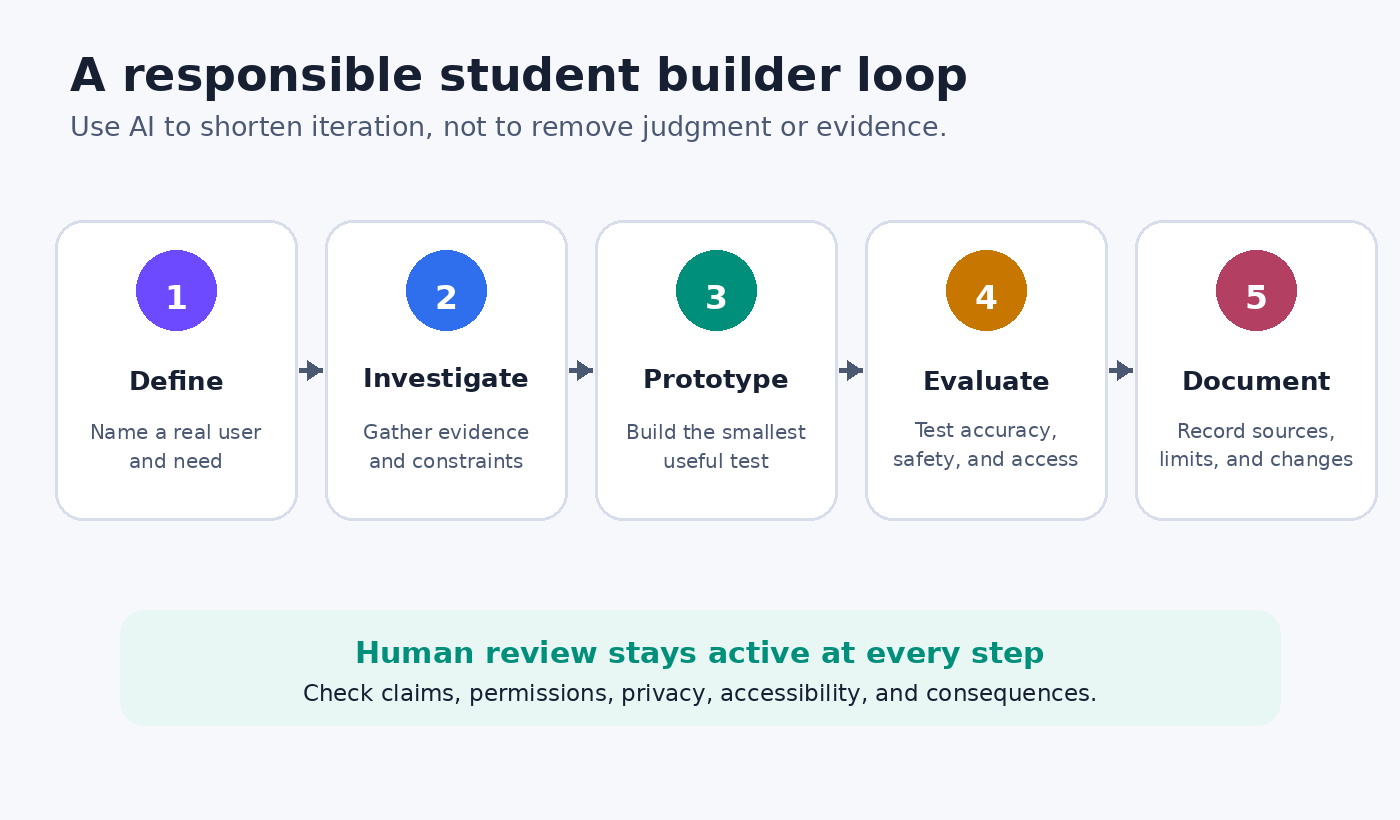
This loop works for a research assistant, accessibility prototype, campus service, study resource, or early business idea. For longer work, a dedicated workspace can reduce confusion. The ChatGPT Projects guide shows how to separate shared sources, instructions, and task-specific chats. Organization is not proof of accuracy, but it makes review and provenance easier.
Learning should remain active
Student building depends on learning, and learning weakens when the model quietly does every difficult step. OpenAI’s official Study Mode announcement describes a different interaction pattern: guiding questions, scaffolded explanations, knowledge checks, self-reflection, and feedback. It was introduced in July 2025 as a way to help students work through a problem rather than simply receive an answer.
That design points to a useful habit even outside Study Mode. Ask the AI to reveal less, not more. A student can request one hint at a time, attempt a solution before seeing an example, explain a concept in their own words, or ask the system to challenge an assumption. Afterward, the student should close the chat and reproduce the reasoning independently. If the understanding vanishes when the conversation is hidden, the work is not finished.
OpenAI also acknowledged that Study Mode could behave inconsistently and make mistakes. That caveat applies broadly. A conversational style can feel personal and authoritative even when the underlying content is wrong. Verification should match the stakes. A casual brainstorming error may cost minutes. A wrong laboratory instruction, accessibility claim, or mental health recommendation can harm someone.
Good builders therefore design verification into the product rather than adding it after a failure. They link claims to primary material, show uncertainty where it exists, give users a path to report a problem, and establish clear boundaries for what the system cannot do.
What universities and educators can do
Student agency does not require institutions to remove safeguards. It requires clearer conditions for experimentation. Educators can publish assignment-level AI rules, specify acceptable assistance, and ask for process evidence such as notes, drafts, source checks, or reflection. This gives students room to use new tools without forcing them to guess where the boundary lies.
Courses can also assess decisions instead of only polished outputs. A short demo can hide weak reasoning, while a design review exposes it. Ask students why they chose the problem, what alternatives they rejected, where the model failed, whose feedback changed the prototype, and what they would not automate. Those questions reward judgment and make outsourcing the entire task less attractive.
Institutions need suitable technical and governance choices too. OpenAI introduced ChatGPT Edu in May 2024 as a university offering with enterprise-level security, privacy, and administrative controls. That official description does not mean every institution should adopt it, nor does it make all uses automatically compliant. Universities still need procurement review, data classifications, accessibility testing, retention rules, training, and alternatives for students who cannot or do not wish to use a particular tool.
Access is another part of responsibility. A class that requires a paid AI subscription can create an uneven playing field. A project showcase may favor students with stronger networks, more free time, or existing technical confidence. Schools can respond with shared access, mentoring, interdisciplinary teams, small grants, and transparent selection criteria. AI may lower some barriers to prototyping, but it does not erase social and institutional barriers.
How to read the Futures stories critically
The Futures cohort is valuable as a set of examples, not as a complete map of student AI use. Selection programs highlight unusual, visible work. Many worthwhile student contributions are quieter: improving a lab workflow, translating a community document with expert review, helping a club organize accessible events, or creating a small tool that serves one course well.
Readers should also distinguish a project’s mission from evidence of impact. A tool built for accessibility may have an admirable goal, but it still needs testing with the people it intends to serve. A mental health resource may expand access to information, but it requires careful boundaries and qualified oversight. A research prototype may accelerate exploration, but its findings still need reproducible methods and expert scrutiny.
The most credible student builders make those limitations visible. They do not claim that AI alone created the result. They can identify where data came from, explain what was generated, describe who reviewed it, and state what remains uncertain. That is a more durable signal than a dramatic demo.
What the Class of 2026 really reveals
OpenAI’s announcement supports a modest but meaningful conclusion. Students are not merely future users of AI. Some are already deciding which problems to pursue, how tools should fit into human workflows, and which values should guide a project. The important skill is not prompt cleverness. It is the combination of curiosity, domain learning, collaboration, verification, and responsibility.
The Class of 2026 label captures a real historical transition. This graduating generation entered college before ChatGPT became an everyday reference point and left with AI embedded in many conversations about study and work. The 26 honorees are a selected snapshot of that transition, not proof that all students benefited or that every problem is solved.
For a student, the practical invitation is straightforward: choose a problem close enough to understand, start with evidence, build a small test, involve the people affected, and keep a record of what the AI can and cannot do. For educators, the task is to make room for that agency while protecting learning, privacy, access, and academic integrity. Faster tools raise the value of good judgment rather than reducing it.
Frequently asked questions
Is the ChatGPT Futures Class of 2026 an official OpenAI program?
Yes. OpenAI officially announced the inaugural ChatGPT Futures Class of 2026 on May 6, 2026. The announcement says it recognizes 26 students and young builders from more than 20 universities and institutions.
What do members of the ChatGPT Futures Class of 2026 receive?
According to OpenAI, each member receives a $10,000 grant to continue advancing their work and access to OpenAI frontier models. The official post is the source for those benefits.
Does the program prove that ChatGPT improves student learning?
No. It is a recognition program and a collection of selected examples, not a controlled study of learning outcomes. Student projects can offer useful ideas, but claims about educational effectiveness need appropriate evidence.
How can a student use AI without outsourcing the learning?
Start with course rules, attempt the problem, ask for hints or critique, verify claims against primary sources, and reproduce the reasoning without the chat. Document AI assistance when required and keep human review active throughout the project.
Official sources
- OpenAI: Introducing ChatGPT Futures: Class of 2026, published May 6, 2026.
- OpenAI: Introducing Study Mode, published July 29, 2025.
- OpenAI: Introducing ChatGPT Edu, published May 30, 2024.