A prompt can look polished and still be useless. The only meaningful test is whether it produces an answer you can use for a particular task, with evidence you can check and a format that fits the next step. That makes prompt quality less like collecting clever phrases and more like editing a work instruction.
This guide shows how to evaluate, adapt, and test ChatGPT prompts for work, writing, and research. It is not another list of supposed “best prompts.” You will build a small test set, define what a good answer means, compare revisions, and keep a record of what changed. The method here is an editorial adaptation of current OpenAI guidance, not an official OpenAI framework or a promise that one prompt will behave identically on every request.
Start with the task, not the wording
Before revising a prompt, write down the job it must do. “Help with a report” is too broad to test. “Turn these meeting notes into a 250-word update for department heads, separating decisions from unresolved questions” gives you something observable. You can check the length, audience, structure, and treatment of uncertainty.
OpenAI’s prompt engineering best practices recommend putting instructions first, separating them from context, and being specific about the desired outcome, length, format, and style. Those ideas help, but they do not remove the need to judge the result. A detailed prompt may faithfully produce the wrong deliverable if the underlying task was poorly defined.
Write a one-sentence task contract before you write the prompt. Name the input, the intended reader, the output, and the decision or action that follows. For example: “Using the approved interview transcript, produce a factual profile outline that an editor can review before drafting.” This contract becomes the basis of your test rather than a decorative introduction pasted into every request.
Build a small prompt test card
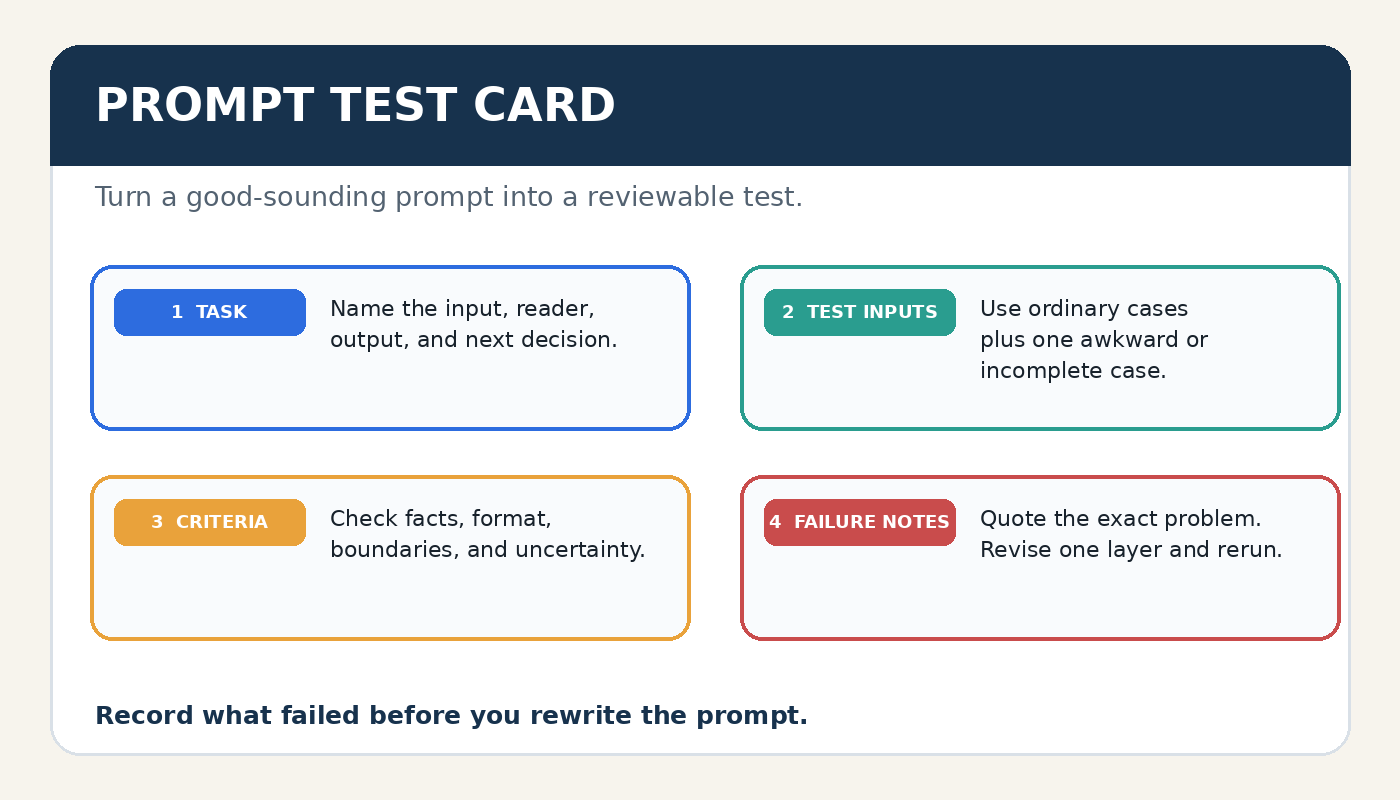
A prompt test card can fit on one page. It prevents you from changing several things at once and then guessing why the output improved. Keep these fields:
- Task contract: what the answer must help someone do.
- Prompt version: the exact text you sent.
- Test inputs: two ordinary examples and at least one awkward example.
- Review criteria: the properties you will score or mark as pass and fail.
- Failure notes: the exact sentence, omission, or formatting problem you found.
- Revision: one purposeful change linked to a recorded failure.
The awkward example matters. A work prompt may face incomplete notes. A writing prompt may receive a source that contradicts the brief. A research prompt may encounter a claim with no traceable citation. If you test only the neatest input, you learn how the prompt behaves in a demo, not how it behaves during ordinary use.
Do not use sensitive company, client, student, patient, or personal material merely to make a realistic test. Use approved data, a redacted sample, or a synthetic case that preserves the structural difficulty without exposing private information. Your organization’s policies still apply when a prompt is being tested.
Choose criteria you can actually inspect
“Better” is not a criterion. Replace it with a short rubric that matches the task. A useful rubric might ask whether the response follows the requested structure, covers every supplied fact, labels uncertainty, avoids unsupported additions, and stays within the specified length. Not every task needs every criterion. A brainstorming prompt can allow novelty while a source summary should be judged more strictly for fidelity.
OpenAI’s evaluation best practices describe evaluations as structured tests for variable model output. The developer documentation recommends combining metrics with human judgment and including typical cases, edge cases, and adversarial cases. A personal ChatGPT workflow is smaller than a production evaluation system, but the principle transfers well: use repeatable examples and explicit criteria instead of relying on a vague impression.
Keep the scoring simple enough to use. A pass or fail mark works for hard requirements such as “contains exactly four headings.” A three-point scale can work for judgment calls: 0 means missing or wrong, 1 means partly useful, and 2 means ready with minor edits. Add a note beside every low score. The note is more useful than the total because it tells you what to revise.
Adapt the prompt by changing one layer
When a response fails, resist the urge to double the prompt’s length. First identify the layer that failed. Then make one focused change.
- Instruction layer: clarify the action. Replace “review this” with “identify unsupported claims and quote the sentence that needs evidence.”
- Context layer: supply only the source material and background required for the task. Label source text clearly so it is not confused with instructions.
- Constraint layer: state boundaries such as approved sources, excluded topics, length, and whether the answer must flag missing information.
- Format layer: provide headings, fields, or a short example when the output must follow a pattern.
- Review layer: ask for a final check against named criteria, but still inspect the result yourself.
This diagnosis keeps prompts readable. If the response includes invented facts, adding a prettier table will not fix the evidence problem. If the answer is accurate but impossible to paste into your workflow, the format layer needs attention. If the model overlooks a condition buried in a long paragraph, move that instruction near the top and make it concrete.
For a broader introduction to instruction structure, read our ChatGPT prompt engineering guide. If your recurring preferences belong across many conversations rather than in one task, our guide to setting Custom Instructions in ChatGPT explains that separate layer. Keep task-specific evidence and acceptance criteria in the task prompt.
Run a controlled comparison
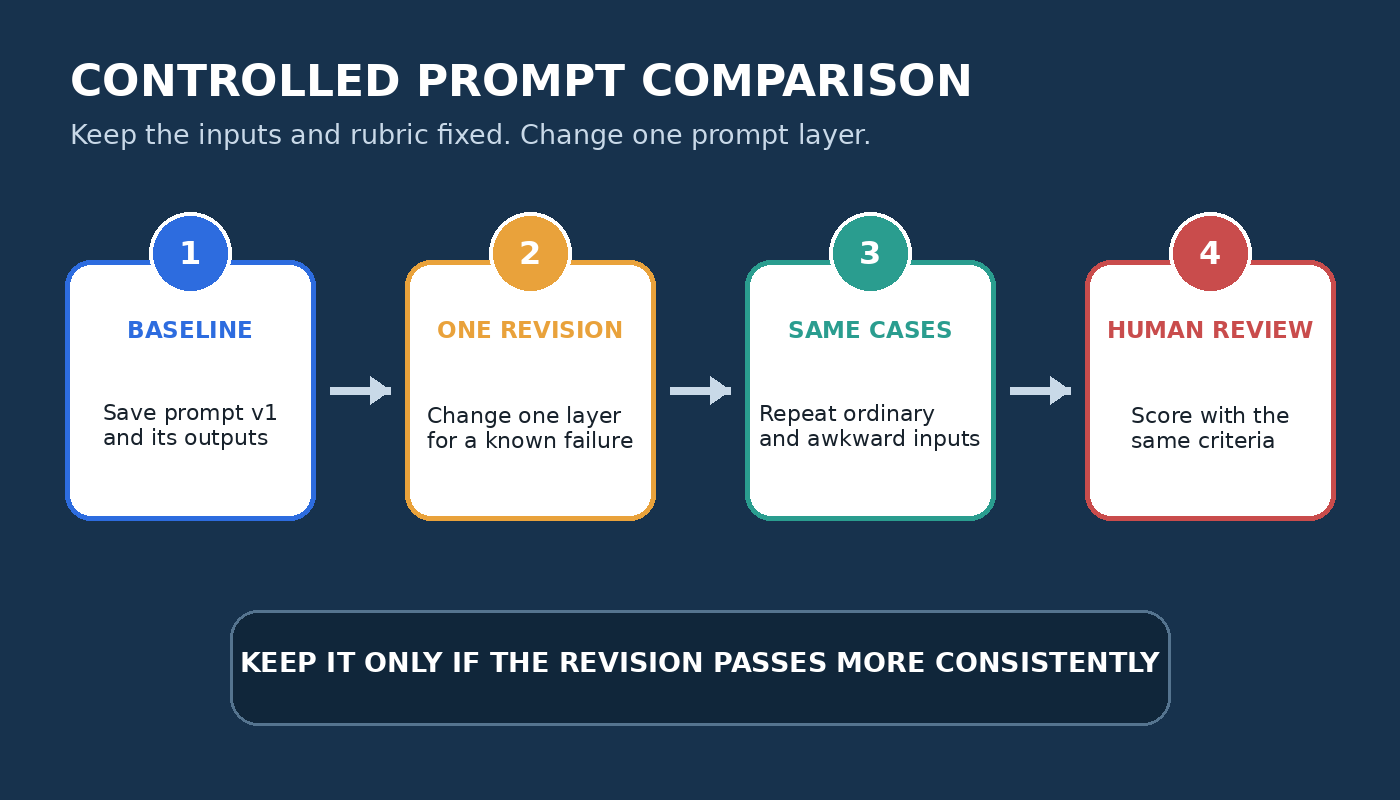
Save the baseline prompt and its outputs. Make one revision, then run the same test inputs again. Compare the two versions against the same rubric. If you change the prompt, source text, requested format, and model selection at the same time, the comparison cannot tell you which change mattered.
One run is useful for finding obvious failures, but it is weak evidence for a reusable prompt because generated answers can vary. Repeat the important cases and look for patterns. You do not need a laboratory or a large spreadsheet. A small table with the input name, prompt version, result, score, and reviewer note is enough for many personal and team tasks.
Do not choose a winner from the smoothest prose alone. A confident answer can still be wrong. OpenAI’s article Does ChatGPT tell the truth? warns that ChatGPT can produce incorrect facts, fabricated quotations, and nonexistent citations. It recommends checking important claims and visiting cited sources. For factual tasks, source fidelity and traceability should outweigh polish.
Apply the method to work prompts
Suppose you need a weekly project update. The first prompt says, “Summarize these notes for management.” The output mixes decisions, progress, and unresolved issues. Your failure note is specific: decision owners are missing, and risks are presented as settled facts.
Adapt the prompt by naming the reader and structure: “Using only the notes below, write a project update for department heads. Use the headings Decisions, Progress, Open questions, and Risks. For each decision, name the owner only if the notes provide one. If ownership or timing is missing, write ‘not stated.’ Keep the update under 300 words.” Then test it with complete notes, sparse notes, and notes that contain a disagreement.
Your rubric can check source fidelity, section placement, treatment of missing information, and length. A failed test may show that “not stated” appears too often and makes the report clumsy. Rather than removing the safeguard, narrow it to ownership and dates. That is adaptation based on evidence, not prompt decoration.
Apply the method to writing prompts
Writing prompts need different criteria at different stages. An outline prompt should be judged for logical coverage and source boundaries. A drafting prompt needs voice, pacing, and paragraph purpose. A revision prompt should diagnose a real weakness rather than rewriting every sentence into the same tone.
Start with a short piece you can review closely. Give ChatGPT the audience, purpose, approved notes, and a sample of the intended format. Ask it to mark any claim that lacks support instead of filling the gap. Test the prompt with one strong source packet and one that is incomplete. If the incomplete case produces made-up transitions or facts, revise the instruction about missing evidence and test again.
Our ChatGPT writing prompts workflow provides examples for distinct editorial stages. Use those examples as starting material, then evaluate them against your own publication standard. A prompt that works for an internal memo may be wrong for a reported article even when both outputs read cleanly.
Apply the method to research prompts
Research prompts should make the evidence boundary visible. State which documents are approved, whether outside knowledge is allowed, how citations should be represented, and what to do when the material does not answer the question. Requesting citations is not enough because a citation can look plausible without existing.
A practical test uses a source packet with known answers, one question the sources cannot answer, and one tempting but unsupported claim. Score whether the response distinguishes evidence from inference, points to the correct document, and refuses to manufacture support. Open every cited link or locate the quoted passage yourself. If the task carries legal, medical, financial, safety, or academic consequences, involve an appropriately qualified human reviewer.
When current information matters, confirm that the relevant tool is available and inspect its sources. Tool access can improve access to recent information, but it does not make every conclusion correct. Your test should cover source quality, date relevance, contradictory evidence, and whether the answer states what remains uncertain.
Keep a prompt only while it earns its place
A reusable prompt should include a short record: its purpose, owner, last test date, test cases, known limitations, and current version. Retest it when the task, source format, model, tool access, or quality standard changes. Archive versions that no longer pass rather than leaving several nearly identical prompts in a shared folder.
The final decision remains human. A passing prompt test means the version met your stated criteria on the cases you ran. It does not guarantee every future answer. That modest conclusion is still useful. You know what you tested, what failed, what you changed, and what still needs review.
Frequently asked questions
How many examples do I need to test a ChatGPT prompt?
Begin with two ordinary examples and one difficult example. Add cases when you discover a new failure pattern. The goal is not an arbitrary number. It is enough variation to expose the mistakes that matter for your task.
Should I make every failed prompt more detailed?
No. Diagnose the failure first. Add detail when an instruction, boundary, or format is ambiguous. Remove irrelevant context when it distracts from the task. A shorter, better placed instruction can be more useful than another paragraph of rules.
Can ChatGPT grade its own answer?
It can help apply a clear rubric or compare two outputs, but its judgment should not be your only evidence. Check important facts, citations, and high impact decisions yourself. For team use, compare automated ratings with human reviews before trusting the rating process.
When should I stop revising a prompt?
Stop when the prompt meets the agreed criteria across your test cases and the remaining editing cost is acceptable for the task. Record known limitations. Reopen the prompt when a new input, failure, or requirement shows that the old test set is no longer sufficient.