
Research with ChatGPT works best when you treat the product as a navigator and analyst, not as the final authority. It can help you define a question, search the web, inspect uploaded material, compare claims, and shape a readable synthesis. Your job is still to decide what counts as evidence, open the cited pages, and confirm that each important statement is supported.
The most useful starting point is choosing the right mode. ChatGPT Search is designed for a quick, current answer supported by web links. Deep Research is designed for a larger investigation that may examine many sources before producing a structured report. An ordinary chat remains useful for planning, analyzing text you provide, and drafting from evidence you have already checked. Those are related tools, but they are not interchangeable.
Start with a research decision, not a clever prompt
Before opening ChatGPT, write one sentence that describes the decision your research must support. “Learn about electric vehicles” is too broad. “Compare the published warranty terms, charging standards, and starting prices of three models sold in the United Kingdom as of this month” gives you a scope, evidence types, geography, and date. A precise brief makes it easier to notice when the answer wanders.
- Question: What must the research establish?
- Audience: Who will use the result, and what do they already know?
- Boundary: Which period, market, products, or definitions are included?
- Evidence: Which primary sources would be strongest?
- Output: Do you need a short answer, a comparison table, or a sourced report?
- Risk: What would happen if a claim were wrong or outdated?
This short specification is more valuable than decorative prompt language. It also tells you whether one search is enough or whether the task needs a deliberate investigation.
ChatGPT Search and Deep Research solve different problems
According to OpenAI’s ChatGPT Search help article, ChatGPT can search automatically when a question may benefit from web information, and a user can also choose the web search option. Search responses include inline citations, with a Sources control for reviewing links. That makes Search a good fit for a focused question whose answer can be checked in a handful of pages.
Deep Research is a different workflow. OpenAI’s Deep Research help article describes a process in which you state the outcome, choose sources, review a proposed plan, watch progress, and receive a documented report. You can direct it toward the public web, uploaded files, and connected sources that are available in your account. OpenAI also notes that access and usage limits can depend on plan and workspace settings.
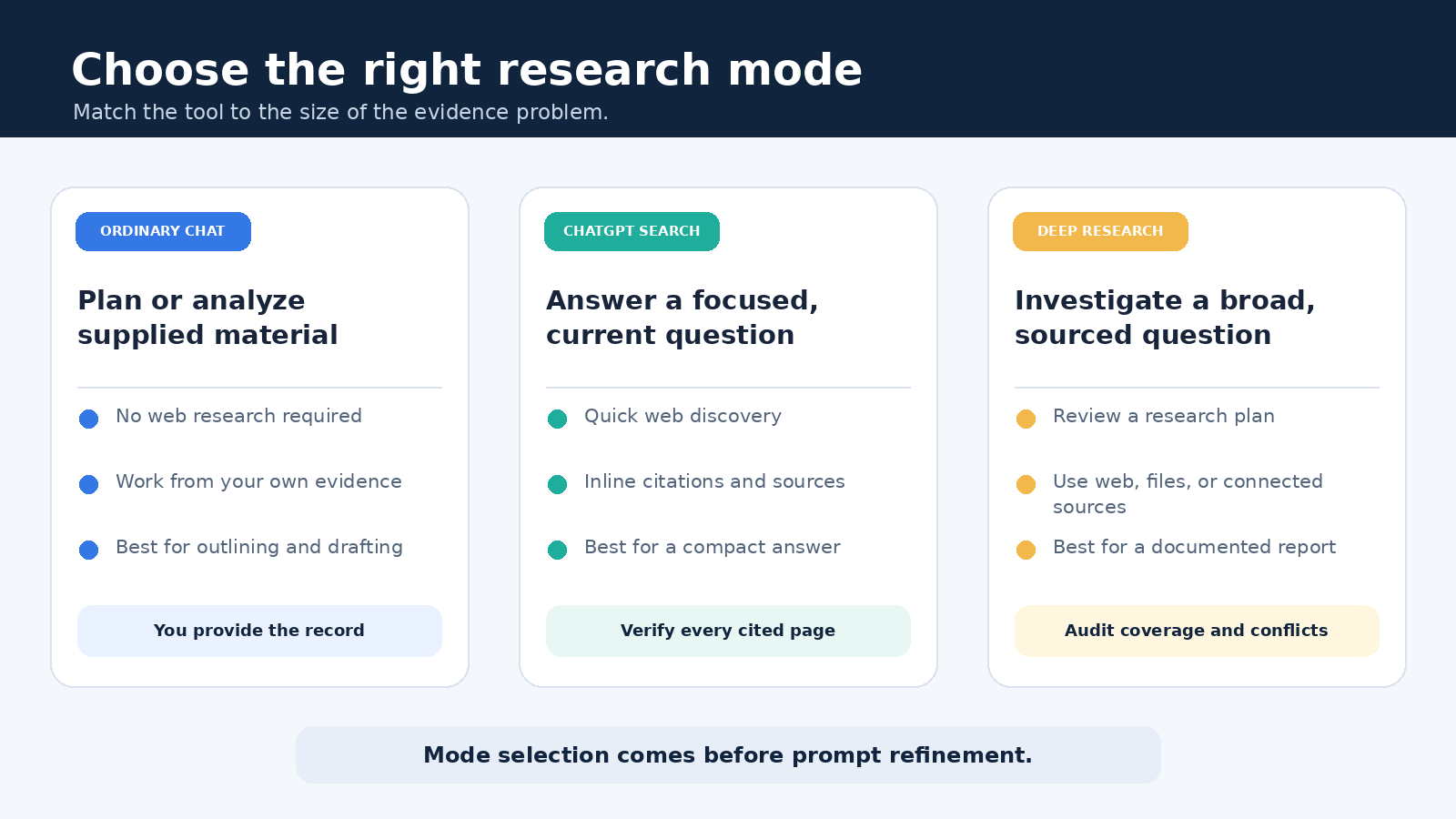
| Mode | Use it when | Typical result | Your review burden |
|---|---|---|---|
| Ordinary chat | You are planning or working from material already supplied | Questions, summaries, transformations, or a draft | Check every claim against your supplied evidence |
| Search | You need a timely fact or a compact overview | A conversational answer with web citations | Open the cited pages and verify the exact support |
| Deep Research | The task is broad, comparative, or source heavy | A longer report with citations and a sources section | Audit coverage, source quality, conflicts, and conclusions |
Time is not the only difference. Search helps answer a question. Deep Research helps execute a research plan. If you need today’s release date from an official announcement, start with Search. If you need to compare policy changes across multiple official documents and explain their practical effects, Deep Research is the more suitable starting point. For a very high stakes conclusion, neither mode removes the need for specialist review.
A six step workflow for research with ChatGPT
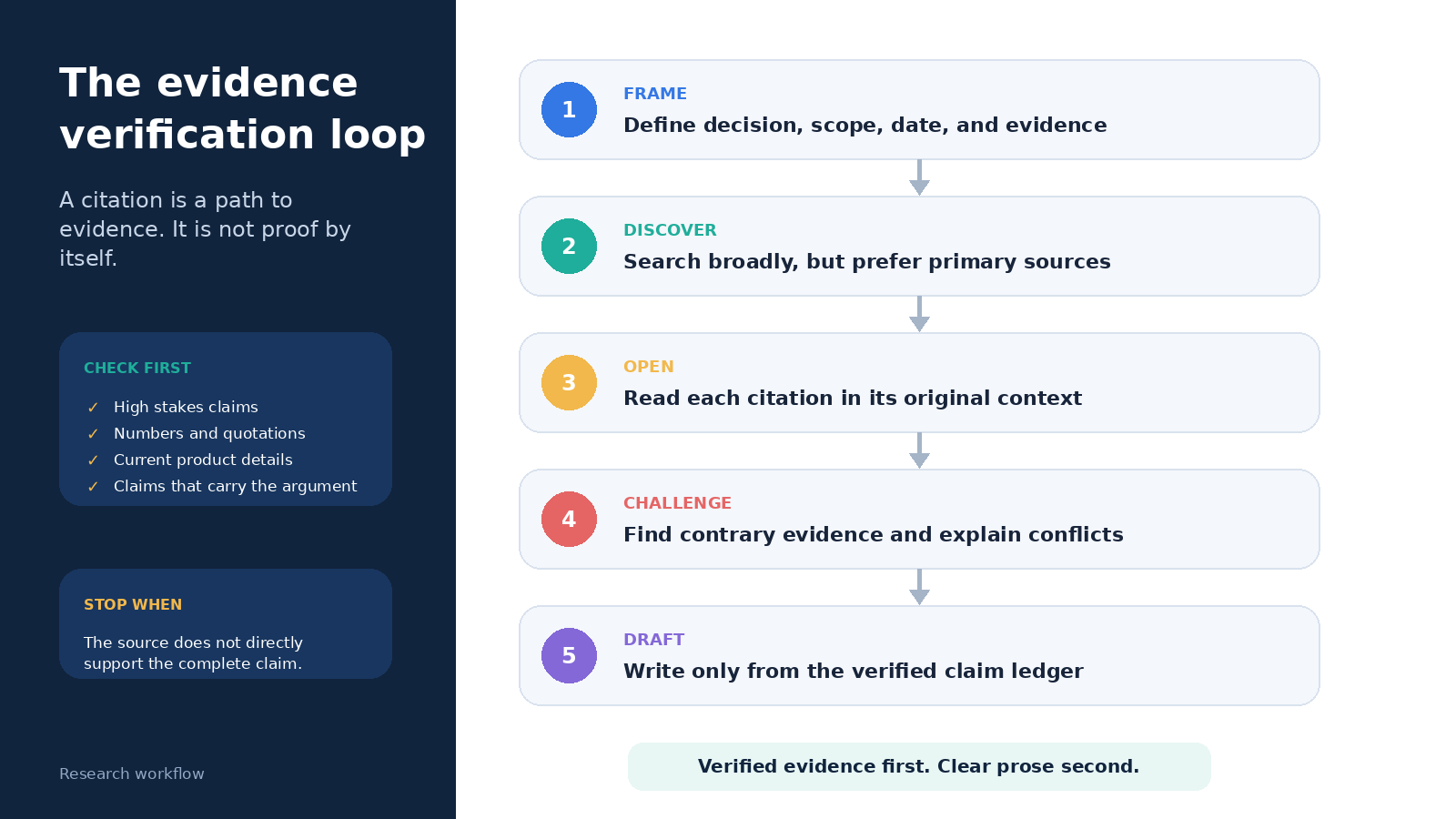
1. Frame a question that can be disproved
Ask for a claim that evidence could confirm or overturn. Instead of “Why is remote work better?” ask, “What do employer reports and peer reviewed studies published since 2023 say about the effects of hybrid work on retention, and where do their findings disagree?” The second version does not assume the conclusion. It names the evidence and explicitly invites disagreement.
2. Build a source hierarchy
Tell ChatGPT what should count as a preferred source. For product behavior, begin with the vendor’s documentation and release notes. For laws, use the statute, regulator, court record, or official guidance. For research findings, inspect the paper itself, its methods, and any correction rather than relying on a blog summary. Secondary reporting can add context, but it should not silently replace the underlying record.
Reusable request: Research [question] for [audience] within [scope]. Prefer [primary source types]. Separate documented facts from your interpretation. For every material claim, cite the page that directly supports it. Note conflicting evidence, missing data, and dates that may make a source stale. Do not invent a citation when support is unavailable.
3. Choose Search or Deep Research deliberately
Use Search when you can describe the desired answer in one or two narrow clauses and expect a small source set. Use Deep Research when the work requires comparison, multiple dimensions, or a report that combines files with web material. The OpenAI Academy Deep Research resource recommends describing the question, desired output, and relevant constraints, then reviewing the plan before the research proceeds.
If the task is large, do not rush through that plan. Check whether it covers the markets, dates, definitions, and counterarguments in your brief. Remove branches that are merely interesting. Add a missing primary source class. A five minute plan review can prevent a polished report on the wrong question.
4. Inspect citations while the answer is fresh
A citation is a route to evidence, not proof that the sentence is correct. Open it. Confirm that the page says what the answer claims, that the date and jurisdiction fit, and that the quoted number uses the same denominator. Look for a qualification hidden in a footnote or methods section. If a cited page summarizes another document, follow the trail to the original.
- Does the source directly support the whole sentence, or only one part?
- Is it the original document or a repetition of someone else’s claim?
- Is the publication date appropriate for a time sensitive answer?
- Does the source have an obvious commercial or institutional interest?
- Can you reproduce the number or comparison from the page?
5. Run a contradiction pass
Ask ChatGPT to identify the three conclusions most vulnerable to challenge, then request contrary evidence from equally strong sources. This is not a magic fact check. It is a way to expose assumptions and search gaps. You can also ask for a claim ledger with columns for claim, supporting source, opposing source, publication date, confidence, and required follow up.
When sources disagree, keep the disagreement visible. Differences may come from sample size, definitions, geography, funding, or the period studied. A trustworthy report explains those reasons instead of averaging incompatible numbers or choosing the most convenient result.
6. Draft only from the verified ledger
Once the evidence is checked, start a clean drafting pass. Provide the approved claims and links, specify the audience and structure, and tell ChatGPT not to add unsupported facts. Keep interpretation labeled as interpretation. If your report changes a number, date, quotation, or causal claim during editing, return to the source before publication.
How to verify a ChatGPT research report
A fast verification pass should prioritize claims by consequence. Check legal requirements, safety statements, financial figures, medical information, quotations, and current product details first. Then review the claims that carry the argument. Background descriptions can follow. This risk based order is more realistic than pretending every sentence deserves equal time.
For each important claim, record a short excerpt from the source and enough location information to find it again. A URL alone may point to a changing page. Where possible, note the title, publisher, publication or update date, section heading, and access date. If the work will be audited, save an approved copy according to your organization’s rules.
The OpenAI developer guide to Deep Research reinforces the distinction between broad web research and controlled data access. For API builders, it discusses web search, file search, remote tools, and the need to manage tool behavior. The practical lesson for an everyday ChatGPT user is simpler: know which information spaces were available to the investigation, and do not assume that an uncited or inaccessible source was searched.
Use files and Projects without muddying the evidence
Uploaded files are useful for comparing contracts, interview notes, reports, or a private literature set. Label each file clearly and include its date and status. A draft policy and an approved policy should never look interchangeable. Ask ChatGPT to cite the file name and page or section for each extracted claim, then verify the passage yourself.
For work that continues over several sessions, a Project can keep instructions, chats, and reference material together. Our guide to setting up a ChatGPT Project explains how to organize sources and review boundaries. Keep one evidence register outside the conversation, however, so your record does not depend on chat history alone.
A broader ChatGPT guide for research, writing, data, and automation can help when the research feeds a larger workflow. The handoff should remain explicit: discovery produces candidates, verification approves claims, drafting communicates approved evidence, and a human owns publication.
Privacy, copyright, and high stakes limits
Do not upload confidential interviews, personal data, trade secrets, unpublished manuscripts, or restricted client files until you have confirmed that your account, workspace, permissions, and retention rules allow it. Redact unnecessary identifiers. If a connected source contains more material than the task requires, narrow access before beginning.
Summarization does not erase copyright or licensing duties. Quote only what you are allowed to use, attribute it properly, and do not ask the tool to disguise copied expression. For academic work, follow the institution’s disclosure and citation policy. For legal, medical, safety, or investment decisions, use ChatGPT to organize questions and evidence, then obtain review from a qualified professional.
Common research failures and practical fixes
| Failure | Why it happens | Better move |
|---|---|---|
| Starting with a vague topic | The answer optimizes for breadth and fluency | Define the decision, scope, evidence, and date |
| Trusting the citation marker | The link may support only part of the sentence | Open the source and record the supporting passage |
| Using Search for a complex review | A short response compresses unresolved differences | Use Deep Research and inspect its plan |
| Using Deep Research for one fact | The workflow adds time without adding useful coverage | Run a focused Search and verify the primary source |
| Mixing supplied files with web claims | The origin of a statement becomes unclear | Require source labels and maintain a claim ledger |
| Drafting before verification | Unsupported claims become embedded in the narrative | Approve evidence first, then draft from that set |
A reusable prompt sequence
Research improves when each request has one job. Begin with: “Turn this objective into a neutral research question. List ambiguous terms and ask me to choose the scope.” Next: “Propose a source hierarchy and a research plan. Include contrary evidence and stop for my approval.” After discovery: “Create a claim ledger. Do not mark a claim verified unless a cited source directly supports it.” Finally: “Draft for this audience using only verified rows. Preserve uncertainty and add no new factual claims.”
This sequence creates useful stopping points. You can correct the question before searching, correct the plan before spending time, reject weak evidence before drafting, and inspect the final language against an approved record. That is the core habit behind reliable research with ChatGPT.
Frequently asked questions
Is ChatGPT Search the same as Deep Research?
No. Search is suited to timely, focused questions and returns a conversational response with web citations. Deep Research is built for a multi step investigation, lets you review a plan and source scope, and produces a more extensive documented report.
Can I cite ChatGPT as my research source?
Usually, the stronger practice is to cite the original document that supports the claim and disclose AI assistance when your institution or publisher requires it. ChatGPT’s wording is not a substitute for the underlying evidence. Follow the citation rules that apply to your work.
How do I know whether a ChatGPT citation is accurate?
Open the cited page and compare it with the complete claim. Check authorship, date, context, definitions, jurisdiction, and whether the page is the primary source. If you cannot locate direct support, mark the claim unverified and search again.
When should I avoid using ChatGPT for research?
Avoid providing material you are not authorized to share. Do not rely on ChatGPT alone when an error could affect health, safety, legal rights, finances, or another high stakes outcome. In those cases, use authoritative records and qualified human review.