
ChatGPT personal finance use should start with a boundary. The tool can help organize a budget, explain unfamiliar terms, turn a bank statement into categories if the user provides safe data, or draft questions for an adviser. It should not be treated as a licensed financial adviser or as the final source for tax, investment, insurance, or debt decisions.
The practical value is in planning language. A user can ask for a monthly budget template, a checklist for comparing subscriptions, or a plain English explanation of compound interest. The risky part begins when the prompt includes full account numbers, identity documents, salary records, family information, or instructions to make a money decision without a qualified review.
Minimize the data before the prompt
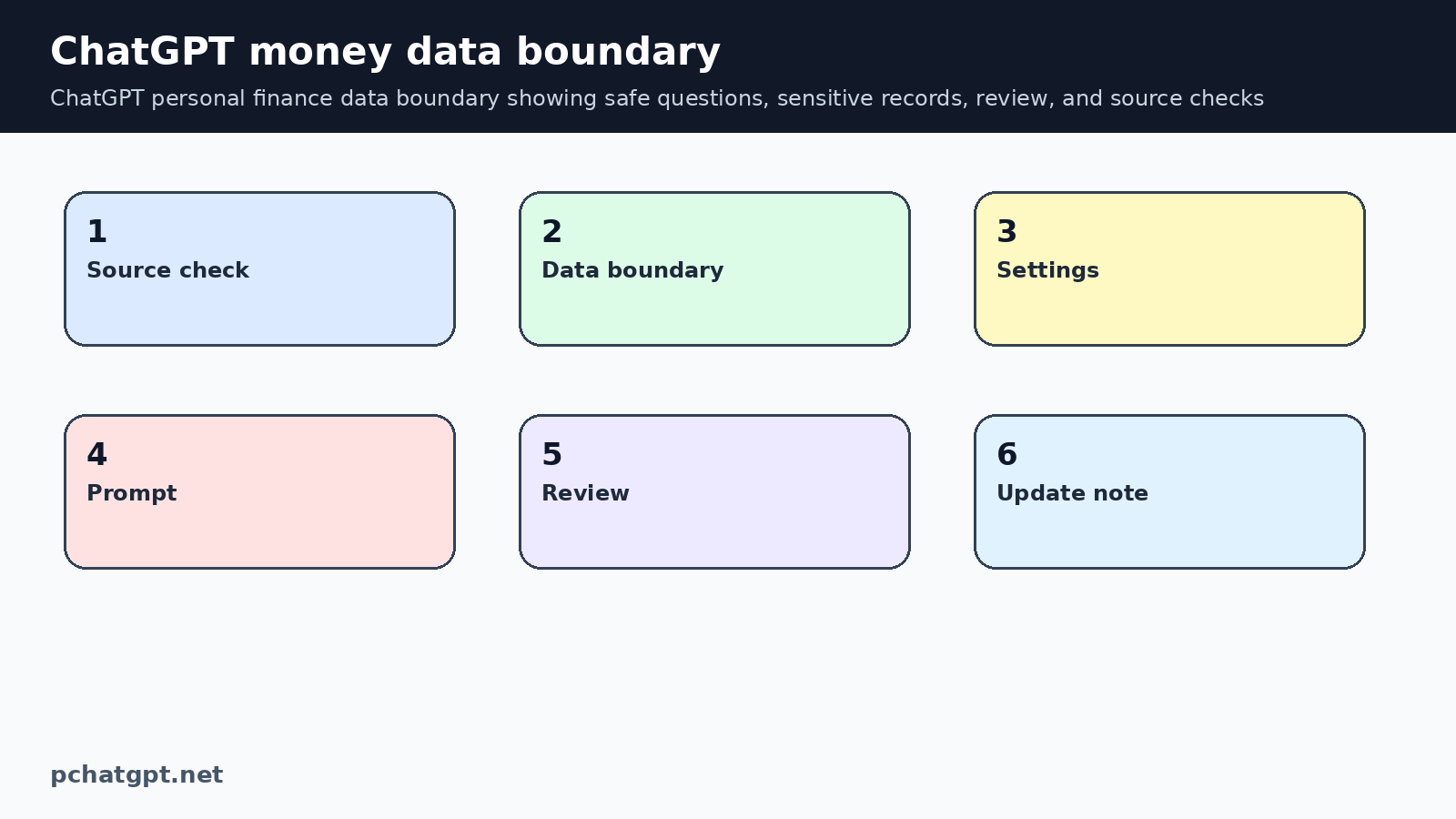
OpenAI privacy documentation says user content can include prompts and uploaded files. That means a finance prompt should be edited before it is sent. Replace exact account numbers with labels, round amounts when exact values are not needed, remove names, and avoid uploading statements unless there is a clear reason.
For many tasks, ChatGPT only needs categories and approximate totals. Instead of pasting a full bank export, write: “Rent is about 30 percent of income, food is about 15 percent, transport is about 8 percent, and subscriptions are too high.” That gives enough context for a planning conversation without exposing the full record of a household.
Check data controls first
OpenAI Data Controls let users decide whether conversations help improve models. Signed in users can turn off “Improve the model for everyone” in settings, and OpenAI says the choice applies across devices for the account. The Help Center also explains Temporary Chats, which are not saved in history, do not create memories, and are deleted from systems after 30 days, subject to abuse monitoring.
Those settings should be checked before a finance session, not after. If the question involves sensitive money details, use the most private available workflow and keep the prompt small. Turning off training is not a reason to paste more data than the task requires. Privacy controls reduce one risk, while data minimization reduces another.
Memory can help and hurt
Memory can personalize ChatGPT, but finance topics make personalization sensitive. OpenAI Help Center material says memory can use context from chats, files, and connected apps, and that users can manage memory in settings. If a finance discussion includes income, debt, family obligations, or business plans, decide whether that information should be remembered.
A safer habit is to use normal chat for general learning and Temporary Chat for sensitive finance questions. If memory is enabled, review the memory summary after a finance conversation and remove anything that should not guide future answers. Do not assume a later answer is neutral if the account has remembered old financial context.
Good finance prompts are narrow
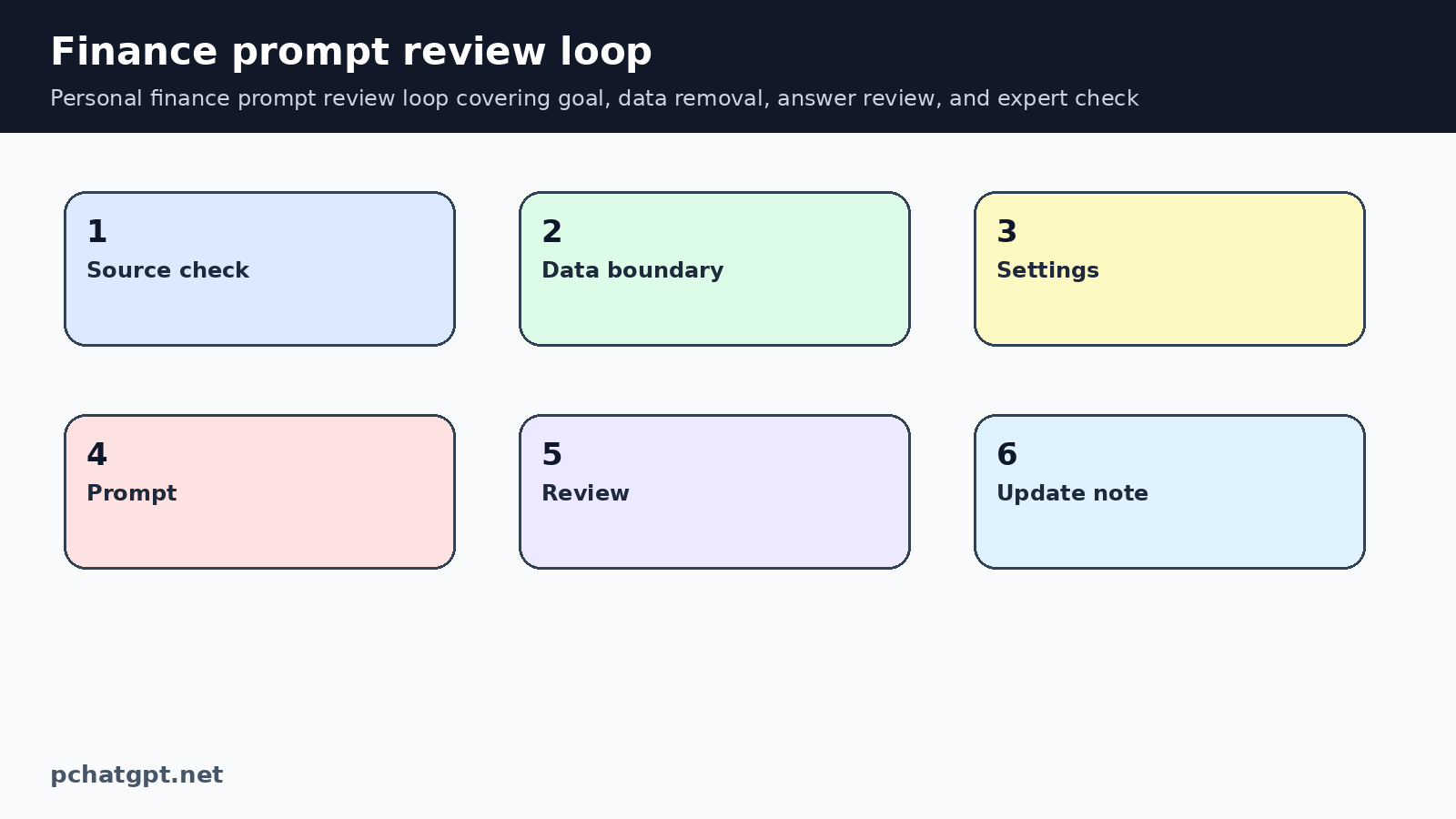
A strong prompt asks for a worksheet, comparison table, checklist, or explanation. For example: “Create a monthly budget review checklist for someone trying to reduce subscription spending. Do not ask for account numbers. Include questions I should verify myself.” That prompt keeps the model in an educational role.
A weak prompt asks ChatGPT to choose an investment, predict a market, or decide whether someone can afford a loan using incomplete data. Those answers may sound confident. They still need real documents, current rules, and qualified review. If money will move, ChatGPT should help prepare questions rather than make the decision.
How to verify the answer
Finance answers should be checked against original sources. If the answer mentions a fee, tax rule, product term, interest rate, or deadline, open the provider page or official regulator source. If the answer creates a budget, compare it with actual income and expenses. If it suggests a debt or investment action, ask a qualified professional where needed.
The final review should ask whether the answer is educational, whether it used unnecessary private data, whether it relies on current facts, and whether a human has checked the consequence. If the answer cannot pass those checks, use it as a draft only. ChatGPT can make money conversations easier to structure, but it cannot remove the need for careful judgment.
Practical publishing checklist
Before publishing advice about ChatGPT personal finance, check the current official page, the live account settings, and the exact product surface named in the article. Do not mix mobile, desktop, business, API, and workspace behavior unless the source says the same rule applies to each surface. This matters because readers may follow the article while holding a phone, opening a desktop app, or managing a business account, and each surface can expose different controls.
Keep the reader close to the task. A useful ChatGPT personal finance article should tell someone what to open, what setting to inspect, what data to remove, what answer to verify, and when to stop and ask a qualified person. Broad claims about AI adoption do less work than a narrow decision rule. The page should feel like a working note for someone making a real choice, not a recycled summary of why AI is changing everything.
Remove reused paragraphs during every refresh. If a sentence could appear unchanged in an article about coding, finance, voice assistants, and image tools, it probably does not belong here. Replace it with the specific risk, setting, source, or review step for ChatGPT personal finance. This is the easiest way to reduce low value signals without deleting URLs or hiding indexable posts that can still serve a searcher.
Maintenance for this article should begin with OpenAI Data Controls and memory documentation. If the Help Center changes how training controls, Temporary Chat, or memory sources work, the privacy sections need an update. If plan pages change, avoid copying price or access details unless they are necessary for the reader decision.
The final editorial test is practical. A reader should leave the page knowing how to use ChatGPT personal finance more carefully today. The article should not promise accuracy, safety, income, or feature access. It should explain the workflow, cite the official source, and leave consequential decisions with the user or the right professional. If the article cannot do that, it needs another pass before publication.
Preserving the finance URL matters because users already search for ChatGPT money guidance, but the old page needed a safer angle. The refresh keeps the identity of the post and reframes it around data minimization, Data Controls, Temporary Chat, memory review, and source checking. That gives the reader a cautious workflow without pretending ChatGPT is a financial adviser.
Internal links should help the reader continue the same job. For ChatGPT personal finance, one link should point to a broader AI tools or governance guide, while another should point to a related practical topic. Avoid dumping unrelated links near the end of the page. A link earns its place when it answers the next question a careful reader is likely to ask.
The finance diagrams are there to make the data boundary visible. They should remind the reader to remove account numbers, use rounded categories, review the answer, and check original financial sources. If the image text ever becomes vague, replace it with labels tied to safe money prompts and human review.
Finally, keep the FAQ short and different from the body headings. Each answer should resolve one likely objection or confusion about ChatGPT personal finance. If two FAQ answers say the same thing in different words, merge the idea and use the freed space for a more useful question. That small edit makes the page feel maintained rather than automatically expanded.
This article should avoid invented dashboards, made up product promises, market predictions, and specific financial recommendations. It can say ChatGPT is useful for budgeting structures, explanations, and checklists. It should not tell a reader what to buy, borrow, insure, or invest in.
When the content mentions safety, define the actual action. For ChatGPT personal finance, safety might mean using Temporary Chat, removing account numbers, checking device support, reviewing memory, or asking a human to inspect a consequential answer. Name the action plainly. Readers do not need a slogan. They need to know what to click, remove, compare, or verify.
The page remains indexable because it now gives a careful money workflow. It explains what data to remove, which settings to inspect, when Temporary Chat may help, how memory can affect future answers, and why consequential decisions need another source. That is a clearer answer than a thin post about a rumored dashboard.
The public verification step for this post should confirm the original slug, indexable robots, self canonical, two money workflow images, four FAQ answers, and working internal links. It should also verify that no old generic paragraph tells readers to browse recent AI tool guides from the homepage. Store the verification beside the batch summary so later runs can prove the finance article stayed indexable, source grounded, and different from the other refreshed posts.
The maintenance note should also list what was deliberately not claimed. For ChatGPT personal finance, that may include unavailable rollout details, unsupported regional assumptions, exact prices, benchmark results, or promises about accuracy. Stating the boundary is useful because it stops later rewrites from adding attractive but unsupported details during a routine cleanup pass.
If the reader needs a deeper companion article, route them to the memory controls guide or the AI governance guide. This page should stay close to personal finance prompts and privacy choices. That boundary keeps it useful for people who want a safe first session, not a broad theory of AI in banking.
For this finance page, the extra review point is practical: never let a budget prompt become a decision prompt by accident. Keep the model in an educational role, compare the answer with real statements outside ChatGPT, and ask a qualified adviser when the decision affects debt, taxes, insurance, or investment risk.
Official sources used
- https://help.openai.com/en/articles/7730893-data-controls-faq
- https://openai.com/policies/row-privacy-policy/
- https://openai.com/chatgpt/pricing/
- https://help.openai.com/en/articles/8590148-memory-faq
- https://platform.openai.com/docs/guides/safety-best-practices
Related guides
- https://pchatgpt.net/memory-and-new-controls-for-chatgpt-a-practical-guide-for-2026/
- https://pchatgpt.net/generative-ai-governance-2026-business-ai-rules/
FAQ
Is ChatGPT safe for personal finance questions?
It can be useful for budgeting, explanations, and checklists if users remove unnecessary private data and verify important claims.
Should I upload bank statements to ChatGPT?
Avoid uploading full statements unless the task truly requires them. Use categories, rounded amounts, and labels when possible.
Do Data Controls replace financial privacy habits?
No. Data Controls help manage account settings, but users should still minimize the data they put into prompts.
Can ChatGPT tell me what investment to buy?
Do not use ChatGPT as the final authority for investment decisions. Use it to prepare questions and learn terms, then verify with qualified sources.