
The Best Ways to Use ChatGPT for Brainstorming
ChatGPT is most useful for brainstorming when you treat it as a thinking partner, not an idea vending machine. A vague request may produce a long list, but a clear decision, realistic constraints, and a deliberate review process can turn that list into something you can actually use.
This practical guide shows you how to move from a blank page to a focused, testable plan. The method follows official OpenAI guidance: define the task, provide context, specify the expected output, generate widely, then evaluate and refine with human judgment.
Why ChatGPT works well as a brainstorming partner
Brainstorming often fails in one of two ways. You cannot get beyond the first obvious ideas, or you generate so many options that nobody knows what to do next. OpenAI’s Academy describes ChatGPT as a structured thought partner that can generate options, organize them into themes, and turn a rough direction into an actionable plan. That combination is more valuable than raw volume alone.
The key is to give ChatGPT a defined job. It can help you explore different angles, identify assumptions, compare tradeoffs, and impose structure on scattered notes. It does not know your unwritten priorities, office politics, customer nuances, or operational limits. Your expertise supplies those missing pieces.
A productive session therefore has two distinct modes. In expansion mode, you want variety and you postpone judgment. In selection mode, you introduce criteria and ask for comparison. Mixing the modes too early usually produces safe, repetitive options. Staying in expansion mode forever leaves you with an impressive list and no decision.
Start with the decision, not a request for ideas
Before opening ChatGPT, finish this sentence: “At the end of this brainstorm, I need to decide…” Your answer gives the session a destination. “Give me marketing ideas” is open ended. “Help me choose three campaign concepts that a two-person team can launch in six weeks” is a decision brief.
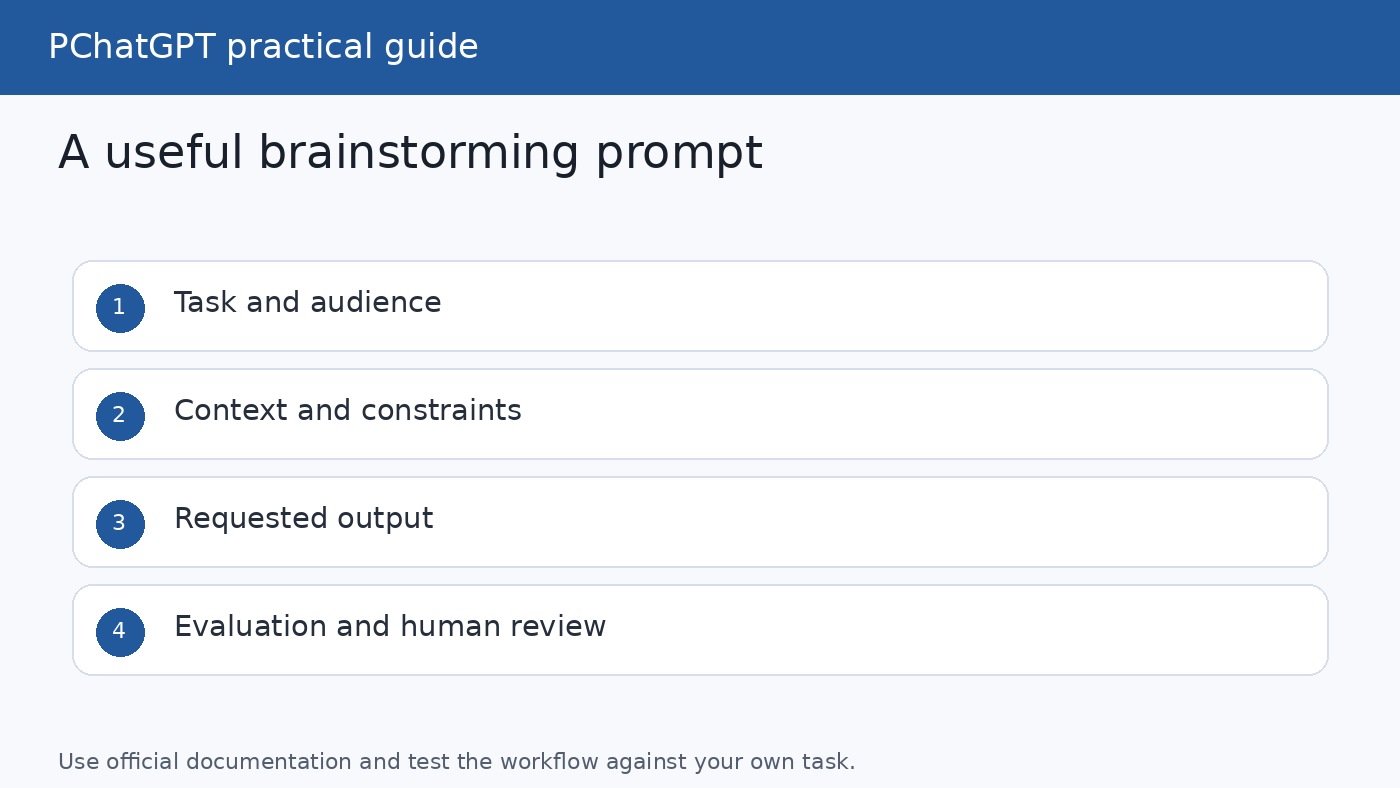
Official OpenAI materials repeatedly emphasize three prompt ingredients: the task, the context, and the expected output. The OpenAI Cookbook also recommends making the audience, format, and definition of success clear. You do not need an elaborate formula. A compact handoff is usually enough.
- Decision: What will you choose, approve, test, name, create, or improve?
- Context: Who is involved, what has already happened, and why does the decision matter?
- Audience: Who must understand, use, or respond to the result?
- Constraints: State the deadline, budget, capacity, channels, policies, and non-negotiables.
- Success criteria: Explain what a strong option must achieve.
- Output: Request a specific number of ideas and a useful format.
For example, do not merely ask for webinar topics. Explain that the webinar is for first-time managers, must fit 30 minutes, should solve an immediate workplace problem, and needs a practical takeaway. Ask for 15 distinct topics grouped into three themes, with one sentence explaining the value of each. The added detail does not limit creativity. It directs creativity toward your real problem.
If you are unsure how to structure the request, read our guide to writing better ChatGPT prompts. The page was confirmed live before this draft was prepared.
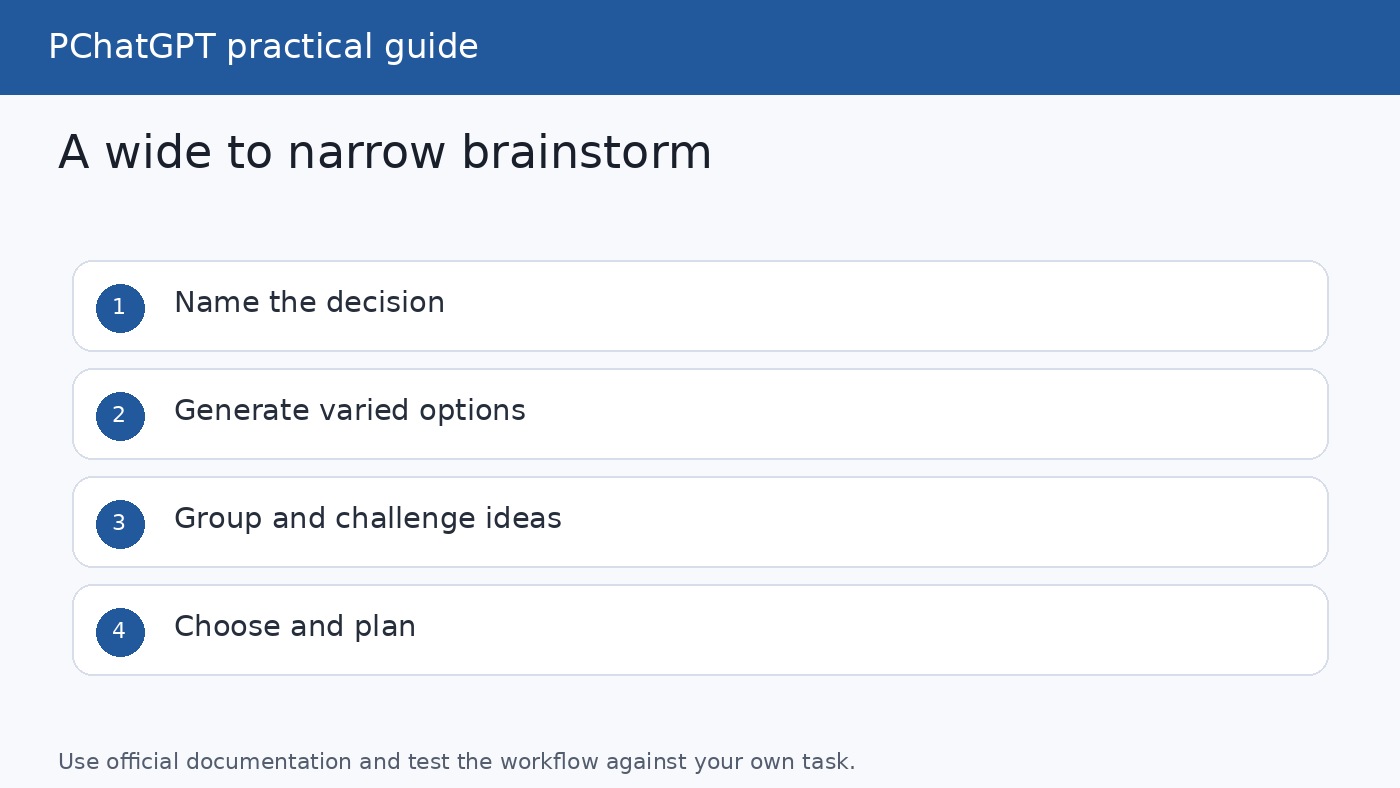
Use this wide to narrow brainstorming workflow
OpenAI Academy recommends separating idea generation from evaluation. The following workflow turns that principle into a repeatable session. Keep the conversation in one chat while the topic stays the same so ChatGPT can use the context and decisions already stated. Start a new chat when you switch to an unrelated problem, as the ChatGPT 101 resource guide advises.
-
Write a one-paragraph brief.
State the decision, audience, context, constraints, and desired output. Include relevant failed attempts so ChatGPT does not simply recycle them. Do not paste confidential material unless your organization permits it.
-
Generate for range, not perfection.
Ask for 15 to 25 ideas that differ in strategy, tone, effort, or risk. Explicitly request a mix of straightforward, unconventional, low-cost, and ambitious options. At this stage, do not ask ChatGPT to select the winner.
-
Expose repetition and missing angles.
Ask which ideas are essentially duplicates. Then request overlooked perspectives, such as the customer’s objections, a frontline employee’s needs, an accessibility concern, or a simpler approach that removes work rather than adding it.
-
Group the ideas into themes.
Request three to six meaningful clusters and a short label for each. Ask ChatGPT to explain the common logic behind every cluster. This step turns a flat list into a map of the option space.
-
Define the selection criteria yourself.
Useful criteria might include customer value, expected impact, effort, cost, speed, reversibility, strategic fit, and risk. Choose only criteria that matter to the decision. If one criterion matters more, assign it a higher weight and explain the reason.
-
Compare and challenge the shortlist.
Ask for a table showing how the strongest options perform against each criterion. Treat scores as discussion aids, not facts. Then ask what assumption would need to be true for each option to succeed and what evidence would disprove it.
-
Turn one direction into a small test.
Choose the direction yourself, then request a pilot with an owner, first action, timeline, resources, success signal, and review date. OpenAI’s brainstorming guide specifically recommends moving from selection into planning with milestones, ownership, and a basic timeline.
This staged approach is a form of prompt chaining. Each prompt has one clear purpose, and your review controls what moves to the next step. For a deeper explanation, see our live guide to prompt chaining in ChatGPT.
Copyable ChatGPT brainstorming prompts
Replace the bracketed text with your details. These templates are starting points, not magic commands. Adjust them after you see what ChatGPT misunderstood or left out.
1. Start a broad but relevant brainstorm
I need to decide [decision]. The audience is [audience], and the relevant context is [context]. We must work within [budget, time, team, channel, and policy constraints]. A strong idea should [success criteria]. Generate 20 genuinely distinct options. Include a mix of low-effort, moderate, and ambitious approaches. For now, do not rank or reject them. Group the final list loosely by approach and explain each idea in two sentences.
2. Find less obvious directions
Review the ideas above for repetition and conventional thinking. Identify the assumptions they share. Then add 10 options that challenge those assumptions without violating my constraints. Include at least two ideas based on simplifying the problem, two based on combining existing ideas, and two inspired by how a different industry might approach the same need.
3. Organize a messy collection of ideas
Organize these notes into four to six themes. Give each theme a plain-English name, explain the shared logic, and place every idea in the most appropriate group. Flag duplicates, contradictions, and ideas that are too vague to assess. Do not invent missing evidence. End with three questions that would make the collection easier to evaluate.
4. Improve a team process
Brainstorm 15 ways to improve [process]. Current friction includes [problems]. The team has [capacity] and needs to show progress within [timeline]. Include quick fixes and larger changes. For every option, list the likely benefit, effort, main tradeoff, people who need to participate, and a small first test.
5. Generate content or campaign concepts
Create 12 campaign concepts for
aimed at [audience]. The goal is [goal], the available channels are [channels], and the tone should feel [tone]. Avoid [cliches, claims, or prohibited themes]. Give each concept a name, one-sentence premise, audience insight, sample headline, and reason it differs from the others.
6. Compare options without pretending certainty
Compare the shortlisted ideas against these criteria: [criteria]. Use a table with a brief rationale for each assessment. Separate facts I supplied from assumptions you inferred. Do not choose a winner yet. For each option, identify the biggest uncertainty, the cheapest way to test it, and the evidence that would cause us to reject the idea.
7. Run a pre-mortem
Assume we selected [idea] and it failed six months later. Generate 10 plausible reasons for the failure, covering audience response, execution, resources, timing, dependencies, and unintended effects. Rank the reasons by likelihood and severity, label every estimate as an assumption, and propose one preventive action or early warning signal for each.
8. Convert the choice into an experiment
Turn [chosen idea] into a limited pilot we can run within [time and budget]. Provide the objective, target participants, scope, owner, dependencies, first five actions, success measures, stop conditions, and review date. Keep claims provisional and list the decisions that still require a human owner.
Ways to make the ideas more original and useful
Asking ChatGPT to “be creative” is less useful than changing the dimensions it explores. Give it a set of lenses. Ask how the answer changes for a new user versus an expert, for a one-day deadline versus a quarter, or for no budget versus a modest budget. Ask for one option that removes a step, one that reuses an existing asset, and one that changes the delivery channel.
You can also request combinations. Have ChatGPT select two ideas from different themes and explain whether a hybrid preserves their advantages or merely adds complexity. Another strong move is inversion: ask what would guarantee a bad outcome, then translate those failure conditions into design principles.
Role perspectives can reveal blind spots, but use them carefully. Ask ChatGPT to examine an idea from the perspective of a skeptical customer, an operations lead, or an accessibility reviewer. Do not present the simulated reaction as real research. It is a hypothesis generator that helps you decide whom to interview and what to test.
Evaluate the output with human judgment
ChatGPT can make ideas sound polished before they are proven. A confident explanation is not evidence that customers want the idea, that a budget estimate is accurate, or that a plan complies with policy. OpenAI Academy advises keeping a human in the loop and reviewing outputs. Its brainstorming guidance also frames the model as a fast draft partner rather than a replacement for context, expertise, or judgment.
Use the following review questions before acting:
- Does this idea solve the decision we actually defined?
- Which statements come from our brief, and which did ChatGPT infer?
- What customer, market, technical, legal, or financial facts need verification?
- Does the idea conflict with company policy, privacy obligations, or brand standards?
- Who is missing from the review, especially people who must execute the plan or experience its effects?
- Can we test the riskiest assumption cheaply before making a large commitment?
For team sessions, consider giving people quiet time to generate ideas before showing the model’s list. This reduces the chance that ChatGPT’s first framing anchors the room. Combine human ideas with model-generated ideas, remove duplicates, and evaluate the mixed set without labeling the source. The objective is better thinking, not proving that either humans or AI “won.”
When the topic needs current information, use ChatGPT’s web search tools and inspect the cited sources. The official ChatGPT 101 guide notes that search can provide up-to-date resources and lets users open the sources behind a response. For consequential decisions, verify important claims at the original source rather than relying on a summary.
Common brainstorming mistakes to avoid
- Starting too broadly: A request such as “brainstorm business ideas” omits the decision, audience, resources, and success criteria.
- Ranking immediately: Early evaluation favors familiar ideas and prevents the session from exploring a wider range.
- Requesting quantity without diversity: Twenty lightly reworded ideas are not twenty strategic options. Ask for distinct mechanisms and lenses.
- Letting the model invent context: If a key fact is missing, ask ChatGPT to list questions or assumptions instead of filling gaps silently.
- Accepting numerical scores as objective: A scoring table reflects your criteria, weights, inputs, and model assumptions. It supports a decision but does not make it for you.
- Stopping at the list: A useful session ends with a shortlist, a testable assumption, an owner, and a next action.
- Sharing sensitive data carelessly: Follow your organization’s AI and data policies. Remove unnecessary confidential or personal information from the brief.
A simple 30-minute brainstorming session
If you need a lightweight routine, use five minutes to define the decision and constraints. Spend the next seven minutes asking ChatGPT for a wide set of options. Use five minutes to request missing angles and cluster the list. Then spend eight minutes applying your chosen criteria and discussing assumptions. Reserve the final five minutes for selecting one or two ideas to test, naming an owner, and setting a review date.
Do not worry about finding a perfect first prompt. The OpenAI Cookbook says prompting is iterative and recommends clarity rather than cleverness. Notice where the response drifts, revise the brief, and continue. A good conversation becomes more specific as your own thinking becomes clearer.
For more reusable starting points, browse our ChatGPT prompts for daily productivity, which was also confirmed to return a successful live response during preparation.
Frequently asked questions
Is ChatGPT good for brainstorming?
Yes, especially for generating multiple directions, organizing ideas into themes, exposing assumptions, and drafting a first action plan. Its suggestions still require your context and judgment. Treat outputs as options to inspect and test, not authoritative recommendations.
How many ideas should I ask ChatGPT to generate?
There is no universal number. For a focused problem, 15 to 25 ideas usually creates room for variety without making review unmanageable. Ask for distinct approaches rather than a high count alone, then remove duplicates and expand the most promising themes.
How can I stop ChatGPT from giving generic ideas?
Define the decision, audience, constraints, prior attempts, and success criteria. Specify the kinds of variation you want, such as low-cost, unconventional, fast, or ambitious approaches. If the first response is generic, ask it to identify shared assumptions and generate alternatives that challenge them.
Should I use one prompt or several prompts for brainstorming?
Several focused prompts are usually easier to control. Use one prompt to generate widely, another to find gaps, another to group themes, and a later prompt to compare a shortlist. Review each stage before carrying its output forward.
Final takeaway
The best way to use ChatGPT for brainstorming is to design a process, not hunt for a magic phrase. Begin with a real decision and enough context to make the task meaningful. Generate broadly without ranking, organize the option space, apply explicit criteria, challenge the assumptions, and finish with a small test. ChatGPT supplies speed and structure. You remain responsible for evidence, judgment, and the final call.