
Running out of content ideas rarely means you have nothing useful to say. More often, you are trying to invent a topic, judge its value, choose a format, and write the opening all at once. That is a crowded decision, especially when a deadline is close. ChatGPT can help by separating those jobs. It can widen the field, organize possibilities, challenge predictable angles, and turn one promising thought into a workable brief. You still decide what deserves to be published.
This guide shows how to use ChatGPT for content ideas without handing over your editorial judgment. The method works for articles, newsletters, videos, podcasts, social posts, and campaign themes. It starts with material you already know, not a request for random viral topics. Then it moves through audience tension, angle generation, selection, and validation. The result should sound like your publication because the raw ingredients and final choices remain yours.
Start with the reason you feel stuck
“I need ideas” describes the symptom, not the blockage. You might have too many broad themes and no sharp angle. Perhaps every idea feels familiar. Maybe you know the subject but cannot connect it to a reader’s immediate problem. You could also be exhausted and asking an empty document to provide the first clue. Name the blockage before opening ChatGPT, because each one needs a different task.
- No starting material: collect questions, observations, objections, and examples first.
- A topic is too broad: divide it by audience, stage, constraint, or desired outcome.
- Ideas feel repetitive: look for contrasts, mistakes, decisions, experiments, or overlooked details.
- You cannot choose: score candidates against reader value, evidence, originality, and effort.
- You have an angle but no structure: ask for several outlines rather than more topics.
This diagnosis keeps the conversation focused. OpenAI’s prompt engineering guidance for ChatGPT recommends clear, specific requests with enough context, followed by iterative refinement. That advice is particularly useful during ideation. A vague request such as “give me blog ideas” invites generic answers. A clear description of your reader, goal, available evidence, and constraints gives ChatGPT something meaningful to work with.
Build a small idea inventory before prompting
The strongest content ideas usually come from contact with real work. Spend ten minutes gathering fragments before asking ChatGPT to brainstorm. Useful inputs include questions from customers, notes from sales calls, search queries, support issues, comments, failed attempts, lessons from a project, changes in your field, and claims you can support with primary sources. An unfinished thought is enough. You are creating a box of parts, not drafting the finished piece.
Remove confidential information and details you do not need to share. Replace a customer’s name with a role, and summarize sensitive conversations rather than pasting them. Then label each fragment. Is it a question, frustration, misconception, decision, result, example, or source? Labels make patterns easier to see and help ChatGPT combine related material without pretending that every note has equal value.
If you have no recent notes, interview yourself. Write answers to five questions: What did I explain more than once this month? What mistake do beginners keep making? What decision looks simple but is not? What have I changed my mind about? What useful process happens behind the scenes? These answers are first party material. They give an ordinary topic a point of view that a generic list cannot provide.
Use a clear handoff, not a magic phrase
A productive prompt resembles a brief to a capable collaborator. OpenAI’s ChatGPT Enterprise Prompting Guide suggests organizing a request with context, instructions, and additional information or constraints. It also emphasizes that there is no single perfect template. For idea generation, a compact handoff can contain the following pieces:
- Context: your publication, subject area, and what prompted this session.
- Audience: who the reader is, what they already know, and what they are trying to do.
- Goal: the outcome the content should create, such as helping someone make a decision.
- Raw material: your inventory of questions, examples, observations, and credible sources.
- Constraints: format, scope, tone, claims to avoid, and available production time.
- Output: exactly what you want back, including the fields for each proposed idea.
Reusable prompt: I create [format] for [specific audience]. They understand [baseline knowledge], but struggle with [problem]. My goal is to help them [outcome]. Below are notes from my work. Generate 12 distinct content angles grounded only in these notes. For each, provide a working title, the reader question, a one sentence promise, the evidence I would need, and the main risk of becoming generic. Group similar ideas and explain the meaningful difference between them. Do not invent facts or results. Notes: [paste your safe, relevant inventory].
The output fields matter. A title alone can look exciting while hiding a weak premise. Asking for the reader question, promise, evidence, and genericity risk exposes whether an idea has substance. For more detail on constructing precise instructions, see our guide to writing better ChatGPT prompts.
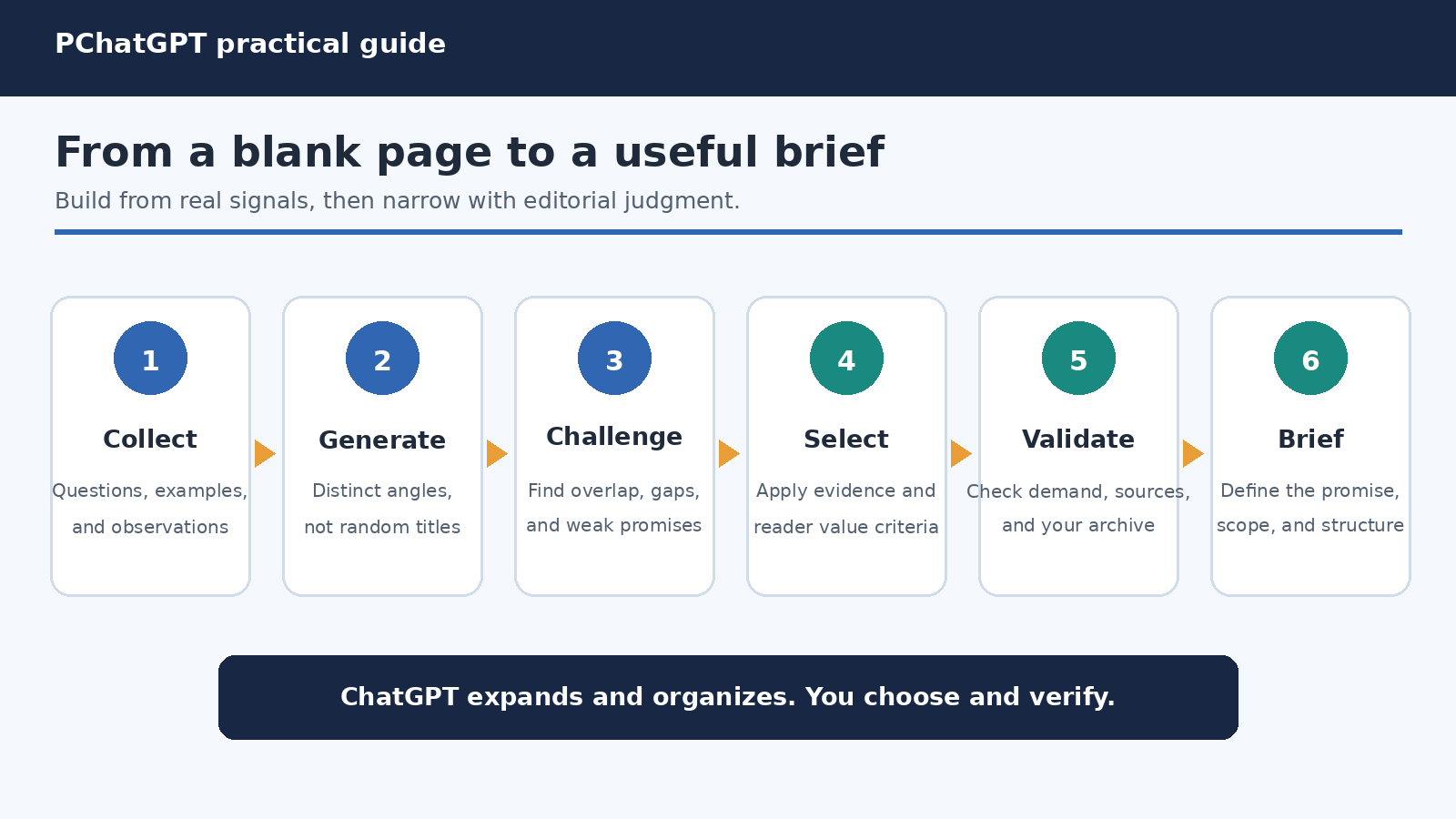
Generate angles, not just subjects
“Email marketing” is a subject. “How a small service business can plan a welcome sequence when it has only three customer stories” is an angle. An angle identifies a reader, tension, boundary, and useful destination. When ChatGPT returns broad subjects, do not keep requesting a larger list. Ask it to transform a few subjects through different editorial lenses.
Useful lenses include a beginner’s first decision, an expert’s tradeoff, a common mistake, a before and after process, a myth tested against evidence, a comparison under a defined constraint, an annotated example, and a behind the scenes explanation. You can also vary the reader’s stage. Someone discovering a problem needs different content from someone comparing methods or implementing a choice.
Take ideas 2, 5, and 8. Create four substantially different angles for each: one decision guide, one mistake analysis, one practical walkthrough, and one evidence led argument. Keep the audience and source notes unchanged. Explain what new reader value each angle adds. If two angles would lead to essentially the same article, merge them.
This second turn is often more valuable than the first. OpenAI’s ChatGPT prompting guidance explicitly recommends reviewing an initial response and refining the request. Iteration is not a repair for failure. It is the normal way to move from a wide search to a precise editorial choice.
Make ChatGPT challenge the obvious ideas
Brainstorming can produce a neat list of familiar headlines. Use a separate critical pass before falling in love with one. Ask ChatGPT to identify assumptions, overlaps, missing reader stages, and reasons an idea may not earn attention. The purpose is not to let the model veto your work. It is to make weaknesses visible while change is cheap.
Act as a skeptical editor. Review this shortlist for repetition, vague promises, unsupported claims, and mismatch with the stated audience. For each idea, name the strongest reason to publish it and the strongest reason to reject it. Suggest one concrete revision where the core insight is worth saving. Do not score writing style because these are concepts, not drafts.
Also ask what is absent. A set of ideas may focus entirely on acquisition while ignoring retention, or explain tools without addressing decisions. Try: “Map these ideas to the reader journey and show which questions remain uncovered.” This turns a one day brainstorm into a view of your editorial gaps.
Choose with an editorial scorecard
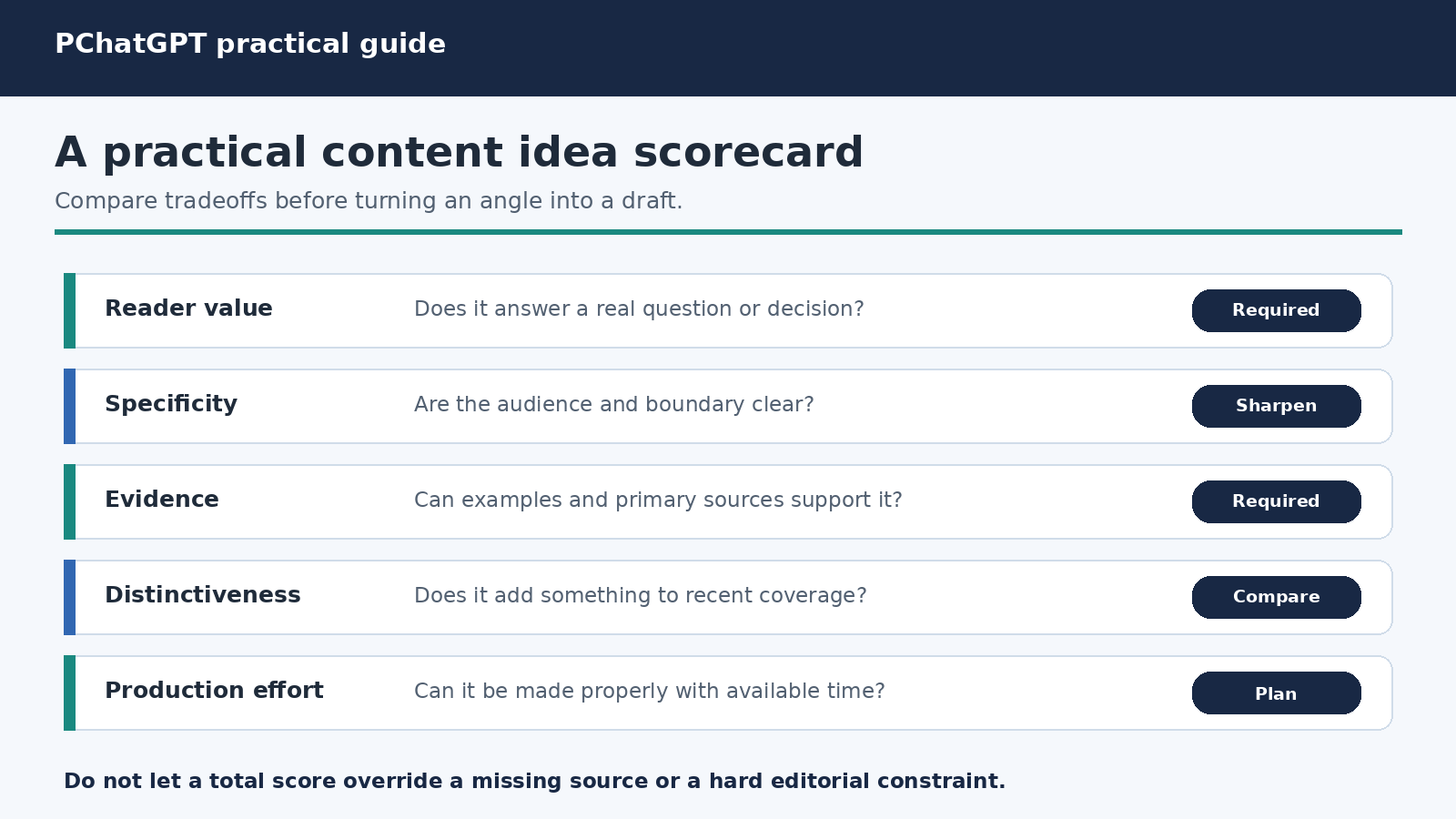
ChatGPT can organize a scorecard, but you should set the criteria and make the final call. Use a short scale and define what each criterion means. A practical scorecard might cover audience relevance, specificity, evidence available, distinctiveness from your recent work, timeliness, and production effort. Do not hide hard constraints inside a total. If an idea requires data you cannot verify, a high relevance score does not make it publishable.
| Criterion | Question to ask | Warning sign |
|---|---|---|
| Reader value | Does this solve a real question or decision? | The promise is only “learn about” a broad topic. |
| Specificity | Can the audience and boundary be named? | The same headline could fit any publication. |
| Evidence | What examples or sources can support it? | The idea depends on invented results or vague trends. |
| Distinctiveness | What will this add to existing coverage? | Only the wording is new. |
| Effort | Can we produce it properly with available time? | The scope exceeds the reporting or review budget. |
Ask ChatGPT to fill the table using only information you supplied and to mark missing evidence as “unknown.” Then inspect the reasoning, not just the total. A lower effort idea can be the right choice for tomorrow’s newsletter, while a research heavy idea belongs in next month’s calendar. Editorial value depends on context.
Turn the winner into a brief
Once you choose an angle, stop generating more options. Convert it into a brief with a single reader promise, key questions, source requirements, examples to gather, proposed structure, and exclusions. This transition prevents endless ideation from becoming procrastination. It also separates what you know from what you still need to report.
Build a content brief for the selected idea. Include the target reader, their situation before reading, the useful change after reading, the central question, five supporting questions, evidence required for each section, likely objections, and topics that are outside scope. Label every claim that needs external verification. Do not draft the article and do not fill evidence gaps with assumptions.
You can then ask for two or three outlines with genuinely different logic. One might proceed step by step, another by decision, and another from problem to diagnosis to solution. Choose the structure that makes the evidence easiest to follow. Our broader ChatGPT workflow guide for research and writing explains how to carry a defined task into drafting and review.
Five prompts for different kinds of creative block
When every topic feels too broad
“Break [topic] into reader stages, decisions, constraints, and common failure points. Produce a matrix rather than titles. Use my audience description and notes. Mark any cell that lacks enough information.” This creates a map you can inspect instead of another random headline list.
When your recent content feels repetitive
“Here are the titles and summaries of my last 15 pieces. Cluster them by reader problem, format, and promise. Identify repeated territory and three important questions that remain unanswered. Suggest angles only for those gaps.” Include summaries so the model does not judge novelty from titles alone.
When you have one useful example
“Interview me about this example before suggesting content. Ask one question at a time about the starting situation, decision, constraint, process, result, and lesson. After my answers, propose five formats that could communicate the lesson without overstating what one example proves.” This keeps the idea anchored to what happened.
When you need a content series
“Turn this audience problem into a five part learning sequence. Each part must answer a different question and prepare the reader for the next. State the job of each installment, evidence needed, and what would be redundant. Avoid stretching one article into five.” A series should have progression, not merely matching titles.
When you need a fast, small idea
“From these notes, identify three ideas I can produce responsibly in 60 minutes using evidence already available. Limit each to one reader question and one practical takeaway. List exactly what I must verify before publishing.” The time limit narrows the production plan, not the standard of accuracy.
Validate ideas outside the chat
A plausible idea is not proof of demand. Check it against evidence you control: actual audience questions, site search terms, support logs, newsletter replies, sales conversations, community discussions, and performance patterns from comparable content. Search the web to see what already exists, but do not mistake a crowded results page for automatic demand or originality.
Open the primary sources behind factual claims. ChatGPT can help list questions and possible sources, but it may misunderstand a source or present an unsupported detail confidently. OpenAI’s official guide on clear and effective instructions recommends being specific about the desired context, outcome, length, format, and style. Clear prompting improves relevance, but it does not replace reporting, source review, or subject expertise.
Run a quick originality check against your own archive too. If you covered the same promise recently, decide whether new evidence, a narrower audience, or a changed decision justifies another piece. A new title is not a new contribution. The question is what a reader can understand or do after this piece that your existing work did not provide.
Common mistakes that keep creators stuck
- Requesting huge lists: fifty shallow titles create more sorting work. Ask for fewer ideas with reasons and evidence needs.
- Providing no audience context: the model fills gaps with broad assumptions, so the ideas could belong to anyone.
- Confusing novelty with value: a strange angle is not useful merely because competitors have not covered it.
- Combining ideation and drafting: a polished introduction can make a weak premise feel settled. Choose and validate first.
- Accepting invented evidence: never treat a proposed statistic, quotation, customer story, or test result as real.
- Publishing the model’s voice: add your observations, examples, reporting, and judgment. Remove generic transitions and repeated conclusions.
- Brainstorming forever: set a stopping rule, such as selecting one viable idea after two expansion rounds and one critical review.
A repeatable 25 minute rescue session
For the first five minutes, diagnose the block and gather ten raw notes. For the next five, use the structured handoff to request a dozen grounded angles. Spend five minutes expanding the best three through different lenses. Use another five for the skeptical editor review and scorecard. In the final five, choose one angle and create the brief. If no idea survives, the useful result is a clearly named evidence gap. Go talk to readers or gather material rather than asking for more synthetic variety.
Save the prompts that work, but update the context each time. A template is a checklist, not an autopilot. Your audience’s questions change, your archive grows, and your available evidence differs from one week to the next. The enduring habit is simple: begin with real signals, define the editorial job, generate distinct options, challenge them, and validate the winner before drafting.
Frequently Asked Questions
Can ChatGPT give me original content ideas?
It can produce fresh combinations and help you see angles you missed, but originality cannot be guaranteed by a prompt. Add your own observations, audience evidence, examples, and point of view. Compare the proposed angle with your archive and existing coverage before calling it original.
How much context should I include in an idea prompt?
Include details that change the answer: audience, goal, raw notes, relevant history, constraints, and desired output. Leave out decoration and sensitive information. If the response is generic, add the missing decision context rather than simply making the prompt longer.
Should I ask for 10 ideas or 100?
Start with about 10 to 15 well described angles. Require a reader question, promise, and evidence need for each. A smaller set is easier to critique and expand. Ask for another round only when you can specify which territory is missing.
Can I publish an idea or outline directly from ChatGPT?
Treat it as working material, not a finished editorial product. Verify claims, review primary sources, add first party insight, check overlap with existing work, and edit for your audience and voice. A human remains responsible for what is selected and published.