Prompt chaining in ChatGPT is a practical way to turn one complicated assignment into a series of small, reviewable conversations. You ask for one useful output, inspect it, correct it, and then use the approved result in the next prompt. A writer might move from brief to outline, from outline to section draft, and from draft to an evidence check. The value comes from those deliberate handoffs, not from making the conversation longer.
This guide treats prompt chaining as an editorial method. It is not presented as an official named OpenAI framework. The method does, however, line up with OpenAI guidance to be clear and specific, refine prompts iteratively, provide reference text, split complex tasks into simpler subtasks, and test changes systematically. Used well, a chain gives you places to make decisions before weak assumptions spread through an entire document.
What prompt chaining means in everyday ChatGPT work
A prompt chain is a sequence in which each prompt has a narrow job and receives selected material from the previous step. The output of step one is not automatically trusted. It becomes a draft input that a person can approve, edit, or reject. That distinction matters. A chain is a controlled editorial process, not a guarantee that every answer is correct.
Imagine asking ChatGPT to research a topic, choose an angle, build an outline, write 2,000 words, verify every claim, and format the final article in one message. The request contains several different kinds of judgment. If the angle is wrong, the finished draft may still look polished. If a source is misunderstood, that error may appear in the introduction, examples, and conclusion. A chain lets you catch the wrong angle after the outline and the unsupported claim before publication.
OpenAI’s prompt engineering best practices for ChatGPT recommend clear, specific prompts with enough context and describe prompting as iterative refinement. OpenAI’s developer guidance on optimizing model accuracy also includes splitting complex tasks into simpler subtasks, providing reference text, and testing changes systematically. Those recommendations are the useful foundation. The chain described here is a human-managed way to apply them to editorial work.
When a chain is better than one prompt
Use a chain when an early decision changes everything that follows. An article outline, a comparison rubric, a lesson plan, and a software diagnosis all have this property. Reviewing the intermediate structure is cheaper than repairing a polished but misguided final answer. Chaining is also useful when different stages need different inputs. The outlining stage may need audience goals and source notes, while the editing stage needs the approved draft and a style checklist.
A single prompt is often enough for a direct transformation with low stakes, such as changing a short paragraph into bullets or suggesting several subject lines. Adding stages to a tiny task creates ceremony without adding control. The best chain is usually the shortest sequence that exposes the decisions you genuinely need to inspect.
- Chain the task when it has distinct phases, uncertain inputs, several quality criteria, or a meaningful approval boundary.
- Use one prompt when the input is complete, the transformation is simple, and mistakes are easy to notice and fix.
- Stop the chain when a required source is missing, an instruction conflicts with another instruction, or the next stage would amplify an unresolved error.
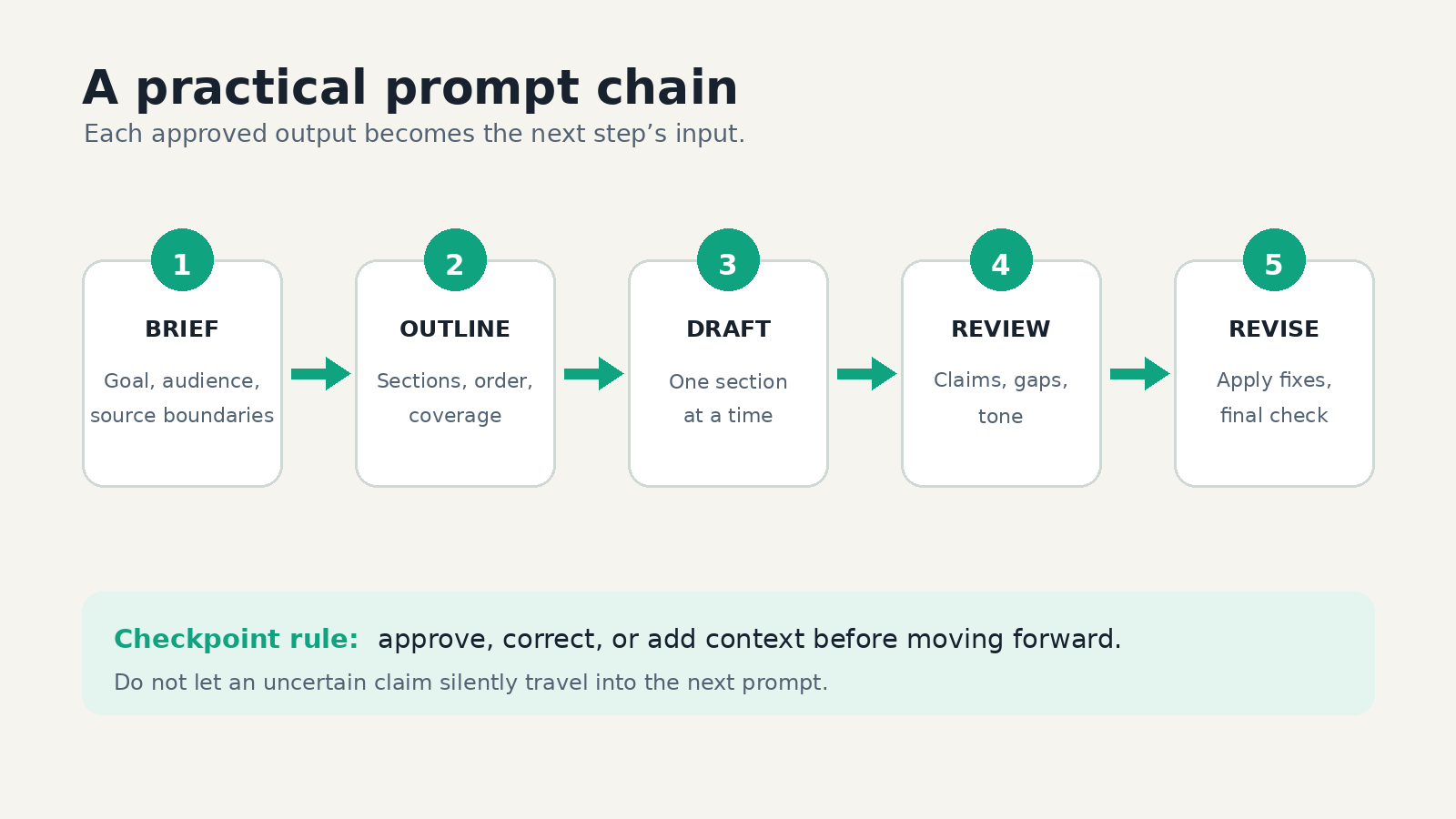
A five-step prompt chaining workflow
1. Write a compact brief
Begin with the outcome, audience, allowed source material, constraints, and acceptance criteria. Do not ask for a draft yet. Ask ChatGPT to restate the brief and identify missing information. This first response is a diagnostic. It reveals whether your request is specific enough before you spend time generating prose.
I am preparing a practical guide for new team leads.
Goal: help them run a useful weekly project update.
Audience: first-time managers in small remote teams.
Use only the notes pasted below.
The final guide must include a meeting agenda, a status template, and a review checklist.
First, restate the assignment in five bullets. List missing inputs and do not draft the guide yet.

[Paste reviewed notes]
Read the response as an editor. Correct the audience, scope, or source boundaries in your own words. Do not merely tell ChatGPT to make it better. A concrete correction such as “The guide is for a ten-minute written update, not a live meeting” becomes a stable decision that can travel to the next stage.
2. Approve the structure before prose
Ask for an outline that maps every required element to a section. Request a short purpose statement for each section and ask the model to flag any section that lacks source support. This makes coverage visible. You can move sections, remove repetition, and reject invented detail while the document is still inexpensive to change.
Using the corrected brief below, create an outline only.
For each section, provide:
1. the section goal
2. the source notes it relies on
3. the practical example it needs
Flag any requirement that the notes do not support.
Do not write paragraphs.

[Paste corrected brief]
The phrase “outline only” gives the stage a boundary. If ChatGPT drafts anyway, ignore the extra prose and evaluate the structure. OpenAI’s guidance emphasizes clear instructions, and boundaries are most useful when they describe both the requested output and what should not happen yet.
3. Draft in meaningful sections
Once the outline is approved, draft one coherent section at a time. Provide the relevant part of the outline, the source notes for that section, and any decisions that must remain consistent. Asking for one sentence at a time is too fragmented, while requesting the whole article removes your checkpoints. A section is often a useful middle size because it has enough context for flow but remains easy to review.
Draft the section called “The weekly update template.”
Use only the approved outline and notes below.
Write for a first-time manager in plain English.
Include one filled example, then explain each field.
If the notes do not support a claim, insert [SOURCE NEEDED] instead of guessing.
Return only this section.

[Paste approved outline excerpt and source notes]
After each section, record important choices in a small continuity note. For example, save the terms you chose, the example organization, and facts already established. Pass that note to later drafting prompts. This is more reliable than assuming every detail in a long conversation will receive equal attention.
4. Separate review from revision
Do not ask for a critique and a silent rewrite in the same step. First ask for a review against explicit criteria. You want to see the diagnosis before the text changes. A useful review can identify unsupported claims, missing requirements, vague passages, repeated ideas, inconsistent terminology, and places where the tone does not fit the audience.
Review this draft without rewriting it.
Create a table with these columns:
Location | Issue | Why it matters | Suggested fix
Check source support, completeness, clarity, repetition, and audience fit.
Quote the exact words that need attention.
If a criterion passes, say so.

[Paste draft and acceptance criteria]
This stage turns general dissatisfaction into an edit list. You still need to inspect the critique because ChatGPT can misread a source or recommend an unnecessary change. Approve the valid fixes, reject the rest, and carry only the approved list forward.
5. Revise with a controlled change list
The revision prompt should contain the current draft and the accepted edits. Tell ChatGPT to preserve material that was not flagged. Then compare the revision with the original rather than assuming every change was beneficial. This final comparison catches accidental deletions, new claims, and style drift.
Revise the draft using only the approved changes below.
Preserve all unflagged facts, links, headings, and examples.
Do not add new claims.
After the revision, provide a short change log that maps each approved fix to the updated passage.

[Paste draft]
[Paste approved change list]
How to create a clean handoff
A handoff is the small packet of information that moves from one prompt to the next. Copying an entire conversation can carry rejected ideas, obsolete instructions, and irrelevant detours into the next stage. Instead, assemble a clean packet with five parts: approved input, decisions, open questions, the next job, and its acceptance test.
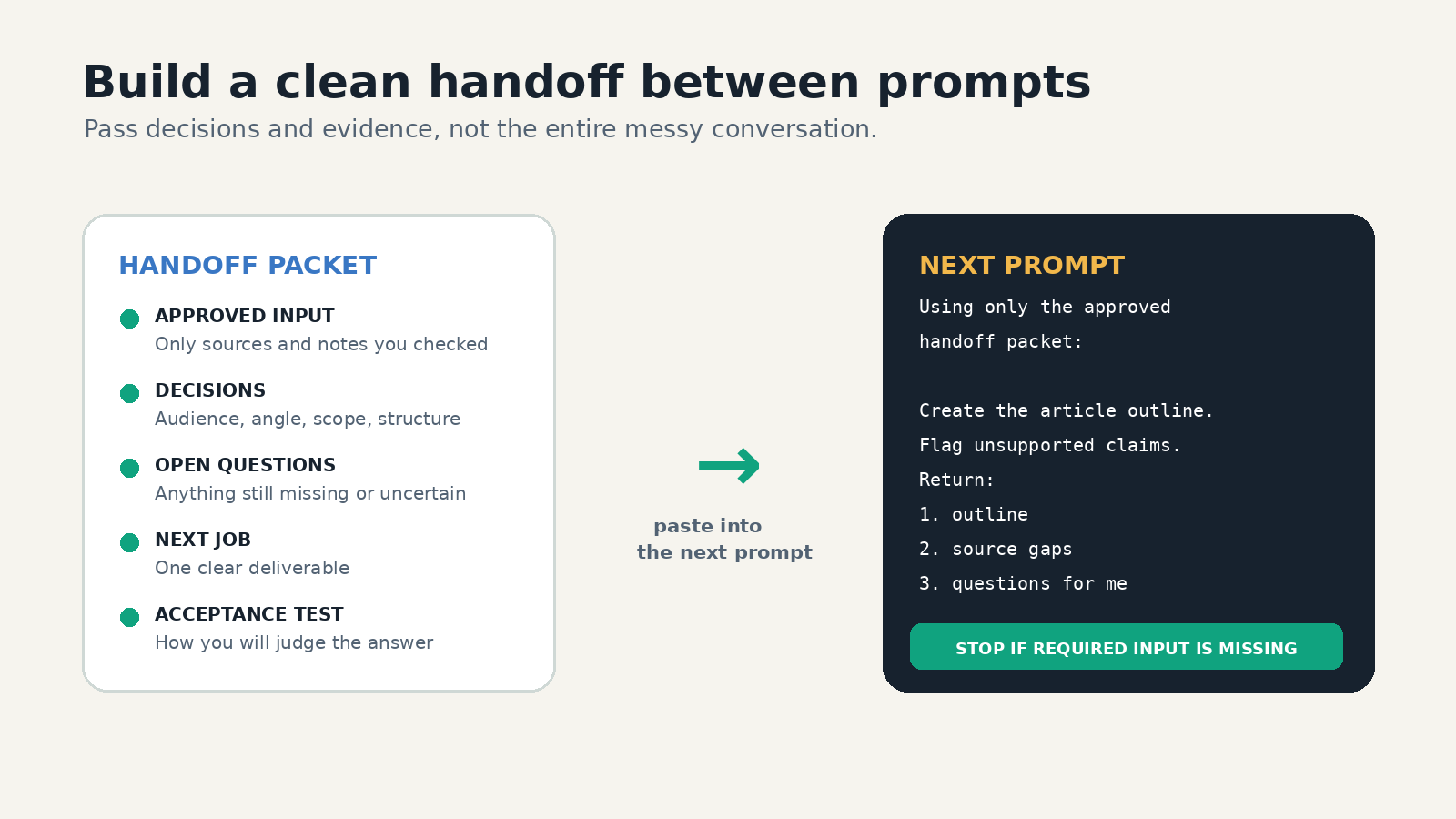
Label source text separately from your instructions. Quotation marks, headings, or fenced blocks help distinguish material to analyze from the job you want done. OpenAI’s prompt engineering guide discusses providing relevant context and examples. In an editorial chain, context should be selected for the current stage rather than dumped into every prompt.
Keep uncertainty visible. If a date, quotation, or causal claim has not been checked, mark it as unresolved. Never let a fluent rewrite convert an open question into an apparent fact. For publishing work, open the cited source yourself, confirm that it supports the sentence, and check that the link still leads to the intended page.
A worked example from notes to article
Suppose you have interview notes for an article about a neighborhood repair club. In the brief stage, define the audience, intended length, central idea, and permission boundaries for quotations. Ask ChatGPT to list missing spellings, dates, and attribution details. You might discover that the notes do not say when the club began. That gap should remain explicit rather than being filled with a plausible date.
At the outline stage, decide whether the article opens with a scene, a problem, or the club’s process. Map each section to specific notes. At the drafting stage, provide only the notes needed for the opening and request placeholders for anything unsupported. At review, compare every factual sentence with the interview record. At revision, apply the approved corrections and perform a final human read for fairness, tone, and context.
The chain does not make ChatGPT the reporter or final editor. It gives the reporter a visible process for using ChatGPT on bounded tasks. For a broader approach to planning, drafting, and reviewing work, see our practical ChatGPT workflow guide. Writers can also use the examples in our ChatGPT writing prompts workflow as starting points, then adapt them to their own evidence and editorial rules.
Common prompt chaining mistakes
- Letting the model approve its own work. A critique can help you look, but a person must decide whether the evidence and final output are acceptable.
- Passing every previous answer forward. This preserves discarded ideas and makes the active instructions harder to identify.
- Using vague stage names. “Improve this” does not say whether the job is to verify facts, change the structure, shorten sentences, or adjust tone.
- Rewriting before diagnosing. If you cannot see the proposed changes first, you cannot make a controlled editorial decision.
- Treating a citation as proof. A linked page can be real while failing to support the nearby claim. Read the primary source and check the exact relationship.
- Ignoring privacy and permissions. Remove confidential, personal, or restricted material unless you are authorized to use it in the relevant service and workflow.
- Building a chain that is too long. Extra stages can add inconsistency and review work. Merge steps that do not need separate judgment.
A reusable prompt chain template
The following sequence works as a starting point for articles, reports, lesson plans, and internal guides. Replace every bracketed field, and keep source material clearly separated from instructions.
- Brief: “My goal is [outcome] for [audience]. Use [allowed inputs]. Follow [constraints]. Restate the task and list missing information. Do not draft yet.”
- Structure: “Using the approved brief, create [outline or plan]. Map each part to its supporting input. Flag unsupported requirements.”
- Produce: “Create only [named section or component]. Use the approved plan and sources. Mark unsupported claims instead of guessing.”
- Review: “Do not rewrite. Evaluate the output against [criteria]. Quote each problem and propose a specific fix.”
- Revise: “Apply only these approved fixes. Preserve unflagged material. Return the result and a change log.”
- Human check: verify sources, names, numbers, permissions, links, tone, and whether the output actually serves the audience.
Save the sequence only after it works on a real task. Note which stage caught important problems and which stage added little value. A reusable chain is an editable procedure, not a magic incantation. When your source material, audience, or risk changes, revise the chain as well.
FAQ
Is prompt chaining an official OpenAI framework?
This article uses prompt chaining as a descriptive name for an editorial method: dividing work into stages and carrying approved outputs forward. OpenAI’s official guidance supports related practices such as iterative refinement, clear instructions, relevant context, and splitting complex tasks into simpler subtasks, but this guide does not claim that its five-step workflow is an official OpenAI framework.
Does prompt chaining make ChatGPT answers accurate?
No. It can make assumptions and errors easier to spot because you review intermediate outputs, but it does not establish truth. Accuracy still requires appropriate primary sources, careful comparison between claims and evidence, and human judgment. High-impact decisions need review suited to their real-world risk.
Should every ChatGPT task use multiple prompts?
No. Use one prompt for straightforward, low-risk transformations when the input and desired format are already clear. Add a chain when separate planning, production, and review decisions would help. If a stage has no distinct purpose or approval decision, remove it.
What should I carry from one prompt to the next?
Carry the approved source material, current decisions, unresolved questions, one clearly defined next job, and its acceptance criteria. Leave behind rejected drafts and unrelated discussion. This clean handoff keeps the active context smaller and makes it easier for you to see what the next answer is supposed to accomplish.