
Editorial status, checked September 4, 2026: GPT-5.5 is a real OpenAI model, but it is no longer the newest model named in OpenAI’s official product pages. OpenAI introduced GPT-5.5 on April 23, 2026 and added GPT-5.5 and GPT-5.5 Pro to the API on April 24. The original headline behind this page therefore pointed to a genuine launch, although its framing is now historical. OpenAI has since introduced GPT-5.6 and announced GPT-6 Astra. Current access depends on the product, plan, workspace controls, region, and rollout stage.
This replacement guide keeps the historical URL useful without pretending that an April launch headline is a current buying or deployment guide. It explains what the GPT-5.5 name means today, how ChatGPT labels differ from API identifiers, where to verify access, how published token prices compare, and how to test a migration without trusting a model name alone.
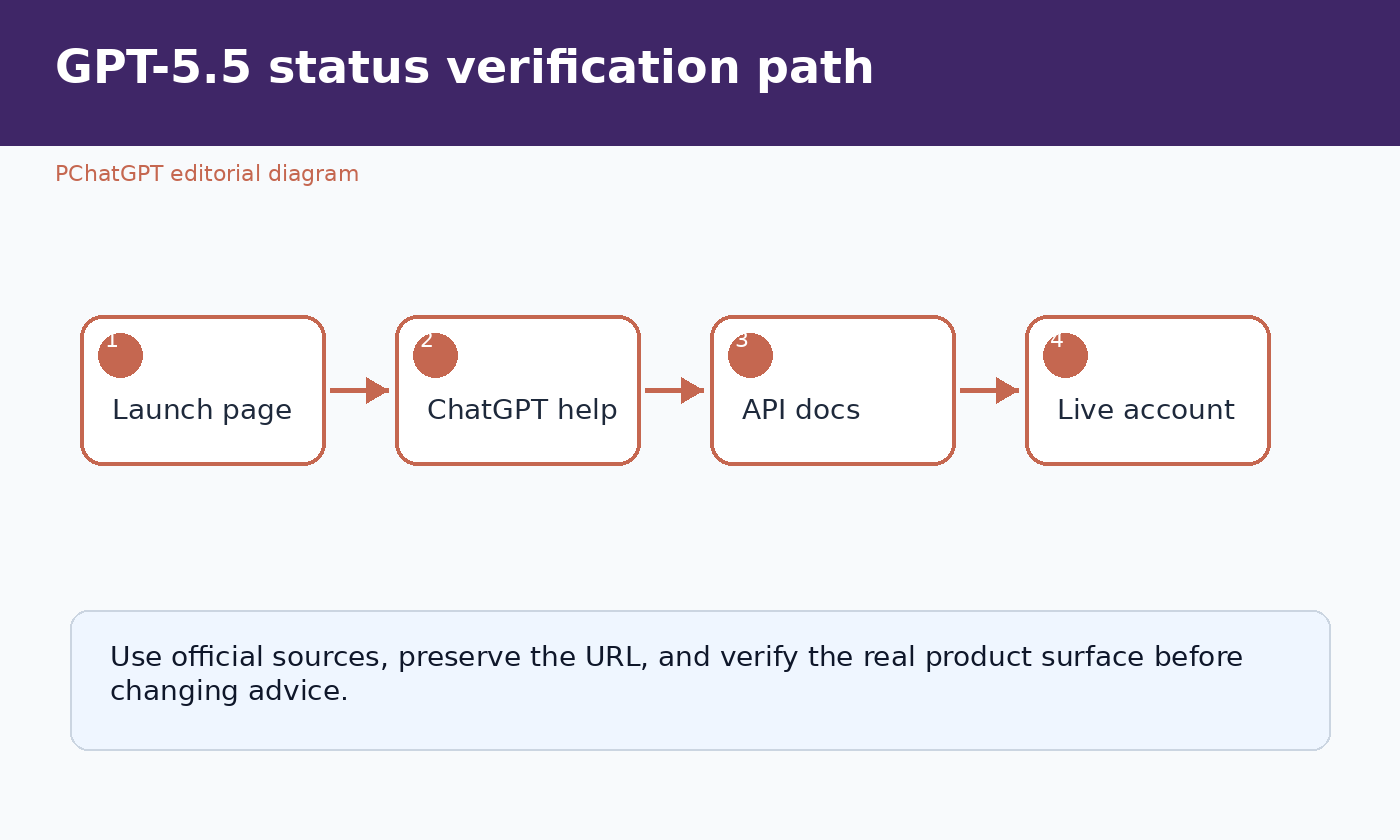
The corrected status of GPT-5.5
There are two truths to hold at the same time. First, GPT-5.5 was officially launched. OpenAI’s announcement calls it a model for real work and covers coding, knowledge work, scientific research, inference efficiency, cybersecurity, availability, and evaluations. The page carries an April 23, 2026 date and an April 24 update confirming API availability. That primary source resolves the basic historical question: GPT-5.5 was not merely an unverified label.
Second, GPT-5.5 is not the current endpoint of OpenAI’s model line. The same announcement now tells readers that the post introduced GPT-5.5 and directs them to GPT-5.6 as a later model. OpenAI’s current ChatGPT help article says GPT-5.6 Sol is rolling out as the updated experience for eligible paid users, while GPT-5.6 Luna serves Free and Go users. OpenAI has also announced GPT-6 Astra, with a staged rollout rather than a claim that every account already has it.
That distinction matters because “officially released,” “still documented,” “selectable in my ChatGPT account,” and “recommended for a new API workload” are separate statuses. GPT-5.5 remains in the API documentation with an exact model ID and published specifications. At the same time, the current model catalog points developers who are unsure where to start toward GPT-5.6 Sol, with Terra and Luna offered for different cost and throughput needs. GPT-6 Astra occupies another position: OpenAI describes it as its most capable model, but access is rolling out and its ChatGPT plan rules are narrower than a casual reading of a launch announcement might suggest.
ChatGPT labels are not API model IDs
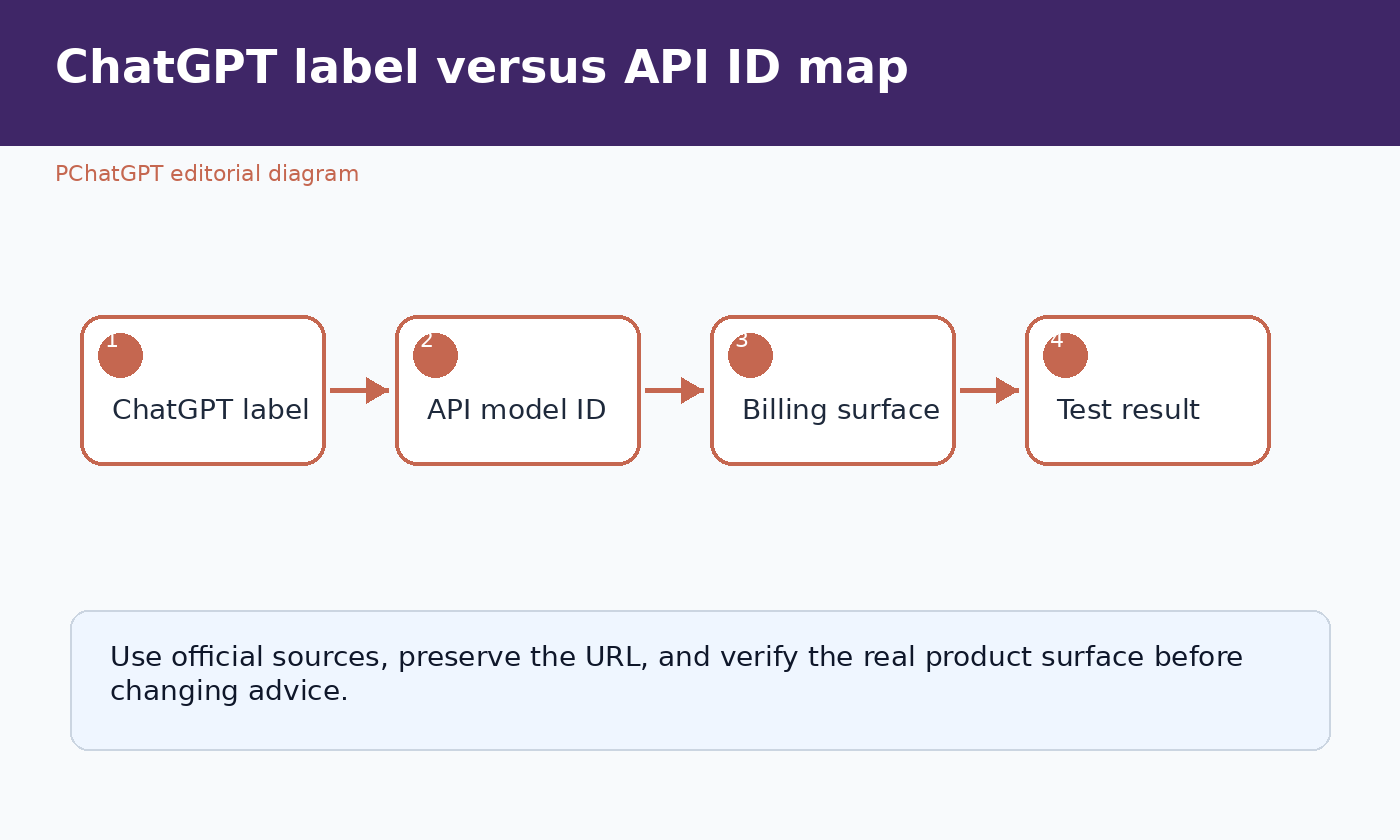
A model name in the ChatGPT interface is a product label. It sits inside a managed experience that can include automatic routing, tools, reasoning controls, usage allowances, fallback behavior, and workspace policy. An API model ID is a value a developer sends in a request. Treating those two things as interchangeable is the fastest way to write an inaccurate guide.
OpenAI’s current ChatGPT documentation describes choices such as Instant, Medium, High, Extra High, and Pro. On eligible paid plans, GPT-5.6 Sol powers Instant and the listed reasoning levels, while a Pro choice can use GPT-5.6 Sol Pro. Free and Go users receive GPT-5.6 Luna, including through the Think option for harder questions. OpenAI also says GPT-6 Astra appears as GPT-6 Pro on eligible plans as it rolls out. A user can therefore see a simple experience label without seeing the literal API identifier that a developer would type.
In the API, identifiers are explicit. The GPT-5.5 documentation names gpt-5.5 and the dated snapshot gpt-5.5-2026-04-23. The higher compute version is gpt-5.5-pro, with the documented snapshot gpt-5.5-pro-2026-04-23. For the next family, gpt-5.6 is an alias that routes to gpt-5.6-sol. OpenAI separately lists gpt-5.6-terra and gpt-5.6-luna. The GPT-6 Astra API identifier is gpt-6-astra.
Do not infer API access from a ChatGPT subscription, and do not infer ChatGPT picker access from a successful API request. The products have separate billing and access checks. A model can also remain callable in an API integration after the main ChatGPT experience has moved to newer labels. Always check the surface you actually intend to use.
What GPT-5.5 officially supports in the API
The GPT-5.5 model page documents text and image input with text output. It lists a 1,050,000 token context window, a 128,000 token maximum output, and a December 1, 2025 knowledge cutoff. OpenAI marks reasoning token support, function calling, and structured outputs as supported. Fine tuning is not supported.
For Responses API use, the same page lists web search, file search, image generation, code interpreter, hosted shell, apply patch, computer use, and tool search. This is a statement about supported API tools, not a promise that every tool should be enabled for every request. Each tool changes cost, latency, permissions, and risk. A production application still needs least privilege, clear confirmation rules for consequential actions, and tests that verify the final answer as well as tool behavior.
GPT-5.5 Pro is a different choice, not a free quality switch. OpenAI describes it as using more compute for tougher problems and warns that some requests may take several minutes. Its model page recommends background mode to avoid timeouts. It supports the Responses API and Batch API, but its documented tool support differs from standard GPT-5.5. For example, the page marks computer use as unsupported for GPT-5.5 Pro. Read the model page before assuming that a workflow built for the standard model can move to Pro without changes.
The dated snapshots matter when behavioral stability is important. An alias is convenient, but a snapshot helps keep a test baseline stable. That does not remove every source of variation, since generated output remains nondeterministic and tool results can change. It does make the selected model version explicit, which is valuable for regulated reviews, regression investigations, and repeatable release comparisons.
How to check ChatGPT access today
Start by signing in to the exact account and workspace you intend to use. Open a new chat, inspect the model selector or reasoning control, and note the labels that actually appear. Do not use an old conversation as the only check because OpenAI can route continuing chats to a current corresponding model. If your interface shows Instant or a reasoning level rather than GPT-5.5, that is consistent with OpenAI’s newer ChatGPT design.
Next, compare your plan with the current official help article. OpenAI says GPT-5.6 Sol’s Medium and High choices are included for Plus, Pro, Business, and Enterprise. Extra High and Pro are listed for Pro, Business, and Enterprise, but not Plus. Free and Go receive GPT-5.6 Luna rather than GPT-5.6 Sol. Managed Business and Enterprise workspaces can add another gate because administrators may control model availability.
GPT-6 requires its own check. OpenAI’s current help page says GPT-6 Astra is rolling out in ChatGPT as GPT-6 Pro for Pro $100, Pro $200, Business, and Enterprise plans. It also says GPT-6 Pro is not included with Plus in Chat, and Enterprise access depends on workspace permissions. This is a useful example of why “coming to a plan” and “visible in this account now” are not identical claims.
- Confirm the signed in account, plan, and workspace.
- Check the current model or reasoning selector in a new conversation.
- Compare what you see with OpenAI’s current ChatGPT help page and release notes.
- For a managed workspace, ask an administrator whether model access is enabled for your role.
- If the documentation says “rolling out,” allow for account differences and check again later.
- Record the date of your check because labels, allowances, and rollout language can change.
This process is more dependable than copying a screenshot from another account. It also prevents a common support mistake: assuming that a missing model proves a broken subscription when the actual reason may be plan eligibility, phased rollout, a workspace setting, or a product specific limit.
How to check API access
For API work, use the intended organization, project, and API key. Confirm that billing and project limits are configured, then make a small request in a development environment with the exact identifier you want to test. A successful request is stronger evidence of access than seeing a model name on a general catalog page. If the request fails, preserve the error code and request identifier, then check authentication, project selection, usage tier, limits, and the model documentation before changing application logic.
Keep ChatGPT credentials and API credentials conceptually separate. Paying for a ChatGPT plan does not turn ChatGPT usage into API credits. API usage is metered under the API account and project. Likewise, an API model appearing in documentation does not mean that every API tier can call it. The GPT-5.5 model pages publish rate limit tables by usage tier, and their Free tier rows say the model is not supported.
When you need reproducibility, call the dated GPT-5.5 snapshot and log the model returned with the response. When you want OpenAI’s moving selection within a family, use an alias only after reading what it currently routes to. For new work, inspect the live model catalog rather than assuming the model named in this historical URL is still the recommended starting point.
Current published API pricing and the caveats around it
OpenAI’s GPT-5.5 model page lists standard text token prices per one million tokens as $5.00 for input, $0.50 for cached input, and $30.00 for output. It also says prompts above 272,000 input tokens are charged at twice the input rate and one and a half times the output rate for the full session across standard, Batch, and Flex processing. Regional processing endpoints carry a documented 10 percent uplift for GPT-5.5.
GPT-5.5 Pro is priced differently. Its model page lists $30.00 per million input tokens and $180.00 per million output tokens, with no cached input discount. OpenAI also documents a 10 percent regional processing uplift for that model. These rates explain why “Pro” should be evaluated on the hardest tasks where a quality gain can justify higher cost and latency, not enabled by default because its name sounds better.
For context, the GPT-5.6 Sol page currently lists $4.00 per million input tokens, $0.40 for cached input, and $20.00 per million output tokens. It labels those as promotional prices available at least through November 21, 2026. GPT-6 Astra’s model page lists $10.00 for input, $1.00 for cache reads, $12.50 for cache writes, and $50.00 for output per million tokens. Long prompts, tools, service tiers, regional processing, and other platform features can alter the bill.
Prices in an article age quickly. Before estimating a budget, open the linked model page and pricing documentation. Then calculate cost from real request logs, including input, cached input, output, reasoning work reported in usage, retries, and paid tool calls. ChatGPT subscription prices and allowances belong to a separate product and should not be inserted into an API cost model.
A sensible migration and testing plan
A model migration should begin with a representative evaluation set, not with a broad production switch. Collect real tasks that cover the work you care about: short answers, long documents, structured data, function calls, tool sequences, refusal boundaries, multilingual inputs, and difficult edge cases. Remove secrets and personal data. For each case, define what a passing response must contain and what would count as a serious failure.
OpenAI’s current model guidance says that when moving from GPT-5.5 or GPT-5.4 to GPT-5.6, developers should begin with their existing reasoning setting, then test that setting and one level lower. OpenAI notes that GPT-5.6 can often maintain or improve quality with fewer tokens, while emphasizing that the best setting depends on the workload. That is practical advice because maximum reasoning is not automatically the best choice for latency, cost, or even consistency.
Run old and candidate configurations against the same cases. Capture task success, schema validity, required facts, unsupported claims, tool selection, tool errors, total tokens, latency, and estimated cost. Review failures by category rather than averaging everything into one attractive score. A candidate that improves drafting but breaks a critical function call is not ready for a complete rollout.
- Pin the baseline. Record the old model ID, snapshot where available, reasoning setting, prompt version, tool definitions, and decoding controls.
- Change one major variable at a time. Test the model before rewriting every prompt and tool schema at once.
- Test lower reasoning effort. A less expensive setting may meet the same acceptance criteria.
- Validate structured outputs mechanically. Parse schemas, enforce required fields, and reject malformed results.
- Exercise failure paths. Include timeouts, unavailable tools, empty retrieval results, permission denials, and partial responses.
- Use a staged rollout. Start with internal traffic or a small percentage, monitor, and keep a tested fallback.
Do not grade only for eloquence. The most pleasant answer can still be wrong, omit a required caveat, or take an action outside scope. Human review is essential for high impact decisions, and tool using workflows need explicit confirmation before external messages, purchases, deletions, account changes, or other consequential actions.
What ordinary users should do with the old headline
Read it as a historical marker, not a promise about the model currently serving your chat. GPT-5.5 did launch, so the core model name is legitimate. What aged is the word “new.” OpenAI’s own GPT-5.5 announcement now points forward to GPT-5.6, while current OpenAI pages describe GPT-6 Astra as a newer, staged rollout.
If you use ChatGPT, choose among the options your account offers based on the task. Instant is appropriate for everyday questions. A reasoning level is worth trying when the work has several constraints, requires careful analysis, or needs validation. A Pro option should be reserved for difficult work where the extra allowance and waiting time have a clear payoff. The exact underlying model can change as OpenAI updates the product, which is why the live selector and current help page are the final authority.
If you build with the API, do not migrate merely to make the version number larger. Compare GPT-5.5 with the current catalog on your own tests. A newer or more capable model may improve difficult tasks, while a lower cost family member may be the better production choice for clear, repetitive work. The right model is the least costly configuration that reliably passes the requirements, stays within latency targets, and supports every tool your workflow needs.
For broader context, see our OpenAI GPT-5.4 guide and our practical overview of how ChatGPT works and how to verify its current features. Both links provide background, while OpenAI’s live documentation should settle current model and access questions.
Official OpenAI sources
- Introducing GPT-5.5, used to verify the April 23, 2026 launch, the April 24 API update, and the historical positioning of the model.
- GPT-5.5 API model page, used for the identifier, snapshot, modalities, context, tool support, limits, and current published token prices.
- GPT-5.5 Pro API model page, used to distinguish Pro capabilities, latency guidance, tool support, snapshot, and pricing.
- GPT-5.6 and GPT-6 Pro in ChatGPT, used for current ChatGPT labels, plan eligibility, rollout language, workspace controls, and usage distinctions.
- OpenAI API model catalog, used to identify current model families and OpenAI’s starting guidance for developers.
- OpenAI model guidance, used for the documented GPT-5.5 to GPT-5.6 migration and evaluation approach.
- GPT-6 Astra announcement and GPT-6 Astra API model page, used to verify the newer model’s staged availability, identifier, and published token prices.
FAQ
Was GPT-5.5 actually released by OpenAI?
Yes. OpenAI’s official announcement is dated April 23, 2026, and its update says GPT-5.5 and GPT-5.5 Pro became available in the API on April 24. The model remains documented in OpenAI’s API catalog. The historical headline is therefore grounded in a real release, but calling GPT-5.5 “new” is no longer current.
Why might GPT-5.5 not appear in my ChatGPT model picker?
ChatGPT now uses newer product labels and model routing. OpenAI says GPT-5.6 Sol is rolling out for eligible paid accounts, while GPT-5.6 Luna serves Free and Go users. Availability can also depend on rollout timing and managed workspace settings. Check a new chat, your plan, and the current OpenAI help page rather than expecting an API model ID to appear in the picker.
Can I still use GPT-5.5 through the API?
OpenAI’s current API documentation lists gpt-5.5, gpt-5.5-pro, and dated snapshots for both. Actual access still depends on the API project, billing, usage tier, rate limits, and model availability. Verify it with a small request from the intended project, not with a ChatGPT subscription or a documentation screenshot alone.
Should developers migrate from GPT-5.5 immediately?
Not without testing. OpenAI’s model guidance recommends comparing GPT-5.6 at the current reasoning setting and one level lower on representative tasks. Measure correctness, schema compliance, tool behavior, latency, token use, and cost. Roll out gradually and keep a tested fallback. A migration is successful only when the candidate passes the requirements of the real workload.