
Two ChatGPT answers can look equally polished and still differ sharply in usefulness. One may follow the brief, preserve the facts, and make the next step obvious. The other may sound confident while quietly changing a requirement or filling a gap with an unsupported claim. Comparing responses is how you tell the difference.
You do not need a complicated scoring system. You need a stable task, a short rubric, and a habit of checking claims instead of rewarding smooth prose. This guide gives you a practical method for comparing ChatGPT responses, diagnosing weak outputs, and revising the prompt without turning the conversation into an endless cycle of “make it better.”
Start by defining what a good answer must do
Do not generate several responses and then decide what you wanted. Write the acceptance criteria first. If the task is an email, perhaps the result must be under 180 words, confirm a delivery delay without admitting fault, propose two meeting times, and sound calm. If the task is a summary, perhaps it must use only the supplied document, distinguish facts from recommendations, and keep every number intact.
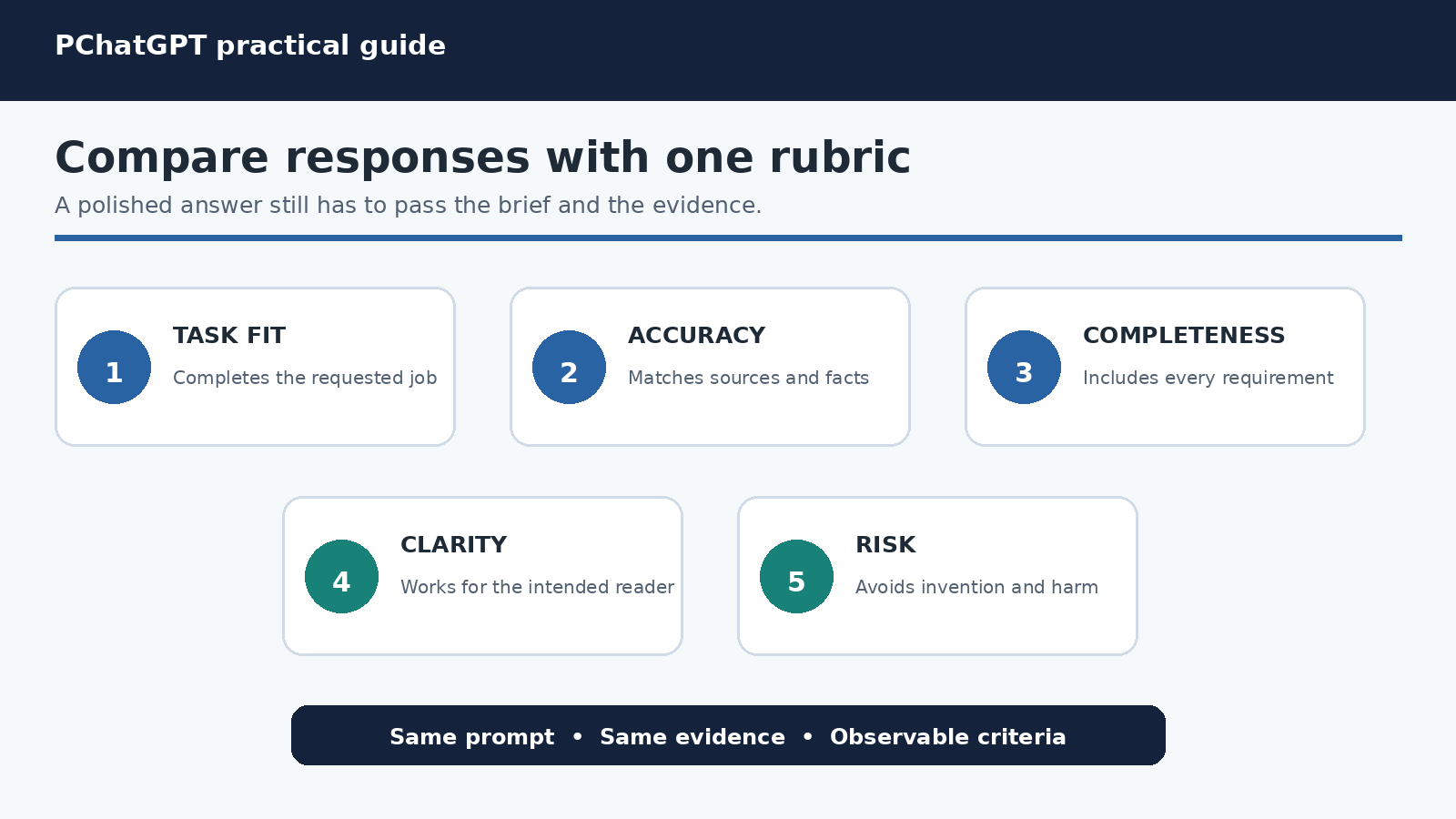
A useful rubric usually covers five questions:
- Task fit: Did the answer complete the requested job rather than a nearby job?
- Accuracy: Are factual statements supported by the material or reliable sources?
- Completeness: Did it include every required point and respect every constraint?
- Clarity: Can the intended reader understand and use it without decoding vague language?
- Risk: Does it invent facts, expose private information, overstate certainty, or encourage an unsafe action?
Make each criterion observable. “Professional” is open to interpretation. “Uses a neutral greeting, avoids blame, and ends with one clear action” is easier to judge. OpenAI’s official prompt engineering guidance for ChatGPT recommends clear, specific prompts with enough context, followed by iterative refinement. A concrete rubric turns that advice into a repeatable review process.
Use the same input for a fair comparison
If you change the source text, audience, or constraints between attempts, you are not comparing responses fairly. Save one test prompt and run it without editing. Keep the same attachments and reference material. If you are comparing work from different conversations or different settings, note those differences instead of pretending they do not matter.
ChatGPT outputs can vary, so one answer is not proof of consistent quality. For an important repeatable workflow, try the same prompt more than once and look for recurring failures. The goal is not to find the prettiest isolated response. It is to find a prompt and review process that performs acceptably across the kinds of inputs you actually use.
Avoid testing with a prompt whose correct answer you cannot evaluate. Begin with a familiar, low-risk example. A customer support lead might use an approved policy excerpt and an old, anonymized ticket. A writer might use a public source and a brief with known requirements. Once the method catches obvious errors, expand it to more difficult cases.
A simple response comparison workflow
- Freeze the brief. Copy the task, source material, audience, required format, and exclusions into one reference prompt.
- Write the rubric. Choose three to five criteria and identify any automatic failure, such as an invented quotation or a missing legal disclaimer.
- Generate candidates. Obtain two or three answers from the unchanged prompt. Label them A, B, and C to reduce attachment to the first one.
- Review independently. Read each answer against the brief before comparing them with one another. This stops an impressive candidate from redefining the standard.
- Verify important claims. Open sources, compare numbers with the input, and check quotations word for word.
- Record the failure pattern. Note exactly what went wrong, where it happened, and which instruction should have prevented it.
- Change one prompt element. Add missing context, clarify a constraint, provide an example, or split the task. Then rerun the same test.
This process separates selection from repair. First you decide which candidate best meets the original standard. Then you improve the instructions based on evidence. For broader ways to structure work around reviewable stages, see the site’s practical ChatGPT workflow guide.
Score without pretending the numbers are scientific
A small scorecard can keep your attention on the brief. Use a simple scale such as pass, partial, or fail for each criterion. You can also mark a criterion “not applicable.” The labels matter less than writing one sentence of evidence beside each judgment.
| Criterion | Response A | Response B | Evidence to record |
|---|---|---|---|
| Task fit | Pass | Partial | Which requested deliverables are present? |
| Accuracy | Partial | Pass | Which claims match the supplied or primary source? |
| Completeness | Pass | Fail | Which constraint or section is missing? |
| Clarity | Partial | Pass | What would the intended reader misunderstand? |
| Risk | Pass | Fail | What unsupported or sensitive detail appears? |
The sample labels above illustrate the method, not results from a benchmark. Do not add the marks into a grand score unless every criterion deserves equal weight. Accuracy may be non-negotiable in a research summary, while tone may be easier to fix. A single fabricated source can disqualify an answer that wins every style category.
For team reviews, ask reviewers to cite a sentence or omission rather than saying “A feels better.” If two reviewers disagree, the dispute usually reveals a vague criterion. Improve the rubric before blaming the reviewers or the model.
How to diagnose a weak ChatGPT response
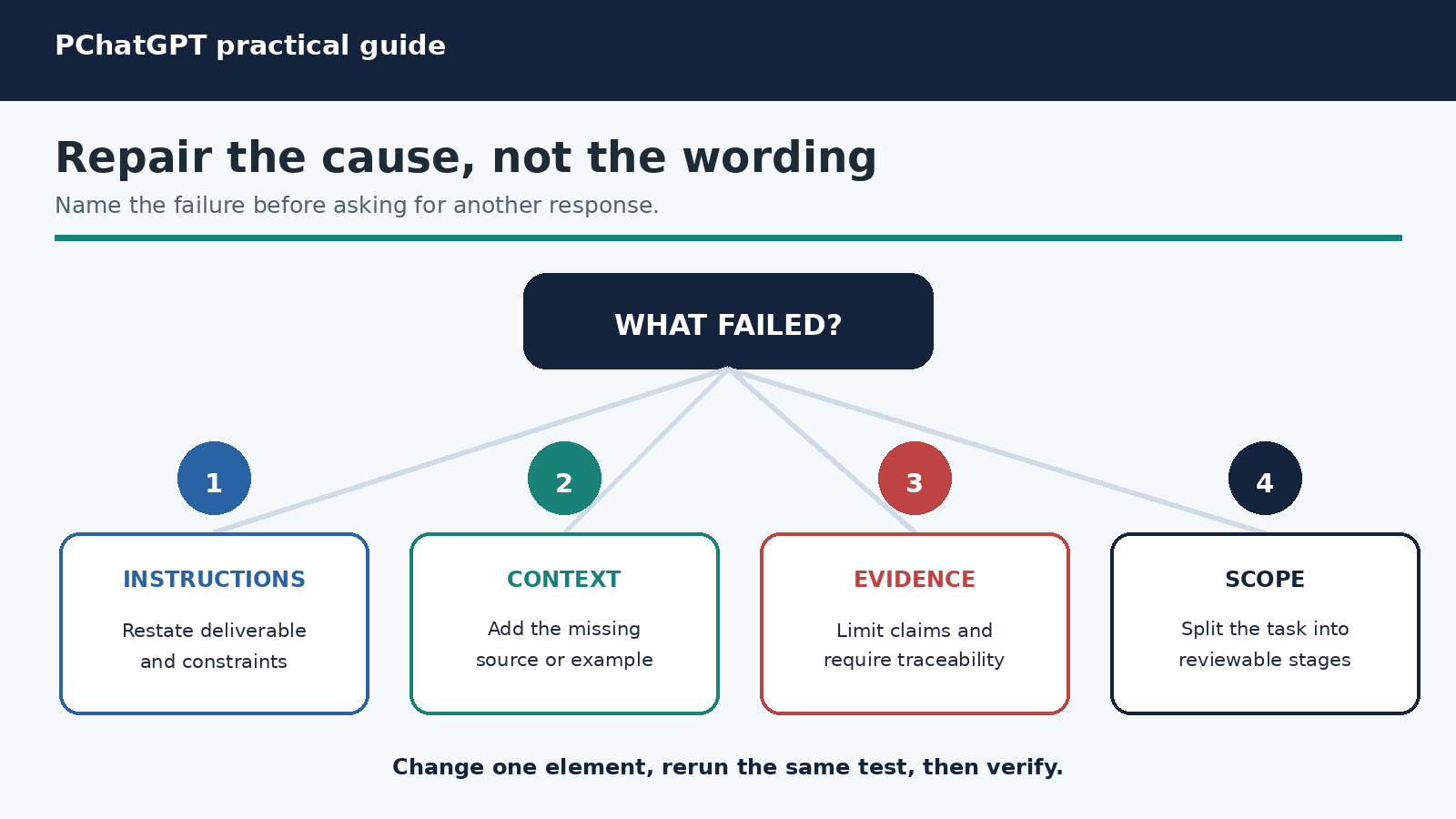
“Weak” is not a diagnosis. Name the failure before changing the prompt. Most disappointing outputs fall into one or more of these groups.
- Instruction failure: The answer ignores a requested format, audience, length, or exclusion.
- Context failure: The prompt did not provide a policy, definition, example, or background detail needed for the task.
- Evidence failure: The answer makes a claim that the supplied material does not support.
- Reasoning gap: The conclusion may be plausible, but the answer skips a necessary comparison, condition, or tradeoff.
- Communication failure: The content is mostly right but buried in repetition, jargon, or an unsuitable tone.
- Scope failure: The answer tries to solve too much at once and gives every part shallow treatment.
OpenAI explicitly warns that ChatGPT can produce incorrect facts, fabricated quotations or references, and overconfident answers. Its official article Does ChatGPT tell the truth? advises users to verify important information, including quotes, data, technical details, and external references. That warning belongs inside the comparison process, not in a footnote after publication.
Improve the prompt by fixing the diagnosed failure
Once the failure has a name, make the smallest prompt change likely to address it. A full rewrite can accidentally remove an instruction that was working.
If task fit is weak, restate the deliverable. Put the action near the start: “Draft a customer reply,” “Compare these two proposals,” or “Extract the obligations into a table.” Name the audience and intended use. Replace “discuss” with the exact operation you need.
If completeness is weak, use a checklist. List required sections and say that each one must appear. Ask for a final self-check against the listed requirements, but still perform your own review. A model’s claim that it complied is not proof.
If accuracy is weak, constrain the evidence. Tell ChatGPT to use only the supplied source for the requested summary, cite the relevant section, and mark information as unavailable when the source does not contain it. For current information, use an available research tool where appropriate and open the cited pages yourself.
If the answer is vague, provide a real example. A short example can show desired specificity, structure, or tone better than a stack of adjectives. Make clear which features of the example should be copied and which facts must not be reused.
If the task is overloaded, split it. Ask first for an outline or extraction, review that intermediate result, and only then request the draft. This makes the point of failure visible. The site’s guide to using ChatGPT for email writing and replies shows how a narrow brief and human review can improve a common writing task.
Use contrastive feedback instead of vague criticism
“Try again” gives ChatGPT almost no information about the failure. Contrastive feedback identifies what to keep, what to change, and why. For example: “Keep the three-step structure from Response A. Replace its unsupported cost estimate with ‘not provided in the source.’ Use the clearer opening from Response B, but remove its extra recommendation because the brief asks only for a summary.”
This works because the revision request points to observable differences. It also leaves an audit trail for you. If the new answer still fails, you can tell whether the model ignored the correction or whether the correction itself was incomplete.
Do not paste two long answers and ask “Which is better?” without a standard. Ask for a comparison against your rubric and request quoted evidence from each candidate. Treat that model-assisted comparison as a second opinion, not the final judgment. The model can miss the same subtle error in both the answer and its critique.
Separate factual review from writing review
Fact checking and editing are different jobs. If you blend them, a graceful rewrite can distract you from an unsupported premise. Review claims first. Identify names, dates, numbers, quotations, technical statements, and recommendations that depend on external facts. Trace each important item to the supplied material or a primary source.
Then review communication. Remove repetition, tighten headings, make pronouns unambiguous, and check whether the tone fits the audience. Preserve verified details during the rewrite. A shorter sentence is not an improvement if it drops a condition that changes the meaning.
For calculations, structured data, or current web information, use appropriate tools when available and inspect their inputs and outputs. Tool use can help, but it does not remove the need to check assumptions, sources, and interpretation.
Build a small test set for work you repeat
If you regularly use ChatGPT for the same kind of task, save a few representative, non-sensitive examples. Include an ordinary case, a difficult case, and a case that previously caused trouble. Attach the expected requirements, not necessarily one perfect answer. When you revise the prompt, test all cases so that fixing one does not break another.
This is the everyday version of evaluation. OpenAI’s model optimization guidance notes that model output is non-deterministic and that behavior can change between model snapshots and families. It recommends measuring results against test inputs that resemble production use. A personal user does not need an evaluation platform to apply the principle: keep the prompt, examples, criteria, and results together.
Do not put confidential customer records or private documents into a casual test library. Use approved, anonymized, or synthetic material that preserves the task’s difficulty without preserving identifying data. Follow your organization’s rules for tools, retention, and review.
A reusable prompt for comparing two responses
You can adapt the following template. Replace every bracketed item with your real standard:
Compare Response A and Response B against this task: [task]. The intended audience is [audience]. Required constraints are [constraints]. Evaluate task fit, accuracy against the supplied source, completeness, clarity, and risk. For each criterion, mark each response pass, partial, or fail and quote brief evidence. Treat invented facts, quotations, or sources as an automatic failure. Do not choose a winner until every criterion is reviewed. End with: 1) the stronger response and why, 2) defects that still need correction, and 3) one revised prompt that addresses those defects.
The template is intentionally explicit, but it cannot supply domain expertise you do not have. For legal, medical, financial, safety, or other high-impact material, use qualified review and authoritative sources. A polished comparison table does not make an unsafe conclusion reliable.
Common comparison mistakes
- Choosing the longest answer: Length can hide repetition and unsupported detail.
- Choosing the most confident answer: Confidence is a presentation style, not evidence.
- Changing the criteria after reading: This rewards whichever candidate happens to match your new preference.
- Counting every criterion equally: A pleasant tone should not offset a wrong number.
- Testing only easy examples: A workflow must survive ambiguity, missing data, and edge cases you expect to encounter.
- Asking the model to be its only judge: Automated critique can help organize review, but important claims still need human and source checks.
- Editing without preserving evidence: A rewrite can make a claim harder to trace or subtly change its meaning.
Frequently Asked Questions
How many ChatGPT responses should I compare?
Two or three are usually enough for a practical review. More candidates create more reading without necessarily revealing a new failure pattern. For repeatable work, it is more useful to test a small number of candidates across several representative inputs than to generate many answers for one easy prompt.
Should I ask ChatGPT to grade its own responses?
You can ask it to apply a rubric and quote evidence, but do not make it the only reviewer. It may overlook the same unsupported claim when critiquing that claim. Verify important facts yourself and use a knowledgeable human reviewer when the decision has meaningful consequences.
What should I do when both responses are weak?
Do not combine them automatically. Identify whether the shared problem comes from missing context, vague instructions, weak evidence, or an overloaded task. Change one prompt element, rerun the same test, and compare the new result against the original acceptance criteria.
Can a better prompt guarantee an accurate answer?
No. Clear prompts can improve relevance and make uncertainty easier to see, but they cannot guarantee factual accuracy. Check quotes, numbers, references, and consequential claims against reliable primary sources. Use ChatGPT as assistance in the workflow, not as the final authority.
Final checklist
- Define acceptance criteria before generating candidates.
- Use the same prompt, context, and source material for each candidate.
- Judge every answer against the brief before comparing style.
- Record evidence for pass, partial, or fail decisions.
- Disqualify serious factual or safety failures even when the prose is polished.
- Fix the diagnosed cause with one focused prompt change.
- Retest representative examples and verify important claims independently.
The strongest ChatGPT response is not the one that sounds most finished. It is the one that meets a defined need, respects the evidence, exposes uncertainty, and survives review. Once you compare outputs that way, weak answers become useful feedback. They show exactly what the prompt, source material, or review process needs next.