

Sam Altman’s return as OpenAI CEO in November 2023 closed an extraordinary week of leadership upheaval, but it did not settle every question about how the company would be governed. OpenAI’s own announcements described a staged response: restore the executive team, install an initial board, commission an independent review, expand the board, and adopt specific governance changes. For people who use ChatGPT or build on OpenAI’s services, those steps matter, but they should not be confused with product updates or guarantees about future behavior.
This guide stays close to OpenAI’s two official accounts: the November 2023 announcement of Altman’s return and the initial board, and the March 2024 announcement about the completed review and governance changes. Together, they provide a useful record of what OpenAI said happened, what its board changed, and which questions users can monitor without filling gaps with speculation.
What changed when Sam Altman returned
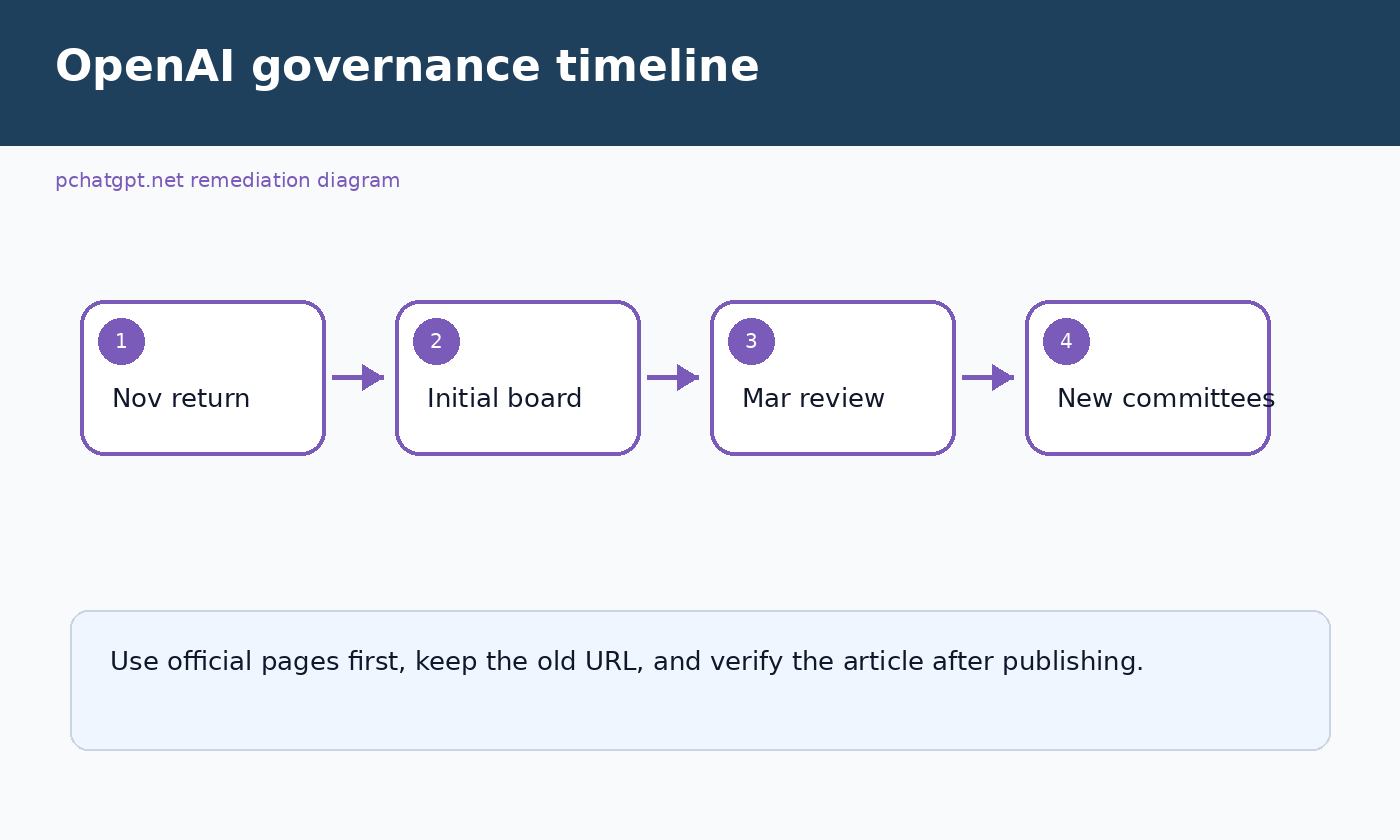
OpenAI announced on November 29, 2023 that Altman was returning as CEO. Mira Murati would return to her position as chief technology officer, and Greg Brockman would return as president. The company also named an initial board consisting of Bret Taylor as chair, Larry Summers, and Adam D’Angelo. OpenAI described Microsoft as receiving a non-voting observer position rather than a voting board seat.
The word “initial” deserves attention. The announcement did not present that three-person group as the finished board. Taylor wrote that the board planned to recruit qualified members with experience spanning technology, safety, and policy. He also identified organizational stability, an independent review of the recent events, and improvements to the governance structure as priorities.
Altman’s message separated the company’s immediate work into distinct areas. One was advancing research and investing in safety efforts. Another was improving and deploying products for customers. A third was the board’s work on membership, governance, and review. That separation is useful for readers today because it prevents a common category error: treating a feature launch as evidence that governance has improved, or treating a board change as proof that a product has become safer or more capable.
What the independent review reported
On March 8, 2024, OpenAI announced that WilmerHale had completed the review commissioned by a special committee of the board. According to the company, the firm conducted dozens of interviews, reviewed more than 30,000 documents, and evaluated various corporate actions. The people interviewed included members of the prior board, OpenAI executives, advisers to that board, and other witnesses whom the reviewers considered relevant.
OpenAI’s published summary said the November events followed a breakdown in trust between the prior board and Altman. It also said the prior board believed its action would address internal management problems and did not anticipate destabilizing the company. According to the summary, the decision did not arise from concerns about product safety or security, the speed of development, company finances, or statements made to investors, customers, or business partners.
The review summary drew a distinction that is easy to lose in simplified retellings. It said the prior board had broad discretion to remove Altman, while also finding that his conduct did not require removal. It further said the board acted on an abridged timetable, without advance notice to important stakeholders, a full inquiry, or an opportunity for Altman to address the board’s concerns.
After considering those findings, the special committee recommended that the full board endorse the earlier decision to rehire Altman and Brockman. The board expressed confidence in their continuing leadership, and Altman was to rejoin the board. These are the conclusions OpenAI published. They are not a blanket finding about every management decision, every safety question, or every future conflict. A careful reading should preserve that limited scope.
The concrete governance measures OpenAI announced
The March announcement moved beyond the temporary three-member board. OpenAI named Sue Desmond-Hellmann, Nicole Seligman, and Fidji Simo as new directors. The company described their backgrounds in areas that included global organizations, regulation, technology, nonprofit work, law, and board governance. They joined Taylor, Summers, and D’Angelo, while Altman’s return to the board was announced separately.
Board composition is only one part of governance. OpenAI also listed four structural measures:
- a new set of corporate governance guidelines;
- a strengthened conflict of interest policy;
- an anonymous whistleblower hotline for employees and contractors; and
- additional board committees, including a Mission and Strategy committee focused on carrying out and advancing OpenAI’s core mission.
These measures address different failure points. Governance guidelines can clarify how directors and executives are expected to operate. A conflict policy can establish how personal or institutional interests are disclosed and managed. A reporting hotline gives workers and contractors a formal channel for raising concerns without naming themselves. Board committees can assign sustained attention to subjects that a full board might otherwise handle only intermittently.
Still, an announced mechanism is not the same as a public record of how that mechanism works. The two official posts establish that OpenAI adopted or planned these changes. They do not provide a running account of hotline reports, committee deliberations, recusals, meeting attendance, or how directors vote. Users should avoid both extremes: dismissing the measures because every operational detail is not public, or assuming that the announcement alone proves lasting effectiveness.
What users should track now
Board membership and voting authority
Start with basic institutional facts. Who sits on the board? Which members are independent of management? Who can vote, and who attends only as an observer? The November post explicitly described Microsoft’s observer role as non-voting. That distinction matters because access to discussions and legal authority over board decisions are not identical.
Changes in board size or membership can also show whether the “initial” structure continued to develop. Biographies help explain what experience directors bring, but resumes do not reveal how a person will vote. Readers should give more weight to formal appointments, committee assignments, and published governance documents than to assumptions based on a director’s previous employer.
Committees and written rules
The Mission and Strategy committee was the only additional committee named in the March post. Users can watch for official information about its remit, membership, and actions, along with any other committees OpenAI identifies. The same applies to the governance guidelines and conflict of interest policy. A written rule is easier to evaluate when its scope, responsible body, and enforcement process are clear.
For individual users, this does not require reading every company announcement. A sensible check is to revisit official governance disclosures after a major leadership change, reported internal dispute, or restructuring. The goal is to see whether OpenAI identifies the decision maker and the process used, not to infer a hidden story from ordinary silence between announcements.
How concerns can reach the board
The whistleblower hotline is relevant because boards often depend on information that travels through management. An anonymous route for employees and contractors can create another path. OpenAI’s announcement confirms the hotline’s creation, but it does not publish case statistics or describe outcomes. Unless OpenAI releases more information, users cannot responsibly claim how often the channel is used or how effective it has been.
Future official descriptions could make the mechanism easier to assess. Useful details would include who receives reports, what protections apply, whether allegations can be escalated outside management, and how the board reviews recurring concerns. Those are criteria for evaluating a reporting system, not claims that OpenAI has or has not implemented any unpublished practice.
Whether later explanations keep governance and safety claims precise
The review summary specifically said the 2023 removal did not arise from concerns about product safety or security or the pace of development. That statement narrows the explanation for that episode. It does not establish that OpenAI has no safety risks, that every internal concern was resolved, or that later product decisions should receive less scrutiny.
Precision matters here. If OpenAI discusses a governance event, look for the stated scope of the review, the body that commissioned it, and the conclusion actually reported. If it discusses a product, look for the release documentation, limitations, and safety information attached to that product. Blending the two can produce a confident narrative that neither source supports.
Governance signals are not product release notes
Governance determines who has authority, how oversight is organized, and what channels exist for resolving conflicts or receiving concerns. Product reporting covers a different set of questions: which model or feature is available, who can access it, what changed, and how the service behaves. The subjects can affect each other, but evidence in one category does not automatically answer the other.
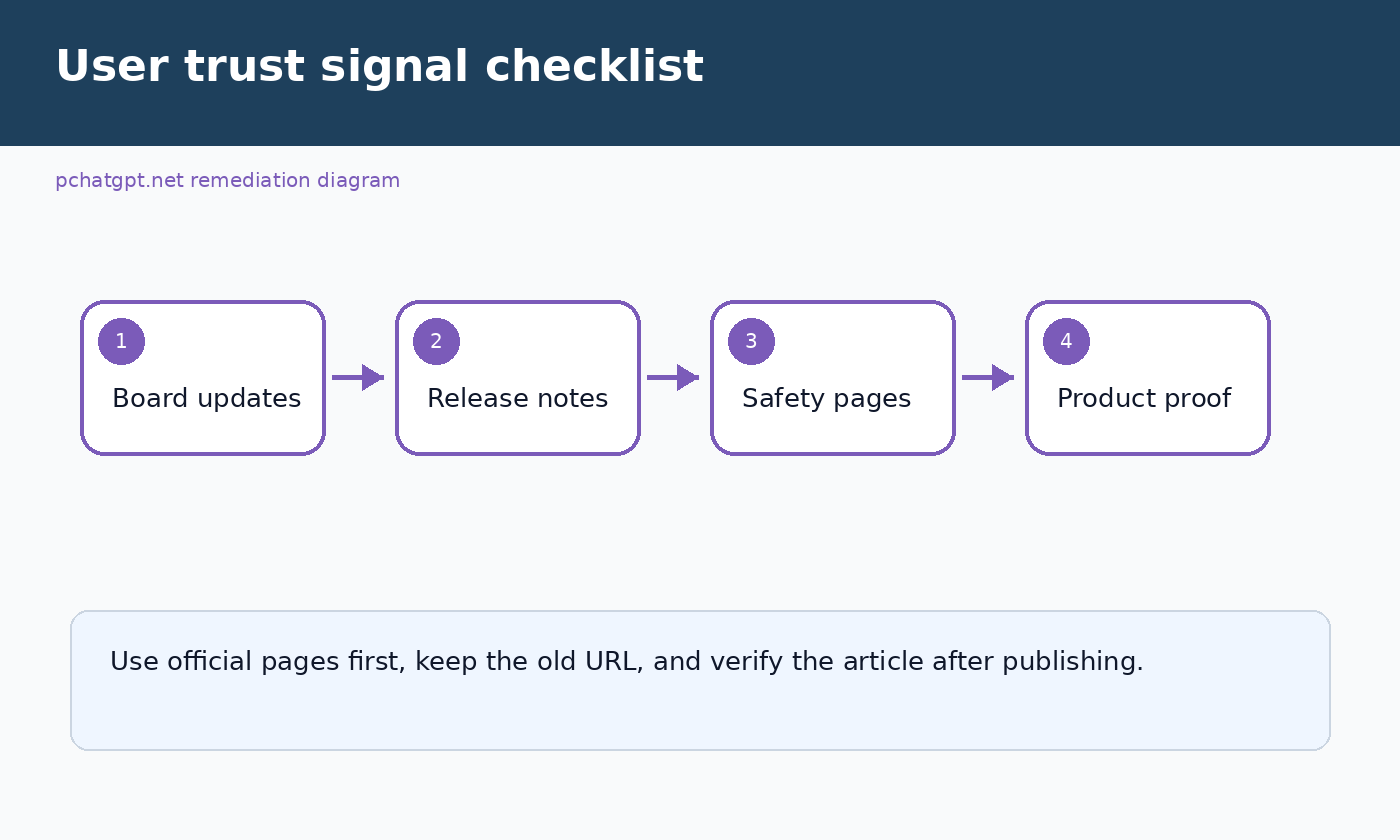
If your practical concern is what ChatGPT can do, consult product documentation and a clear service overview such as ChatGPT: everything you need to know about the AI chatbot. For a chronological view of shipped changes, use a dedicated update record such as OpenAI release notes and latest updates. Those pages answer product questions that the two governance announcements do not.
The reverse is also true. A smoother interface, a new model option, or a faster response does not tell users whether a board committee met, whether a conflict was disclosed, or whether an internal report reached directors. Product quality may shape trust in the service, but it is not a substitute for evidence about corporate oversight.
A practical reading method
When a new OpenAI governance statement appears, first identify its issuer. A message from the CEO expresses management’s account or priorities. A statement from the board describes the board’s position. A review commissioned by a board committee has a defined assignment and reports within that scope. Keeping those voices separate prevents a company page from being treated as if every sentence came from an independent authority.
Next, separate completed actions from intentions. In November 2023, Altman’s return and the initial board appointments were announced as changes in place, while board expansion and the independent review were work still to be done. By March 2024, OpenAI said the review was complete, named three additional directors, and announced governance measures. Reading the posts in sequence shows which commitments later received a stated outcome.
Then look for boundaries. The March summary explained what WilmerHale reviewed and listed several issues that OpenAI said did not cause Altman’s removal. Those boundaries stop the finding from being stretched into a general endorsement of all company conduct. They also make the announcement more useful, because a limited claim can be checked against later official statements without inventing implications.
Finally, keep a short record of durable facts: current directors, voting status, named committees, published policies, reporting channels, and completed reviews. This is more reliable than tracking personalities through social media commentary. It also makes genuine changes easier to spot.
FAQ
Why did Sam Altman return as CEO?
OpenAI announced his return on November 29, 2023 after the leadership crisis earlier that month. The later review summary said the prior board’s action resulted from a breakdown in trust and that Altman’s conduct did not mandate removal. After reviewing the findings, the special committee recommended endorsing the decision to rehire Altman and Brockman, and the board expressed confidence in their leadership.
Did the review say the dispute was caused by AI safety concerns?
No. OpenAI’s published summary said the prior board’s decision did not arise from concerns about product safety or security, the pace of development, company finances, or statements to investors, customers, or business partners. That finding concerns the cause of the November 2023 removal. It should not be expanded into a general judgment about every safety issue or product.
What governance changes were announced after the review?
OpenAI announced three new directors, Altman’s return to the board, corporate governance guidelines, a strengthened conflict of interest policy, an anonymous whistleblower hotline for employees and contractors, and additional board committees. The company specifically named a Mission and Strategy committee.
How can a ChatGPT user monitor OpenAI governance responsibly?
Follow official board and company announcements, distinguish voting directors from observers, and check whether promised reviews or policies later receive a documented outcome. Read claims within their stated scope. For feature availability and model changes, use product release notes rather than governance statements.
What a careful user can reasonably conclude
The official record shows that OpenAI restored Altman as CEO, rebuilt its board in stages, commissioned a review, accepted the review’s findings, and announced several governance mechanisms. It also shows that the company attributed the 2023 rupture to a breakdown in trust rather than the product, safety, financial, or stakeholder communication concerns listed in the review summary.
That record supports a focused conclusion, not a sweeping one. OpenAI responded to the episode with named people, a review process, and structural changes. Whether those arrangements remain effective is a continuing question best judged through later official disclosures, clearly assigned authority, and evidence of follow-through. Users do not need to guess at motives to track that record. They need to keep governance evidence separate from product news and read each claim no more broadly than its source allows.
Official sources
- OpenAI: Sam Altman returns as CEO, OpenAI has a new initial board, November 29, 2023.
- OpenAI: Review completed and Altman, Brockman to continue to lead OpenAI, March 8, 2024.