
GPT-5.5-Cyber began as a limited OpenAI preview for a narrow group of verified defenders working on critical infrastructure and other authorized security tasks. OpenAI announced that preview on May 7, 2026, two days before the original publication date attached to this page. The headline’s central claim was therefore real, but the old article body did not explain it. It discussed generic prompt chaining instead of cybersecurity. This rewrite corrects that mismatch and follows the product from the initial preview to OpenAI’s later June update.
The most important distinction is easy to miss: GPT-5.5-Cyber was not simply a less restricted chatbot for anyone who wanted one. OpenAI described an access ladder. Standard GPT-5.5 served general work, GPT-5.5 with Trusted Access for Cyber supported most verified defensive workflows, and GPT-5.5-Cyber addressed a smaller set of specialized, authorized tasks that required more permissive behavior. Identity checks, account controls, monitoring, scoped use, and human review remained part of the design.
What OpenAI actually announced
In its official post, Scaling Trusted Access for Cyber with GPT-5.5 and GPT-5.5-Cyber, OpenAI said it was rolling out GPT-5.5-Cyber in limited preview to defenders responsible for securing critical infrastructure. The purpose was to support specialized cybersecurity workflows that could protect the wider ecosystem. That is more precise than saying the model was opened broadly to security professionals.
The preview sat beside, rather than replaced, GPT-5.5 with Trusted Access for Cyber. OpenAI presented the trusted-access version of its general model as the best starting point for most legitimate defense. It listed secure code review, vulnerability triage, malware analysis, binary reverse engineering, detection engineering, and patch validation among the workflows that approved defenders could perform with fewer unnecessary classifier refusals.
GPT-5.5-Cyber targeted the harder edge of the same problem. Authorized red teams and penetration testers sometimes need to demonstrate exploitability inside a controlled lab or an environment they are explicitly permitted to test. A general model may refuse such a request because the same instructions could be abused against someone else’s system. OpenAI designed the preview to explore how stronger verification and oversight could permit valid work without turning off protections for malicious conduct.
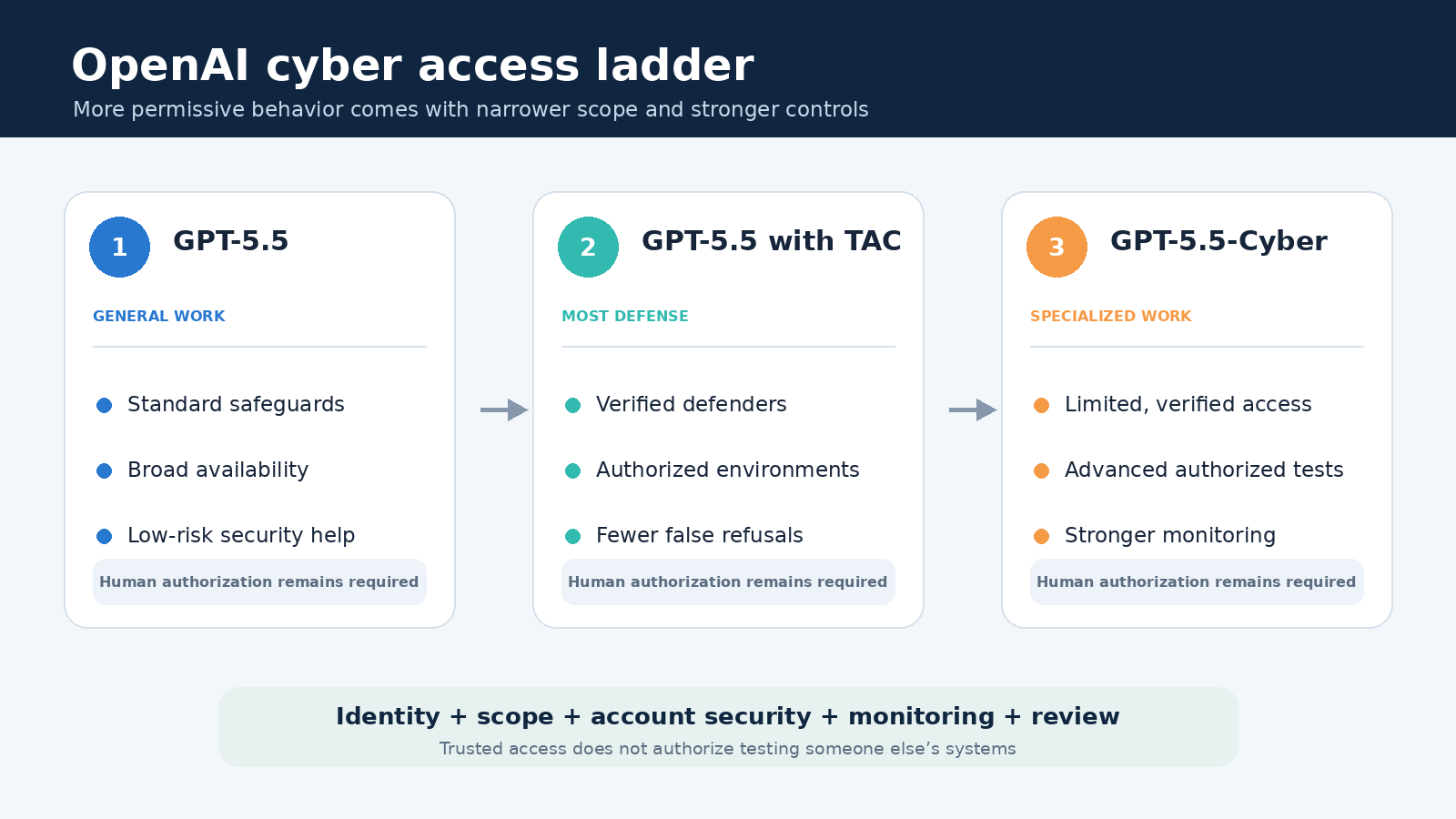
Three access levels, not one unrestricted model
The first level was ordinary GPT-5.5 with standard safeguards. It was meant for general knowledge, development, and business work. Security teams could still use it for low-risk tasks, such as explaining defensive concepts, reviewing a secure configuration, summarizing an advisory, or drafting a remediation checklist. Its boundaries could become more cautious as a request moved closer to operational exploitation.
The second level was GPT-5.5 with Trusted Access for Cyber. Approval established more confidence about who was requesting help and why. OpenAI said this level used more precise safeguards for verified defensive work in authorized environments. It reduced false refusals, but did not permit credential theft, persistence, stealth, malware deployment, destructive action, or attacks on third-party systems. Trusted access changed the calibration around legitimate dual-use work; it did not erase the rules.
The third level was GPT-5.5-Cyber. In the May preview, its main difference was permissiveness on specialized security requests, not a guarantee that it was better than GPT-5.5 on every benchmark. OpenAI explicitly cautioned that the first preview was not expected to outperform GPT-5.5 across all cyber evaluations. That qualification matters because the product name can sound like proof of across-the-board technical superiority. At launch, it was better understood as a controlled deployment for requests that a broad model might decline.
This tiered model reflects the dual-use nature of cybersecurity. Reading a vulnerable function, constructing a test case, reversing suspicious code, or reproducing a published flaw may help a maintainer patch software. The same skills can help an attacker. Intent is hard to infer from a prompt alone. OpenAI’s answer was to combine model safeguards with identity, authorization, access scope, telemetry, and escalation rather than rely on a single content filter.
Why the preview focused on vetted defenders
Verification provides context that a standalone prompt cannot. A known organization can document what systems it owns, which clients have authorized testing, how researchers disclose vulnerabilities, and who is accountable for the work. That does not make every request safe, but it creates a stronger basis for granting capabilities and investigating misuse.
OpenAI also tied privileged access to stronger account security. Its May announcement said individual trusted-access members using the most capable and permissive cyber models would need Advanced Account Security beginning June 1, 2026. Organizations could instead attest to phishing-resistant authentication in their single sign-on setup. The principle is sensible: an account with unusually capable tools becomes a valuable target, so its authentication should be harder to steal.
Access was also scoped to authorized use. A professional role or security certification is not blanket permission to test any network. Defenders still need asset-owner authorization, a written scope, data-handling rules, safe test infrastructure, and a disclosure path. Teams evaluating any AI security assistant should treat those controls as prerequisites, not paperwork added after a model produces a risky artifact.
What the safeguards were trying to balance
Overly broad refusal can slow down defenders at exactly the moment speed matters. A team validating whether a critical patch works may need a faithful reproduction in an isolated environment. A malware analyst may need help understanding obfuscation that resembles malicious development. A detection engineer may need to describe an attack chain precisely enough to build a useful alert. If a model declines every request containing exploit terminology, it can become least helpful to the people doing the most demanding defensive work.
Overly permissive assistance creates the opposite problem. Detailed operational guidance can lower the effort required to compromise an exposed service, steal credentials, evade monitoring, or maintain access. OpenAI’s GPT-5.5 System Card describes cybersecurity as a High capability area under its Preparedness Framework and documents layered controls, evaluations, external red teaming, and monitoring. It also records limitations and testing findings rather than claiming that misuse can be eliminated.
The practical lesson is that model behavior is only one layer. Safe deployment also depends on authentication, least-privilege credentials, sandboxing, network boundaries, audit logs, rate limits, approval gates, and human review. Readers interested in the account and software side of that defense can also see our ChatGPT Mac app security update guide. A capable model running from a compromised device or overprivileged account can defeat careful workflow design.
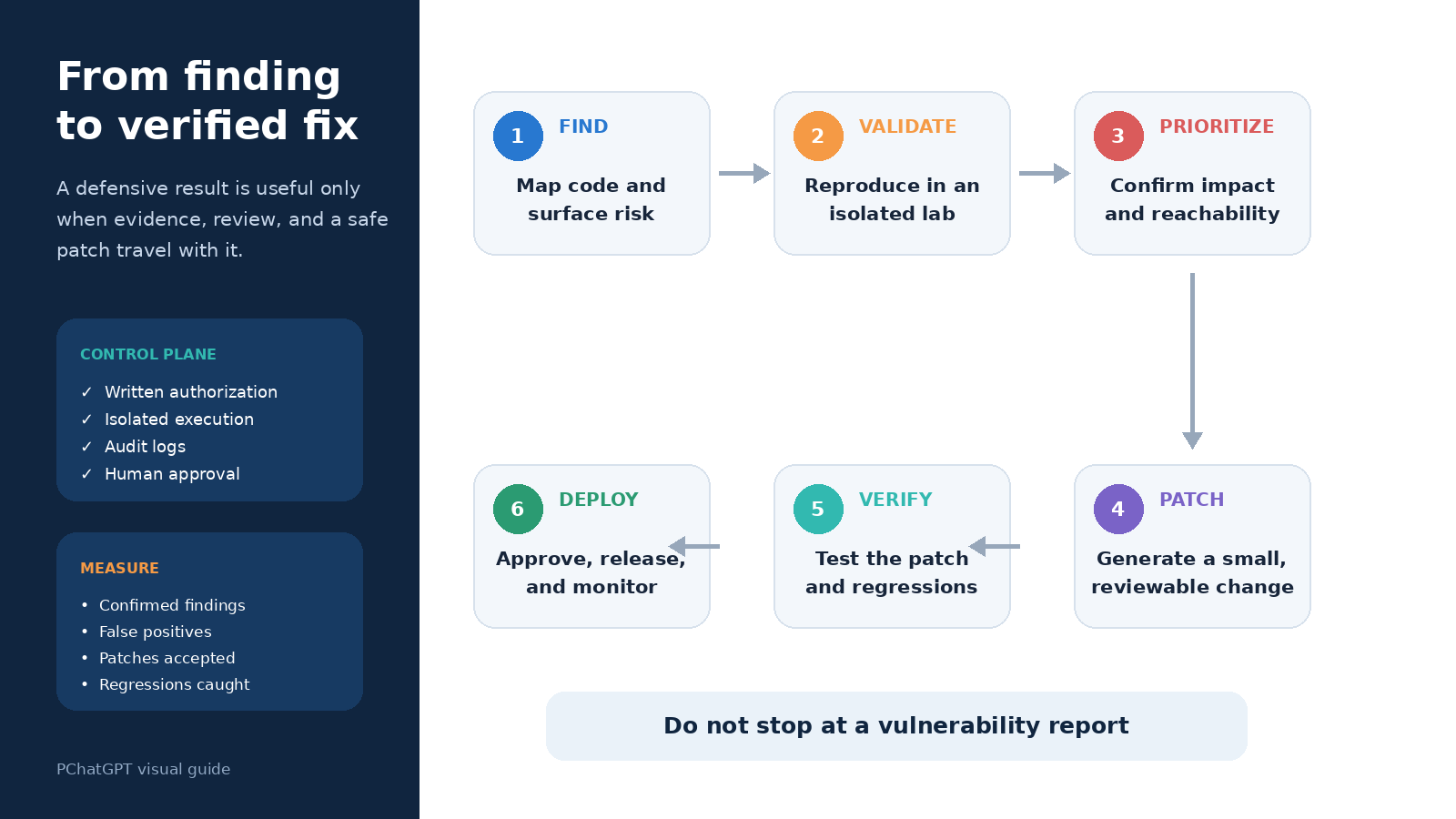
How GPT-5.5-Cyber changed after the preview
The story did not stop in May. On June 22, OpenAI published Daybreak: Tools for securing every organization in the world and announced an updated full version of GPT-5.5-Cyber. OpenAI said the initial preview had primarily reduced unnecessary refusals, while the update combined that permissiveness with stronger capability for advanced authorized work.
The updated description moved from access policy toward the full remediation loop. OpenAI said the model could analyze large codebases, identify security-relevant components, trace reachable vulnerable code, validate likely issues in controlled environments, develop and test patches, and prepare evidence for human review. This sequence is important. Finding a vulnerability does not protect a user until someone validates the finding, prioritizes it, lands a safe fix, tests that fix, and deploys it.
OpenAI reported that the updated model scored 85.6 percent on CyberGym in single-model evaluations, compared with 81.8 percent for GPT-5.5. It also published results on ExploitGym and SEC-bench Pro. Benchmarks can illuminate specific capabilities, but they do not prove that a model will be accurate on a team’s repository or safe in production. Test coverage, target selection, evaluation harnesses, and operational constraints all affect the result.
Even after the update, OpenAI maintained that GPT-5.5 with Trusted Access for Cyber and Codex Security remained the right starting point for most defenders. GPT-5.5-Cyber was for verified users whose authorized work genuinely required the most advanced capabilities and more permissive behavior. That repeated recommendation is a useful antidote to model-name chasing: choose the least privileged tool that reliably completes the approved job.
A responsible evaluation workflow for security teams
Start with a narrow, measurable defensive task. Good pilots include reviewing a known patch, triaging scanner findings in an owned repository, generating detection logic from a confirmed incident, or testing whether a fixed package still reproduces a published crash in a sandbox. Avoid a vague mandate to find anything interesting across production. A bounded target makes authorization, measurement, and cleanup much easier.
- Document authority. Record the asset owner, permitted targets, excluded systems, test window, and disclosure procedure.
- Minimize access. Give the workflow only the repositories, logs, tools, and network routes needed for the test.
- Isolate execution. Run generated tests in an ephemeral lab with synthetic credentials and no route to unrelated services.
- Require evidence. Ask for affected code paths, reproducible steps, assumptions, confidence, and a proposed fix, not just a severity label.
- Keep approval gates. A qualified person should review exploit validation, external communication, code changes, and production deployment.
- Measure outcomes. Track confirmed findings, false positives, review time, patches accepted, regressions, and incidents avoided.
Teams should also separate analysis from action. Letting a model read an approved repository and suggest a patch is different from letting it scan public infrastructure, run generated code, merge changes, or deploy to production. Each additional tool increases impact and deserves a separate permission decision. This is the security version of a broader AI-workspace lesson discussed in our ChatGPT for Excel and Google Sheets guide: convenience does not remove the need to verify inputs, formulas, assumptions, and final decisions.
What readers should not infer
First, the announcement did not make advanced cyber capability available to every ChatGPT account. The initial rollout was limited and identity-gated. Availability could depend on organization, use case, account security, geography, product surface, and OpenAI’s current approval process.
Second, trusted access did not authorize testing. Permission comes from the asset owner and applicable law, contract, and policy. OpenAI approval concerns access to its service; it does not grant rights over someone else’s software or infrastructure.
Third, a cyber-specialized model is not an autonomous security authority. It can misunderstand code, overstate exploitability, suggest a faulty patch, expose sensitive information, or generate an artifact that behaves differently outside the lab. Security professionals must validate findings and control execution. This article is educational, not cybersecurity or legal advice, as explained in the site’s disclaimer.
The corrected takeaway
The preserved URL says OpenAI opened a GPT-5.5-Cyber preview to vetted defenders, and official evidence supports the substance of that claim. The careful version is narrower: on May 7, 2026, OpenAI began a limited preview for defenders responsible for critical infrastructure, within a tiered trusted-access program. Most security teams were directed to GPT-5.5 with Trusted Access for Cyber, while GPT-5.5-Cyber served specialized authorized workflows under stronger controls.
OpenAI’s June update then turned the preview story into a broader remediation story, with an updated model intended to help verified defenders move from vulnerability analysis to tested patches. The durable idea is not that security models should have no restrictions. It is that capable defense requires proportional access: enough freedom to perform legitimate work, enough verification and monitoring to deter misuse, and enough human oversight to keep findings from becoming new risks.
Frequently asked questions
Was GPT-5.5-Cyber really announced in May 2026?
Yes. OpenAI’s official May 7, 2026 post announced a limited GPT-5.5-Cyber preview for defenders responsible for securing critical infrastructure. The original page body was unrelated to that news, which is why it has been replaced with sourced coverage.
Is GPT-5.5-Cyber available to every ChatGPT user?
No. OpenAI described identity-gated access for verified defenders and specialized authorized work. Product access and requirements can change, so applicants should consult OpenAI’s current official information rather than assume a normal subscription includes it.
How is Trusted Access for Cyber different from GPT-5.5-Cyber?
Trusted Access for Cyber is an access framework that makes GPT-5.5 more useful for verified defensive work by reducing unnecessary friction while retaining safeguards. GPT-5.5-Cyber is a specialized model for a smaller set of advanced, authorized workflows requiring more permissive behavior and stronger controls.
Can a team use the model to test any internet-facing system?
No. Model access is not permission to test a target. Teams need explicit authorization, a defined scope, safe infrastructure, data controls, and a disclosure plan. Generated findings and patches also require qualified human validation before use.