Gemini 2.5 Pro vs GPT-5: A Practical Historical and Current Comparison
Gemini 2.5 Pro vs GPT-5 is best understood as a comparison between two important reasoning models, not as a permanent contest with one universal winner. Google introduced the experimental Gemini 2.5 Pro in March 2025, while OpenAI introduced GPT-5 in August 2025. Both releases pushed coding, complex analysis, multimodal work, and tool use forward. Today, they remain useful reference points for understanding how model choice affects real work, even as both companies offer newer model families.
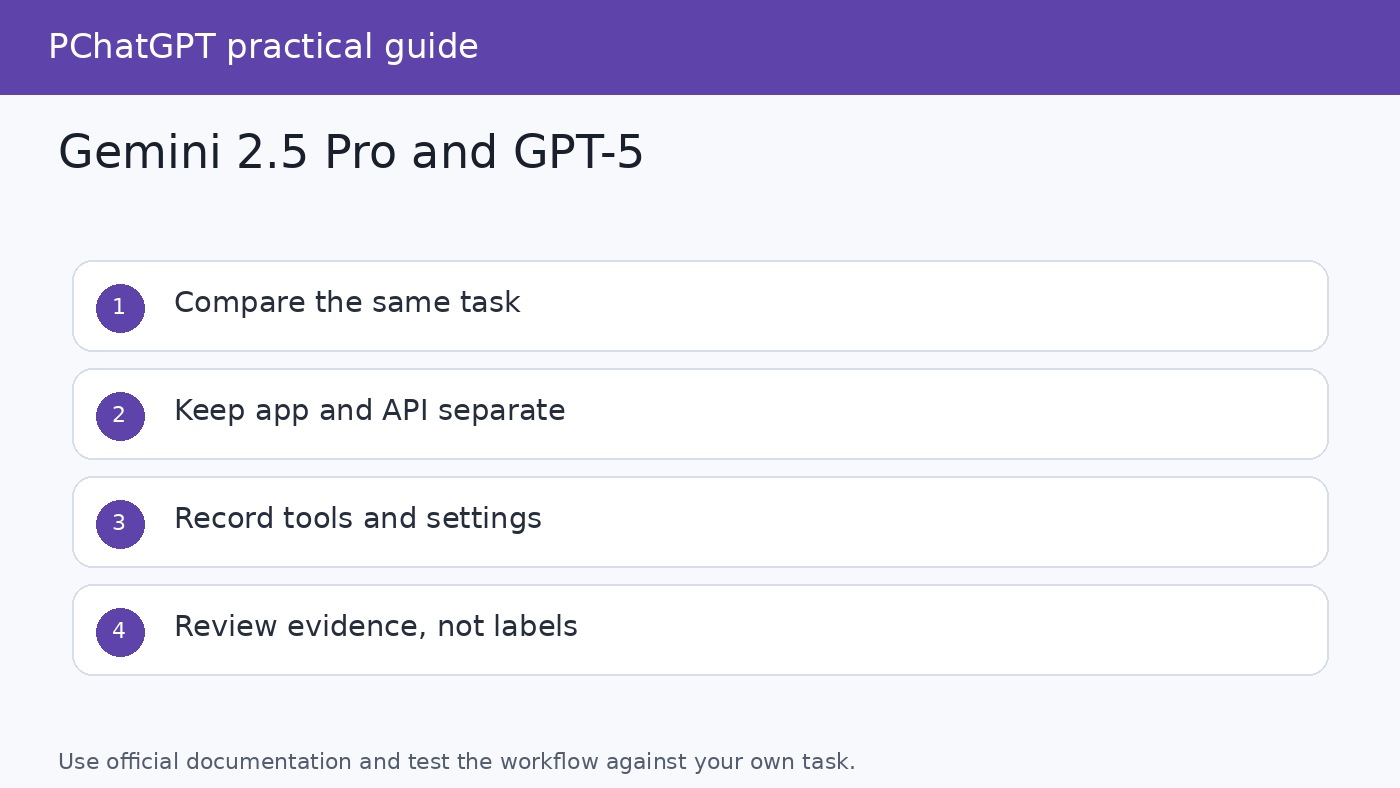
Quick answer: Choose according to the task, interface, data flow, and measured results. Gemini 2.5 Pro has a clear case for large, mixed media inputs and workflows built around Google services. GPT-5 has a clear case for coding, instruction following, and agentic workflows in the OpenAI ecosystem. Test both with your own material before committing a production process to either one.
First, a correction to the original comparison
The original headline framed Gemini 2.5 Pro as challenging “GPT-5.4 dominance.” That wording was not suitable for a reliable comparison because the dominance claim was not supported by the original article or an official source. This corrected article compares Gemini 2.5 Pro against GPT-5. Google announced its first experimental 2.5 Pro release on March 25, 2025. OpenAI announced GPT-5 on August 7, 2025. This timeline matters because launch claims, benchmark setups, product access, and API features were not captured at the same moment.
This article therefore compares what each company officially documented about those named models. It also explains what the comparison means now. It does not claim that either model is the latest offering from its provider, and it does not turn provider benchmarks into a universal league table. A model can lead a published evaluation and still be the weaker option for a particular codebase, document set, language, latency target, or review process.
The short practical verdict
| Decision area | Gemini 2.5 Pro | GPT-5 |
|---|---|---|
| Historical position | Google’s advanced thinking model for complex reasoning, coding, and long context work | OpenAI’s unified GPT generation focused on stronger reasoning, coding, writing, and tool use |
| Large mixed inputs | Official API documentation supports text, images, audio, video, and PDF input | Strong multimodal reasoning was part of the launch, but exact input support depends on the selected OpenAI endpoint and model |
| Coding and agents | Designed for complex codebases and supports function calling, code execution, structured output, and grounding in the Gemini API | Launch materials emphasized repository work, instruction following, tool calling, and long running agentic tasks |
| Best ecosystem fit | Often easier to evaluate when work already lives in Google products or Google Cloud | Often easier to evaluate when a team already uses ChatGPT, the OpenAI API, or OpenAI centered developer tools |
| Best buying rule | Use a task specific evaluation with current documentation, current access, and total workflow cost | |
That table is a starting point, not a purchasing decision. The best choice usually becomes obvious only after a small test set includes your difficult examples, required output format, tools, and human review criteria.
How the models arrived
Gemini 2.5 Pro began as an experimental release. Google’s announcement described Gemini 2.5 models as thinking models that reason before responding, with 2.5 Pro aimed at complex tasks. The company highlighted mathematics, science, code, native multimodality, and a long context window. The current Gemini API model page identifies gemini-2.5-pro as a stable model and documents its supported input types and tools. This distinction between the experimental launch and the stable API identifier prevents an old preview name from slipping into new production code.
GPT-5 arrived later as both a ChatGPT experience and an API model family. OpenAI described the ChatGPT release as a unified system with a fast model, a deeper reasoning model, and a router that decides how to handle a request. Its developer announcement made a crucial clarification: GPT-5 in the API was the reasoning model used for maximum performance, while the nonreasoning ChatGPT model had a separate API identifier. In other words, “GPT-5” did not mean an identical runtime behavior everywhere.
That historical difference still teaches a valuable lesson. Model names are product labels as well as technical identifiers. A comparison must say whether it is evaluating an app experience, a fixed API model, or a larger routed system. Otherwise, two testers can select what looks like the same brand and receive different tools, limits, system behavior, or reasoning settings.
Reasoning quality is task dependent
Both providers presented their models as major reasoning advances. Google emphasized performance on demanding math and science evaluations and explained that thinking was built into the 2.5 family. OpenAI emphasized gains in mathematics, coding, visual perception, health questions, instruction following, and factuality. These claims are useful signals, but they do not settle a general comparison.
Benchmark results depend on the prompt, tool access, reasoning configuration, test subset, scoring method, and model snapshot. Provider launch posts also compare against different competitors at different times. Reading two percentages side by side can be misleading when one run used tools, another did not, or one result came from a custom agent setup. The responsible interpretation is that both models were designed to spend more computation on difficult work, and both deserve direct testing on the tasks that matter to you.
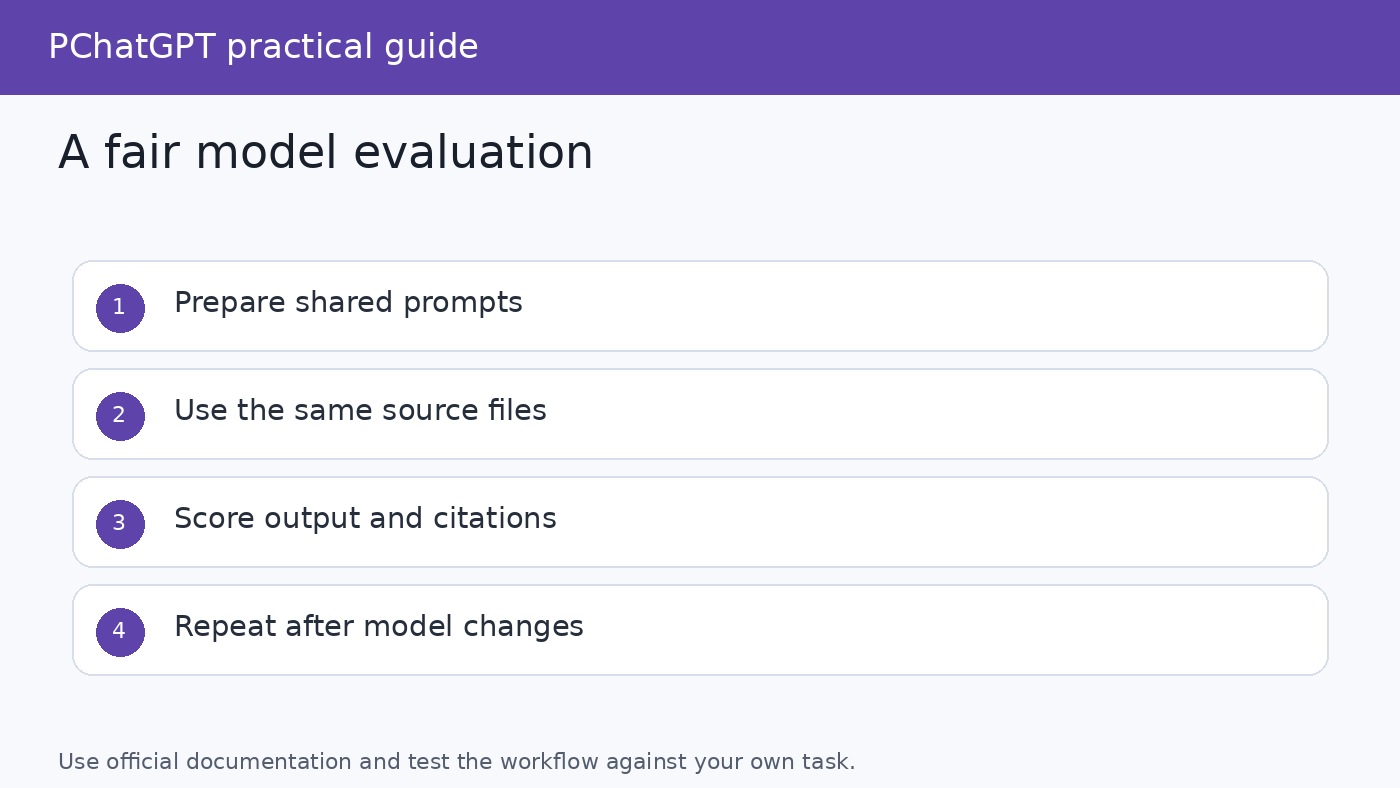
For analysis, build a set of ten to thirty representative cases. Include straightforward examples, ambiguous requests, known failure cases, and inputs near your normal size limit. Score factual accuracy, use of evidence, compliance with instructions, clarity about uncertainty, and the amount of editing required. Keep the prompt and source material constant. If a model can use search or code execution, run a second track for that tool enabled configuration instead of mixing the results.
Coding and agentic work
Gemini 2.5 Pro was explicitly positioned for code generation, transformation, editing, and reasoning across substantial repositories. Its official API documentation lists function calling, code execution, structured outputs, file search, caching, URL context, and search grounding among supported capabilities. Those features can make the model more useful than a plain chat response, but each one requires implementation, permissions, error handling, and logging.
OpenAI positioned GPT-5 as its strongest coding model at launch. Its developer material focused on fixing bugs, editing repositories, frontend work, detailed instruction following, and chaining tool calls. The API release also introduced controls for reasoning effort and response verbosity, plus custom tools. These controls matter in real applications because the most elaborate answer is not always the best answer. A quick classification step and a repository repair task need different budgets and behavior.
Do not choose a coding model from a generated demo alone. Give each candidate the same real issue from a test repository. Require it to inspect relevant files, propose a patch, run tests, and explain any unresolved risk. Measure test pass rate, unnecessary file changes, tool errors, token usage, elapsed time, and reviewer effort. A model that writes attractive code but misses the test loop is not ready for autonomous work.
Long context and multimodal work
Gemini 2.5 Pro has a particularly clear documented profile for mixed inputs. Google’s model page supports audio, images, video, text, and PDF as input, with text as output. It also documents a large input context. That makes it a strong candidate for tasks such as reviewing a long report with diagrams, tracing a question across a large codebase, or combining a recorded session with supporting files.
OpenAI’s GPT-5 announcement highlighted multimodal reasoning and stronger retrieval from long context. In practice, however, developers should confirm the selected model identifier, endpoint, file handling method, and current limits in the official model documentation. The fact that ChatGPT accepts a file does not prove that every API model accepts the same file in the same way.
Large context also does not guarantee careful attention to every detail. Test retrieval by planting known facts at the beginning, middle, and end of a realistic input. Ask questions that require combining separated passages. Check citations against the source. For audio and video, verify names, dates, and exact statements manually. More input capacity is valuable only when the model can find and use the right evidence reliably.
Keep the product surfaces separate
A common comparison error is to take a feature from a consumer app and attribute it directly to the underlying API model. The Gemini app, Google AI Studio, the Gemini API, and Vertex AI are related surfaces, but they are not interchangeable. They can differ in available models, connected services, quotas, data controls, tools, and release timing.
The same rule applies to ChatGPT and the OpenAI API. OpenAI described GPT-5 in ChatGPT as a routed system, while the API exposed specific models and controls for developers. A ChatGPT plan can include an app experience, interface features, and usage rules that do not translate into API credits or identical limits. API access is metered and governed separately.
For an individual choosing a chat assistant, compare the actual app plans and features available to the account. For a developer, compare API identifiers, supported inputs, tools, rate limits, regional availability, data handling, and deprecation policy. For an enterprise, add identity management, auditability, legal terms, retention controls, and support. Never copy a subscription price into an API cost model or assume an API feature automatically exists in the consumer app.
If you want a broader view of how the interfaces fit daily work, see this source checked comparison of everyday AI tools. For better controlled prompts in the ChatGPT product, our practical guide to ChatGPT custom instructions explains how to set stable preferences without treating them as a substitute for task specific context.
Pricing, limits, and availability
Pricing ages quickly, and the wrong comparison can be worse than no number at all. Gemini API billing must be checked on Google’s current pricing pages for the exact model, input type, output type, caching choice, and service tier. OpenAI API billing must likewise be checked for the exact model and endpoint. Consumer subscriptions belong in a separate table because they purchase access to a product, not a portable bucket of API usage.
Rate limits also vary by account tier, region, platform, and time. A model may look affordable per token but cost more per successful task if it produces longer answers, needs repeated calls, or requires more human correction. Conversely, a more expensive call may reduce total cost when it completes a complex task correctly on the first attempt.
Build a simple cost sheet using your own logs. Record input volume, output volume, cached content, tool calls, retries, latency, and reviewer minutes. Recheck the official pages before launch and at regular intervals. Model aliases and previews can change, so production applications should use the provider’s recommended stable identifier and maintain a tested migration path.
A fair five step evaluation
- Define the job. Write down the input, expected output, acceptable error rate, privacy level, and maximum response time. “Best AI” is not a measurable requirement.
- Create a locked test set. Use real but approved examples. Include difficult and ordinary cases. Remove secrets and personal data unless your agreement and controls explicitly permit them.
- Match configurations. Give both candidates equivalent source material and tools. Document reasoning settings, system instructions, temperature where relevant, and model identifiers.
- Score outcomes blind. Ask reviewers who do not know which model produced each answer to rate correctness, completeness, format compliance, and edit time.
- Run a limited pilot. Put the winner into a reversible workflow with human approval, monitoring, and a fallback. Reevaluate when a provider changes the model or your task changes.
This process is less exciting than declaring a winner from a launch chart, but it produces a decision you can defend. Our practical ChatGPT workflow guide offers related patterns for research, writing, and automation with an explicit verification step.
Which model should you choose?
Start with Gemini 2.5 Pro when your test centers on very large or mixed media inputs, the documented Gemini API tools match your architecture, or your organization is already set up around Google services. Start with GPT-5 when the test centers on coding agents, precise instruction following, adjustable reasoning behavior, or an existing OpenAI workflow. “Start with” is important: it means first candidate, not automatic winner.
For many teams, the practical answer is a small model portfolio. One model can handle large document analysis while another handles code changes or concise structured responses. That approach adds routing and governance work, so it only makes sense when measured quality or cost gains justify the complexity. A single well tested model is often safer than a clever router nobody monitors.
Whichever model you select, keep human review for high impact decisions. Both providers describe meaningful capability gains, not infallibility. Verify facts against original sources, execute generated code in a controlled environment, and require qualified review for medical, legal, financial, security, or employment decisions.
Frequently asked questions
Is Gemini 2.5 Pro better than GPT-5?
Not for every task. Gemini 2.5 Pro is a strong candidate for long context and mixed media analysis, while GPT-5 was strongly positioned for coding, instruction following, and agentic tool use. The reliable answer comes from a controlled test using your prompts, files, tools, and review criteria.
Is this really a comparison with GPT-5.4?
No. This corrected article compares Gemini 2.5 Pro with GPT-5, the model OpenAI officially introduced in August 2025. It does not preserve the original page’s unsupported dominance claim. The unchanged URL is only the page’s existing slug and should not be treated as evidence about the article’s scope.
Are Gemini and ChatGPT subscriptions the same as API access?
No. Consumer apps and developer APIs are separate product surfaces. They can use related model families while differing in routing, tools, limits, billing, privacy controls, and availability. Check the plan page for the app and the model documentation for the API, then budget them separately.
How should a business test Gemini 2.5 Pro and GPT-5?
Use a locked set of representative tasks, equivalent tools, documented model settings, blind review, and a limited pilot. Measure accuracy, format compliance, latency, retries, human edit time, and total cost per accepted result. Repeat the evaluation when model versions or business requirements change.
Official sources
- Google: Gemini 2.5 announcement, March 25, 2025
- Google AI for Developers: Gemini 2.5 Pro model documentation
- Google AI for Developers: Gemini API release notes
- OpenAI: Introducing GPT-5, August 7, 2025
- OpenAI: Introducing GPT-5 for developers
- OpenAI API: GPT-5 model documentation
Editorial note: Model availability, limits, and pricing can change. Consult the linked official documentation for current operational details before making a purchase or deployment decision.