Trust in ChatGPT at work does not begin with a promise that the model is always right. It begins with a much more useful question: can the organization explain what data entered the system, why it was allowed, who checked the result, and what happened next? That is the heart of practical ChatGPT data governance. It turns a popular assistant into a managed business tool without pretending that every task carries the same risk.
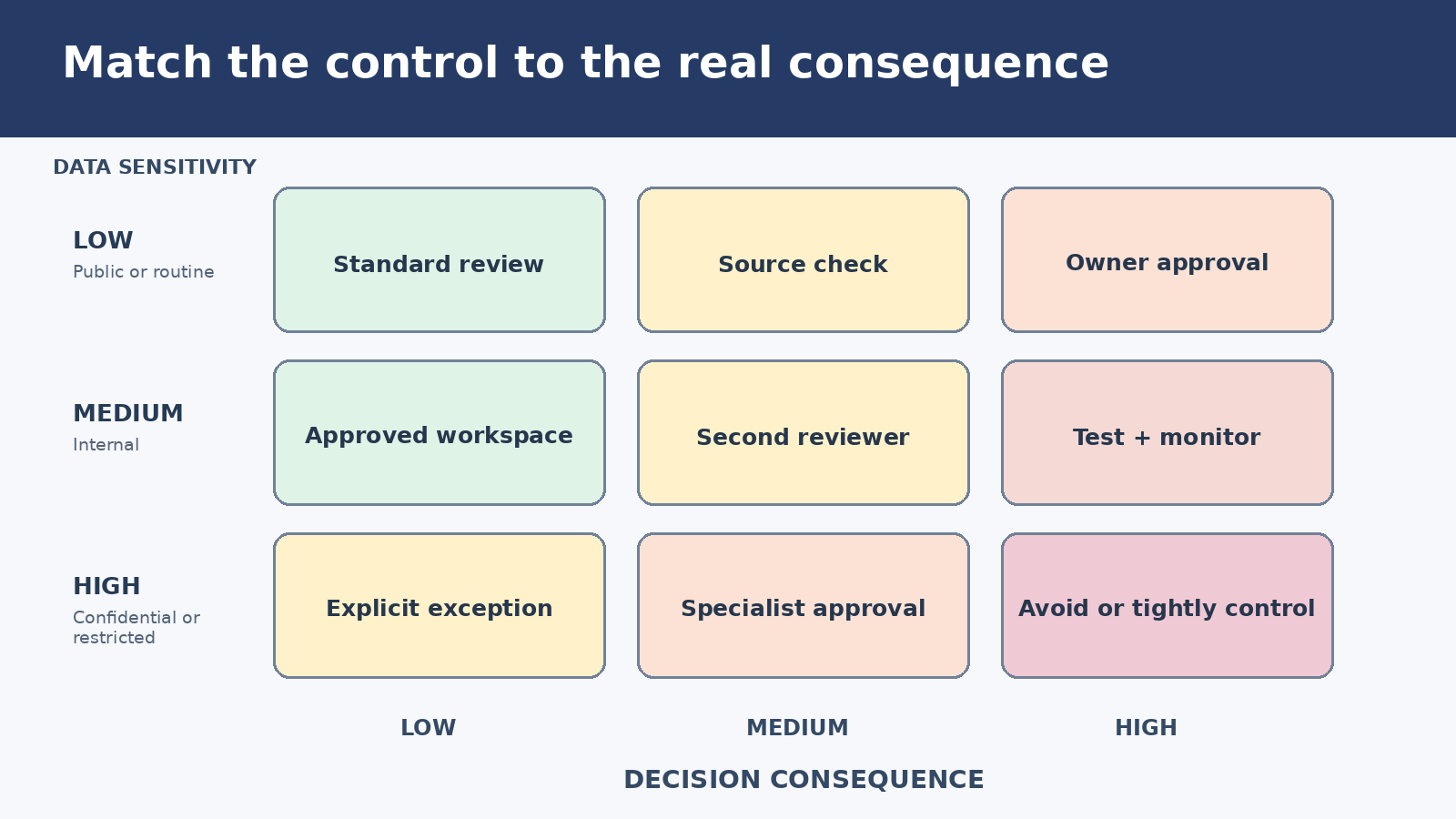
A marketing brainstorm based on public product pages is not equivalent to summarizing patient notes, ranking job candidates, or drafting a payment instruction. Yet many policies treat them alike. They either ban everything or allow almost everything. A better approach sorts work by data sensitivity and consequence, then adds controls that people can actually follow.
This guide is for teams using ChatGPT through individual accounts, managed workspaces, or applications built with the OpenAI API. Those routes have different settings and data practices. Confirm the product, plan, configuration, region, connected apps, and contract that apply to your deployment. Product documentation is evidence, not a substitute for your own legal, privacy, security, or records review.
Start with the data journey, not the prompt
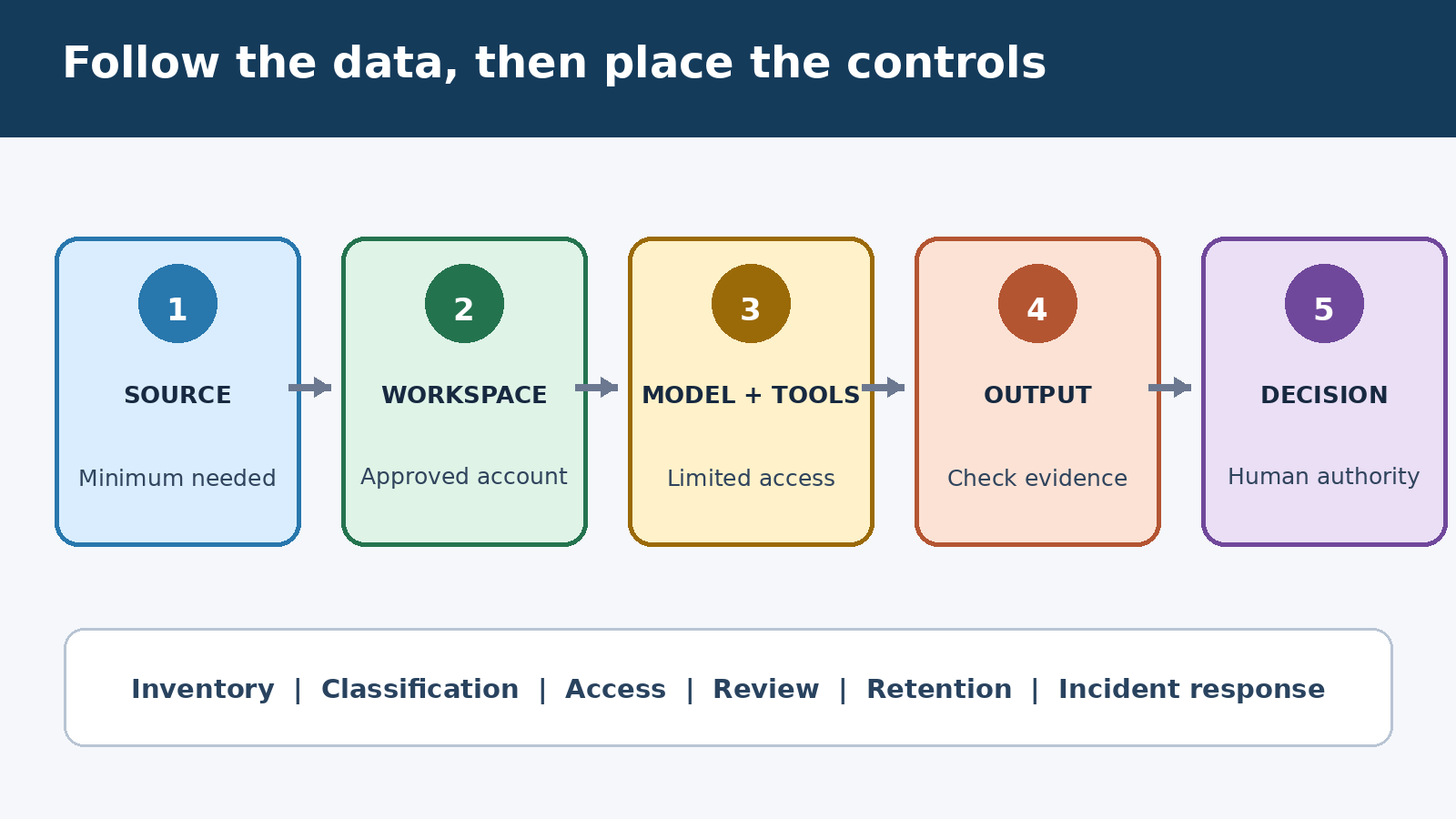
A prompt is only one stop in a longer journey. An employee may copy information from a customer system, upload a spreadsheet, retrieve files through a connected app, receive a generated answer, paste that answer into another system, and keep the conversation for later. Governance has to cover the whole route. Protecting the initial prompt while ignoring uploads, connectors, outputs, exports, and downstream decisions leaves obvious gaps.
Map each use case in plain language. Record the business purpose, user group, source data, sensitivity, product and workspace, enabled tools, output destination, reviewer, retention need, and incident owner. Include whether the output can trigger an action. A draft that stays in a sandbox has a different consequence from text that is automatically sent to customers.
OpenAI’s enterprise privacy page says that business data from its listed business products is not used to train models by default. It also describes workspace controls, encryption, access, and retention features, with availability varying by product. By contrast, OpenAI’s article on how content is used to improve models says content from services for individuals may be used for training unless the user opts out. This distinction should appear in employee guidance. “We use ChatGPT” is not precise enough to describe a data flow.
Classify inputs before anyone uploads them
A short, memorable classification scheme works better than a forty page rulebook. One practical version has four lanes. Public information can usually support low consequence drafting. Internal information can be used only in an approved workspace and for approved purposes. Confidential information needs an explicit use case, minimum necessary fields, access controls, and an accountable owner. Restricted information stays out unless a specialized review and contractual basis expressly allow it.
Restricted data commonly includes passwords, API keys, authentication tokens, full payment card data, highly sensitive personal records, privileged legal material, export controlled information, and records whose use is prohibited by contract or law. The exact list belongs to the organization, not to a generic AI policy. Put examples from real departments next to each lane so a salesperson, analyst, and engineer can recognize the boundary.
Minimization is the most reliable first control. Remove names when a role or case number will do. Replace a full account record with the few fields needed for the task. Summarize a contract clause rather than uploading an entire deal room. Use synthetic examples for prompt development. Redaction is not magic, since combinations of ordinary details can reidentify a person. Someone who understands the source data should review what remains.
Individual users who choose to work with non-sensitive material can review OpenAI’s Data Controls FAQ. It explains the “Improve the model for everyone” setting and Temporary Chat. Turning off training does not make a personal account an approved business environment, and Temporary Chat does not cancel an employer’s policy, a confidentiality duty, or a legal retention requirement. For a focused walkthrough, see PChatGPT’s guide to opting out of model training and managing ChatGPT data.
Choose controls according to consequence
Risk rises when a plausible but wrong answer can affect money, rights, safety, employment, eligibility, reputation, or access to essential services. For low consequence work, a user review and a ban on sensitive inputs may be enough. Medium consequence work may require an approved template, source citations, sampling, and a second reviewer. High consequence work needs specialist approval, documented testing, strong access controls, meaningful human authority, monitoring, and sometimes a decision not to use generative AI at all.
Do not label every human glance as oversight. A reviewer needs enough time, source access, expertise, and authority to reject the answer. If the interface encourages rapid approval, or the reviewer cannot see the evidence, the control exists mostly on paper. Require verification against authoritative records for facts that matter. Ask reviewers to record corrections and uncertainty, not merely click “approved.”
The NIST AI Risk Management Framework organizes risk work around Govern, Map, Measure, and Manage. NIST notes that AI RMF 1.0 is voluntary and is being revised. Its official Generative AI Profile adds generative AI considerations such as governance, content provenance, testing, and incident disclosure. These resources are useful scaffolding. A team can map its own controls to them without claiming certification or assuming that a framework answers every sector specific question.
For organizations operating in or affecting the European Union, the European Commission’s AI Act overview explains the regulation’s risk based structure, transparency duties, and implementation timing. Legal obligations depend on role and use case. A general writing assistant and a system used in employment or access to essential services can present very different issues. Obtain qualified advice rather than assigning a legal category from a blog post.
Configure the workspace as a governed environment
Policy and technical configuration should agree. Use centralized identity, single sign-on where available, prompt removal of departed users, least privilege, and separate workspaces or projects when business units have materially different data. Review who can create or share custom GPTs, enable apps, connect internal sources, publish content, and export conversations. Defaults deserve the same scrutiny as advanced features because defaults shape everyday behavior.
Connections need their own register. For every app or knowledge source, list the owner, authorized users, information classes, permissions, external subprocessors, retention behavior, and removal procedure. A connector can make work easier while widening the data path. Existing permissions help, but they do not prove that every retrieved document is appropriate for a given AI use case.
Retention must follow a purpose. Keeping everything “just in case” increases exposure and discovery volume. Deleting everything immediately can prevent investigation, quality review, and required recordkeeping. Define conversation, upload, output, log, and evaluation retention separately. OpenAI’s business privacy page describes retention controls for specified plans, while its API data documentation has feature and endpoint specific details. Verify the live documentation and your contract before designing a schedule.
Enterprise and Edu customers evaluating audit workflows can consult OpenAI’s Compliance Platform documentation. The help article describes logs and metadata that can connect with eDiscovery, data loss prevention, and security monitoring tools. Logging should be proportionate: collect enough to investigate and demonstrate control, restrict access to the logs, protect their contents, and dispose of them on schedule.
Test the use case, not just the model
A model benchmark does not tell you whether a finance team’s monthly narrative is reliable with your files, instructions, reviewers, and deadlines. Build an evaluation set from representative work, including awkward cases. Remove or synthesize protected information. Write expected characteristics before testing so the team does not move the goalposts after seeing a fluent answer.
Measure what failure looks like in context: unsupported claims, omitted caveats, incorrect numbers, disclosure of restricted details, biased treatment, failure to follow an instruction, unsafe tool use, or excessive reviewer effort. Track severe failures separately. A high average score should never hide one invented payment account or one exposure of confidential data.
Repeat evaluations after a meaningful change to the model, system instructions, connector, source collection, workflow, or user population. Keep the test version, date, result, approver, known limitations, and release decision. In production, monitor samples and user reports. Watch for teams moving to unapproved tools when the approved route is too slow. That is both a security signal and feedback about process design.
Output labels can help, but they should say something useful. “AI assisted draft, verified by [role] against [sources] on [date]” carries more information than a vague sparkle icon. For customer facing or public interest content, decide when disclosure, provenance, or citation is required. Do not imply that a label proves truth. Provenance can show where content came from; factual review establishes whether it is supportable.
Create a workflow people can use on Monday
Start with three to five narrow use cases, not an enterprise wide promise. Choose tasks with a clear owner, accessible ground truth, and reversible outputs. A safe early example might be turning approved public documentation into an internal draft that a subject expert edits. Avoid beginning with autonomous decisions, sensitive investigations, or direct changes to critical records.
- Name the purpose. State what the assistant may do and what it may not decide.
- Approve the data lane. Specify allowed sources and fields, plus information that must be removed.
- Fix the environment. Identify the approved product, workspace, account type, tools, apps, and settings.
- Design the review. Give the reviewer source access, a checklist, and authority to stop publication or action.
- Test predictable failures. Include missing context, conflicting documents, malicious text in retrieved files, and requests outside scope.
- Log the decision. Record the version, owner, approval, limitations, and next review date.
- Prepare the exit. Know how to disable access, preserve required evidence, notify affected teams, and return to a manual process.
Training should use examples rather than slogans. Show an acceptable prompt, a prohibited upload, a well-redacted alternative, a fabricated answer, and the exact reporting route. Give users a quick place to ask before they paste. PChatGPT’s practical rules for safer business AI can help teams translate a policy into everyday boundaries, but local rules and named owners must remain authoritative.
Build trust through evidence and honest limits
Trust is calibrated when people know what the system is good at, where it fails, and how the organization responds. Publish a short internal use case card with the purpose, allowed data, prohibited data, reviewer, measured performance, known limitations, escalation contact, and last review date. Update it when reality changes. This is more credible than calling a system “responsible” without evidence.
When an incident occurs, preserve relevant records according to policy, contain the data path, disable the affected integration if needed, assess who and what was affected, and involve privacy, security, legal, records, and business owners as appropriate. Give staff a reporting channel that does not punish good faith mistakes. Near misses reveal confusing interfaces and unrealistic rules before they become larger events.
A small set of measures can keep governance grounded: percentage of active use cases in the register, evaluation coverage, severe failure count, review time, policy exception age, incident response time, and completion of corrective actions. Productivity still matters, but count it beside risk. If a workflow saves ten minutes and creates twenty minutes of verification, the team learned something valuable.
Good ChatGPT data governance is not a one-time approval. It is a repeatable habit of mapping information, choosing proportionate controls, testing the real workflow, watching production, and revisiting assumptions. The reward is not perfect certainty. It is the ability to use generative AI while answering reasonable questions from employees, customers, auditors, and leaders with evidence.
Frequently asked questions
Does ChatGPT train on business data?
OpenAI states that it does not train on inputs and outputs from its listed business products by default unless an organization explicitly opts in to sharing. Services for individuals have different practices and controls. Confirm the exact product, account, settings, contract, and current official documentation used by your organization.
Can employees paste confidential information into ChatGPT if training is off?
Not automatically. A training setting addresses only one part of the data lifecycle. Approval also depends on the workspace, contract, retention, access, connected tools, legal duties, and the organization’s classification policy. Use only the minimum data authorized for an approved purpose.
Who should own ChatGPT governance?
A senior business owner should be accountable, but the work is shared. Use case owners, security, privacy, legal, records, procurement, compliance, and affected domain experts each see different risks. Assign one named owner for every use case and one clear route for exceptions and incidents.
How often should a ChatGPT use case be reviewed?
Set a scheduled review based on risk and trigger an earlier review after significant changes to models, prompts, data sources, connectors, users, laws, incidents, or business purpose. High consequence uses need more frequent evidence and monitoring than low consequence drafting from public material.