Connecting an AI governance platform to the tools where teams already plan, build, and review AI can remove tedious handoffs. It can also automate the wrong process with impressive efficiency. That tension is the most useful way to examine the Credo AI Integrations Hub. The product is not merely a directory of connectors. Credo AI describes integration patterns for bringing use cases, models, datasets, evidence, and governance artifacts into a connected workflow.
For AI teams, the practical lesson is broader than one vendor. Governance automation works when every transfer has a defined owner, purpose, data boundary, and verification step. It fails when a connector is treated as proof that the underlying record is complete or correct. This guide explains what Credo AI officially says its hub does, how to design a useful workflow around it, and how to evaluate an implementation without assuming that software can make legal or risk decisions for you.
What the Credo AI Integrations Hub is
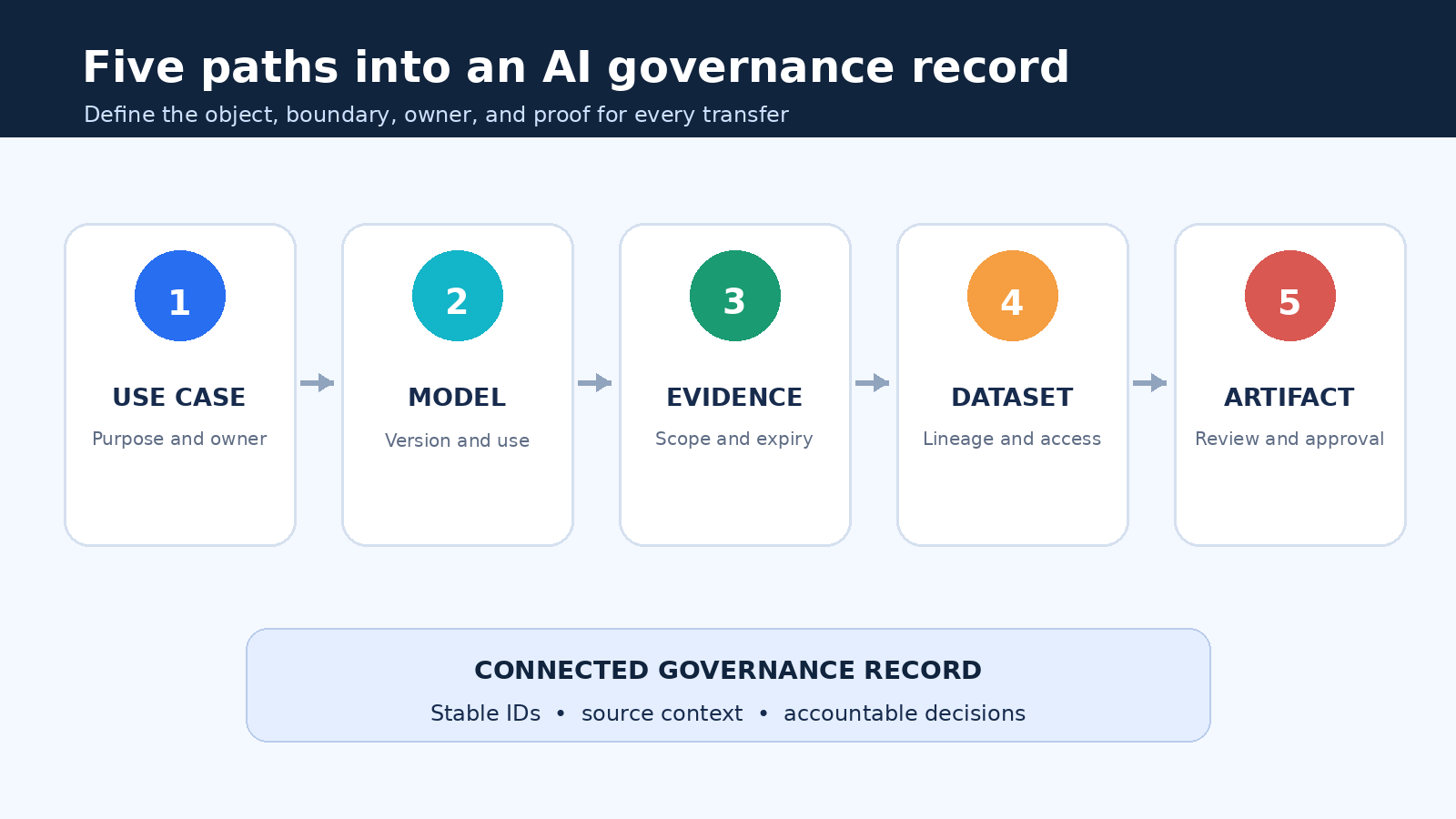
Credo AI’s current Integrations Hub page organizes the product around five integration types: use case import, model upload, evidence ingestion, dataset connection, and GRC artifacts. In plain terms, those patterns move records from business and technical systems into governance, connect supporting material to those records, and turn approved evidence into documentation. The page also positions integrations as a way to meet engineering, legal, compliance, and business stakeholders in their existing workflows.
The company’s original Integrations Hub announcement gives concrete examples of those categories. It describes importing selected AI use cases, uploading model records from model stores, ingesting evidence, connecting dataset registries, and creating GRC artifacts. It also names integrations that were available at launch. Treat that list as a historical launch snapshot, not a promise that every connector, field, or behavior is unchanged today. Confirm the current catalog and configuration in the product before designing a dependency around one.
This distinction matters because an integration can mean several different things. One connector may import a record, another may synchronize selected fields, and another may trigger a task or generate a document. The existence of a connector does not establish direction, frequency, permissions, conflict behavior, or data coverage. A serious evaluation starts with the exact object and event flow rather than a logo on an integrations page.
Translate the five integration types into operational questions
Use case import should create a governable record for an actual use of AI, not just copy a project name. Decide which source record qualifies for import, who owns it, and which fields are mandatory. Purpose, users, affected people, input data, output destination, model or service, business owner, technical owner, deployment status, and review date are useful starting fields. Define how rejected experiments, duplicates, and abandoned pilots are handled so the inventory does not become a graveyard.
Model upload links technical assets to the business context in which they are used. A model record alone cannot describe consequence. The same model may support a low impact drafting assistant and a high consequence decision workflow. Preserve source identifiers and versions, then connect each model to its use cases, environments, evaluations, and owners. Decide what happens when a model is replaced, fine tuned, moved, or used by another application.
Evidence ingestion should bring in reviewable material, not an unfiltered document dump. Every evidence item needs a source, collection time, scope, responsible owner, applicable requirement, and validity period. A test report may apply only to one version and one evaluation dataset. A policy approval may expire. If the integration cannot preserve that context, reviewers can mistake stale or unrelated material for current assurance.
Dataset connection makes data lineage relevant to the governance record. Teams should know whether the connection references a dataset or copies data, which metadata is transferred, and whether sensitive values can cross the boundary. Record the dataset owner, permitted purpose, provenance, access conditions, retention expectations, and the models or evaluations that use it. Metadata synchronization can improve visibility, but it does not correct weak consent, quality, representativeness, or access controls.
GRC artifact generation turns governed information into an output for a defined audience. The artifact may be useful for internal review, procurement, audit preparation, or a regulatory process, depending on its template and evidence. Generation is not the final decision. Assign a qualified reviewer who can check the applicable requirement, source evidence, omitted fields, version, and approval status. Credo AI itself places an informational disclaimer on its blog, so teams should not treat generated material as legal advice.
Start with a record contract, not a connector
Before configuring anything, write a compact contract for each exchanged record. Name the source of truth, destination, trigger, direction, required fields, allowed values, owner, service account, update frequency, error route, and retention rule. Add a conflict rule. If a business owner changes in two systems, which value wins? If an imported use case is deleted at the source, is it retired, hidden, or deleted downstream? A silent last-write-wins rule can erase accountability.
Use stable identifiers rather than names for correlation. Project and model names change, and different teams often choose the same label. Store the source system, source object ID, governance object ID, and relationship type. Keep human-readable names for navigation, but do not make them the join key. This small design choice reduces duplicates and makes reconciliation possible.
Minimize fields at the boundary. Import what the governance workflow requires, not every property available through an API. Classify fields before transfer and exclude secrets, raw prompts, personal data, proprietary training examples, and attachments unless there is a documented need and appropriate protection. A governance platform can become highly sensitive because it joins business purpose, technical architecture, risk findings, vendors, and evidence in one place.
Give the integration identity only the permissions it needs. Separate read operations from actions that create tasks, change status, or export evidence when the connected product allows it. Document credential ownership, storage, rotation, and revocation. The PChatGPT guide to non-human identity security provides a deeper checklist for service accounts, secrets, and machine identities.
Build a closed-loop governance workflow
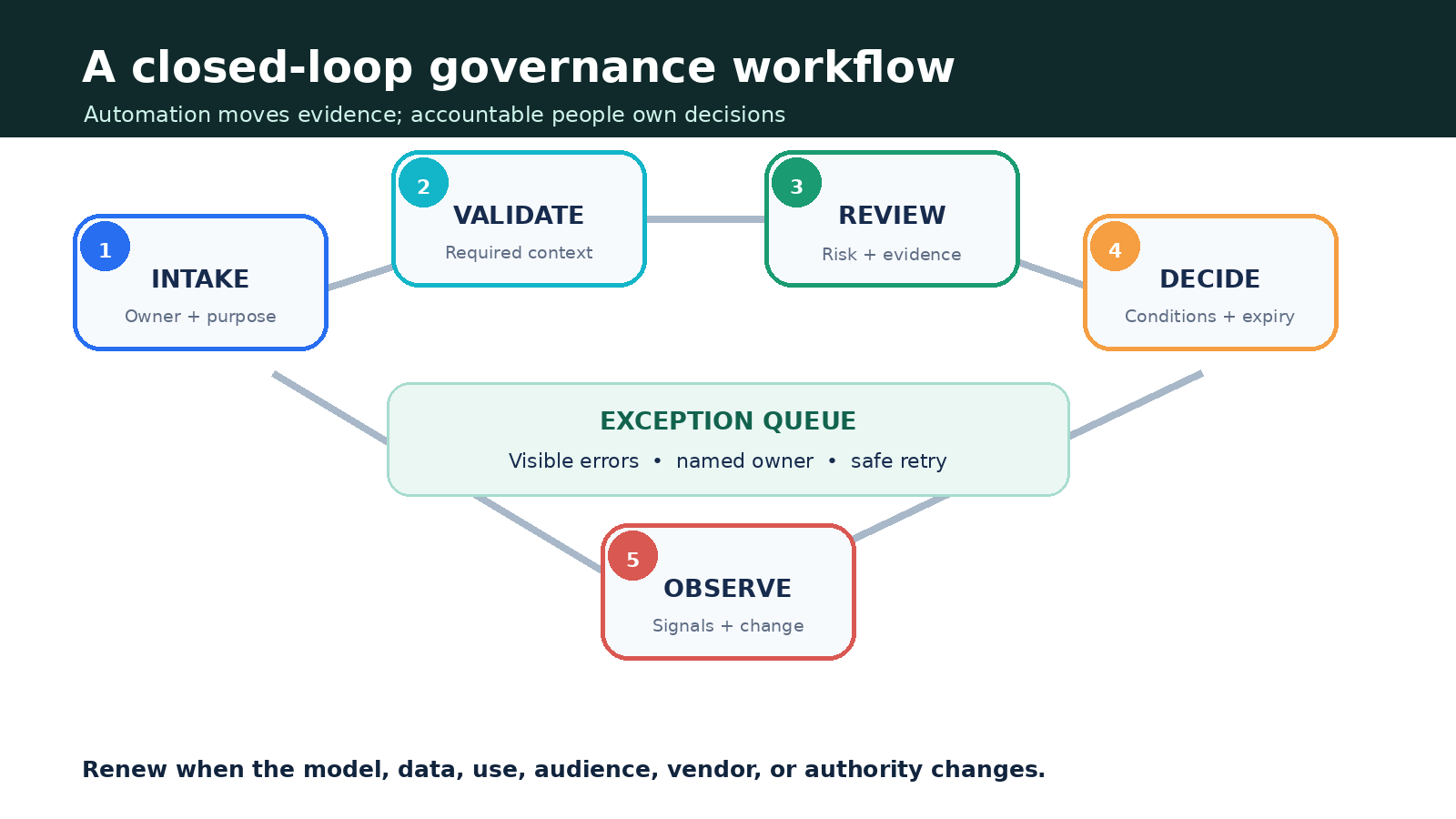
A useful workflow starts with intake. A selected source record creates or updates a governance use case. Validation checks confirm that the record has an owner, purpose, system boundary, and enough information for triage. Incomplete records should enter a visible exception queue rather than silently appearing complete. The owner receives a specific request for missing information in the tool where that person works.
Next, triage determines the review route. The team maps context to relevant risks, internal policies, and evidence needs. Automation can apply routing rules and reusable requirements, but a person should own ambiguous classification and consequential decisions. The workflow then collects technical evidence from model, data, testing, and operational systems. Reviewers accept, reject, or request changes with reasons that return to the responsible team.
Approval should contain conditions, not just a green label. State the approved version, environment, use, user group, data boundary, monitoring expectation, and renewal trigger. A material change to the model, vendor, data, audience, or decision authority should reopen the appropriate checks. This approach keeps automation tied to a decision that can be explained and revisited.
The final stage is observation and renewal. Credo AI’s official article on monitoring and data integrations describes linking approved use cases to models and revisiting them against compliance rules and risk tolerances. Whether a team uses that particular configuration or another one, the principle is sound: production signals should feed a response path. An alert without an owner, threshold rationale, evidence snapshot, and decision deadline is noise rather than governance.
Test the workflow before broad rollout
Choose a small set of representative use cases. Include an incomplete intake, a duplicate, a model version change, an expired evidence item, a failed connection, a permission denial, and a retirement. Use synthetic or low sensitivity records first. Write the expected result before running each scenario so the test does not become a demonstration where every outcome is declared acceptable.
Check data mapping field by field. Confirm that identifiers remain stable, controlled values map correctly, timestamps retain their meaning, and empty values do not overwrite authoritative information. Verify both directions if the workflow writes back. Then revoke the connector’s credential and confirm that failure is visible, queued safely, and recoverable without creating duplicate records.
Test authorization separately from functionality. A connector that can import a use case should not automatically be able to approve it. A reviewer should not gain access to raw sensitive evidence merely because the person can see a summary. Exercise role changes, offboarding, temporary access, and emergency revocation. Review audit logs to confirm they show who or what changed a field, when it changed, and which source initiated the action.
Measure workflow quality with operational signals, not a vanity count of connected tools. Useful measures include incomplete intake rate, duplicate rate, time waiting for an owner, evidence rejection reasons, overdue approvals, unresolved synchronization errors, exceptions without an expiry, and changes that failed to trigger reassessment. These measures reveal friction and control gaps without pretending that a lower review time always means lower risk.
Common failure modes and practical safeguards
- Everything imports: apply a documented eligibility rule and show excluded records in a reconciliation report.
- Ownership disappears: require named business and technical owners, and prevent approval while either is missing.
- Evidence goes stale: attach version, scope, collection time, and expiry to each item, then route expiry to an owner.
- Generated artifacts look authoritative: label drafts clearly and require qualified review before external use.
- Two systems disagree: publish a field-level source-of-truth matrix and an exception process.
- Failures stay silent: monitor authentication, schema, rate, and delivery errors with a retry limit and accountable queue.
- The connector is overprivileged: use a dedicated identity, least privilege, credential rotation, and tested revocation.
- Approval becomes permanent: define renewal dates and material change triggers for each approved use case.
Teams governing agents need the same foundations with more attention to changing tools and authority. An agent may gain a new action, data source, or identity without its model changing. The related PChatGPT guide to AI agent security and inventory explains how deployment records, permissions, runtime evidence, and ownership can stay connected.
A practical decision checklist
- Can the team describe each object, direction, trigger, and source of truth?
- Are only necessary fields transferred, with sensitive data explicitly excluded or protected?
- Does every use case, model, dataset, evidence item, exception, and approval have an owner?
- Can reviewers trace an artifact back to the exact evidence and applicable system version?
- Do failures enter a visible queue with safe retry and duplicate prevention?
- Are approval authority and connector permissions separated?
- Can the organization revoke access and reconcile state after an outage?
- Do material changes and monitoring signals trigger reassessment?
- Has the team confirmed current connector behavior in official product information or its own environment?
The Credo AI Integrations Hub offers a useful model for thinking about governance as connected work rather than a separate paperwork exercise. Its five integration types cover the main movement of context and evidence through an AI lifecycle. The value, however, comes from the operating design around those connections. Begin with record contracts, narrow permissions, explicit ownership, and measurable exception handling. Automate collection and routing where rules are clear. Keep consequential judgments reviewable, and verify generated outputs against their source evidence.
Official sources
- Credo AI Integrations Hub, current product overview and five integration types.
- Credo AI Integrations Hub announcement, launch design, examples, and launch connector list.
- Credo AI monitoring and data integrations, lifecycle and continuous oversight description.
FAQ
What does the Credo AI Integrations Hub connect?
Credo AI’s current official page describes five integration types: use case import, model upload, evidence ingestion, dataset connection, and GRC artifacts. The exact products, fields, directions, and availability should be confirmed against the current catalog and your intended configuration.
Does an integration automatically make an AI system compliant?
No. An integration can collect context, route work, connect evidence, and help generate artifacts. Compliance depends on the applicable obligations, facts, controls, evidence quality, and qualified judgment. Generated documentation should be reviewed and traced to current source evidence.
What should an AI team automate first?
Start with a narrow, repeatable handoff such as importing eligible use cases with stable identifiers and required owners. Add visible validation and reconciliation before automating approval or external reporting. This produces evidence about data quality and workflow behavior with limited consequence.
How should a team test a governance connector?
Test field mapping, duplicates, incomplete records, version changes, stale evidence, permission limits, credential revocation, outages, retries, and retirement. Define expected results in advance, inspect audit logs, and verify that recovery does not overwrite authoritative data or create duplicate governance records.