

AI Agent Runtime Security in 2026: Permissions, Logs, and Guardrails for Production Teams
An AI agent becomes a security concern at the moment it can do more than produce text. Give it a repository token, a browser, a mailbox connection, a cloud role, or a tool that changes customer records, and a model decision can become a real system event. The practical question is no longer whether the model is intelligent enough to help. It is whether the runtime limits what the agent can reach, records what it actually did, and stops consequential actions when confidence is not enough.
AI agent runtime security is the control layer around an agent while it is operating. It includes workload identity, tool authorization, credential lifetime, network boundaries, data handling, approval gates, traceability, rate limits, and incident response. Prompt instructions still matter, but they cannot carry this burden alone. A sentence telling an agent not to delete production data is not equivalent to a database role that has no delete permission.
This article translates current guidance from OpenAI, OWASP, NIST, AWS, and Google Cloud into an operating model for production teams. The product examples are deliberately labeled. OpenAI SDK controls apply to that SDK, while AWS and Google Cloud identity features apply to their respective environments. The design principles remain useful across stacks, but the implementation details do not magically transfer from one product to another.
Why runtime security is different from model safety
Model safety asks whether a model will generate harmful, disallowed, or unreliable output. Runtime security asks what happens if the output is wrong, manipulated, or simply misunderstood. An agent might correctly summarize an email yet be tricked by instructions hidden inside that email. It might select the intended deployment tool but supply the wrong environment. It might retrieve far more customer data than the user needed. None of those failures requires a cinematic rogue AI. Ordinary ambiguity, prompt injection, stale context, or excessive permissions is enough.
OpenAI’s official agent safety guidance describes prompt injection as untrusted text attempting to override the system’s instructions. It also warns that private data can leak without a deliberate attacker, for example when a model sends more information to a connected tool than the user expected. Crucially, the guidance says mitigations reduce risk but do not make agents perfect. That is the right production assumption: the model is a fallible planner operating inside a security boundary, not the boundary itself.
OWASP frames a related problem as excessive agency. Its guidance identifies three common roots: excessive functionality, excessive permissions, and excessive autonomy. These are useful diagnostic categories. If a support agent only needs to look up an order, do not expose a general SQL console. If it needs read access, do not connect with a role that can update and delete. If a refund is allowed, do not let the agent issue it silently at any value. Each reduction removes a different path from mistaken text to harmful action.
Start with an inventory that describes power, not just software
A conventional application inventory usually names the owner, version, host, and data classification. An agent inventory needs those fields plus a map of its possible actions. Record every model, orchestration service, tool, connector, MCP server, plugin, queue, human approval step, and downstream identity. For each tool, capture whether it reads, creates, changes, sends, executes, or deletes. Also note the resources it can touch and whether an action can be reversed.
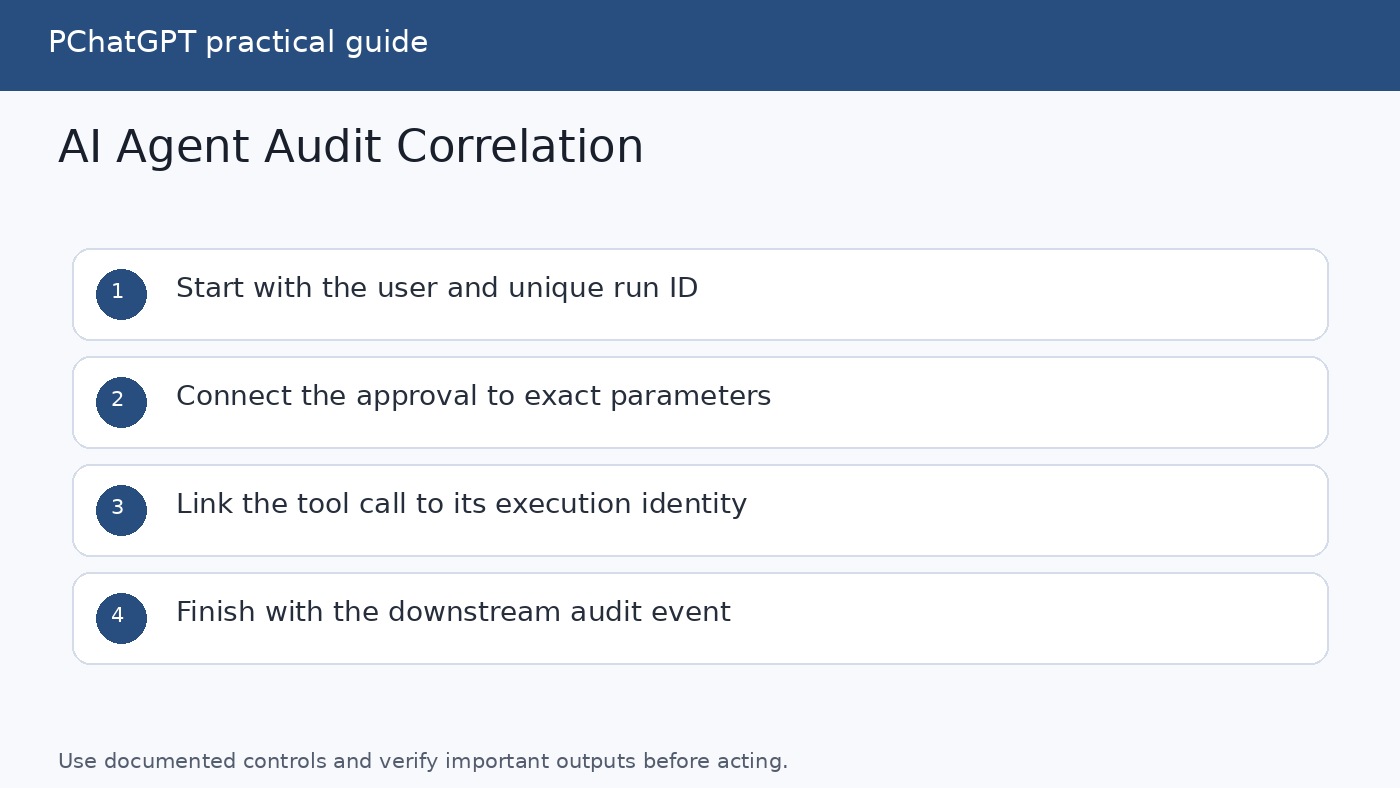
This is where many teams discover that the visible agent is not the only relevant identity. The orchestrator may call a tool gateway, which uses a shared service account, which reaches a database and an object store. An audit record that ends at the gateway leaves the final action unattributed. Map the chain from requesting user to agent run, tool call, workload credential, and downstream API event. The companion overview of non-human identity security for agents and cloud workloads explains why those machine identities need owners and life cycles of their own.
Inventory should be an operating process, not a spreadsheet created for launch day. Register an agent before production credentials are issued. Update the entry when a tool or scope changes. Disable its identity when the deployment is retired. Require a named service owner and a security contact, because an alert with no accountable recipient is only a log entry.
Build a permission model around one job
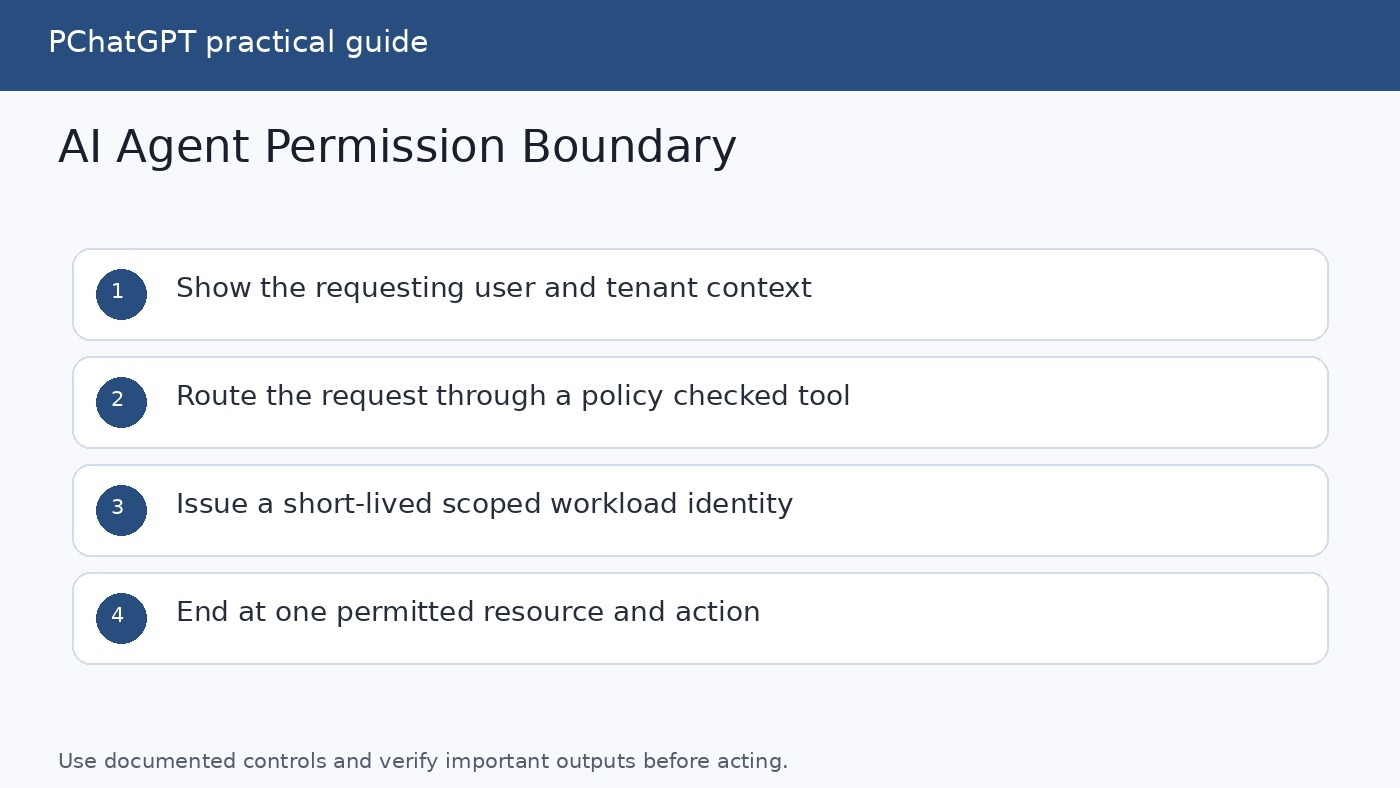
The cleanest production design gives each agent deployment a dedicated identity for one defined purpose. Separate the billing assistant from the incident triage agent, even if they use the same model and orchestration code. Separate development, staging, and production identities. Avoid one shared credential for several agents, because the combined role tends to accumulate every permission any of them needs and makes attribution weaker.
Cloud guidance supports this workload-oriented approach. AWS recommends temporary credentials with IAM roles for workloads and least-privilege policies that specify actions, resources, and conditions. Google Cloud recommends single-purpose service accounts and warns that sharing one across applications can widen privileges and make Cloud Audit Logs harder to attribute. Google also recommends avoiding service account keys where possible. These are provider-specific mechanisms, but they reinforce a general rule: issue a narrow, attributable, short-lived credential at runtime instead of placing a broad static secret in the agent’s environment.
Design the role from the intended transaction, not from the connector’s full menu. A document summarizer may need to read one collection but never share, move, or delete files. A code review agent may read pull requests and post a review comment but not merge to the protected branch. A deployment assistant may prepare a plan while the CI system, after approval, performs the change. The agent does not need every permission involved in the larger business process.
- Limit resources: scope access to named repositories, buckets, tables, tenants, or queues.
- Limit verbs: split read, propose, create, update, execute, send, and delete into separate permissions.
- Limit context: carry the requesting user’s tenant and authorization into downstream checks where appropriate.
- Limit time: prefer credentials that expire and require fresh authorization for later runs.
- Limit environment: deny production access from development agents and untrusted execution contexts.
Do not ask the model to enforce these limits. OWASP recommends complete mediation, meaning downstream systems validate requests against security policy. The model may propose an action, but the tool gateway and target service must decide whether that identity can perform it. A denial should remain a denial even if a prompt insists that the situation is urgent.
Treat tools as security interfaces
A tool schema is more than a convenience for function calling. It is a security interface. A general tool such as run_command(text) gives an attacker or mistaken model a large language-shaped control surface. A narrow tool such as get_order_status(order_id) has a smaller action space, a typed parameter, and no write capability. OWASP explicitly recommends minimizing extensions, minimizing their functionality, and avoiding open-ended extensions where possible.
Validate every argument independently of the model. Enforce types, ranges, resource ownership, tenant boundaries, allowed destinations, and state transitions in code. Use allowlists where the business workflow permits them. For a money movement or message send, validate both the object and the recipient. Never treat a plausible model explanation as authorization.
Structured data also helps contain prompt injection. OpenAI’s Agent Builder safety guide recommends structured outputs between workflow nodes to constrain freeform channels, and it advises against placing untrusted variables in higher-priority developer messages. That is specific guidance for OpenAI’s Agent Builder workflow model. The broader engineering lesson is to keep retrieved documents, web pages, emails, and user text labeled as untrusted data, then extract only the fields required for the next step. A schema reduces the room for hidden instructions to travel, although OpenAI notes that structure and isolation reduce rather than eliminate risk.
Network policy should match the tool policy. If an agent only calls an internal ticket API and the model provider, arbitrary outbound internet access is unnecessary. Restrict egress destinations and protocols, isolate code execution, and prevent a tool from reaching metadata services or internal control planes unless that is its explicit job. This turns a broad exfiltration route into a small set of monitored channels.
Place approval gates at consequences, not everywhere
Human review is most useful when the reviewer sees a clear proposed consequence. Approving every read creates fatigue and teaches people to click through. Never asking for approval gives the agent autonomy where judgment belongs. Classify tool actions by impact and reversibility, then set approval requirements accordingly.
Low-risk, bounded reads may run automatically. A proposed change can be generated automatically but held for review. Sending external messages, modifying access, deploying code, moving money, disclosing regulated data, and destructive actions usually deserve stronger checks. The approval view should show the exact target, important parameters, source request, relevant diff, expected side effects, and the identity that will execute. Approval should authorize that specific action, not grant a reusable blank check.
OpenAI’s current Agents SDK documentation distinguishes input, output, and tool guardrails from human-in-the-loop approvals. In that SDK, a run can pause before a side effect and resume after an approval or rejection. This is an available OpenAI SDK pattern, not a claim that every agent platform behaves the same way. Whatever framework you use, put validation beside the tool that creates the side effect. OpenAI’s documentation specifically cautions that agent-level guardrails do not run at every possible boundary.
Guardrails should fail closed for sensitive operations. If a policy service is unavailable, a production deletion should not proceed because the approval check timed out. Define safe behavior for unavailable dependencies, expired approvals, changed parameters, duplicate requests, and retries. Use idempotency controls so a resumed or retried run cannot charge, send, or deploy twice.
Log the decision path and the system event
A conversational transcript alone is not an audit trail. It may omit tool arguments, credential identity, policy decisions, retries, and downstream results. Conversely, a cloud API log may show that a service account changed a resource without revealing which user request, agent version, or approval caused it. Production observability has to correlate both layers.
Assign a unique run identifier and propagate it through the orchestrator, tool gateway, approval service, and downstream request metadata where supported. For each material step, record the timestamp, requesting principal, agent and policy version, tool name, validated arguments or a safe representation, target resource, authorization result, approval identity, execution identity, outcome, latency, and error category. Record model and workflow versions needed for investigation, but do not assume that storing hidden reasoning is necessary or appropriate.
Logs can contain prompts, retrieved records, customer data, credentials, or tool output, so more logging is not automatically safer. Redact secrets before ingestion, minimize captured content, restrict log readers, encrypt storage, and set retention from legal, operational, and incident response needs. Keep the security event fields needed for attribution even when sensitive payloads are omitted or hashed. Test that a real on-call investigator can follow one run from request to final API event.
Cloud controls can strengthen this design. AWS describes CloudTrail records as an audit log of actions by IAM identities and AWS services, recommends centralized storage, and provides log file integrity validation. Google Cloud notes that a service account entry alone may not identify the application or person behind it and recommends correlating application or pipeline history with Cloud Audit Logs. These details apply to those cloud products, but the architectural point is universal: a shared machine identity without correlation leaves an accountability gap.
Detect behavior that permissions still allow
Least privilege limits blast radius, but allowed actions can still be abused. A compromised read-only agent might enumerate every customer record. A message agent may send an unusual volume to approved domains. Build detections around the agent’s expected job: new tools, denied actions, repeated policy failures, unusual resources, large retrievals, abnormal destinations, credential use outside the expected runtime, approval bypass attempts, and sudden changes in action volume.
Rate limits and quotas create time for detection and response. OWASP lists rate limiting as a way to reduce the damage excessive agency can cause, while noting that logging and limits do not prevent the underlying vulnerability. Apply limits by user, agent, tool, tenant, and high-impact action. A global request limit alone may miss a low-volume but sensitive operation.
Alert messages should include the run ID, owner, current credential status, and a safe containment action. Maintain a kill switch that can disable tool execution or revoke the workload identity without taking unrelated services offline. Exercise containment in a nonproduction environment and verify that queued, paused, and retried runs cannot continue after revocation.
Use governance to make the controls durable
NIST’s AI Risk Management Framework is voluntary and organizes risk work around Govern, Map, Measure, and Manage. Its Generative AI Profile applies those functions across the AI life cycle and emphasizes governance, content provenance, pre-deployment testing, and incident disclosure. It is not a product configuration checklist. For an agent program, it is best used to connect technical controls to ownership, risk tolerance, evidence, and recurring review.
Map each agent to its business purpose, affected users, data, dependencies, and credible failure modes. Measure with scenario-based evaluations that include indirect prompt injection, malformed tool arguments, cross-tenant requests, approval changes, unavailable policy services, excessive retrieval, and credential revocation. Manage findings through deployment gates and tracked remediation. Govern the whole process with named owners, exception expiry, incident criteria, and review schedules. The related article on practical generative AI governance rules offers broader organizational context.
Testing must examine the complete system, not only the model response. Verify that unauthorized calls are rejected downstream, sensitive parameters trigger approval, logs correlate, retries are idempotent, and the kill switch stops work already in flight. Re-run relevant scenarios when a model, prompt, tool, permission, policy, connector, or data source changes. A passed evaluation is evidence for one tested configuration, not a permanent certificate of safety.
A production rollout sequence that teams can operate
- Define the job: write the allowed outcomes, forbidden actions, data classes, and accountable owner.
- Map the path: enumerate inputs, tools, identities, networks, resources, approvals, and downstream logs.
- Remove capability: delete unused tools, replace open-ended tools with narrow functions, and separate read from write.
- Issue the identity: create a dedicated workload identity with temporary credentials and resource-level conditions where supported.
- Enforce at the boundary: validate every tool argument and authorize every request in code or a policy service outside the model.
- Gate consequences: require specific approval for high-impact or difficult-to-reverse actions, with clear context for the reviewer.
- Correlate evidence: connect user, run, approval, tool, identity, and downstream event while minimizing sensitive log content.
- Test failure modes: include prompt injection, over-broad retrieval, service outages, duplicate execution, revocation, and containment.
- Release narrowly: start with a small user group, bounded resources, conservative quotas, and an on-call owner.
- Review drift: compare actual tool and permission use with the declared job, then remove what is no longer required.
This sequence deliberately starts by removing power before adding detection. Monitoring a general shell tool with an administrator credential is not equivalent to replacing it with a purpose-built, read-only operation. Prevention, approval, detection, and response work together, but they are not interchangeable.
Frequently Asked Questions
Can prompt instructions provide enough security for a production agent?
No. Clear instructions can improve behavior, but untrusted content, ambiguous requests, and model errors can still influence a run. Enforce authorization, validation, resource scope, and approval outside the model so a persuasive prompt cannot grant permission.
Should every AI agent tool call require human approval?
Not necessarily. Requiring approval for every bounded read can create fatigue. Focus mandatory review on actions with meaningful side effects, sensitive disclosure, high value, broad scope, or poor reversibility. Keep automatic actions tightly scoped and observable.
What is the minimum useful audit record for an agent action?
At minimum, connect the requesting principal, run ID, agent and policy version, tool, target, authorization result, executing identity, outcome, and any approver. Preserve correlation to the downstream system event. Minimize or redact prompt and payload content that would expose secrets or personal data.
How often should an agent’s permissions be reviewed?
Review them whenever tools, workflows, data sources, environments, or business purposes change, and on a recurring schedule based on risk. Use observed access to remove unused permissions, but confirm that the observation window covers infrequent legitimate operations before making changes.
Sources
- OpenAI: Safety in building agents
- OpenAI: Guardrails and human review
- OWASP: Top 10 for Agentic Applications for 2026
- OWASP: LLM06:2025 Excessive Agency
- NIST: AI Risk Management Framework
- NIST AI 600-1: Generative Artificial Intelligence Profile
- AWS: Security best practices in IAM
- AWS: Security best practices in CloudTrail
- Google Cloud: Best practices for using service accounts securely