
Using ChatGPT for writing is not automatically cheating, and a detector score is not proof of misconduct. The real question is whether the way you use the tool follows the rules for the assignment, workplace, publication, or client relationship. An ethical workflow keeps your thinking visible, protects confidential material, verifies every important claim, and discloses AI help when the relevant policy requires it.
This guide does not teach tricks for disguising generated text or beating an AI detector. Those tactics miss the point and can create a clearer integrity violation than the original use. Instead, you will learn how to use ChatGPT as a tutor, critic, organizer, and editing partner while keeping authorship and accountability with you. The result should be work you understand, can defend, and are permitted to submit.
Start with the rule, not the prompt
Before opening ChatGPT, read the exact policy that governs the work. A professor may allow brainstorming but prohibit generated prose. Another may permit AI assistance if you attach a transcript and disclosure. An employer may approve ChatGPT Business for public marketing material but forbid client records in a personal account. A journal, contest, grant program, or professional body can have its own definition of authorship and acceptable assistance.
If the policy is vague, ask the person who owns it. A useful question is specific: “May I use ChatGPT to challenge my outline and suggest edits if I write the draft myself, verify all sources, and disclose that assistance?” Save the response. Silence is not permission, and a classmate’s practice is not an authoritative rule.
Separate three issues that people often mix together:
- Permission: Does the applicable rule allow this type of AI assistance?
- Attribution: Must you describe, cite, or attach the AI interaction?
- Quality: Is the final work accurate, original in its reasoning, and suitable for its audience?
You need a satisfactory answer to all three. A polished paragraph can still violate a course policy. A permitted use can still produce false claims. A disclosure does not excuse careless work.
Choose assistance that preserves your authorship
The safest role for ChatGPT is usually support around your own intellectual work. Use it to ask questions, test a structure, identify gaps, or explain why a sentence is confusing. The risky pattern is asking for a finished deliverable and submitting it with little understanding or revision.
For a student, start by reading the assigned material and making notes without AI. Write a one sentence claim and list the evidence you believe supports it. Then ask ChatGPT to act as a skeptical tutor: “Ask me five questions that would expose weaknesses in this claim. Do not write my answer.” This produces useful friction rather than outsourced thinking.
For professional writing, begin with facts you are authorized to use, your audience, and the action the document must support. Ask for an outline or a list of reader objections. Draft the substance yourself, then request an editorial review for clarity, unsupported assumptions, jargon, and missing context. The related ChatGPT research and writing workflow guide offers a broader prompt framework for this kind of staged work.
A good test is simple: could you explain every claim, recreate the argument from your notes, and answer questions about your choices without reopening the chat? If not, the tool has probably done too much of the work that the task was intended to assess.
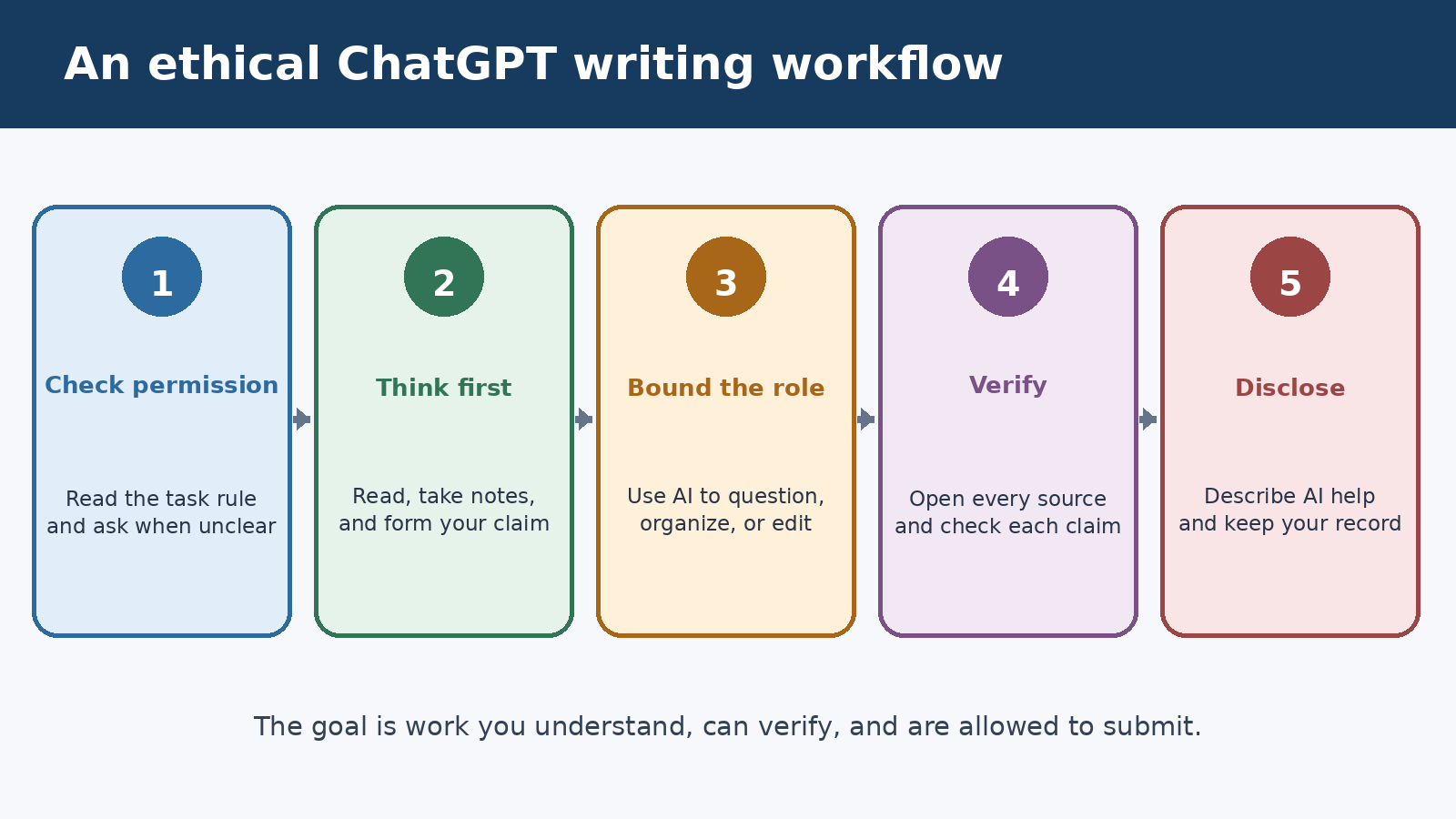
A practical ethical writing workflow
- Define the permitted use. Copy the relevant course, employer, client, or publication rule into your notes. Record any clarification you received.
- Do the core thinking first. Read the material, collect evidence, and write your own working claim. For creative work, establish the premise, characters, or message yourself.
- Give ChatGPT a bounded role. Ask it to question an outline, compare structures, explain a concept, or flag unclear language. Tell it not to invent facts or citations.
- Keep a process record. Save dated notes, outlines, drafts, source excerpts, prompts, and useful responses. Use version history where available.
- Verify independently. Open every cited source. Check names, dates, quotations, calculations, and technical claims against primary material.
- Rewrite from understanding. Close the generated suggestion and express the idea in a way that reflects your evidence, voice, and purpose. Do not merely swap synonyms.
- Disclose accurately. Follow the required format and state what the tool actually did. Never claim that generated output was wholly human written.
- Perform a final ownership check. Remove claims you cannot support, passages you cannot explain, and private information that should not appear in the deliverable.
This workflow is slower than copying an instant answer, but it is much faster than rebuilding a paper after a fabricated citation, handling a conduct complaint, or correcting a public error. It also creates evidence of genuine authorship without pretending that a detector can establish it.
Use source grounded prompts, then verify the sources
ChatGPT can produce confident statements that are wrong, outdated, or unsupported. OpenAI’s current Terms of Use say output may not always be accurate, should not be treated as a sole source of truth, and must be evaluated for accuracy and appropriateness before use or sharing. Treat those points as minimum operating rules.
Whenever possible, provide approved source material and limit the task to that material. For example: “Using only the excerpts below, identify evidence for and against my proposed claim. Quote the excerpt label for each point. If the material is insufficient, say what is missing.” This reduces invention, but it does not eliminate it. Compare the answer with the original document line by line.
For more complex research, OpenAI says deep research reports include citations or source links and let users choose or restrict sources. Those links are a verification trail, not a guarantee. Confirm that each source exists, says what the draft claims, is current enough for the topic, and is appropriate under the assignment’s source rules.
Never cite a reference solely because ChatGPT supplied a plausible title, author, journal, court case, or URL. Open the item. Check the author, publication date, page number, quoted wording, and surrounding context. If you cannot retrieve it from an approved database or the original publisher, do not use it as evidence.
Write a disclosure that is useful, not theatrical
Disclosure should tell a reader what happened. It should not exaggerate a minor spell check, and it should not hide extensive drafting behind a phrase such as “AI was used for assistance.” Follow the governing format first. If none is provided, a short process note can identify the tool, the tasks it performed, and the human review completed.
Example: “I used ChatGPT to generate questions about my outline and to flag unclear sentences in a draft I wrote. I checked all factual claims against the cited primary sources and made the final wording and argument decisions.”
Adjust that statement so it is true. If the tool created substantial prose, say so and confirm that this use is permitted. OpenAI’s Sharing and Publication Policy says creators publishing API assisted written work should describe the relative roles of drafting and editing, should not represent API generated content as wholly human generated, and must take ultimate responsibility for publication. OpenAI’s Terms also prohibit representing output as human generated when it was not.
In academic work, use the citation style and AI guidance specified by your instructor, institution, or style manual. Some assignments may require a transcript, appendix, link, or prompt log. Others may not allow generated language at all. A generic disclosure cannot override the actual rule.
Do not optimize your writing for an AI detector
No ethical workflow can promise that your work will never be flagged. Detector outputs are estimates, products differ, settings change, and false positives exist. OpenAI’s official educator guidance says its research did not find detectors reliable enough for consequential judgments. It also says ChatGPT cannot determine whether it wrote a submitted essay and may invent an answer when asked.
The same OpenAI guidance reports that detector experiments labeled some human writing as AI generated and raised concerns about disproportionate effects on formulaic, concise writing and people learning English. Turnitin likewise states in its own explanation of false positives that its false positive risk is not zero and that its system does not determine misconduct. Turnitin tells instructors to apply professional judgment, institutional policy, knowledge of the student, and assignment context.
These statements do not mean every use of AI is acceptable. They mean a detector score should not be treated as a verdict, and “passing” a detector does not make prohibited assistance honest. Deliberately adding mistakes, using homoglyphs, paraphrasing generated prose to conceal its source, or paying for a so called humanizer is not responsible authorship. It damages clarity while creating intent to deceive.
Focus instead on process evidence: contemporaneous notes, a source log, document history, drafts that show development, and a truthful AI record. These materials help you explain how the work was made. They also improve the work itself.
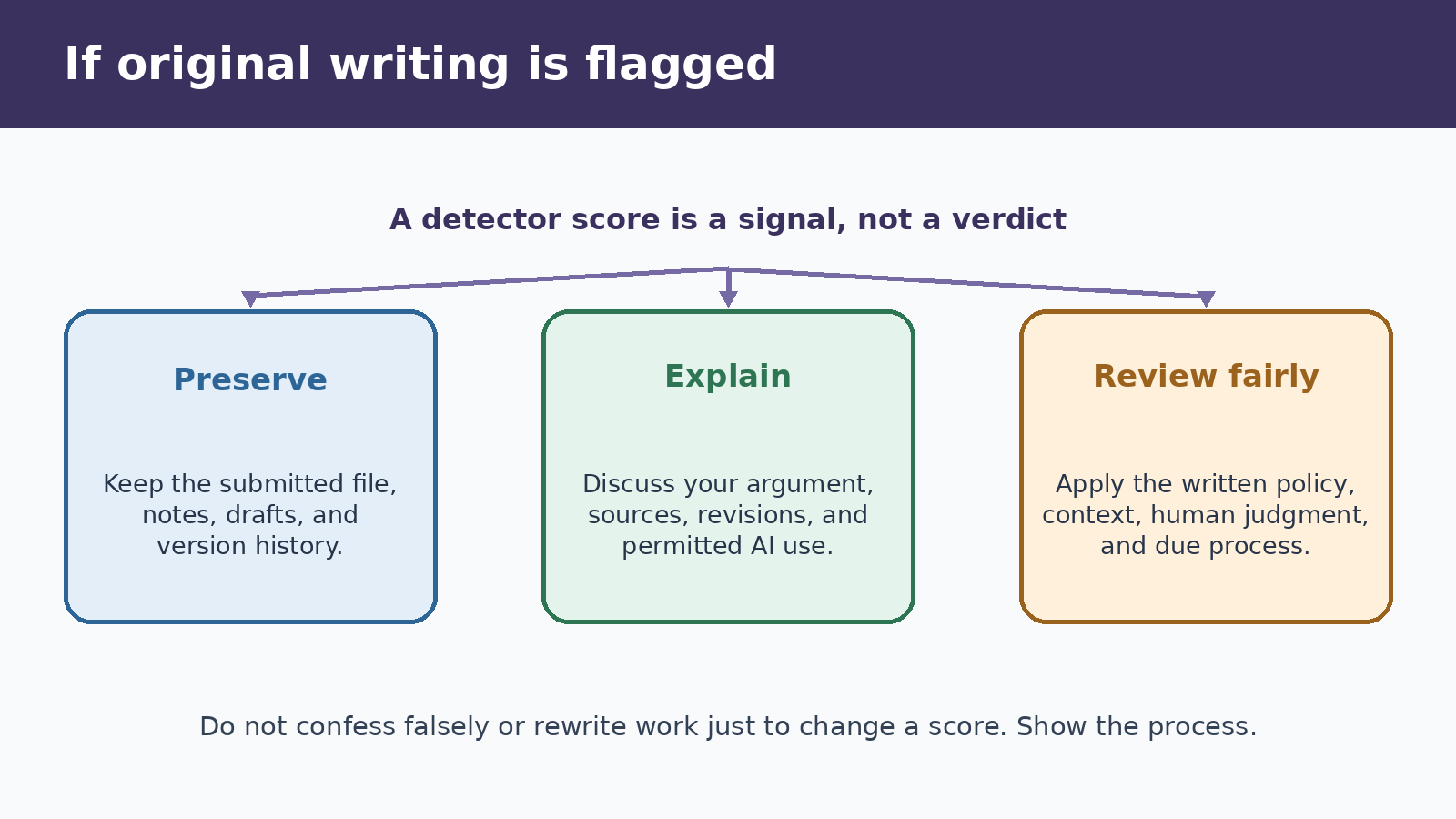
If your original work is flagged
Do not panic, confess to something you did not do, or run the document through another rewriting tool. Preserve the exact submitted file and gather the evidence you already have. That may include handwritten notes, reading annotations, browser or library records, earlier drafts, cloud version history, feedback, source files, and permitted ChatGPT conversations.
Ask for the applicable policy and review procedure. Request a conversation in which you can explain the argument, sources, and revision decisions. Keep your response factual: the tool used, the scope of use, the disclosure made, and the records available. If you did use AI beyond the permitted boundary, be honest about that too. A transparent correction is better than a second deception.
Educators and managers should also avoid asking ChatGPT, “Did you write this?” OpenAI explicitly says such answers have no factual basis. Review the work against the stated policy, speak with the author, examine process evidence, and follow fair institutional procedures. A statistical indicator can prompt a question, but it cannot replace due process.
Protect private and proprietary information
Ethical writing includes data stewardship. Do not paste student records, unpublished research, client files, health information, legal strategy, passwords, personal identifiers, or confidential company material into an account that is not approved for it. Redact or replace sensitive details when a generic example will do, and follow retention and records rules that apply to your organization.
OpenAI’s Data Controls FAQ explains how signed in users can turn off “Improve the model for everyone.” It also says Temporary Chats are not used to train models, do not appear in history, do not create memories, and are deleted from OpenAI systems after 30 days, although they may be reviewed for abuse. These controls matter, but they do not grant permission to upload data you do not have the right to share.
For a fuller account safety checklist, see the internal ChatGPT privacy settings and safer workflows guide. Workplace users should rely on their organization’s approved account, data classification rules, and security team rather than assuming a personal setting satisfies professional obligations.
Prompts that support learning and honest work
These examples deliberately keep the author in charge:
- “Do not write my essay. Ask questions that test whether my thesis follows from the notes I provide.”
- “Using only this approved source excerpt, list claims I can support and claims that still need evidence. Preserve the source labels.”
- “Act as an editor. Identify three places where my draft is vague and explain the problem without rewriting the passage.”
- “Create a counterargument map for my position. Mark assumptions, missing evidence, and the strongest objection.”
- “Check this workplace draft for unsupported promises, ambiguous deadlines, confidential details, and statements that require owner approval.”
- “Interview me about my experience one question at a time, then organize my answers into an outline without adding new facts.”
Notice what these prompts do not request. They do not ask for detector evasion, fake citations, invented experience, or a finished submission disguised as personal work. The best prompt cannot make a prohibited workflow acceptable. Permission and honest authorship come first.
A final submission checklist
- I read the current rule for this specific task and clarified ambiguity with the responsible person.
- I can state exactly what ChatGPT contributed and what I contributed.
- I understand and can defend every sentence, example, and conclusion.
- I opened and checked every source, quotation, number, date, and name.
- I removed confidential or personal data that I was not authorized to share.
- I kept the notes, drafts, version history, prompts, and responses required by the policy.
- I included the required citation, transcript, appendix, or disclosure.
- I did not manipulate language to fool a detector or misrepresent generated output as human work.
Responsible ChatGPT writing is not about sounding less like AI. It is about making the use of AI subordinate to genuine thinking, verifiable evidence, clear permission, and human responsibility. If your process is allowed, documented, and defensible, you have a much stronger foundation than any promise that a detector will approve your prose.
Frequently asked questions
Is using ChatGPT for grammar and clarity cheating?
Not necessarily, but the applicable policy decides. Some settings treat grammar support like ordinary editing, while others restrict any generative assistance. Ask for permission when the rule is unclear, preserve your original draft, and disclose the help if required.
Can ChatGPT tell whether it wrote an essay?
No. OpenAI says ChatGPT has no knowledge of whether content was AI generated and can make up answers to that question. Use process records, source checks, discussion, and the governing policy instead of treating a chatbot response as evidence.
How can I guarantee that original writing will not be flagged?
You cannot guarantee that. Detector providers acknowledge false positives, and OpenAI says detectors are not reliable enough for consequential judgments in its experience. Keep drafts and version history, write from your own understanding, and use a fair review process if a flag occurs.
What is the safest way to use ChatGPT for a paper or report?
Confirm permission first, do the reading and core reasoning yourself, give ChatGPT a bounded tutoring or editing role, verify every factual claim against primary sources, protect private data, save a process record, and disclose the assistance exactly as required.