Cloud infrastructure is no longer just a place to host websites and store files. In 2026, it has become the foundation for artificial intelligence, automation, cybersecurity, analytics, remote work, and modern business applications. Every company that wants faster digital services now depends on cloud systems that can scale, protect data, and support intelligent workloads.
The biggest change is the rise of AI-driven computing. Businesses are running more machine learning models, automated workflows, data pipelines, and real-time applications. These workloads need reliable compute power, flexible storage, strong networking, and security controls that work across cloud, hybrid, and edge environments.
What Is Cloud Infrastructure?
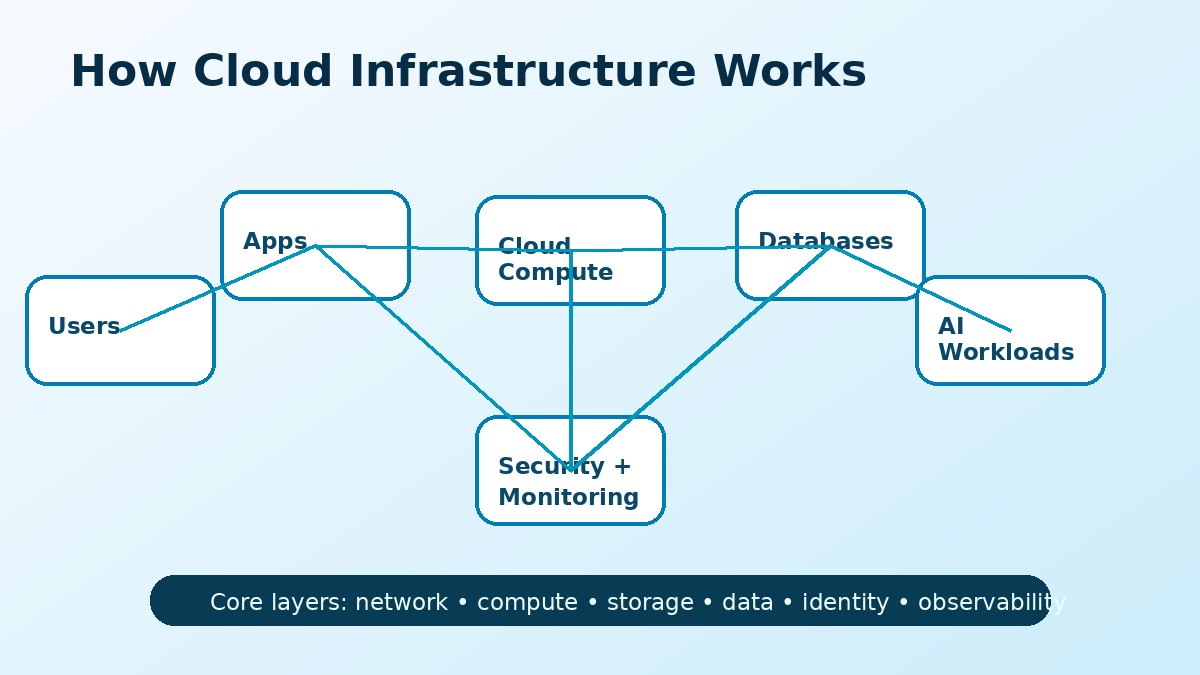
Cloud infrastructure is the collection of technologies that allow applications and data to run over the internet instead of relying only on local servers. It includes compute resources, storage, databases, networking, security systems, monitoring tools, automation platforms, and management dashboards.
In simple terms, cloud infrastructure gives businesses access to computing resources on demand. Instead of buying and maintaining physical servers, organizations can use cloud platforms to run websites, mobile apps, AI tools, analytics systems, backup services, and enterprise software.
Why Cloud Infrastructure Matters in 2026
Modern businesses need speed and flexibility. Customers expect digital services to be available all the time, teams need secure remote access, and companies want to test new ideas without waiting months for hardware. Cloud infrastructure makes this possible by offering scalable resources that can grow or shrink as demand changes.
Cloud also supports innovation. A startup can launch a product globally without building a data center. A small business can use enterprise-grade security tools. A large company can connect offices, apps, and data across different regions. This flexibility is why cloud computing remains one of the most important technology investments in 2026.
How AI Is Changing Cloud Infrastructure
Artificial intelligence is placing new pressure on cloud systems. AI workloads often require GPUs, fast storage, large datasets, and low-latency networking. As more companies use generative AI, agentic AI, computer vision, and predictive analytics, cloud providers are building infrastructure specifically designed for AI performance.
This trend is not only about powerful hardware. AI-ready cloud infrastructure also needs better data governance, model monitoring, identity controls, and cost management. Running AI without cloud discipline can quickly create security risks and unexpected expenses.
Key Cloud Infrastructure Trends
1. AI-Optimized Cloud Platforms
Cloud platforms are adding specialized compute options for AI models, including GPU instances, optimized storage, and faster networking. These services help companies train models, run inference, and process large datasets without building their own AI data centers.
2. Hybrid and Multi-Cloud Adoption
Many organizations do not rely on one cloud provider only. They use hybrid cloud to combine private systems with public cloud services, or multi-cloud strategies to spread workloads across different providers. This can improve resilience and flexibility, but it also requires stronger management and security practices.
3. Cloud Automation and Infrastructure as Code
Automation is becoming essential. Teams use infrastructure as code to define servers, networks, databases, and permissions in reusable configuration files. This reduces manual errors, speeds up deployments, and makes cloud environments easier to audit.
4. Stronger Cloud Security
Cloud security is now a core infrastructure requirement. Businesses need identity and access management, encryption, network segmentation, vulnerability scanning, logging, and incident response plans. Security must be built into the cloud design from the beginning, not added later.
5. Edge Computing and Faster Data Processing
Some applications need data processing closer to users, devices, or sensors. Edge computing helps reduce latency for use cases such as smart devices, industrial monitoring, gaming, video analytics, and real-time AI applications.
6. Cloud Cost Optimization
Cloud flexibility can become expensive if teams do not monitor usage. In 2026, cost optimization is a major priority. Businesses are using budgets, automated scaling, reserved capacity, workload scheduling, and cost dashboards to control spending.
Benefits of Modern Cloud Infrastructure
Well-designed cloud infrastructure gives organizations several advantages. It improves scalability, supports faster product launches, strengthens disaster recovery, and makes advanced technologies more accessible.
- Scalability: resources can expand during high demand and shrink when traffic is low.
- Reliability: cloud platforms offer redundancy, backup options, and regional availability.
- Speed: teams can deploy applications and infrastructure faster using automation.
- Security options: businesses can use advanced identity, encryption, and monitoring tools.
- Innovation: AI, analytics, and automation tools become easier to test and adopt.
Cloud Infrastructure Security Risks
The cloud is powerful, but it must be managed carefully. Common risks include misconfigured storage, weak passwords, excessive permissions, exposed APIs, unpatched workloads, poor logging, and unclear responsibility between cloud providers and customers.
AI workloads add another layer of risk because they often use sensitive data and connect to multiple systems. If permissions are too broad or logs are incomplete, it becomes harder to know what happened when something goes wrong.
Best Practices for Businesses
Start With a Clear Architecture
Before moving workloads to the cloud, define the application architecture, data flows, security requirements, and business goals. A clear design prevents complexity later.
Use Least Privilege Access
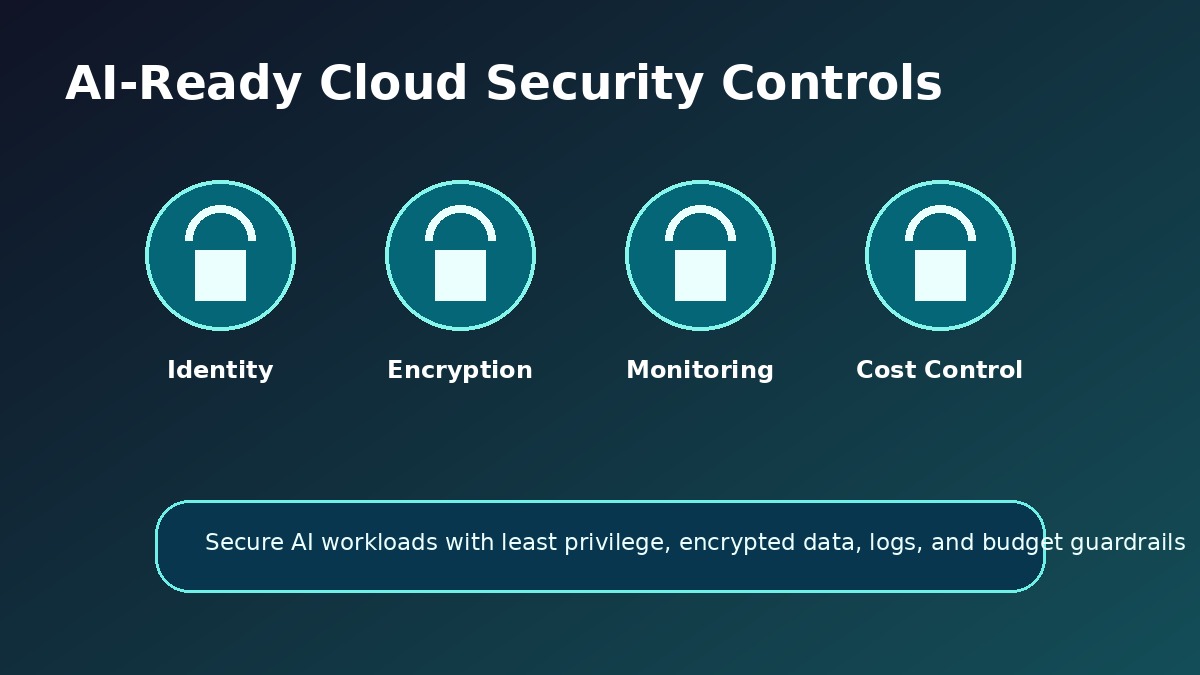
Give users, applications, and automation tools only the permissions they need. Review access regularly and remove unused accounts or keys.
Encrypt Sensitive Data
Use encryption for data at rest and in transit. Sensitive information should also be classified so teams know which data requires stronger protection.
Monitor Everything
Cloud monitoring should include performance, availability, costs, security alerts, API activity, and configuration changes. Good monitoring helps teams detect issues early.
Automate Safely
Automation improves speed, but automated systems should include approval steps for high-risk actions. Infrastructure as code should be reviewed like application code.
Plan for Backup and Recovery
Every cloud environment needs tested backups and recovery plans. A backup that has never been tested is only an assumption.
How Cloud Infrastructure Supports AI and Automation
AI and automation need a dependable foundation. Cloud infrastructure provides the compute power, storage, APIs, and integration tools that allow intelligent systems to work at scale. For example, an AI customer-support tool may need access to documents, databases, messaging systems, and analytics dashboards. Cloud infrastructure connects those services securely.
Automation also helps cloud teams manage complexity. Scripts, policies, templates, and orchestration tools can deploy systems consistently. This is important when businesses operate across multiple regions, teams, or cloud providers.
Choosing the Right Cloud Strategy
There is no single cloud strategy that fits every organization. A small business may start with managed hosting and simple cloud storage. A growing company may need container platforms, managed databases, and backup automation. A large enterprise may require hybrid cloud, compliance controls, and advanced observability.
The right choice depends on budget, skills, security needs, application type, data sensitivity, and growth plans. The most important step is to match cloud services to business goals instead of adopting tools only because they are popular.
Readers can also explore related topics on pChatGPT, including AI Trends.
The Future of Cloud Infrastructure
The future of cloud infrastructure will be more intelligent, automated, and security-focused. AI will help optimize resource allocation, detect security issues, predict failures, and recommend cost improvements. At the same time, businesses will need stronger governance because more systems will be connected and automated.
Cloud infrastructure will also become more distributed. Workloads will run across public cloud, private environments, edge locations, and specialized AI platforms. Managing this complexity will require better visibility, consistent policies, and skilled teams.
FAQ About Cloud Infrastructure
What is cloud infrastructure?
Cloud infrastructure is the combination of compute, storage, networking, databases, security, and management tools that allow applications and data to run through cloud platforms.
Why is cloud infrastructure important for AI?
AI workloads need scalable compute power, fast storage, large datasets, and reliable networking. Cloud infrastructure provides these resources without requiring every business to build its own data center.
What is hybrid cloud?
Hybrid cloud combines private infrastructure with public cloud services. It allows organizations to keep some workloads under direct control while using public cloud resources for flexibility and scale.
What are the biggest cloud infrastructure risks?
The biggest risks include misconfiguration, weak identity controls, exposed data, poor monitoring, excessive permissions, and unmanaged costs.
How can businesses control cloud costs?
Businesses can control cloud costs by monitoring usage, setting budgets, using autoscaling, removing unused resources, choosing the right instance types, and reviewing spending regularly.
Conclusion
Cloud infrastructure is the backbone of modern computing in 2026. It supports AI, automation, data analytics, cybersecurity, remote work, and digital services that businesses depend on every day.
The best cloud strategies combine performance with security, automation with oversight, and flexibility with cost control. Organizations that build cloud infrastructure carefully will be better prepared for AI-driven growth, changing customer expectations, and the next generation of digital business.
Practical Cloud Infrastructure Automation Are Workflow for Readers
This update expands the article with a practical, reader-first workflow designed for people who use ChatGPT and AI tools in real projects rather than only reading a high-level overview. Before you copy a prompt or install another extension, define the task, the expected output, the audience, the data you can safely provide, and the human review step that will catch mistakes. That simple preparation makes cloud infrastructure in 2026: how ai and automation are changing modern computing more useful because it turns AI from a random answer generator into a repeatable assistant that supports writing, research, planning, coding, support, and productivity work.
Start with a short project brief. Write one sentence for the goal, one sentence for the context, three bullet points for constraints, and one example of the format you want. Then ask ChatGPT to produce a first draft, critique the draft, and revise it against your constraints. This three-step loop is more reliable than a single long prompt because it separates generation from quality control. If the output will be published, sent to a customer, or used for business decisions, add a final manual verification step for facts, dates, names, prices, and claims.
Step-by-step implementation checklist
- Clarify the use case: decide whether the AI should summarize, compare, draft, brainstorm, analyze, rewrite, classify, or create a plan.
- Provide trusted context: paste only the minimum safe information needed. Remove private data, credentials, unpublished customer details, and confidential business records.
- Ask for structure: request headings, tables, examples, assumptions, risks, and next actions so the answer is easier to audit.
- Force verification: ask the model to mark uncertain claims, list missing information, and separate facts from recommendations.
- Review like an editor: check accuracy, originality, tone, formatting, and whether the answer actually solves the reader’s problem.
- Save reusable prompts: when a prompt works, store it with notes about the task, input format, output format, and review criteria.
Example prompt you can adapt
Use this structure as a safe starting point: “Act as an AI productivity editor. My goal is [describe goal]. The audience is [describe audience]. Use the following context: [paste non-sensitive context]. Create a practical answer with steps, examples, common mistakes, and a short FAQ. If any claim is uncertain, label it as uncertain and tell me how to verify it.” This prompt works well because it tells the model what role to play, what outcome matters, what context to use, and how to handle uncertainty.
Common mistakes to avoid
The most common mistake is treating every AI answer as final. ChatGPT can be persuasive even when it is incomplete, outdated, or too generic. Another mistake is using one prompt for every task. A prompt for a product comparison should not look like a prompt for a legal-style policy summary or a coding bug report. Finally, avoid publishing AI text without adding your own judgment, examples, screenshots, workflow notes, or local context. Readers and search engines both reward pages that demonstrate experience and usefulness.
Internal resources for deeper learning
- Keep Your CHATGPT Data Private By Opting Out of Training How — use this as a related reference while applying the checklist below.
- You Can Connect to CHATGPT Without an Account How It Works — use this as a related reference while applying the checklist below.
- CHATGPT Project-Only Memory: How to Use Projects Without Mixing Context — use this as a related reference while applying the checklist below.
FAQ: Cloud Infrastructure in 2026: How AI and Automation Are Changing Modern Computing
Is this workflow suitable for beginners?
Yes. Beginners should start with a narrow task, provide clear context, and review the result carefully. The goal is not to automate judgment, but to make the first draft, comparison, or checklist faster and easier to improve.
Can I use the same process for business content?
You can, but business content needs stricter review. Verify facts, remove confidential information, adapt the tone to your brand, and make sure the final version includes examples or insights that come from real experience.
How do I know if the AI answer is good enough?
A good answer is specific, structured, accurate, and actionable. It should explain assumptions, mention risks, include concrete steps, and help the reader make a decision or complete a task without needing to search again immediately.
Should I trust sources generated by ChatGPT?
No source should be trusted blindly. If the answer includes citations, open the sources yourself, confirm they exist, check the publication date, and compare important claims with official documentation or reputable expert references.