Correction: the claim that Anthropic acquired Coefficient Bio for $400 million is not supported by an announcement in Anthropic’s official newsroom that we could locate during this review. Anthropic’s official material does document a substantial life sciences initiative, but that is not evidence that this reported transaction occurred or that the stated price is accurate. This article therefore does not present the acquisition claim as fact. The historical URL is retained so existing links continue to work, while the page now explains what can be verified and how to assess similar claims.
The distinction matters. A partnership, customer relationship, product integration, hiring move, investment, and completed acquisition are different events. Even when several secondary reports repeat the same number, repetition does not replace confirmation from a named party or a reliable transaction record. Readers need a method that separates verified facts from plausible interpretation, especially when a dramatic business headline is tied to health, biology, or drug research.
What Anthropic officially says about life sciences
Anthropic announced Claude for Life Sciences in its official newsroom. That announcement describes an effort to support work across research, early discovery, translation, and commercialization. It names examples such as literature review, hypothesis development, protocol drafting, bioinformatics, data analysis, and assistance with clinical or regulatory documents. These are Anthropic’s descriptions of intended uses and product direction, not independent proof that a model can produce a valid scientific result without expert review.
The same announcement describes connectors to scientific platforms and access to research sources, along with Agent Skills and a life sciences prompt library. A connector can make records or tools available to a model, but it does not automatically make the model’s interpretation correct. The quality of an answer still depends on the source record, permissions, configuration, task definition, and review process. A draft protocol remains a draft. A proposed hypothesis remains a hypothesis. An analysis output remains subject to methodological and scientific validation.
Anthropic also names customers, partners, and scientific organizations in the announcement. Those relationships show that Claude is being explored or used in the sector. They do not support a separate claim about Coefficient Bio or a transaction price. This is a useful reading habit: evidence for a broad strategy should not be stretched into evidence for a specific deal.
How to verify an acquisition headline
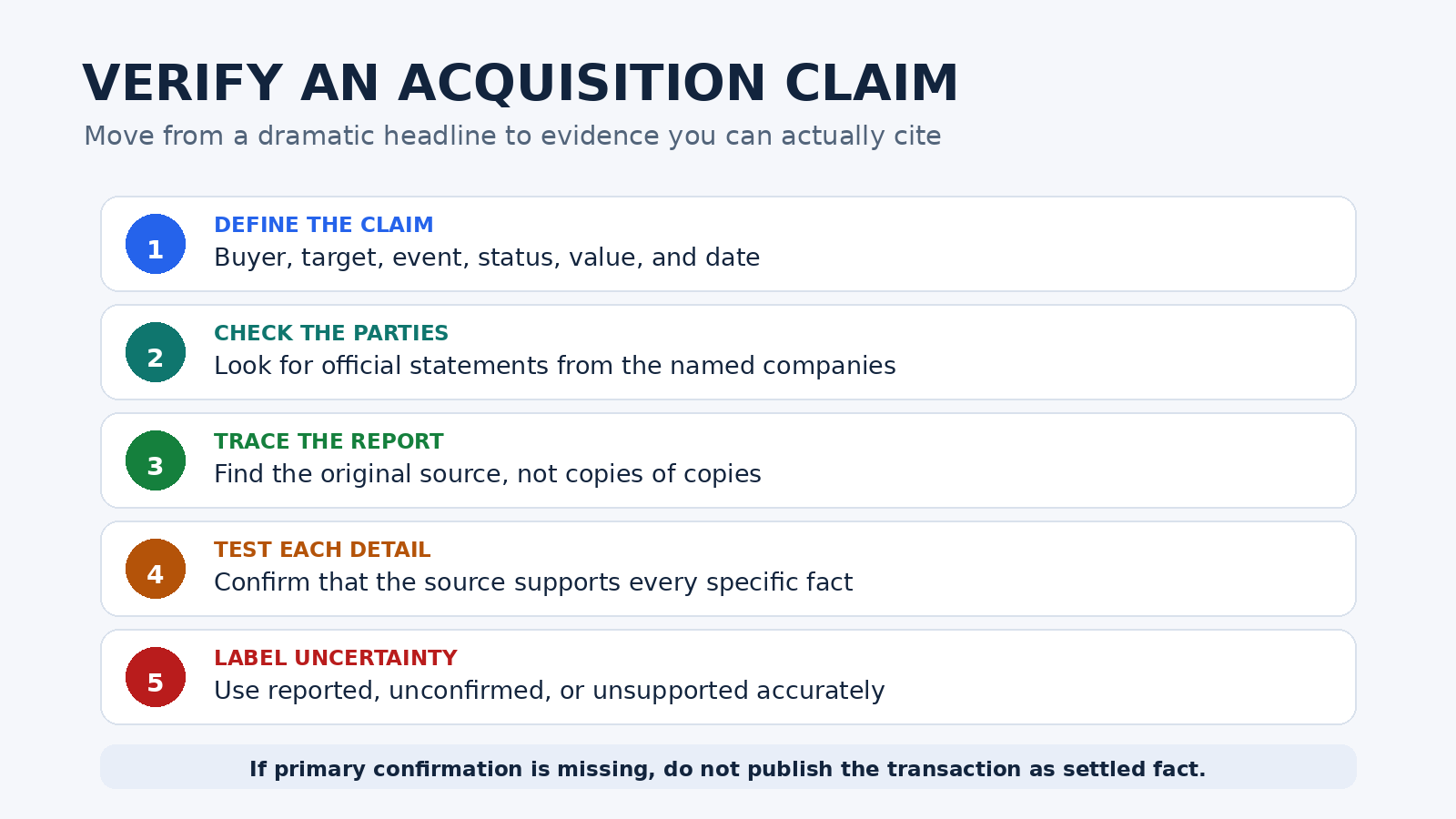
Start with the exact claim. Write down the buyer, target, transaction type, completion status, announced value, announcement date, and source. Words such as acquired, agreed to acquire, invested in, partnered with, and hired the team are not interchangeable. A headline can become misleading when it removes a qualifier or turns an unsigned report into a completed event.
Next, search the official newsroom and company pages of both named parties. An official announcement should clearly identify the parties and describe the event. If the value is material to your article, the primary source should support that value. Do not derive a price from an estimate, employee count, funding rumor, or unnamed source and then write it as a settled figure. If neither party confirms the event, say that official confirmation was not located. Absence from a newsroom is not absolute proof that an event never happened, but it is a strong reason not to state the headline as confirmed.
Then check whether the source is independent or circular. Several pages may trace back to one paywalled report, one social post, or one unattributed paragraph. Count the underlying sources, not the number of search results. Open each page and look for a direct company statement, named spokesperson, filed document, or clearly attributed interview. If every article points to another article, the evidence has not become stronger.
Finally, preserve the uncertainty in your wording. Suitable language includes “reported by” or “not confirmed in the company’s official newsroom,” provided that the attribution is accurate. Avoid adding details that the source did not establish, such as the payment structure, employee destination, product roadmap, closing date, or strategic motive. A careful correction should remove unsupported specifics rather than replace them with a new story that merely sounds reasonable.
A practical evidence ladder
For a completed acquisition, the strongest public evidence usually comes from the parties themselves or a formal record that clearly identifies the event. A named executive statement or official newsroom post can establish what a company chose to announce. Regulatory or corporate filings may provide additional detail when they exist. A reputable news organization with named sourcing can be useful, but readers should still distinguish its reporting from company confirmation.
Lower on the ladder are anonymous social posts, copied summaries, search snippets, generated answers, and articles that do not link to their basis. They can help locate a lead, but they should not carry the final claim. Search snippets are especially weak because they may be stale, truncated, or generated from text that has since changed. An AI answer can also combine separate events into a confident but unsupported narrative.
A simple claim ledger prevents that drift. Create one row for each material statement. Record the exact wording, primary source URL, source date, what the source actually establishes, and any limitation. Label the row confirmed, reported, interpretation, or unsupported. Remove unsupported rows before publication. The PChatGPT guide to web search and source verification explains why linked answers still need this manual review.
What Claude can help with in life sciences
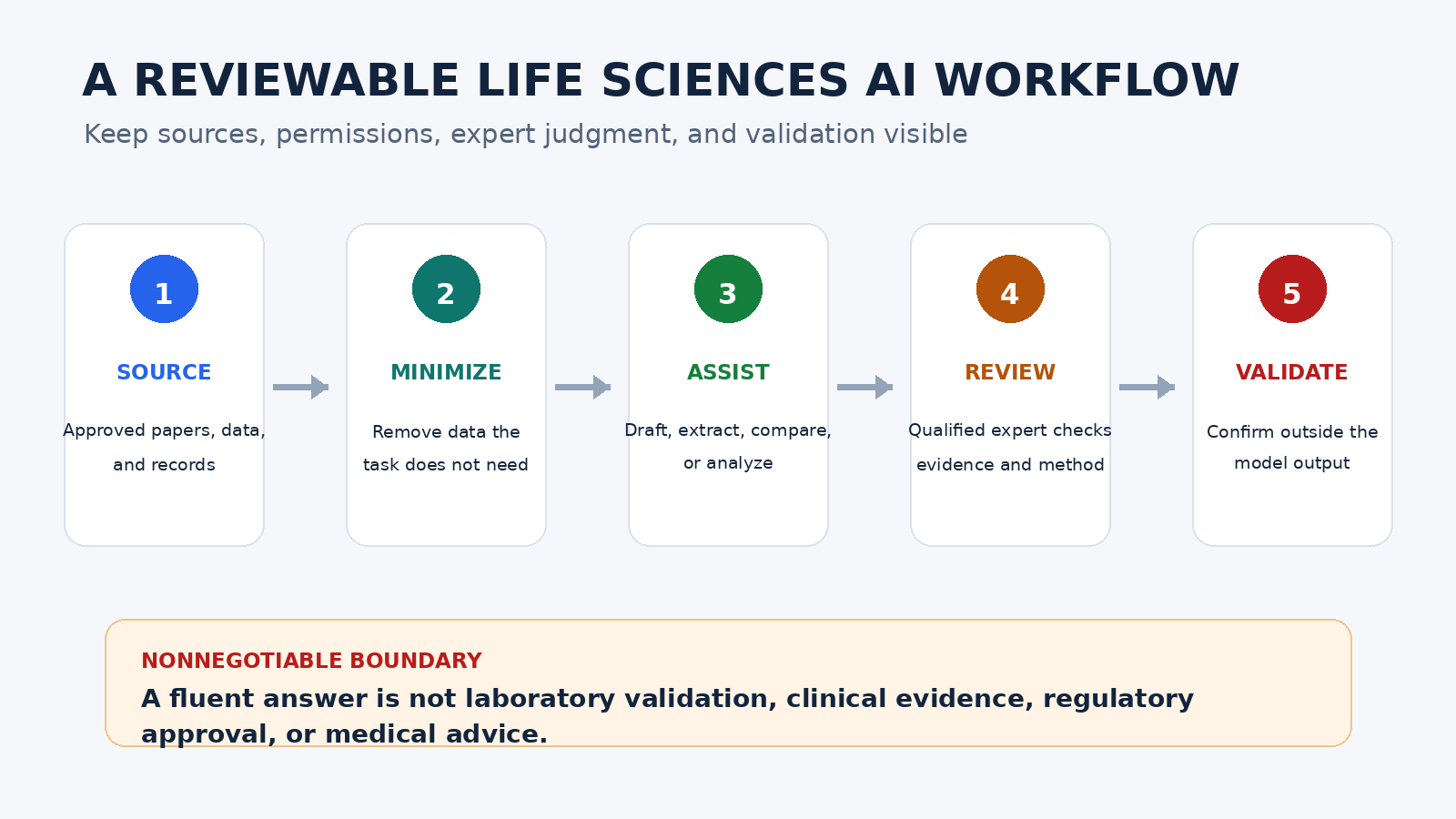
Within an authorized workflow, a language model can organize a literature set, extract candidate facts for review, compare document versions, explain code, draft analysis scripts, outline a protocol, or turn notes into a structured report. These tasks can reduce clerical effort and make a large body of material easier to inspect. They are most useful when the model is asked to show its sources, mark uncertainty, preserve identifiers, and produce output that a qualified reviewer can audit.
The model should not be treated as the source of record. It can misread a paper, invent a citation, omit a contradictory result, confuse an assay with a clinical outcome, or produce code that runs but answers the wrong question. Scientific language can make an answer sound more established than it is. Require the output to distinguish quotation, extraction, calculation, and interpretation. Then compare every consequential statement with the underlying record.
For literature work, define the search boundary and record the query, databases, dates, filters, and inclusion rules. For data analysis, preserve the dataset version, preprocessing decisions, environment, code, random seeds where relevant, and review notes. For protocol drafting, identify which sections came from approved templates and which were newly generated. This creates a trail that another person can inspect instead of relying on a polished chat transcript.
Where AI assistance must stop
A model output is not laboratory validation, clinical evidence, regulatory approval, or medical advice. It should not independently decide patient care, declare a target safe, interpret an ambiguous result as a diagnosis, or approve a submission. Anthropic’s current Usage Policy places additional requirements on high risk healthcare uses, including qualified human review for advice or decisions that directly affect individuals and disclosure when AI contributes to outputs presented to them.
Even low risk drafting can become high consequence when the output enters a clinical, quality, or regulatory workflow. Define who owns the decision, what evidence is required, who can approve the result, and how an error is corrected. A reviewer needs the source material and reasoning trail, not just the final prose. If the team cannot reproduce how an answer was produced, it should not use that answer as a critical record.
Protect sensitive scientific and health data
Before uploading data, classify it. Separate public papers from confidential research, personal data, health information, credentials, unpublished intellectual property, and regulated records. Use only an approved product and account configuration for the classification involved. Do not assume that a consumer chat and a managed commercial workspace have identical data handling. Anthropic’s commercial product training explanation says inputs and outputs from commercial products are not used for model training by default, while also describing exceptions such as feedback or an explicit choice to allow use.
Training use is only one privacy question. Teams should also assess retention, access, geographic requirements, contracts, connector permissions, incident response, audit logs, and deletion processes. Minimize data before submission. Replace direct identifiers where the task allows it, restrict access to the smallest appropriate group, and avoid placing secrets in prompts. The site’s broader AI data governance guide provides a practical framework for owners, permissions, approval rules, and review cycles.
Connectors deserve their own review because they can broaden what the model can retrieve. List each source, the account used, scopes granted, records reachable, actions allowed, and person responsible. Prefer read only access when the task is analysis. A model that can draft a document usually does not need permission to publish it, alter a laboratory record, or message an external party. Keep those actions behind a clear human checkpoint.
A controlled evaluation workflow
- Define the task: choose one narrow workflow and state what a useful output must contain.
- Choose approved data: document the classification, source, permission, and any required minimization.
- Create a reference set: use reviewed examples that represent ordinary cases and important failure modes.
- Set review criteria: check source fidelity, completeness, methodological fit, privacy, and unsupported claims.
- Limit tools: grant only the connectors, files, and actions needed for the evaluation.
- Record the run: preserve prompts, model information, source versions, outputs, corrections, and reviewer decisions.
- Escalate exceptions: route ambiguous, sensitive, or consequential results to the appropriate qualified expert.
- Decide from evidence: expand only if the workflow performs acceptably under the team’s predefined criteria.
Do not invent a success rate from a small pilot or report only the best examples. Track the full set, including abstentions, unsupported citations, missed facts, and corrections. The purpose of a pilot is to discover where the workflow fails and whether review can reliably catch those failures. If a metric is used, define its numerator, denominator, scoring method, and reviewer process before drawing a conclusion.
Questions to ask a vendor or project owner
- Which exact product, model, account type, and connectors are in scope?
- What data can the system read, retain, transform, and send?
- Which claims come from official documentation, and which are internal observations?
- How are citations opened and checked against the original text?
- Who reviews scientific, clinical, quality, and regulatory outputs?
- Which actions require approval, and can permissions be revoked quickly?
- How are model changes, source updates, errors, and corrections recorded?
- What happens when the model lacks evidence or sources conflict?
Official sources used for this correction
This correction relies on Anthropic’s official Claude for Life Sciences announcement for the documented life sciences direction and examples, the official Privacy Center article for commercial product training use, and Anthropic’s official Usage Policy for current use boundaries and high risk requirements. None of those official pages supports the original acquisition headline or the stated $400 million value. Product terms, policies, and capabilities can change, so open the current pages before making a procurement, compliance, research, or publication decision.
FAQ
Did Anthropic acquire Coefficient Bio for $400 million?
We could not locate an official Anthropic newsroom announcement supporting that acquisition and price during this review, so this page does not treat the claim as confirmed. That finding is not proof that no private event occurred. It means the headline lacks the primary official support needed to present it as fact.
What has Anthropic officially announced for life sciences?
Anthropic officially announced Claude for Life Sciences and described research, literature, protocol, bioinformatics, data analysis, and clinical or regulatory document workflows, plus connectors and skills. These are documented product directions and use cases, not proof of a specific acquisition or proof that model output replaces scientific validation.
Can Claude safely analyze confidential biomedical data?
Only an organization can decide that after reviewing the exact product, contract, configuration, data classification, permissions, retention, security controls, and legal duties. Use an approved environment, minimize data, limit access, review connectors, keep audit records, and involve privacy, security, scientific, and compliance owners as appropriate.
How should I verify a similar AI acquisition claim?
Write down the exact parties, event, status, value, and date. Look for an official announcement from the named companies and any relevant formal record. Trace secondary reports to their original source, check whether the value is actually supported, and label uncertainty clearly. Remove details that cannot be tied to reliable evidence.