Amazon Warehouse Robots in 2026: What Is Deployed, What AI Does, and What the Numbers Mean
Amazon’s warehouse robotics story is easy to flatten into a headline about machines taking over a building. The reality is more specific and more interesting. A fulfillment center is not run by one all-purpose robot. It uses a collection of mobile drive units, robotic arms, storage systems, cameras, sensors, planning software, and employee workstations. Each component has a bounded job, such as moving an inventory pod, selecting an item, sorting a package, or carrying a loaded cart.
As of August 2026, Amazon says it has deployed more than 1 million robots across an operations network that includes more than 300 facilities worldwide. That is a company-reported fleet milestone, not a count of humanoid robots and not proof that every facility has the same level of automation. The fleet includes several different machine types accumulated since Amazon acquired Kiva Systems in 2012. It also includes systems that operate in restricted robotic areas as well as newer machines designed to move around people.
The clearest way to understand Amazon warehouse robots is to follow the work. Inventory must be stored, brought to a picker, consolidated, packed, sorted, and moved toward a loading dock. Amazon has developed specialized systems for several of those steps. AI and computer vision matter, but they do not erase the distinctions between a robot that follows floor markers, an arm that recognizes products, and software that coordinates traffic.
The million-robot milestone needs context
Amazon announced its one millionth deployed robot in 2025, saying that the unit went to a fulfillment center in Japan. The same announcement described the network as spanning more than 300 facilities. Those figures establish the breadth of Amazon’s deployment, but they do not reveal how many robots are active at a typical site, how utilization varies, or how much of each order is handled automatically.
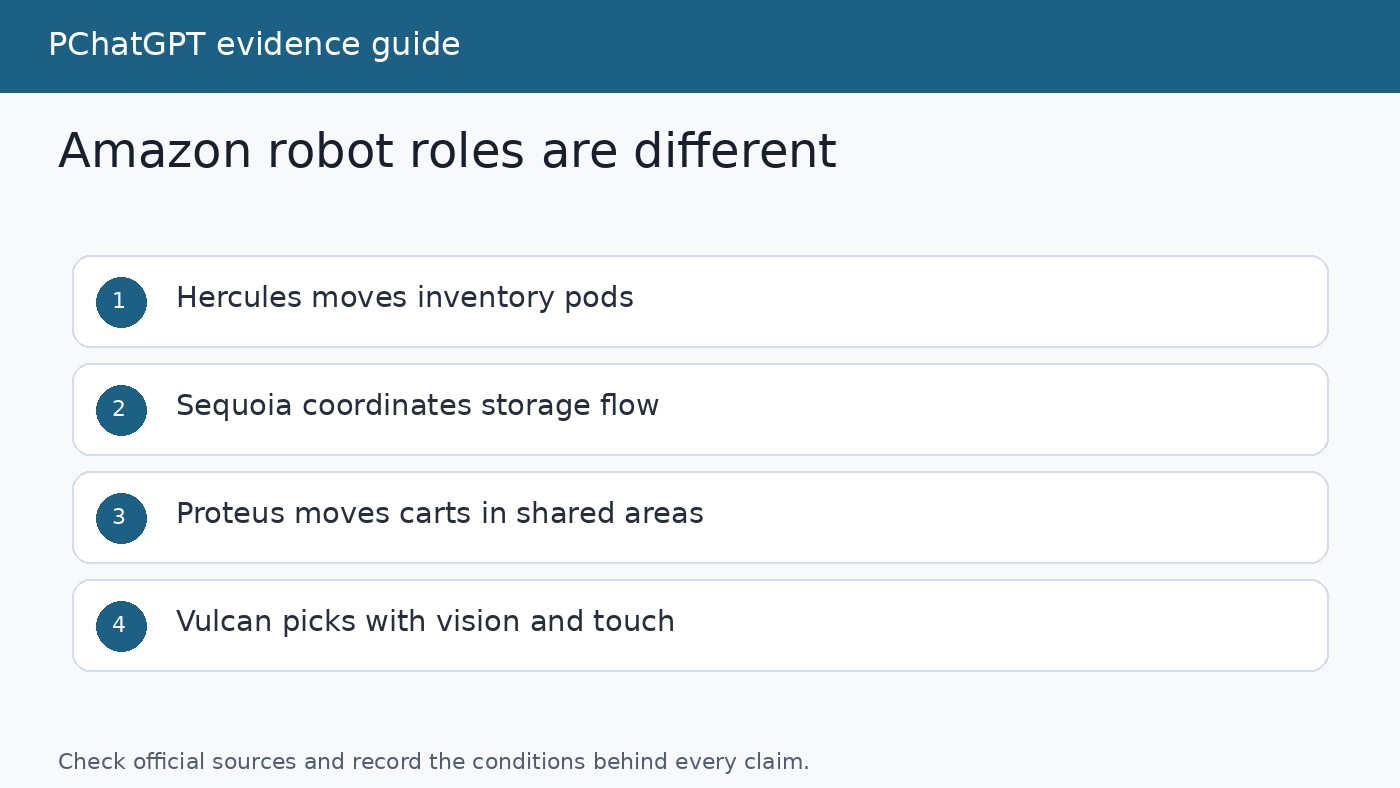
There is another reason to read the number carefully. Amazon uses the word robot for machines with very different capabilities. Hercules is a drive unit that lifts and moves inventory pods. Pegasus handles individual packages with a precision conveyor. Proteus carries carts through open areas. Sparrow, Robin, and Cardinal are robotic arms with different handling and sorting roles. Counting all of them together is useful for a fleet milestone, but the total does not describe one uniform level of intelligence.
Amazon has also published figures at different times as its fleet grew. An older Vulcan article refers to more than 750,000 robots, while the company’s updated robotics overview and DeepFleet announcement use more than 1 million. The newer figure should be used for the current fleet total. The older figure remains relevant only as historical context or as part of a claim tied to the date of that article.
How inventory comes to people
The core Amazon robotics idea predates today’s generative AI enthusiasm: move storage to a person rather than send a person walking through long aisles. Hercules drive units locate pods containing inventory and bring them to employees who select ordered items. Amazon says Hercules can lift and move as much as 1,250 pounds of inventory. It makes local movement decisions while receiving overall direction from centralized planning software. A forward-facing 3D camera helps it distinguish people, pods, robots, and other objects, while encoded markers on the floor provide position and navigation references.
Titan serves a related role for larger or bulkier goods. Amazon describes it as able to lift twice as much as Hercules. Like Hercules, Titan operates on a restricted robotics floor. This is a meaningful boundary. These machines are not freely roaming coworkers in every aisle. Their working area and navigation method are designed around a controlled environment.
Sequoia expands that goods-to-person model into an integrated inventory system. It combines mobile robots, gantries, robotic arms, containerized storage totes, and employee workstations. Mobile robots transport totes to the storage structure or send them to an employee who picks an item for an order. The workstation presents work between mid-thigh and mid-chest height, an area Amazon calls the ergonomic power zone. The aim is to reduce frequent overhead reaching and low squatting.
Amazon says Sequoia can identify and store incoming inventory up to 75% faster and can reduce order processing time by up to 25% when integrated with other technologies. Those percentages describe improvements reported by Amazon for a process and system configuration. They should not be translated into a claim that every Amazon order is 75% faster or that customer delivery time falls by the same amount. Delivery also depends on inventory placement, transport capacity, distance, demand, and the final mile.
The Shreveport, Louisiana, fulfillment center shows what a heavily integrated site looks like. Amazon says the facility opened in 2024 with eight robotics systems, and that its Sequoia installation can hold more than 30 million items. Thousands of mobile robots and multiple robotic arms bring goods to ergonomic stations. This is an important example of dense automation, but it should not be treated as a template already present in every building. Amazon says its newer systems were engineered for integration into existing facilities, which describes a scaling path rather than a completed network-wide conversion.
Robotic arms do different jobs
Once individual items and packages must be handled, the problem changes. A drive unit can move a pod without understanding every product inside it. A robotic arm needs to find a target, select a contact point, grip it, move it, and verify the result. Amazon uses several arms because picking loose retail products is not the same task as sorting closed shipping boxes.
- Sparrow identifies individual products with AI and computer vision, then moves them from containers into the appropriate totes. Amazon’s Shreveport report says its latest version can handle more than 200 million unique products across varied shapes, sizes, and weights. That is a stated product-handling range, not a claim that every item can be picked successfully in every arrangement.
- Robin sorts packed orders. It lifts packages from conveyor belts and places them on robotic drive units, while diverting damaged packages for quality control.
- Cardinal selects a package from a pile delivered through a chute, lifts it using suction, reads the label, and places it in the correct cart. Amazon says Cardinal can handle packages weighing up to 50 pounds.
- Vulcan works inside densely packed inventory pods. It can both stow and pick, combining cameras, suction, custom end-of-arm tools, and force feedback.
Vulcan is especially useful for seeing where vision alone stops. For stowing, its tool pushes existing products aside, senses contact force, grips the new item with paddles, and feeds it into a compartment. For picking, another arm uses a camera to locate the requested item and select a suction point. The camera then checks that the target, and not an extra product, was removed. Amazon says Vulcan can pick and stow about 75% of the item types held in its fulfillment centers at speeds comparable to front-line employees.
That 75% figure also exposes a practical boundary. Vulcan is not presented as infallible or universal. Amazon says it can identify cases it cannot handle and ask a human partner to step in. Its current ergonomic focus is the highest and lowest rows of storage pods, where people would otherwise use a step ladder or crouch. The human interaction is therefore part of the operating design, not merely a transition phase hidden from view.
Proteus changes where a mobile robot can work
Proteus is Amazon’s first fully autonomous mobile robot. In Amazon’s terminology, that means it can navigate freely within open, unrestricted parts of a site, using sensors to detect and avoid obstacles. The original version moves heavy carts from outbound areas toward loading docks and can work around employees. This differs from Hercules and Titan, which operate in restricted robotic zones and use floor markers as navigation coordinates.
The distinction matters because safe navigation around people is not just object detection. Amazon Science describes autonomous mobility as a problem of semantic understanding. Cameras and lidar produce pixels, depth readings, and points in space. Machine learning helps classify those observations as a person, pillar, cable, forklift, pod, or another robot. Planning software can then treat a fixed pillar differently from a person whose path may change. Researchers also consider whether a robot’s motion is legible and comfortable to nearby people, not simply whether it avoids physical contact at the final moment.
Amazon has announced a next-generation Proteus that is intended to work beyond dock areas and accept plain-language task instructions. An employee could describe what needs to move, while the system determines priority, route, and timing. However, Amazon’s current page says this version is being piloted in its labs and is planned for European deployment in the first half of 2027. It should not be described as a network-wide 2026 deployment. The original Proteus is operational, while the conversational version remains a forthcoming system.
What AI does inside the warehouse
AI is not one control layer that independently runs the fulfillment center. It appears in specific perception, prediction, planning, and coordination tasks. Computer vision can classify a product or package, estimate where an arm should grip, verify a pick, and help a mobile robot distinguish obstacles. Machine learning can improve route choices or estimate how objects and people may move. Force data helps Vulcan learn physical interactions that images alone cannot describe.
DeepFleet sits at the fleet coordination level. Amazon calls it a generative AI foundation model trained on inventory movement data from its sites and built with AWS tools including Amazon SageMaker. The company compares its role to traffic management: it coordinates robot movement to reduce congestion and find more efficient paths. Amazon says it will improve robotic fleet travel time by 10%.
That wording calls for restraint. A 10% travel-time improvement is not the same as a 10% reduction in total order time, labor, energy use, or delivery time. Robot travel is one part of a longer chain. Amazon links the expected improvement to lower operating costs, faster delivery, and lower energy use, but it does not publish enough detail in that announcement to independently calculate those downstream effects. The honest interpretation is that 10% is Amazon’s stated fleet travel efficiency improvement for DeepFleet, not a universal logistics outcome.
This boundary resembles a broader lesson in deploying AI systems: useful autonomy is usually constrained by a defined task, data, permissions, monitoring, and escalation. Our guide to building AI agents that work in production explains why a controlled workflow is more credible than open-ended autonomy. Readers comparing software agents can also see the same distinction between assistance and unrestricted action in our AI browser agents safety guide.
People remain part of the operating model
Amazon frames its robots as tools that reduce repetitive movement, heavy lifting, awkward reaches, and long walking distances. The named examples support a narrower version of that claim. Hercules brings pods to pickers. Cardinal handles packages weighing up to 50 pounds. Proteus moves loaded carts. Sequoia places work in an ergonomic height range. Vulcan targets top and bottom storage rows and escalates items it cannot manage.
These examples do not settle the much larger question of automation’s total effect on employment. Amazon reports that more than 700,000 employees have participated in upskilling initiatives since 2019. It also says its Shreveport facility needs 30% more employees in reliability, maintenance, and engineering roles than its traditional fulfillment centers. That is a statement about certain role categories at a particular advanced facility, not evidence that robotics always raises total employment or produces the same mix of jobs everywhere.
The safest conclusion is operational: the systems described by Amazon still rely on employees to pick and pack at workstations, supervise flow, handle exceptions, maintain equipment, perform quality control, and make site-level decisions. Some tasks are automated, others are reshaped, and new technical work is introduced. Claims about broader job creation, displacement, or long-term workforce totals require evidence beyond product announcements.
How to read Amazon’s robotics claims
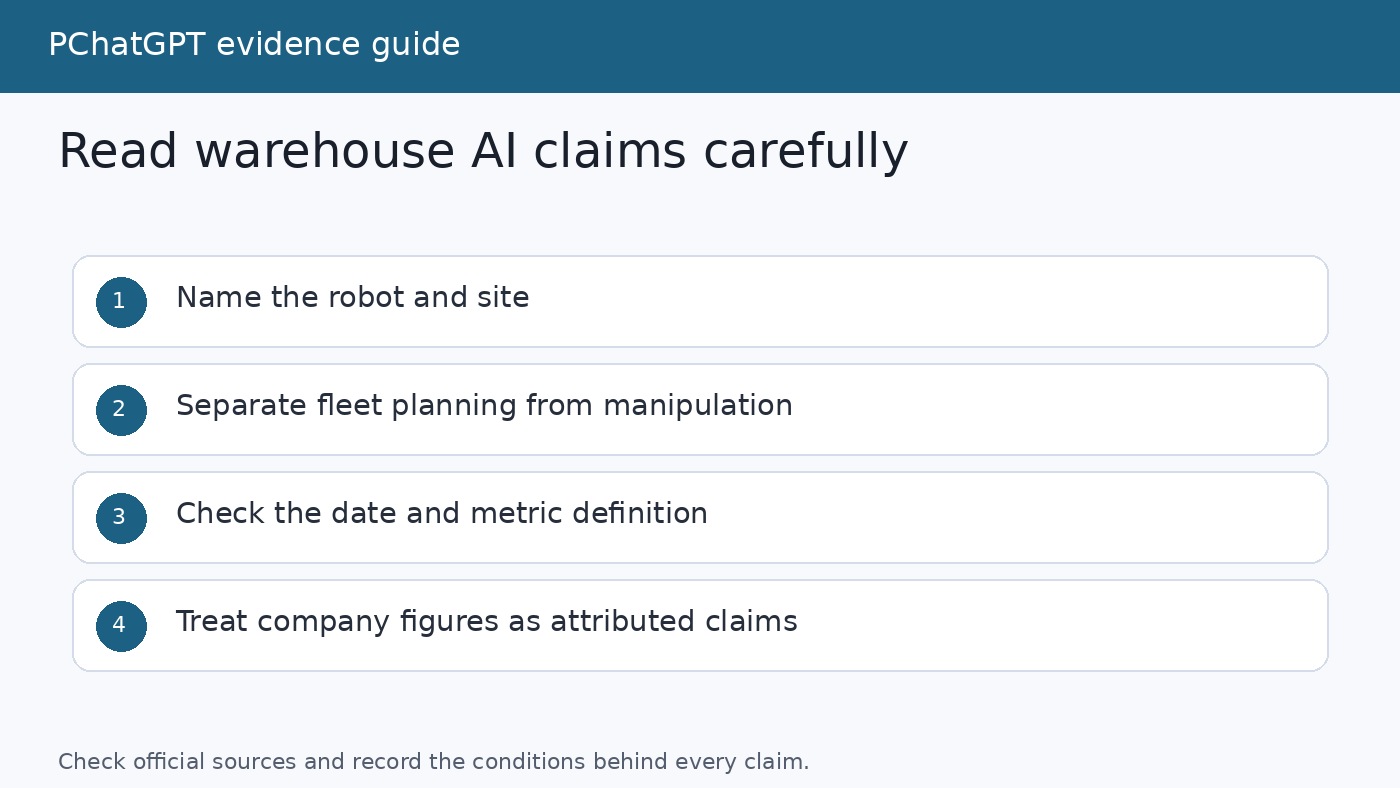
First, separate deployed systems from pilots and plans. Hercules, Titan, Sparrow, Robin, Cardinal, the original Proteus, Sequoia, and Vulcan all have documented operational deployments, although their presence varies by site. The next-generation conversational Proteus is a lab pilot with deployment planned for 2027. Amazon also updated its Blue Jay announcement in February 2026 to say the system is no longer used in operations, even though underlying technology may support other work. A product name in an announcement is not permanent proof of current deployment.
Second, identify the denominator behind every percentage. Sequoia’s 75% concerns the speed of identifying and storing received inventory. Vulcan’s roughly 75% concerns the variety of item types it can pick and stow. DeepFleet’s 10% concerns robot fleet travel time. These numbers measure different things and cannot be added together or converted directly into delivery speed.
Third, distinguish company evidence from independent evaluation. Amazon’s official pages are the primary sources for what the company built, where it says a system is running, and how it describes design goals. They are not independent audits. Phrases such as “Amazon says,” “the company reports,” and “Amazon expects” are not verbal clutter here. They tell the reader who measured or forecast the result.
Finally, look for exception handling. A credible warehouse system does not need to solve every physical problem. Vulcan can call a person when it cannot move an item. Restricted drive units operate inside controlled zones. Proteus uses sensors and planning to work in shared space. Those boundaries are evidence of engineering maturity because they define where a system should act and where another process must take over.
What Amazon’s warehouse robot strategy amounts to in 2026
Amazon is deploying robotics at substantial scale, but scale comes from combining many narrow systems. Mobile robots move shelves, totes, packages, and carts. Arms identify, pick, consolidate, and sort. Integrated storage systems coordinate those machines around ergonomic employee stations. AI contributes perception and route planning, while DeepFleet targets traffic across the mobile fleet. People handle exceptions, operate workstations, monitor flow, maintain equipment, and make decisions that the machines do not own.
The most important 2026 development is therefore not a humanoid robot replacing the warehouse. It is tighter coordination among specialized hardware, software, and human work. The million-robot figure shows how widely Amazon has adopted robotics. The operational details show what those robots actually do, and just as importantly, what they do not do.
FAQ
How many warehouse robots has Amazon deployed?
Amazon says it has deployed more than 1 million robots across its operations network, spanning more than 300 facilities worldwide. The count includes multiple kinds of mobile robots and robotic systems, not one model and not only humanoid machines.
Are Amazon’s warehouse robots fully autonomous?
Some are autonomous within defined conditions, but the fleet is not uniformly autonomous. Proteus can navigate open areas around people. Hercules and Titan work on restricted robotic floors and use encoded floor markers while taking overall direction from planning software. Robotic arms perform bounded picking or sorting tasks and may require human exception handling.
Does DeepFleet control every Amazon warehouse robot?
Amazon presents DeepFleet as a foundation model for coordinating movement across its mobile robot fleet. The company says it will improve robot travel time by 10%. That does not mean DeepFleet performs every physical task or controls every arm, workstation, and warehouse decision.
Will Amazon’s next-generation Proteus be deployed in 2026?
Amazon’s current announcement says the conversational next-generation Proteus is being piloted in its labs, with European deployment planned for the first half of 2027. The original Proteus is already operational at selected fulfillment centers, but the plain-language version should not be presented as broadly deployed in 2026.
Sources
- Amazon launches a new AI foundation model to power its robotic fleet and deploys its 1 millionth robot
- Amazon uses robots that sort, lift, and carry packages
- Introducing Vulcan: Amazon’s first robot with a sense of touch
- Amazon announces new fulfillment center robotics solutions
- Amazon unveils the next generation of fulfillment centers powered by AI and robotics
- Amazon unveils next-generation Proteus
- Amazon Science: The quest to deploy autonomous robots within fulfillment centers
- Amazon’s Blue Jay and Project Eluna update