Executive AI governance fails when it lives only in a policy document. Leaders do not need another list of abstract principles. They need an operating system for deciding which AI uses may proceed, what evidence must exist, who accepts the remaining risk, and when an approval expires. This executive AI governance playbook turns those needs into five repeatable gates for a portfolio of generative AI and other AI systems.
The playbook is built for a chief executive, board committee, business unit leader, chief information officer, risk executive, or general counsel who must govern many use cases without reviewing every prompt. It is not legal advice and it is not a substitute for jurisdiction-specific analysis. Its purpose is to make accountability visible, keep routine decisions close to the work, and reserve executive attention for uses with material consequences.
The executive job is to design decisions, not approve every tool
Many governance programs begin with a committee, a policy, and a list of prohibited data. Those are useful foundations, but they do not answer the questions that arrive on an ordinary Tuesday. A sales team wants an assistant to summarize calls. Human resources wants a system to rank applicants. An operations group wants an agent to change orders. A vendor updates the model behind an approved service. Each request has a different consequence profile, yet all may be described simply as AI.
The executive task is therefore portfolio design. Leaders set the organization’s risk appetite, define the decisions that cannot be delegated, fund the control functions, and require evidence that can survive scrutiny. Product and business owners remain accountable for outcomes. Technical, security, privacy, legal, procurement, and domain specialists provide independent challenge where the consequence warrants it. A central AI council should route and record decisions, not become a queue that silently owns every risk.
This approach is consistent with the official NIST AI Risk Management Framework, which organizes work around Govern, Map, Measure, and Manage. NIST describes the framework as voluntary and intended to improve how organizations incorporate trustworthiness considerations. NIST also states that AI RMF 1.0 is being revised, so executives should treat any implementation as a living system rather than a one-time compliance project.
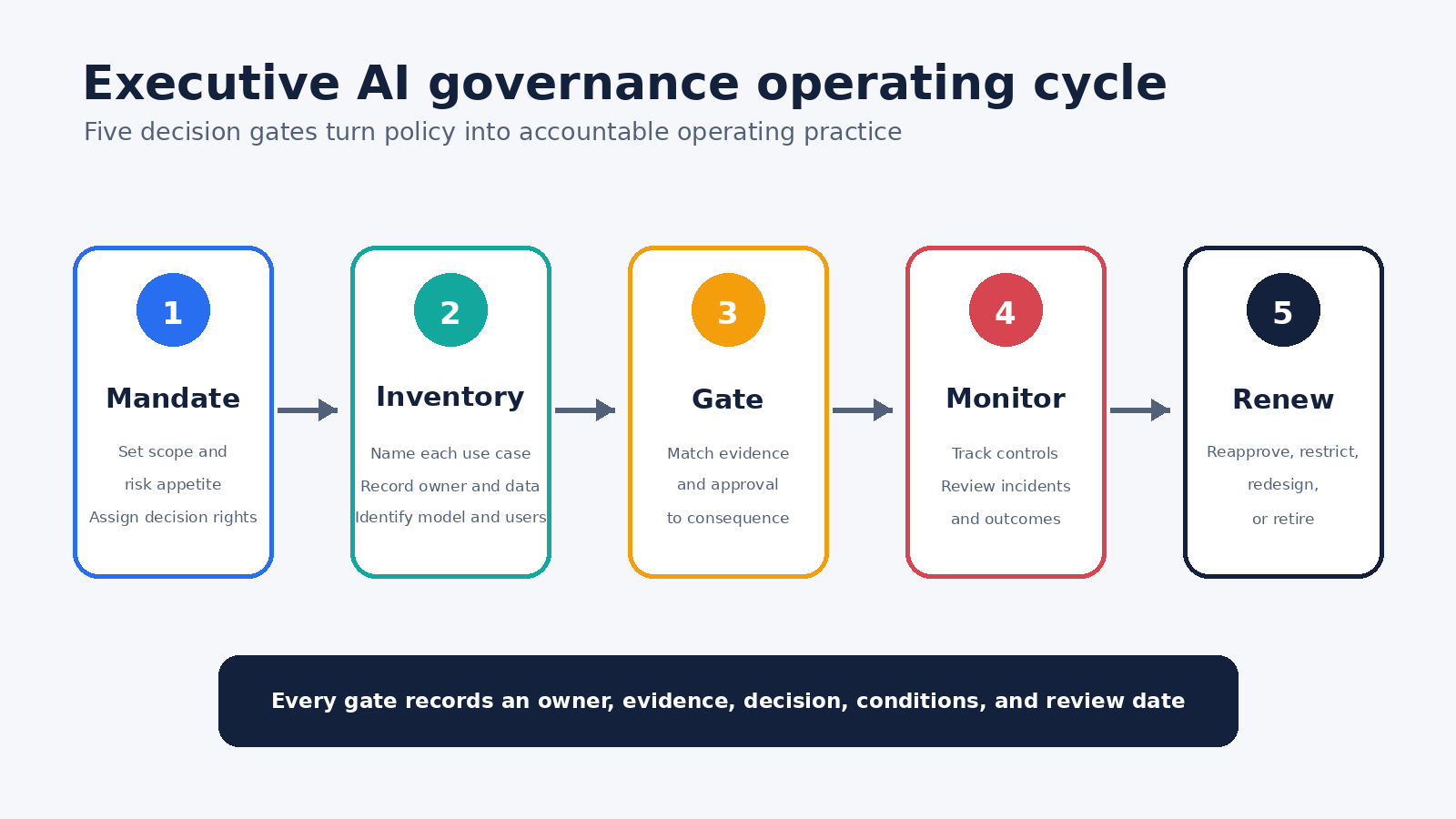
Gate 1: Issue a mandate with explicit decision rights
Start with a one-page mandate. It should identify the executive sponsor, the council or forum that administers the process, the scope of AI covered, and the outcomes the organization is trying to achieve. It should also state boundaries. Examples include uses that require specialist review, information that may not enter an unapproved service, and decisions that a human must retain.
The mandate should separate four roles that are often blurred:
- Business owner: accountable for the use case, user behavior, benefits, operating controls, and retirement.
- System owner: accountable for technical configuration, access, integrations, model or vendor changes, logging, and service continuity.
- Independent reviewer: challenges evidence in a relevant discipline without becoming the business owner.
- Decision authority: approves, rejects, limits, pauses, or retires the use according to delegated thresholds.
Do not assign accountability to “the AI team.” A function can coordinate the process, but a business outcome needs a person with budget and operational authority. Every approval record should name that person. If ownership changes during a reorganization, the approval should return to the gate rather than remain attached to an empty job title.
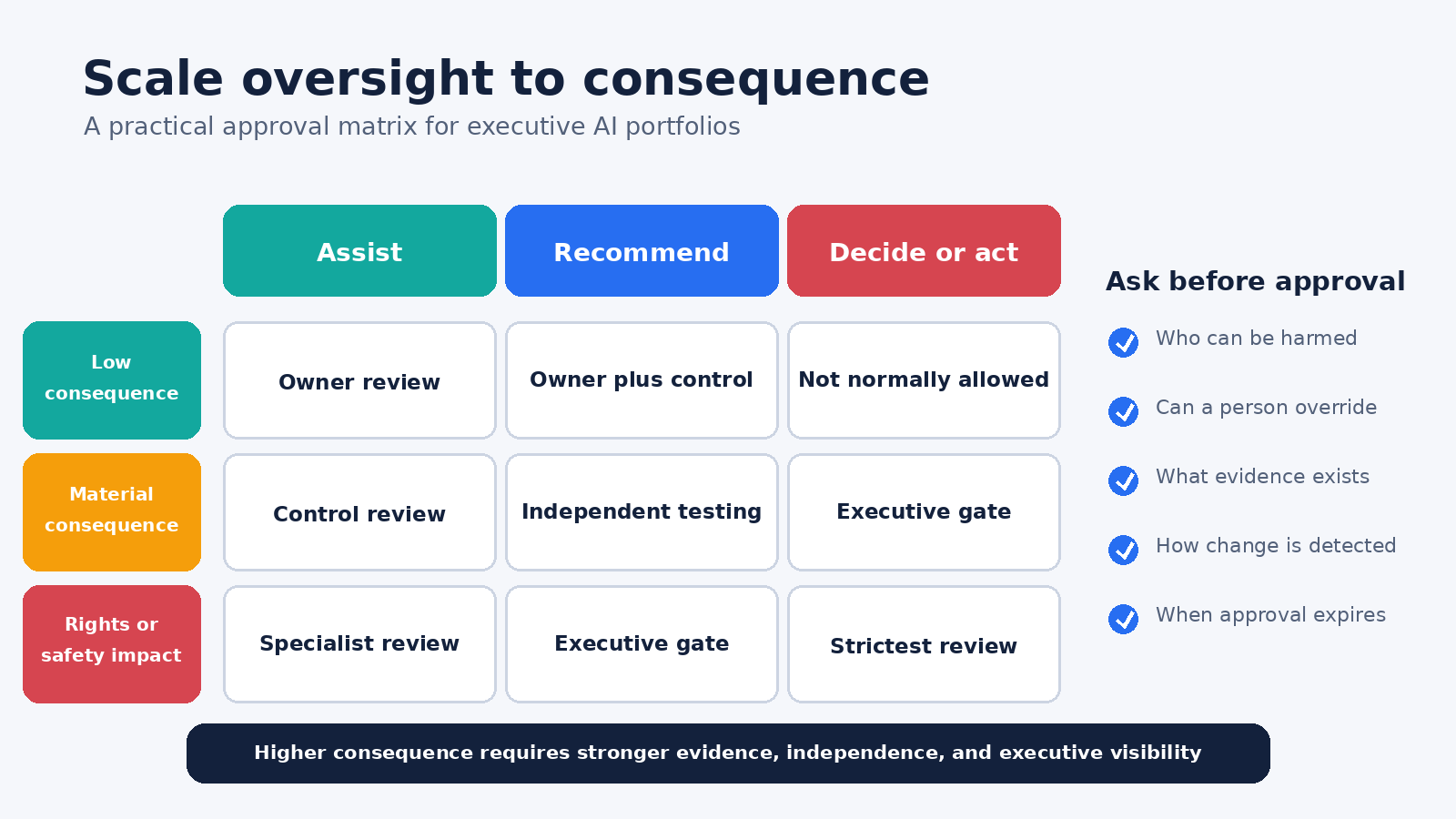
Decision rights should follow consequence, not novelty or cost. A low-consequence drafting assistant may be approved by a business owner using standard controls. A tool that recommends employment, credit, health, safety, or access decisions deserves stronger evidence and independent review. A system that acts on those matters may require the highest authority or may fall outside the organization’s risk appetite.
Gate 2: Build an inventory executives can actually use
An inventory is not a list of vendor names. One service can support many use cases, and each use case can expose different people, data, and decisions. Record each use case as a compact operating record. At minimum, include its purpose, users, affected people, business and system owners, input data, output destination, model or service, integrations, geographic reach, degree of human oversight, potential consequence, approval status, conditions, and next review date.
Add a plain-language statement of how the output is used. “Creates text” is too vague. “Drafts internal meeting summaries that an employee checks before distribution” reveals the human role and audience. “Ranks candidates for recruiter review” reveals a materially different consequence. This sentence is often the fastest way for an executive to understand what is really being approved.
Discovery must include tools purchased centrally, features embedded in existing software, custom systems, employee-created assistants, and automated connections. Procurement records alone will miss free accounts and AI functionality added through ordinary product updates. Give employees a simple path to disclose an experiment without punishment, then distinguish discovery from approval. A truthful inventory is more valuable than a pristine one that hides actual use.
For teams still building safe day-to-day habits, the pChatGPT guide to repeatable ChatGPT workflows explains why trusted context, manual review, and task-specific methods matter. Those practices support the use-case record, but they do not replace executive governance.
Gate 3: Match the evidence package to consequence
A gate is a decision meeting with a defined evidence standard. It is not a presentation about AI potential. Before the meeting, the business owner supplies a short case that covers intended value, affected people, reasonably foreseeable failure modes, alternatives, controls, testing, residual risk, monitoring, incident response, and exit options. Reviewers should be able to distinguish evidence from aspiration.
Use two dimensions to route a use case. First, identify what the AI does: assists a person, recommends a decision, or decides and acts. Second, assess the consequence if it is wrong, misused, unavailable, or changed. Consequence should consider people’s rights and opportunities, safety, financial loss, privacy, security, legal duties, operational disruption, and reputational harm. The matrix below is an internal management aid, not a legal classification.
What belongs in the evidence package
- Purpose and boundaries: the intended task, prohibited uses, affected groups, and acceptable operating conditions.
- Data and access: data categories, sources, permissions, retention, transfers, and controls over sensitive information.
- Performance: tests that resemble real operating conditions, including meaningful subgroups, edge cases, and comparison with the current process.
- Human authority: who reviews or overrides output, what information that person sees, and whether workload or interface design makes oversight realistic.
- Security and resilience: abuse scenarios, access controls, integration risks, logging, fallback procedures, and service dependencies.
- Transparency: what employees, customers, or affected people are told, and what records support explanation or challenge.
- Change and exit: how model, vendor, data, prompt, workflow, or regulatory changes are detected, plus how the organization can pause or replace the system.
The NIST AI RMF Playbook offers suggested actions aligned with the framework’s four functions. NIST explicitly says the Playbook is not a checklist to follow in its entirety. That warning is useful for executives. Evidence should be selected for the use context and consequence, while the decision record should explain why the selected evidence is sufficient.
Organizations operating in or affecting the European Union should separately map their role and obligations under the European Commission’s official AI Act guidance. The Commission describes a risk-based framework, distinguishes providers and deployers, and lists obligations for high-risk systems such as risk management, documentation, logging, human oversight, robustness, cybersecurity, and accuracy. Application dates are phased, so counsel should confirm the current rule, role, and timeline for each use case rather than copying an old summary.
Gate 4: Monitor the conditions of approval
An approval is a hypothesis under stated conditions. Monitoring tests whether those conditions still hold. Every approved use should have a small set of measures tied to its failure modes and intended outcome. A generic dashboard of usage and cost is not enough. If a system drafts customer responses, monitor material corrections, unsafe disclosures, complaints, overrides, and samples of final communications. If it recommends operational action, monitor error severity, human acceptance, exceptions, and downstream effects.
Executives should receive a portfolio view that highlights exceptions rather than drowning them in activity. Useful signals include unowned use cases, overdue reviews, incidents by severity, controls that failed testing, material vendor or model changes, high-consequence uses without independent evaluation, and approvals nearing expiration. Benefits should appear beside risks. A use that delivers no defensible value should not consume permanent control capacity simply because it has not caused a visible incident.
Define escalation triggers before launch. Examples include an unexpected affected population, a new data category, a serious complaint, security compromise, legal change, loss of a required human check, performance outside an approved threshold, or a vendor change that invalidates prior evidence. The first response may be a restriction or pause rather than a full shutdown. The decision authority should know who can activate that response at any hour.
Incident handling should connect to existing security, privacy, safety, legal, and operational processes. Avoid creating an isolated AI incident channel that competes with established response teams. Add AI-specific fields to the common record, such as model or service version, prompt or configuration, input and output evidence, affected use case, human actions, and whether similar uses share the same dependency.
Gate 5: Renew, restrict, redesign, or retire
Every approval needs an expiration date. Renewal forces the owner to show that the purpose, control environment, evidence, and residual risk remain acceptable. The interval should be shorter when consequence is high or change is rapid. A fixed annual review may be adequate for a stable, low-consequence assistant, while material systems may need event-driven review plus a shorter scheduled cycle.
Renewal is not automatic. The authority can continue the approval, impose conditions, narrow users or data, require redesign, pause deployment, or retire the use. Record the rationale and dissent as well as the final decision. If the organization grants an exception, state its owner, compensating controls, expiration, and closure criteria. Permanent exceptions are usually evidence that the mandate or process no longer matches reality.
Retirement also needs controls. Revoke access, disconnect integrations, preserve records required for audit or legal duties, handle retained data, notify users, update the inventory, and confirm the replacement or manual fallback. Vendor offboarding should not depend on the employee who first bought the tool still being available.
Organizations that want a formal management-system structure can review the official overview of ISO/IEC 42001:2023. ISO describes it as a standard for establishing, implementing, maintaining, and continually improving an AI management system. A standard can support consistent governance, but certification or documentation alone does not answer whether a specific business decision is sensible.
The executive scorecard
A concise quarterly scorecard should help leaders decide where intervention is needed. It can show the number of active use cases by consequence and action level, percentage with current owners, percentage with unexpired approval, open high-severity incidents, overdue corrective actions, material changes awaiting review, and measured benefits for major deployments. Definitions should remain stable enough to reveal trends, and notes should explain any change in scope.
Avoid a single “responsible AI score.” Combining unlike risks into one number hides the reason for concern and invites false precision. Show the few measures that connect directly to decision rights. An executive should be able to identify which use needs attention, which owner must act, what evidence is missing, and when the next decision occurs.
Board reporting should focus on risk appetite, material exposures, serious incidents, management’s response, and whether the governance system itself is effective. Operational councils need more detail. The board does not need a catalog of prompts, and the operating team should not wait for a board meeting to handle a known control failure.
A 90-day rollout for the leadership team
- Days 1 to 15: name the executive sponsor, approve the one-page mandate, define consequence tiers, and publish an amnesty-style discovery route for existing use.
- Days 16 to 30: inventory the most material workflows first, assign owners, and flag any use that acts on people, money, access, safety, or regulated processes.
- Days 31 to 45: define evidence templates and delegated approval levels. Select a small number of real use cases to test the gate rather than perfecting the form in isolation.
- Days 46 to 60: run the first decisions, record conditions and expiration dates, and note where reviewers lacked information or authority.
- Days 61 to 75: connect monitoring and incident routes to existing systems. Build an exception-based executive dashboard from inventory records.
- Days 76 to 90: review the pilot, remove unnecessary steps, strengthen weak evidence requirements, and publish the operating cadence for renewal and portfolio reporting.
The result at day 90 should not be a claim that all AI risk is controlled. It should be a working decision loop with visible ownership, a prioritized inventory, tested approval routes, and a way to detect when assumptions change. For a deeper treatment of information boundaries and trust, see pChatGPT’s data governance and generative AI guide.
FAQ
Who should own executive AI governance?
A named executive sponsor should own the governance system, while individual business owners remain accountable for their use cases and outcomes. A cross-functional council can administer routing and challenge evidence. It should not absorb accountability from the people with operational authority and budget.
Does every AI use case need executive approval?
No. Executives should approve the mandate, risk appetite, consequence definitions, and reserved decisions. Low-consequence uses can follow delegated routes with standard controls. Executive review belongs where potential harm, legal exposure, autonomy, scale, or uncertainty exceeds a defined threshold.
How often should an AI approval be reviewed?
Set a scheduled expiration based on consequence and pace of change, then add event-driven triggers. A material model, vendor, data, workflow, legal, security, or performance change should return the use case to review before the normal date when it could invalidate the original evidence.
Is this playbook enough for AI Act compliance?
No. It is an operating model, not legal advice or a compliance determination. Organizations should identify their role, system classification, jurisdiction, and applicable dates using the current legal text and official guidance, supported by qualified counsel. The same governance record can organize evidence, but legal obligations require their own mapping.
Make governance a renewable management decision
Effective executive AI governance is less about predicting every failure and more about building a dependable way to decide under uncertainty. A mandate sets authority. An inventory reveals reality. Evidence gates scale scrutiny to consequence. Monitoring tests whether approval conditions still hold. Renewal gives leaders a disciplined way to continue, restrict, redesign, or stop.
That cycle protects room for useful experimentation without treating every use as harmless. It also gives executives something a principles document cannot provide: a traceable record of who decided, what they knew, which conditions they imposed, and when the organization will look again.