
Competitor research is useful when it helps you understand what customers can already choose, where public claims overlap, and which questions your own product still needs to answer. It becomes unreliable when a tidy summary is mistaken for evidence. It also crosses an ethical line when it depends on impersonation, private accounts, confidential material, or invented facts.
ChatGPT can help organize public or supplied information, but it does not have private knowledge of another company. The safest workflow is simple: collect the source material yourself, preserve the links and dates, ask for a structured analysis, and check every important conclusion against the original pages. This guide provides five prompts for that job. Each prompt creates an output a person can review rather than a verdict you are expected to trust.
The prompting method follows OpenAI’s current ChatGPT prompt engineering guidance: make the request clear, give enough context, review the first response, and refine the prompt when the result misses the point. OpenAI also warns that ChatGPT can produce wrong facts and fabricated references. Its truthfulness guidance recommends checking important information at reliable sources.
Set an ethical research boundary first
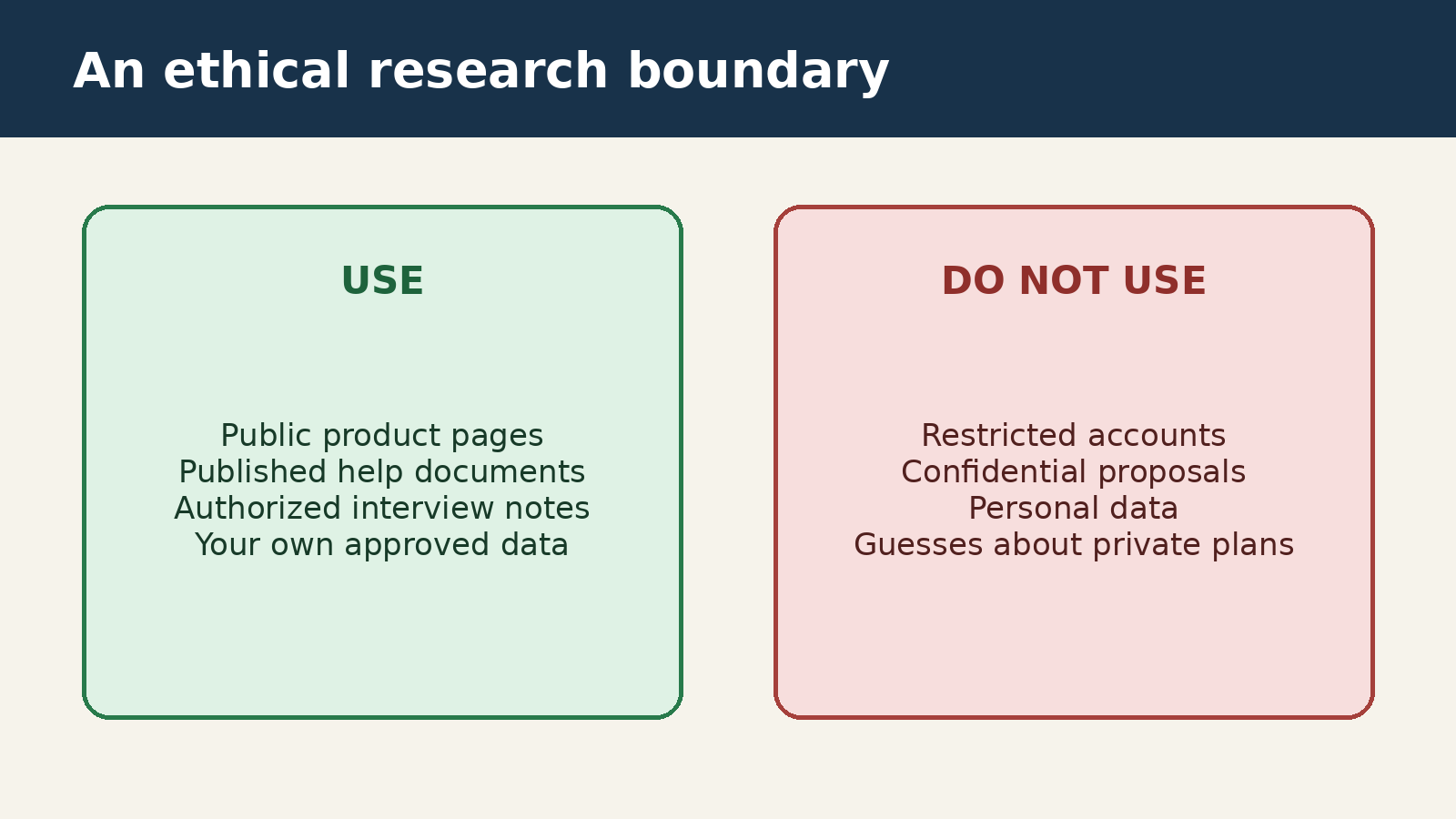
Before comparing anything, write down what information is allowed. Good inputs include public product pages, public pricing pages, published help articles, terms, press releases, public job listings, public reviews, and documents your organization owns or has permission to use. A customer interview can also be an input when the participant agreed to the use and personal details are removed where appropriate.
Do not ask ChatGPT to guess private revenue, nonpublic customer lists, unreleased plans, internal weaknesses, or the contents of a restricted account. Do not create fake identities to obtain sales material. Do not paste trade secrets, personal data, confidential proposals, or material covered by a nondisclosure agreement. Laws and contracts vary, so an internal legal or compliance review may be needed for sensitive projects.
Public does not mean timeless. A pricing page can change after you collect it. A review may describe an older version. Record the URL, page title, and access date for every source. When possible, quote the exact passage that supports a claim. If two sources disagree, keep the disagreement visible instead of asking ChatGPT to choose the answer that sounds most plausible.
Prepare a small evidence packet
A competitor analysis works better with a narrow question than with a request to “analyze the market.” Decide what decision the work will support. You might need to revise a comparison page, prepare customer interview questions, review onboarding language, or identify topics for product documentation. That decision determines which evidence matters.
Create one evidence packet for each company. Use the same headings so the comparison is fair:
- Company and product name as shown on the official site
- Source URL, page title, publisher, and access date
- Short relevant excerpt, copied accurately
- Source type, such as official page, help document, or public review
- Time period or product version, when stated
- Notes about ambiguity, missing context, or possible bias
Keep official company claims separate from customer observations. An official page can establish what a vendor says. It does not prove that every customer experiences the product that way. A public review can describe one person’s experience. It does not establish a universal product fact. This separation prevents an attractive synthesis from flattening different kinds of evidence into one story.
If you want a broader primer before using the templates, read the site’s ChatGPT prompt engineering guide. The guide to common ChatGPT mistakes covers verification habits that also apply here.
How to use the five prompts
Replace every bracketed field. Paste only the evidence you are allowed to use. If the material is long, run the prompt on a few sources at a time, inspect the extraction, and then combine the reviewed tables. OpenAI’s developer guidance says headings and delimiters can separate instructions from source material. The templates use clear sections for that reason.
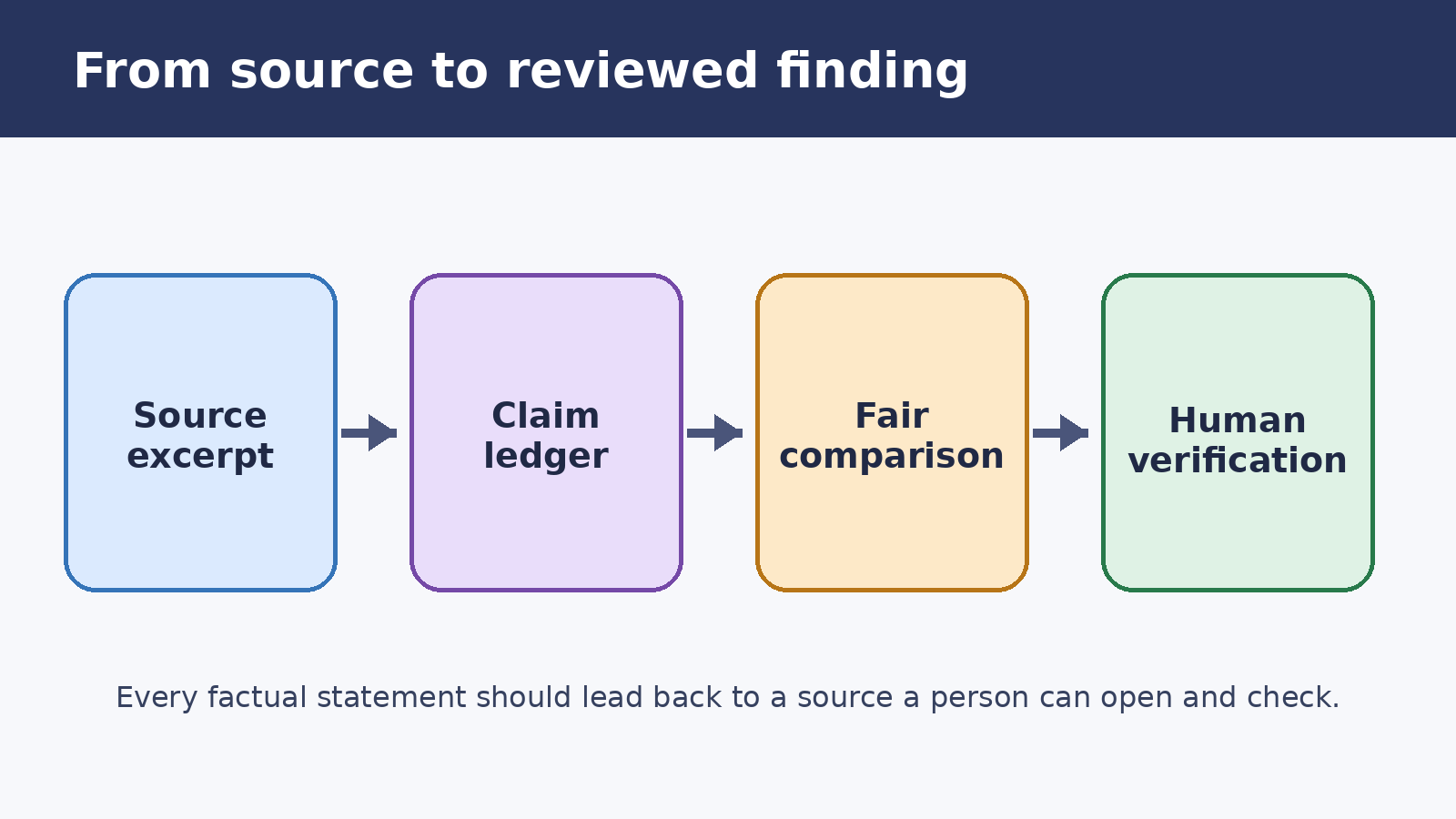
Ask ChatGPT to cite the source label beside each factual statement. A source label makes checking easier, but it does not prove the statement is correct. Open the original page and confirm the wording yourself. If ChatGPT has an available web research tool in your account, inspect every cited link and do not assume a search result is an authoritative source merely because it appears in the answer.
Prompt 1: build a claim ledger
Start by extracting claims before asking for strategy. This prompt turns a mixed evidence packet into a ledger with a visible trail back to each source.
Task:
Create a claim ledger from the supplied competitor research packet.

Research boundary:
Use only the text under SOURCES. Do not use background knowledge. Do not infer private plans, revenue, customers, performance, or intent.

For each distinct claim, return:
1. Claim in plain language
2. Company or product
3. Source label
4. Exact supporting quote
5. Source type: official claim, documentation, or public observation
6. Date or version stated in the source
7. Confidence: direct, ambiguous, or unsupported
8. What a reviewer should verify

Rules:
- Split combined claims into separate rows.
- Mark a claim unsupported if no quoted passage supports it.
- Keep conflicting claims in separate rows.
- Do not convert marketing adjectives into measured facts.

SOURCES:
[paste labeled public or authorized sources here]
Review the ledger row by row. Check that each quotation exists and that ChatGPT has not widened its meaning. For example, “works with selected file types” should not become “works with all business documents.” Delete duplicate rows, correct source labels, and keep unsupported claims out of later analysis.
Prompt 2: compare positioning without declaring a winner
Once the ledger is clean, compare how the companies describe the audience, problem, and value. The goal is to map positioning, not to award a score based on incomplete evidence.
Task:
Compare the public positioning in the reviewed claim ledger.

Decision this supports:
[example: revise our homepage explanation for small accounting firms]

Return these sections:
A. Audience named by each company
B. Problem each company says it solves
C. Outcomes each company explicitly claims
D. Proof offered for those claims
E. Important similarities
F. Important differences
G. Questions the public material does not answer

Evidence rules:
- Cite a source label after every factual statement.
- Distinguish quoted language from your summary.
- Do not rank companies or predict which will win.
- Do not treat absence from the packet as proof that a feature or policy does not exist.
- Label interpretation as interpretation.

REVIEWED CLAIM LEDGER:
[paste the checked ledger here]
Look for false symmetry in the output. Two pages may use the same word while meaning different things. Conversely, different language may describe similar work. Confirm that each comparison uses equivalent product levels, regions, and dates. If those details are unclear, turn the comparison into a research question rather than a conclusion.
Prompt 3: create a feature and policy matrix
Feature tables are easy to publish and easy to get wrong. Plans change, footnotes matter, and similar feature names may refer to different behavior. This prompt uses three states: documented, unclear, and not addressed in the supplied evidence. It does not use “missing” as a shortcut.
Task:
Build a reviewable feature and policy matrix for the products below.

Rows to examine:
[paste the exact feature, support, privacy, onboarding, or pricing questions]

Columns:


[our product, if relevant]

For each cell include:
- Status: documented, unclear, or not addressed in supplied evidence
- Short explanation
- Source label and exact quote
- Plan, region, date, or version limitation
- Verification needed before publication

Rules:
- Use only the supplied sources.
- Do not treat "not addressed" as "not available."
- Do not merge similarly named features without evidence that they work alike.
- Keep prices in their stated currency and billing period.
- Flag contradictory or outdated sources.

SOURCES:
[paste checked source excerpts here]
Check every cell against the original source. Pay close attention to monthly versus annual billing, taxes, introductory offers, usage limits, and plan names. If your final comparison will be public, add a visible “last checked” date and a correction channel. A matrix is a snapshot, not a permanent fact sheet.
Prompt 4: analyze public customer language carefully
Reviews, forum posts, and interview notes can reveal the words people use for a problem. They are not a representative survey unless the collection method supports that conclusion. Use this prompt to find themes while preserving counts, source types, and dissenting examples.
Task:
Analyze the supplied public reviews or authorized interview notes for language patterns.

Return:
1. Repeated jobs or situations described by participants
2. Phrases used to describe the problem
3. Positive experiences, with source labels
4. Friction or complaints, with source labels
5. Contradictory experiences
6. Questions for future customer interviews

For every theme include:
- Number of supplied items that mention it
- Source labels
- One or two short quotations
- A limitation note

Rules:
- Do not identify anonymous people.
- Do not infer demographics, motives, or diagnoses.
- Do not call a theme common unless the supplied count supports that wording.
- Do not claim the sample represents the full customer base.
- Keep product facts separate from personal opinions.

MATERIAL:
[paste de-identified, permitted material here]
Read the minority examples, not only the largest cluster. A small set of detailed complaints may point to a useful interview question, but it cannot establish market size. Remove personal details before sharing notes. If the material came from your own interviews, retain the consent and research records outside ChatGPT according to your organization’s policy.
Prompt 5: turn findings into testable research questions
The final prompt converts reviewed observations into questions and low risk tests. It deliberately avoids a confident strategy prescription. Your team still owns prioritization, customer contact, and interpretation.
Task:
Turn the reviewed competitor findings into a research backlog for our team.

Our decision:
[state the product, content, sales, or research decision]

For each backlog item return:
1. Observation from the evidence
2. Source labels
3. Why it may matter to the stated decision
4. Alternative explanations
5. A research question
6. A low risk validation method using our customers, our analytics, or public information
7. Evidence that would support the idea
8. Evidence that would weaken it
9. Owner role and review date, left blank for our team to fill

Rules:
- Do not predict revenue, market share, or competitor actions.
- Do not recommend deception, scraping behind access controls, or collection of personal data.
- Do not present an observation as a customer need until it is validated.
- Prefer reversible tests and direct customer research.

REVIEWED FINDINGS:
[paste checked findings here]
A useful backlog contains questions your team can answer. “Competitor A emphasizes quick setup” may lead to a usability study of your own setup process. It does not prove that speed is the main buying factor or that copying a competitor’s message will improve results. Record who will test the question, which evidence will count, and when the team will revisit it.
A practical review checklist
Before a comparison leaves your working document, run a human review. Open every source and check the quoted passage. Confirm the date, market, plan, and product version. Separate official claims from observed experiences. Search the draft for words such as “best,” “only,” “all,” and “never,” because these often overstate the evidence. Check that “not found” has not become “does not exist.” Remove any private or unnecessary personal information.
Then check the analysis itself. Could another reviewer reproduce the claim from the packet? Are alternative explanations visible? Does the output distinguish fact, summary, and interpretation? Is a current employee responsible for the final decision? If the answer will be published, give readers links, a checked date, and a way to report a correction.
OpenAI’s prompt engineering documentation recommends clear structure, relevant context, and examples where they help define the desired output. Those techniques make a research request easier to inspect. They do not make the model a source. Your evidence packet remains the source, and the reviewed analysis remains a working document.
Frequently asked questions
Can ChatGPT access a competitor’s private data?
No. You should not assume ChatGPT has access to private systems, internal documents, restricted accounts, or confidential plans. Use public sources and information you are authorized to provide. Do not ask it to invent missing private details.
Is public information always safe to reuse?
No. Public availability does not remove copyright, privacy, contractual, or legal concerns. Quote only what you need, attribute it accurately, respect site terms and access controls, and seek qualified advice when the project is sensitive.
How do I handle a feature that is not mentioned?
Label it “not addressed in the supplied evidence.” That wording describes your research packet. It does not claim the feature is unavailable. Add a verification task using an official source or a direct question to the company.
Should I publish ChatGPT’s comparison as written?
No. Treat the response as a draft analysis. Check every factual statement, quotation, date, and link. A person should review fairness, context, privacy, and legal risk before publication or a business decision.
Keep the conclusion proportional to the evidence
Competitor research rarely produces one final answer. It produces a dated record of claims, differences, uncertainties, and questions worth testing. ChatGPT can reduce the clerical work of sorting that record. It cannot replace source review, customer research, or accountable judgment.
Use the five prompts in sequence only when the sequence fits your decision. For a small copy review, the claim ledger and positioning comparison may be enough. For a public comparison page, the full matrix and verification pass are appropriate. Stop when the evidence stops. An honest blank cell is more useful than a confident guess.