

GPT-4 Turbo is best understood as an important historical OpenAI API release, not as the name of today’s default ChatGPT experience. OpenAI introduced the preview in November 2023, later shipped a production model with vision, and now describes GPT-4 Turbo in its model documentation as an older GPT model. That distinction matters. A search result, old tutorial, or saved API example may still mention GPT-4 Turbo, but it does not prove that the same model is available in a particular ChatGPT plan or API account today.
This guide reconstructs what GPT-4 Turbo actually was, why it mattered, how its 128,000 token context window worked, and what developers should check before maintaining an older integration. It also separates ChatGPT, the consumer product, from GPT-4 Turbo, the API model family. The goal is not nostalgia. It is to help you read old documentation accurately and make safer decisions about inherited prompts, code, and evaluations.
GPT-4 Turbo in one sentence
GPT-4 Turbo was OpenAI’s lower cost, larger context successor within the GPT-4 API generation. At DevDay on November 6, 2023, OpenAI announced a preview with a 128K context window, an April 2023 knowledge cutoff, lower token prices than the original GPT-4 API models, improved instruction following, JSON mode, reproducible output controls, parallel function calling, and a separate vision preview. Those details describe the launch moment. They should not be copied into a current purchasing or architecture decision without checking the live documentation.
The name is also easy to misuse. People often wrote “ChatGPT 4 Turbo,” yet OpenAI’s announcement presented GPT-4 Turbo primarily through API model identifiers such as gpt-4-1106-preview. ChatGPT is an application with its own plans, tools, limits, and model selection interface. An API model name is not a reliable label for whatever model answers in a ChatGPT conversation. If you need to know what your account can use, inspect the model picker or the API model list available to that account rather than asking the model to identify itself.
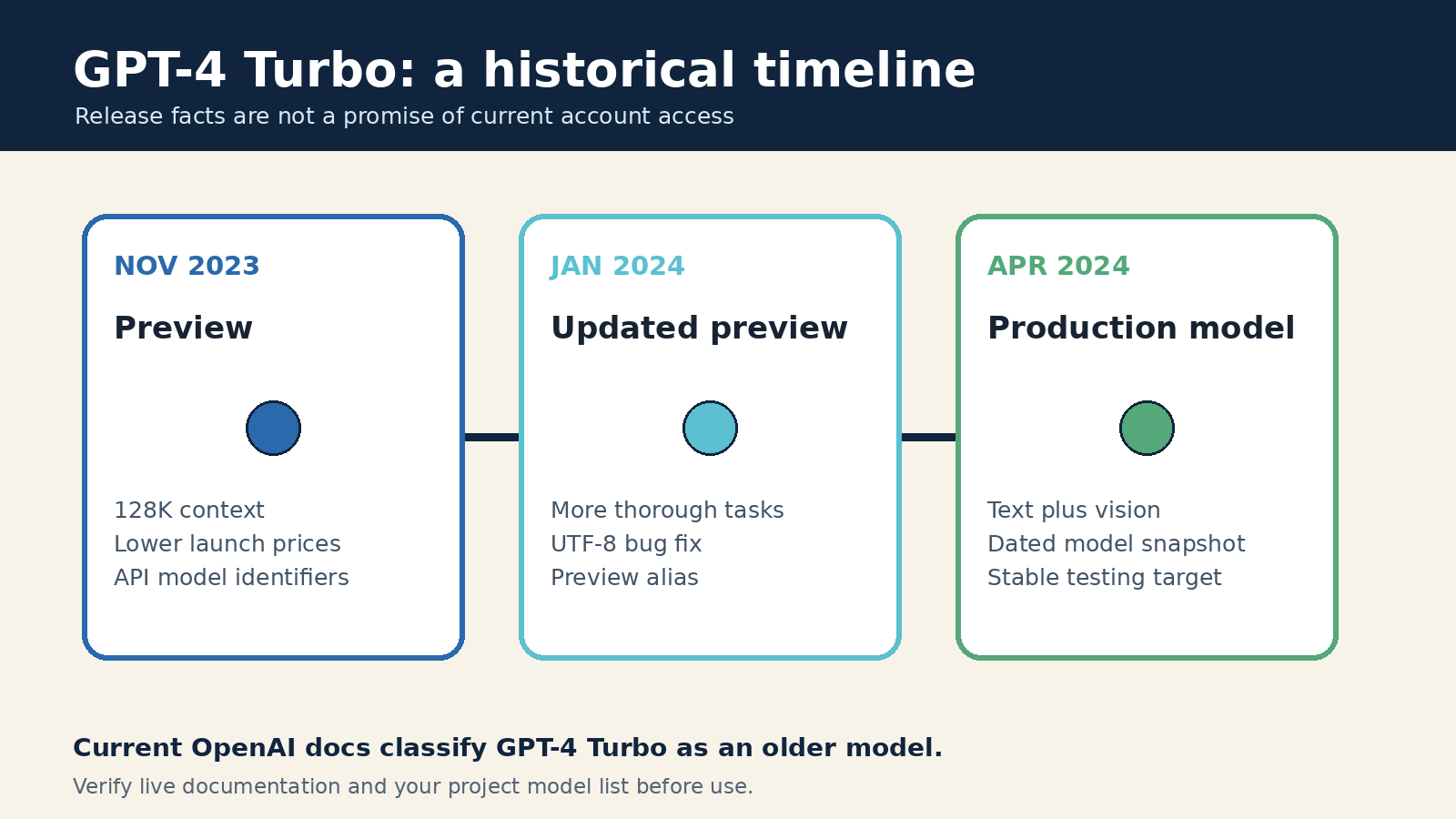
The release timeline that clears up most confusion
November 2023: OpenAI’s DevDay announcement introduced the GPT-4 Turbo preview. The headline features were a 128K context window and lower prices. OpenAI said the model knew about world events through April 2023 and described 128K as enough room for the equivalent of more than 300 pages of text in one prompt. The article also announced updated function calling, JSON mode, seed parameters for more reproducible outputs, and vision through gpt-4-vision-preview.
January 2024: OpenAI released gpt-4-0125-preview. In its API update announcement, the company said the revision was intended to complete tasks such as code generation more thoroughly and fix a bug affecting non-English UTF-8 generations. The same post reported that more than 70 percent of GPT-4 API requests had moved to GPT-4 Turbo at that time. Again, that percentage is a dated launch-era observation, not a current usage statistic.
April 2024: OpenAI made the production GPT-4 Turbo model with vision available as gpt-4-turbo-2024-04-09. This consolidated text and image input in the model family and supported capabilities such as JSON mode and function calling with vision requests. Developers who needed stable behavior could pin the dated model instead of relying only on an alias that might change.
Today: OpenAI’s current GPT-4 Turbo model page calls it an older high-intelligence GPT model and recommends using a newer model. The page records a 128,000 token context window, a 4,096 token maximum output, and a December 1, 2023 knowledge cutoff for the documented production model. Treat that live page, along with the model list returned for your API project, as the authority for present details. This article deliberately does not promise current availability because access, aliases, prices, and deprecation status can change.
What the 128K context window really meant
A context window is the working space available for a request. It includes the instructions, conversation history, source material, tool definitions, and the tokens reserved or produced for the answer. It is not permanent memory, a database, or proof that the model will use every detail equally well. A 128K window let developers submit much larger packets than the earliest GPT-4 configurations, which was useful for long reports, multiple documents, code repositories, or extended conversations.
The number was impressive, but it did not remove information design. Stuffing 100,000 tokens into one request could be slower and more expensive than selecting the relevant passages first. Contradictory documents could still produce a confused answer. Important instructions buried in the middle could receive less attention than a short, clearly labeled task. And the 4,096 token maximum output shown on the current model page was a separate practical constraint. A large input allowance never meant the model could return a book-length answer in one call.
- Count the whole request: system instructions, examples, retrieved text, tool schemas, and expected output all consume space.
- Trim before sending: remove navigation, duplicate passages, irrelevant appendices, and obsolete conversation turns.
- Label sources: give each document a name and date so the answer can distinguish evidence.
- Ask for traceability: request quotations or source labels, then verify them against the supplied material.
- Split complex work: extraction, comparison, drafting, and checking are often more reliable as separate stages.
Those habits remain useful with newer models. For a practical way to turn vague requests into testable instructions, see our guide to writing better ChatGPT prompts. The model name may change, but a clear task, relevant context, explicit constraints, and a verification step still make the workflow easier to evaluate.
Features that made GPT-4 Turbo important
Lower launch pricing: OpenAI announced that GPT-4 Turbo input tokens cost one third as much as GPT-4 input tokens and output tokens cost one half as much at launch. That changed the economics of applications that passed large documents or conversation histories. These are historical comparisons. Do not use them in a current budget model. Read the current pricing page for the model you actually plan to call.
Better developer controls: JSON mode was designed to make valid JSON output easier to obtain, while improved function calling allowed several functions to be called in one message. A seed parameter and a system fingerprint gave developers tools for investigating reproducibility. “More reproducible” did not mean perfectly deterministic. Production systems still needed schema validation, error handling, retries, and tests.
Vision input: the vision preview could inspect images and return text, supporting tasks such as captioning, reading figures, and discussing visual details. The later production model combined vision with the main GPT-4 Turbo line. Vision did not make visual answers automatically correct. Small text, ambiguous charts, spatial relationships, and image quality could all affect results. High impact interpretations still required human review.
A newer knowledge cutoff: the first preview moved the stated knowledge horizon to April 2023, while the documented production model page lists December 1, 2023. A cutoff is not live internet access. It only describes a boundary associated with training knowledge, and it does not guarantee that every fact before that date is present or correct. Current facts still need current sources.
Why GPT-4 Turbo was not the same thing as live web access
The updated cutoff was useful in 2023, but it was often mistaken for browsing. A model can answer from learned patterns without contacting a website, and it can produce a plausible citation that does not exist. Browsing or retrieval is a separate system capability: software searches or fetches information, gives relevant material to the model, and ideally exposes sources to the reader. The model then summarizes or reasons over that evidence.
This separation is still essential when reviewing an old GPT-4 Turbo application. Ask where external facts came from. Were they included in the prompt, returned by a search tool, retrieved from a controlled knowledge base, or generated without evidence? Our guide to common ChatGPT mistakes and how to avoid them explains why confident wording should never replace source checks.
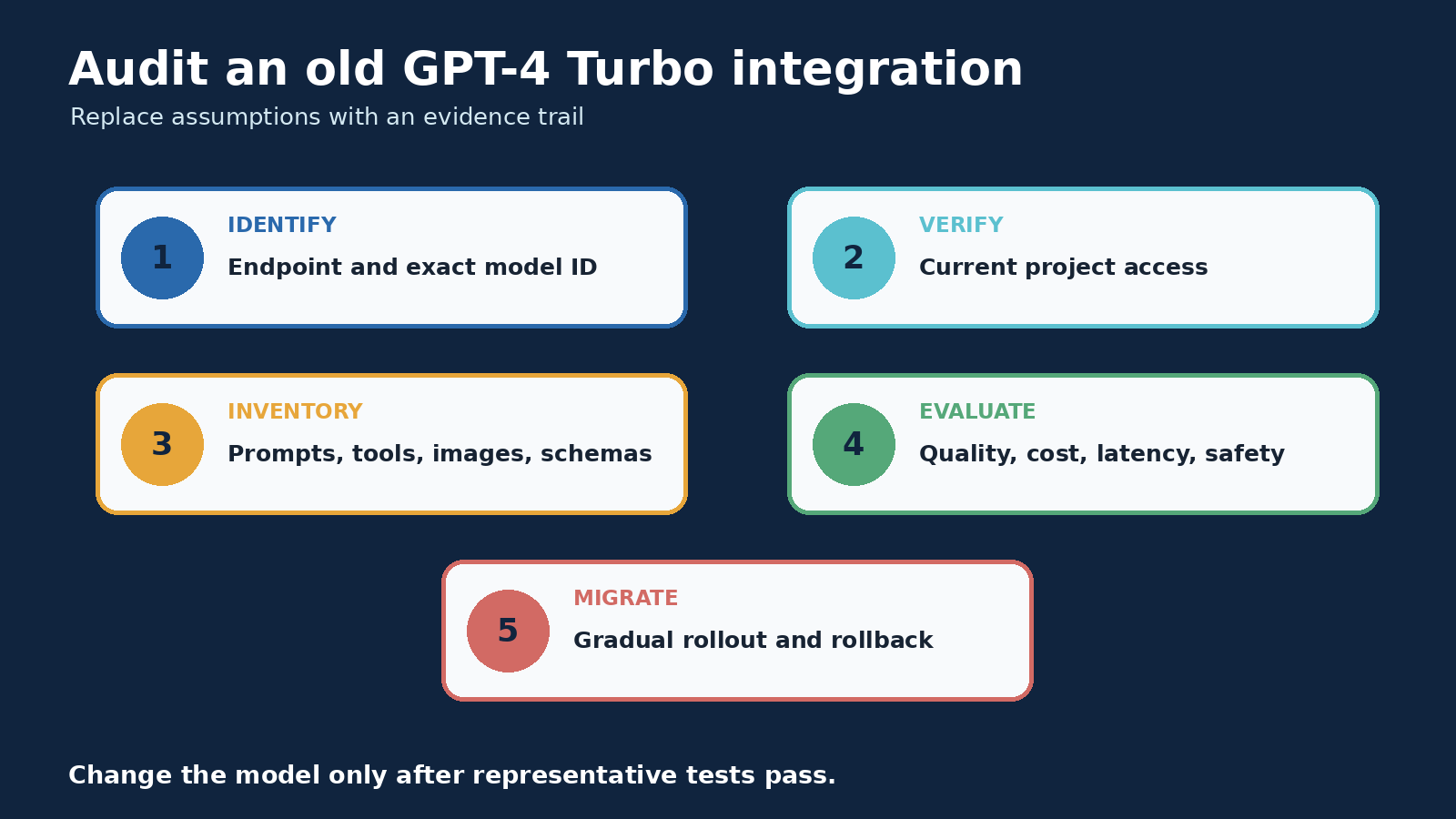
How to audit an inherited GPT-4 Turbo integration
Suppose you open an older codebase and find gpt-4-turbo, gpt-4-0125-preview, or gpt-4-turbo-2024-04-09. Do not swap the string and declare the migration complete. Model changes can alter instruction following, output length, formatting, tool calls, safety behavior, latency, and cost. Start by preserving evidence of what the application expects.
- Confirm the actual endpoint and model identifier. Search application code, environment variables, gateway configuration, saved traces, and vendor dashboards. An interface label may hide a different backend.
- Check present access directly. Use the model list and documentation available to the API project. A public article cannot tell you which models a particular organization may call.
- Inventory dependencies. Record message format, tool definitions, JSON assumptions, image inputs, token budgets, retry logic, and any parsing code tied to a specific response shape.
- Build a representative test set. Include normal requests, long contexts, malformed inputs, conflicting evidence, tool failures, and content that must be refused or escalated.
- Define acceptance criteria. Measure factual accuracy, citation fidelity, schema validity, task completion, latency, and cost. “Feels better” is not enough for a production migration.
- Run old and candidate configurations side by side. Compare outputs without quietly changing prompts at the same time. If the old model cannot be called, use stored approved outputs as the baseline and document that limitation.
- Deploy gradually. Add monitoring and a rollback plan. Watch parse errors, tool call failures, user complaints, and unexpected changes in token use.
The key is to migrate the behavior, not merely the name. An old prompt may contain workarounds that a newer model no longer needs. Conversely, a newer model may be more capable but produce a different structure unless the contract is explicit. Keep model selection in configuration, pin versions when repeatability matters, and store evaluation results with dates. That makes the next transition less painful.
Practical lessons that outlived the model
GPT-4 Turbo’s biggest lesson was not that more context solves every problem. It was that model capability, application design, and evidence quality work together. A longer window made ambitious workflows possible, but developers still had to choose useful material, control output, and verify claims. Function calling helped models interact with software, but the software still needed authorization boundaries and validation. Vision widened the input surface, but it also created new ways to misread evidence.
It also showed why aliases and dated snapshots serve different needs. An alias is convenient when you want platform improvements without editing code. A dated identifier is useful when you need a stable target for an evaluation or regulated process. Neither removes the need to monitor platform notices. Models age, recommendations change, and an application that worked last year can become expensive or unsupported if nobody owns its lifecycle.
For readers using ChatGPT rather than the API, the practical rule is simpler: rely on the product interface and current OpenAI help material for present features. Do not assume that a conversation uses GPT-4 Turbo because an old blog calls every advanced ChatGPT response “Turbo.” OpenAI’s ChatGPT release notes document product changes over time, while API model pages document developer models. Keeping those two source types separate prevents a surprising amount of confusion.
Frequently asked questions
Is GPT-4 Turbo the current ChatGPT model?
No. GPT-4 Turbo is a historical GPT-4 generation API model name. ChatGPT is a product whose available models and tools change by plan, workspace, and date. Check the current ChatGPT interface and official release notes rather than inferring the backend from an old article.
Is GPT-4 Turbo still available in the API?
This article does not make a blanket availability promise. OpenAI’s current model page describes GPT-4 Turbo as an older model, but actual access can depend on the API project and platform changes. Check the live model documentation and the model list available to your own project before planning around it.
Did the 128K window allow a 128K token answer?
No. The context window covers the working token budget for the request, while the documented GPT-4 Turbo production model has a separate 4,096 token maximum output. Instructions, source text, history, tool definitions, and output all have to be budgeted deliberately.
What should replace GPT-4 Turbo in an old application?
There is no safe universal string replacement. Start with OpenAI’s current model recommendations, then test candidate models against the application’s real prompts, tools, image inputs, output schemas, latency targets, and budget. Migrate only after the candidate passes defined acceptance criteria.
Official OpenAI sources
- New models and developer products announced at DevDay, November 6, 2023.
- New embedding models and API updates, January 25, 2024.
- GPT-4 Turbo model documentation, live OpenAI developer reference.
- Hello GPT-4o, May 13, 2024, for the historical transition beyond GPT-4 Turbo.
- ChatGPT release notes, live OpenAI Help Center record of product changes.