
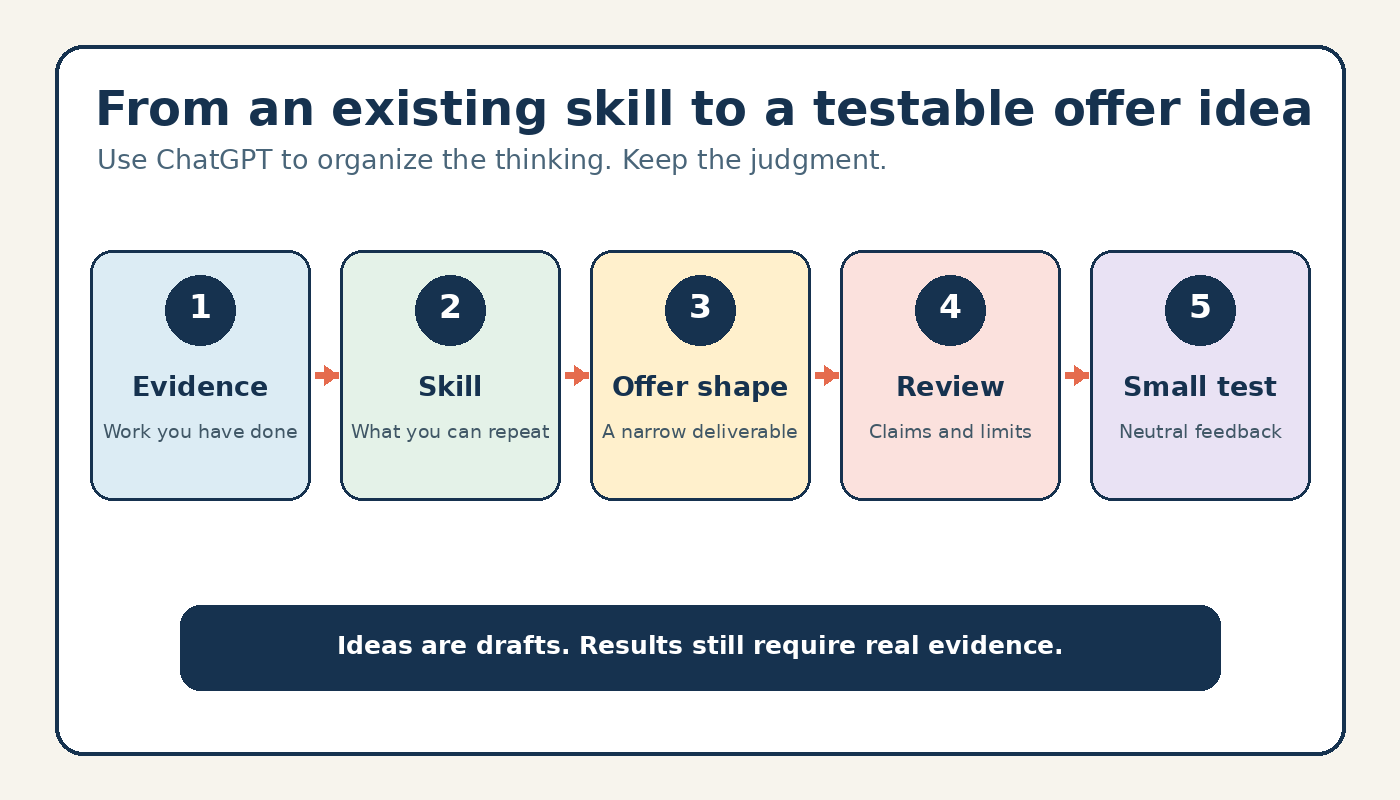
A skill does not become an offer because a chatbot gives it a catchy name. The useful work comes earlier: describing what you can already do, identifying a person who may need that help, setting a narrow scope, and deciding how you would deliver it. ChatGPT can help you think through those choices, but it cannot confirm demand, set a guaranteed price, or promise that anyone will buy.
This guide gives you five prompt templates for examining an existing skill and turning it into possible service or product concepts. The templates are editorial examples created for this article. They are not official OpenAI commands, business results, or financial advice. Treat every response as a draft to inspect, not a verdict about what the market wants.
Start with evidence from your own work
Begin with work you have actually done. A spreadsheet you built for a volunteer group, a lesson plan you used with a student, a repair checklist you follow at home, or a set of photographs you edited all contains better evidence than a broad claim such as “I am good at organization.” You want examples, limits, preferences, and proof that you can repeat the task.
OpenAI’s prompt engineering guidance for ChatGPT recommends clear, specific instructions with enough context. Its separate article on creating a good prompt also suggests breaking complex work into focused requests and refining the result through follow-up prompts. Those product-behavior principles support the process below. The offer ideas, review questions, and templates themselves are our editorial examples.
Prompt 1: make a factual skill inventory
The first prompt is deliberately unglamorous. It asks ChatGPT to separate demonstrated abilities from guesses. Paste only information you are comfortable sharing, and remove client names, private documents, account details, and confidential results.
Editorial prompt template:
I want to examine skills I already use. Based only on the evidence below, create a table with: demonstrated skill, example evidence, type of person who might need it, tasks I enjoy, tasks I avoid, and important limits. Do not invent credentials, results, demand, or experience. Mark missing information as "unknown" and ask up to five follow-up questions.

My evidence:
[Paste short examples of work, responsibilities, tools, feedback, or projects.]
Read the table with a red pen. Delete any skill that depends on a credential you do not have. Correct inflated language such as “expert” if your evidence shows beginner or intermediate experience. The best output is not the longest list. It is the list you can defend with real examples.
Prompt 2: translate one skill into several offer shapes
A single skill can support different forms of work. Someone who knows spreadsheet cleanup might offer a one-time file cleanup, a reusable template, a short training session, or a documented process. These are possibilities, not recommendations. Some will be impractical once you consider time, permissions, local rules, or the buyer’s actual problem.
Editorial prompt template:
Using this verified skill and evidence, suggest six narrowly scoped offer ideas. Include a mix of services, small digital resources, and teaching formats where appropriate. For each idea, state: intended user, specific problem, deliverable, information I would need from the user, what is outside scope, and the easiest assumption to test. Do not estimate income, promise demand, copy competitors, or claim legal, tax, medical, or financial suitability.

Skill and evidence:
[Paste one row from the corrected inventory.]
Look for a deliverable that can be described in one sentence. “Help businesses grow” is too broad. “Clean and document one existing inventory spreadsheet using the client’s current categories” is easier to discuss and review. Narrow scope also exposes missing expertise before you accept responsibility for it.
Prompt 3: write a plain-language offer brief
Choose one possible offer and ask for a brief, not a sales page. The brief should tell you what happens, what does not happen, and what the buyer must provide. Avoid testimonials, urgency, earnings claims, invented success rates, and phrases that imply a guaranteed outcome.
Editorial prompt template:
Draft a one-page internal offer brief for the idea below. Use plain English. Include: who it may suit, the problem it addresses, exact deliverables, delivery steps, buyer inputs, exclusions, revision boundary, risks or dependencies, and questions that remain unanswered. Do not write promotional copy. Do not invent proof, testimonials, scarcity, demand, pricing, or expected financial results.

Offer idea:
[Paste the selected idea and your corrections.]
This is where awkward details are useful. If delivery depends on clean source files, say so. If you can format a resume but cannot advise on immigration or employment law, put that boundary in writing. If you would need access to sensitive data, consider whether the offer should be redesigned to use a sample or redacted file.
Prompt 4: design a low-risk learning test
You do not need a large launch to learn whether the description makes sense. A test might be a conversation with a person in the intended audience, a review of a sample deliverable, or a small pilot with written scope. The aim is to gather specific feedback. It is not to manufacture a success story.
Editorial prompt template:
Help me design a small, ethical test of this offer description. I want to learn whether the problem and deliverable are understandable. Propose: who I could ask for feedback, five neutral interview questions, a sample or pilot boundary, what evidence would support revising the idea, and clear stop conditions. Do not predict sales, recommend paid advertising, create fake urgency, or treat compliments as proof of demand.

Offer brief:
[Paste the corrected brief.]
Neutral questions matter. “Would this save you hours every week?” plants the answer. “How do you handle this task now?” gives the other person room to describe a process that may work perfectly well. Record objections and confusion as carefully as positive reactions.
Prompt 5: review the idea for unsupported claims
ChatGPT can sound confident when a statement is wrong. OpenAI’s guide Does ChatGPT tell the truth? warns that responses can include incorrect facts, fabricated references, and overconfident answers. It recommends checking important information against reliable sources. Apply that caution to every claim in your offer, especially claims about outcomes, rules, qualifications, prices, or what a buyer “needs.”
Editorial prompt template:
Audit the offer brief below as a skeptical editor. Quote each sentence that contains a factual claim, implied guarantee, unverified assumption, credential issue, privacy concern, or vague scope. For each, label it "supported by my evidence," "needs a source," "needs clarification," or "remove." Do not repair a claim by inventing a citation. Finish with questions I must answer myself.

My evidence:
[Paste the corrected skill evidence.]

Offer brief:
[Paste the current brief.]
The model’s audit also needs human review. Visit cited links. Check local professional rules where your work touches regulated fields. Ask a qualified professional about legal, tax, accounting, investment, health, or licensing questions. This article does not tell you whether an offer is lawful, profitable, or suitable for your circumstances.
How to judge the output without chasing polish
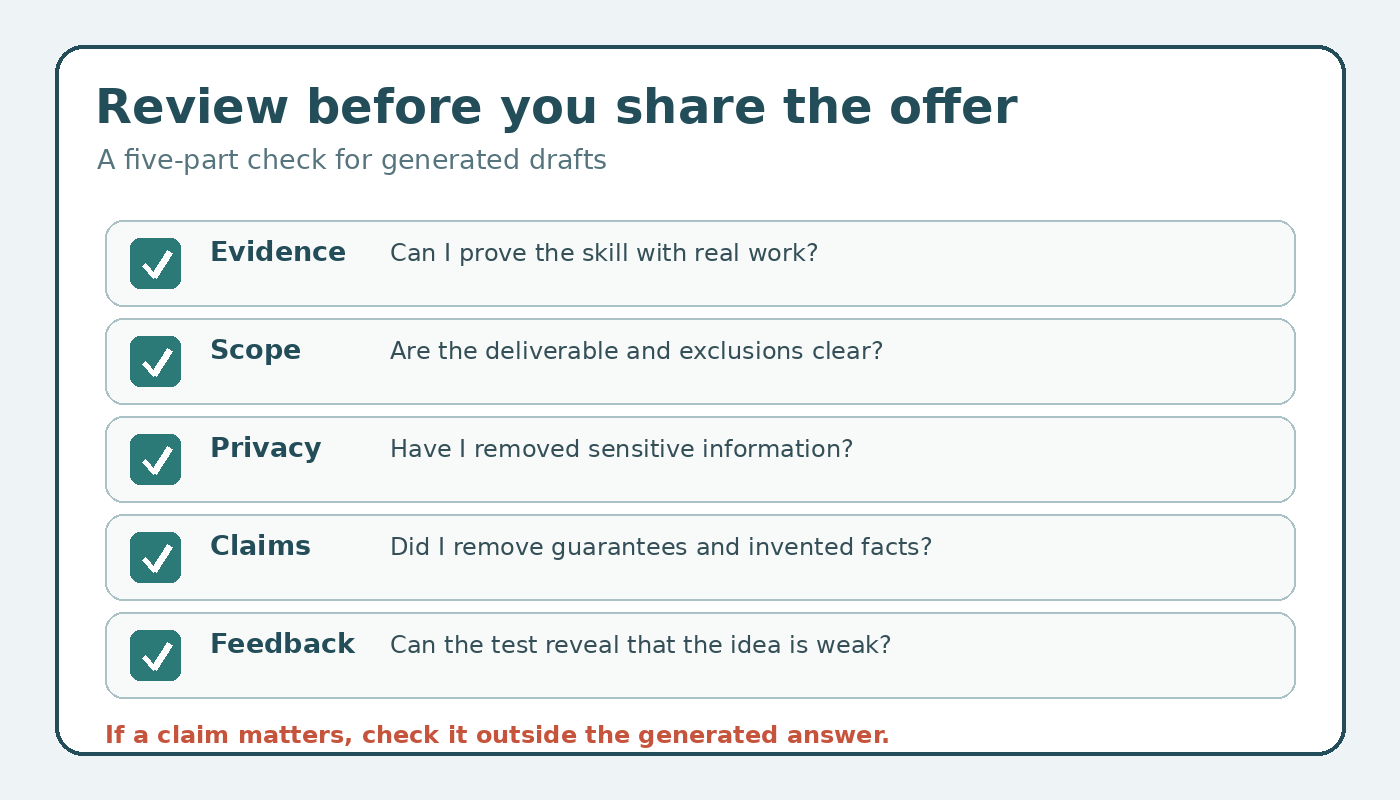
A polished paragraph can hide a weak idea. Judge the output against your evidence and the intended user’s words. Can you produce the stated deliverable? Is the input list realistic? Does the scope exclude work you cannot safely do? Can another person tell what they would receive? If an answer is unclear, add context and ask a focused follow-up question rather than requesting a complete rewrite.
This differs from a collection of general ChatGPT writing prompts. Here, the raw material is your documented skill and the output is a testable offer brief. It also differs from competitor research. You are not asking ChatGPT to imitate another provider, scrape private information, or declare that a market gap exists. You are clarifying your own scope, then checking it with real people and reliable sources.
If you plan to reuse personal context across chats, read the site’s guide to ChatGPT memory and controls. Regardless of settings, minimize the data you paste. Replace identifying details with placeholders and keep confidential client material out of a general brainstorming session unless you have an approved way to handle it.
A practical review card
- The skill is supported by work you have actually done.
- The intended user and problem are specific but not invented.
- The deliverable, inputs, exclusions, and revision limit are written down.
- No sentence guarantees demand, income, savings, ranking, approval, or another result.
- Private data and regulated advice have been removed or handled through an appropriate process.
- Important factual claims have reliable sources outside the generated answer.
- Feedback questions are neutral and allow the idea to fail.
Frequently asked questions
Can ChatGPT tell me which skill will make the most money?
No. It can organize information you provide and suggest questions or possible formats, but it cannot guarantee demand, pricing, profit, or future income. Research the real situation and get relevant professional advice before making financial decisions.
Do I need to use all five prompts in one chat?
No. You can use one template at a time and correct the output before continuing. Separate steps often make it easier to notice unsupported assumptions and supply missing context.
Can I paste client work into these prompts?
Do not paste confidential, personal, or restricted material simply because it is convenient. Use redacted examples or invented placeholders, follow your agreements and workplace policies, and check the relevant ChatGPT data controls.
What should I do if ChatGPT invents a credential or result?
Remove it. Then restate the evidence and instruct the model to mark missing information as unknown. Verify every important claim yourself rather than asking the model to confirm its own answer.
Sources and editorial boundary
The OpenAI sources cited above support only the described behavior and prompting advice: give clear context, split complex work into focused requests, refine responses iteratively, and verify important facts. The five templates are editorial examples. They do not represent an OpenAI business method, a market forecast, financial advice, or a promise of results.